If DEF is not manufacturing the medicine, how is it selling the product under its own brand name?
The answer is simple:
This is usually a third-party manufacturing or contract manufacturing arrangement. One company manufactures the medicine, and another company markets or sells it under its own brand name.
This model is very common in the pharmaceutical, Ayurvedic, nutraceutical, cosmetic and healthcare industries.
Quick Answer
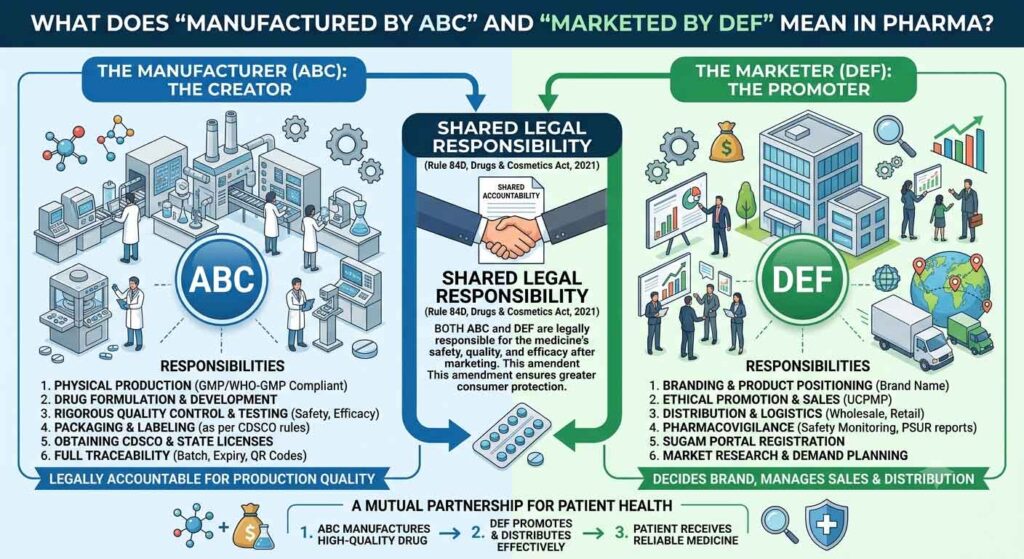
“Manufactured by ABC” means ABC is the licensed manufacturer that has produced the product.
“Marketed by DEF” means DEF is the marketing company, brand owner or marketer that promotes and sells the product in the market.
In this model, the marketing company does not own a manufacturing unit. It gets products manufactured from a licensed manufacturer and sells them under its own brand or company name.
Why Are Two Company Names Printed on Medicine Packs?
Medicines cannot be manufactured without a valid manufacturing licence.
Therefore, the name and address of the actual manufacturer must be printed on the product label.
At the same time, if another company owns, promotes or sells the brand, its name may be printed as “Marketed by.”
This helps identify:
Who manufactured the product
Who marketed the product
Who owns or promotes the brand
Where responsibility and traceability lie
Which company is selling the product in the market
Meaning of “Manufactured By”
“Manufactured by” means the company that physically manufactures the product.
Companies that print “Marketed by” on the label usually work as pharma marketing companies.
Their business model may be:
They register a firm or company.
They obtain wholesale drug licence and GST registration, where applicable.
They select product range.
They create brand names.
They contact a licensed manufacturer.
They get products manufactured on third-party basis.
They print their name as “Marketed by.”
They sell products through distributors, PCD franchise, doctors, institutions or sales teams.
This is one of the most common ways to start a pharma marketing business without setting up a manufacturing plant.
What Is Third-Party Manufacturing?
Third-party manufacturing means getting your product manufactured from another licensed manufacturer.
The marketing company gives the order, brand name, artwork and product requirement to the manufacturer. The manufacturer manufactures and supplies finished goods to the marketing company.
The marketing company then sells the products in the market.
This model is also called:
Contract manufacturing
Third-party pharma manufacturing
Private label manufacturing
Own brand manufacturing
Marketing company manufacturing model
Can a Company Sell Medicines Without Own Manufacturing Unit?
Yes, a company can sell medicines without owning a manufacturing unit, provided it follows the applicable rules.
The company should generally have:
Wholesale drug licence, if selling, stocking or distributing medicines
GST registration, where applicable
Proper firm or company registration
Agreement with licensed manufacturer
Proper invoices and records
Genuine marketed by address
Compliant product label
Valid product documents from manufacturer
A company cannot manufacture medicines without a manufacturing licence, but it can market products manufactured by a licensed manufacturer.
Who Owns the Brand in This Model?
Usually, the marketing company owns or controls the brand name.
For example, if DEF Healthcare gets a product manufactured under the brand name DEF-Cef Tablets, then DEF Healthcare may own the brand, subject to trademark status and agreement.
However, brand ownership should be protected through:
Trademark search
Trademark application
Written agreement with manufacturer
Artwork control
Product records
Invoice records
Without trademark protection, brand disputes may arise later.
How Do Marketed By Companies Earn Profit?
Marketed by companies earn profit by purchasing products from manufacturers at manufacturing or third-party rates and selling them at higher trade rates.
Their profit depends on:
Manufacturing cost
Packing cost
Brand positioning
Product range
Net rate
MRP
Distributor margin
Franchise margin
Promotional expenses
Sales volume
Payment terms
Market demand
Marketing companies may have lower fixed investment than manufacturing companies because they do not need to set up a factory.
However, they still have expenses such as:
Drug licence
GST compliance
Office
Staff
Sales team
Promotional material
Samples
Transport
Credit risk
Expiry replacement
Marketing cost
Packaging inventory
Regulatory documentation
So, it is wrong to think that marketed by companies have no expenses. They simply have a different cost structure.
Why Do Many Pharma Startups Prefer Marketing Company Model?
Many startups prefer the marketed by model because:
No need to set up manufacturing plant
Lower investment than manufacturing unit
Faster product launch
Own brand name possible
Large product range can be developed
Easy to start through third-party manufacturing
Focus remains on sales and marketing
PCD/franchise model can be built
Manufacturing responsibility is shared with licensed manufacturer
This model is practical for beginners who have sales knowledge, doctor contacts or distribution network.
Difference Between Manufacturer and Marketer
Point
Manufacturer
Marketer
Main role
Manufactures product
Promotes and sells product
Licence
Manufacturing licence
Wholesale drug licence usually required for sale/distribution
Printed as
Manufactured by
Marketed by
Own factory
Yes
Not necessary
Brand ownership
May or may not own brand
Usually owns or markets brand
Main work
Production and quality control
Sales, marketing and distribution
Investment
High
Lower than manufacturing
Responsibility
Manufacturing and quality
Marketing, sale and regulatory responsibility as marketer
Legal Documents Required for Marketed By Company
A pharma marketing company should maintain proper documents.
Common documents include:
Wholesale drug licence
GST registration
Firm or company registration
PAN card
Address proof
Rent agreement or ownership proof
Manufacturer–marketer agreement
Trademark application or brand ownership proof
Product artwork approval
Manufacturing licence copy of manufacturer
Product permission copy, where applicable
Certificate of Analysis
Purchase invoices
Sale invoices
Stock records
Batch and expiry records
Complaint and recall records
Good documentation protects the company in the long term.
Is Manufacturer Responsible or Marketer Responsible?
Both have responsibility in their respective roles.
The manufacturer is responsible for manufacturing quality, licence compliance, testing, batch records and production-related matters.
The marketer is responsible for marketing, sale, distribution, label information, complaint handling and regulatory compliance connected with its marketed product.
A marketed by company should not think that all responsibility belongs only to the manufacturer.
If the marketer’s name is printed on the label, the marketer must be serious about product quality, documentation and compliance.
Can a Marketed By Company Work from a Small Office?
Yes, many pharma marketing companies start from a small office.
But if the company is selling, stocking or distributing medicines, it needs proper licensed premises as per drug licence requirements.
The company may start small, but it should not ignore:
Drug licence
Proper storage
Billing
GST
Stock records
Expiry records
Product documents
Legal address
Quality checks
Distributor network
A small office can run a marketing business, but medicine stock should be handled only from licensed premises.
Common Mistakes to Avoid
Avoid these mistakes:
Starting without wholesale drug licence
Printing marketed by name without proper agreement
Not checking manufacturer credentials
Selecting manufacturer only by lowest rate
Not applying for trademark
Not checking product quality
Not maintaining batch records
Giving monopoly without clear terms
Selling below safe margin
Copying competitor brands
Ignoring GST and billing compliance
Not checking marketed by address compliance
Launching too many products at once
Final Thoughts
When a product label shows “Manufactured by ABC” and “Marketed by DEF,” it means the product is manufactured by one licensed company and marketed by another company.
This is a common third-party manufacturing model.
A pharma marketing company can build its own brand without owning a manufacturing unit by getting products manufactured from a licensed manufacturer.
Such companies may work in ethical marketing, PCD franchise, monopoly franchise, generic marketing, OTC marketing or institutional supply.
However, the marketed by company must maintain proper licence, GST, documents, manufacturer agreement, quality responsibility and genuine address.
Do not compete only by low rates. Build your company on quality, service, product range, availability and trust.
Frequently Asked Questions
1. What does “Manufactured by” mean?
“Manufactured by” means the company that has actually manufactured the product at its licensed manufacturing premises.
2. What does “Marketed by” mean?
“Marketed by” means the company that markets, promotes or sells the product under its own company name or brand.
3. Can one company manufacture and another company market the same product?
Yes. This is common in third-party manufacturing and contract manufacturing.
4. Can I sell medicine under my own company name without manufacturing licence?
You cannot manufacture without manufacturing licence, but you can market products under your own name by getting them manufactured from a licensed manufacturer.
5. Is wholesale drug licence required for marketed by company?
If the company sells, stocks or distributes medicines, wholesale drug licence is generally required.
6. Who owns the brand in third-party manufacturing?
Usually the marketing company owns or controls the brand, subject to trademark and agreement.
7. Can marketed by companies offer monopoly rights?
Yes. Many marketed by companies offer PCD or franchise monopoly rights for selected areas.
8. Are marketed by companies profitable?
They can be profitable if they manage product selection, rates, quality, margins, sales network and expenses properly.
9. How can I know competitor rates?
You can know competitor rates through distributors, retailers, franchise product lists, manufacturer quotations, field staff and market research.
10. Should I choose the lowest manufacturing rate?
Not always. Low rates may affect quality, packing, delivery or service. Compare quality and reliability before selecting a manufacturer.
Looking for Ayurvedic Franchise or Distribution Opportunities?
Looking to start an Ayurvedic franchise, become a distributor, or launch your own herbal product range?
Elzac Herbal India offers:
Ayurvedic & Herbal Product Range
Franchise & Distribution Opportunities
Third-Party Manufacturing Services
Product Development Support
Marketing Guidance
PAN India Business Opportunities
Whether you are an entrepreneur, retailer, distributor, or healthcare professional, our team can help you explore the right business opportunity in the growing Ayurvedic sector.
Ajay Kamboj is an entrepreneur and business owners associated with many Ayurvedic and Pharmaceutical start-ups. With years of experience in Ayurvedic product marketing, pharmaceutical distribution, franchise development, and client relationship management, he regularly shares practical business insights based on real-world experiences. His articles focus on business growth, entrepreneurship, customer management, and lessons learned from the healthcare and wellness industry.



Leave a Reply
You must be logged in to post a comment.