Packing material plays a very important role in pharmaceutical and Ayurvedic third-party manufacturing. It is not only used to protect the product, but also to display mandatory product information, brand identity, manufacturing details, batch details, MRP, expiry date, dosage instructions and regulatory warnings where applicable.
For a marketing company or startup brand, understanding packing material procurement is essential because packaging directly affects product presentation, cost, inventory planning and compliance.
What Is Packing Material?
Packing material means the material used to pack, protect, identify and present a pharmaceutical or Ayurvedic product.
It may be made of paper, plastic, aluminium, glass, rubber, metal or other suitable materials depending on the dosage form.
Common packing materials include:
Outer carton
Mono carton
Blister foil
Alu-Alu foil
Labels
Lami tubes
Bottles
Caps
Measuring cups
Droppers
Ampoules
Vials
Rubber stoppers
Shippers
Product inserts
In common trade language, items like bottles, vials, ampoules and tins are sometimes included in the manufacturing rate. However, technically these are also part of the overall packaging system because they help store and protect the product.
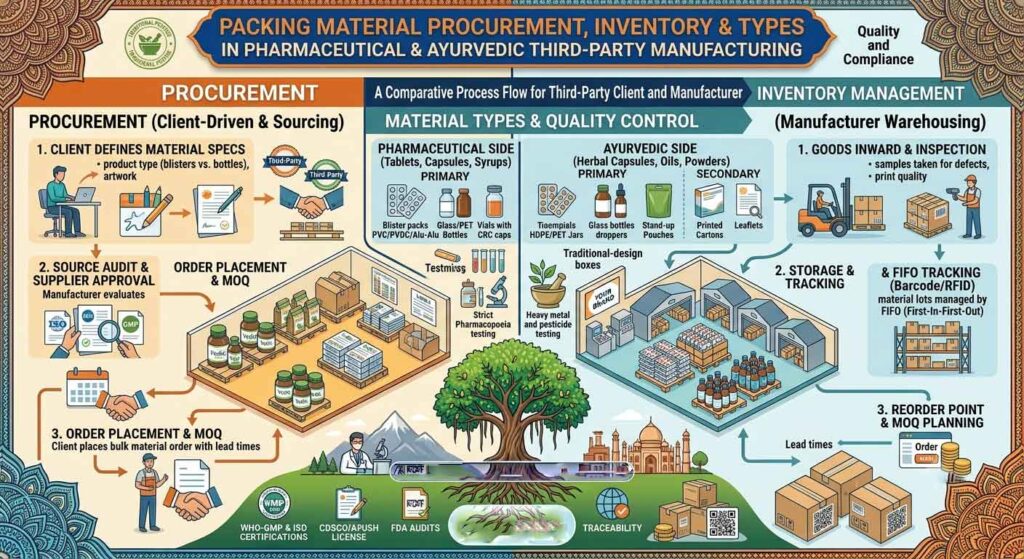
Types of Packing Material
Packing material can be divided into three main categories.
1. Primary Packing Material
Primary packing material comes in direct contact with the product.
Examples:
Blister foil
Alu-Alu foil
PET bottles
HDPE bottles
Glass bottles
Lami tubes
Vials
Ampoules
Rubber stoppers
Caps
Primary packaging is very important because it affects product safety, stability, shelf life and protection from moisture, light and contamination.
2. Secondary Packing Material
Secondary packing material is used outside the primary pack.
Examples:
Outer cartons
Mono cartons
Labels
Product inserts
Leaflets
Stickers
Secondary packaging improves product appearance, brand identity and customer communication.
3. Tertiary Packing Material
Tertiary packaging is used for transportation and bulk handling.
Examples:
Corrugated boxes
Shippers
Tapes
Shrink wrapping
Pallets
This packaging protects products during storage, dispatch and transportation.
Common Packing Materials Used in Third-Party Manufacturing
Tablets and Capsules
For tablets and capsules, commonly used packing materials include:
Printed outer carton
Blister foil
Alu-Alu foil
Mono carton if required
Product insert if required
Shipper carton
Syrups and Liquids
For syrups and liquid preparations, packing materials may include:
PET bottle or glass bottle
Measuring cap
Printed label
Outer carton
Shipper carton
Dry Syrups
Dry syrup packing may include:
Bottle
Cap
Measuring cup
Label
Outer carton
Product insert if required
Ointments, Creams and Gels
For creams, ointments and gels, common packing materials include:
Lami tube
Tube cap
Outer carton
Inner leaflet if required
Shipper carton
Injections and Eye/Ear Drops
For injections and drops, packing materials may include:
Ampoule or vial
Rubber stopper
Flip-off seal
Label
Mono carton
Blister tray if applicable
Outer carton
Shipper carton
Approximate Packing Material Costing
Packing material cost depends on:
Size of the pack
Quantity ordered
Paper quality
Printing quality
Number of colours
Foil type
Tube size
Bottle quality
Minimum printing quantity
Cylinder or plate charges
The following figures are only for understanding the calculation method. Actual rates should always be confirmed from the printer or manufacturer.
Packing Material Cost for Tablets and Capsules
Example: Tablet/Capsule packing in 10×10 blister or Alu-Alu pack.
Approximate requirements:
Outer carton
Foil
Mono carton if applicable
One-time cylinder charges for foil printing
Sample costing:
Item
Approximate Calculation
One-time cylinder charge for single-colour foil
₹1,500
One-time cylinder charge for two-colour foil
₹3,000
Foil
5 kg × ₹450 = ₹2,250
Outer carton
1,000 boxes × ₹2 = ₹2,000
Mono carton, if applicable
10,000 pieces × ₹1 = ₹10,000
Approximate total:
Packing Type
Approximate Cost
Single-colour foil with outer carton
₹5,750
Two-colour foil with outer carton
₹7,250
Single-colour foil with mono carton
₹13,750
Two-colour foil with mono carton
₹15,250
Packing Material Cost for Liquids and Syrups
Example: 1,000 bottles.
Item
Approximate Calculation
Label
1,000 × ₹0.10 = ₹100
Outer carton
1,000 × ₹2.75 = ₹2750
Total approximate packing cost
₹2850
Bottle cost may be included in the manufacturer’s product rate or charged separately depending on the quotation.
Packing Material Cost for Ointments, Creams and Gels
Example: 1,000 tubes.
Item
Approximate Calculation
One-time cylinder charge for single-colour tube printing
₹1,500
One-time cylinder charge for two-colour tube printing
₹3,000
Lami tube
1,000 × ₹2 = ₹2,000
Outer carton
1,000 × ₹1 = ₹1,000
Approximate packing material cost may vary depending on tube MOQ, printing colour and tube quality.
Packing Material Cost for Injections and Eye/Ear Drops
Example: 1,000 pieces.
Item
Approximate Calculation
Label
1,000 × ₹0.10 = ₹100
Outer carton
1,000 × ₹0.75 = ₹750
Foil, if blister packing is required
5 kg × ₹450 = ₹2,250
Cylinder charge, if applicable
₹1,500 to ₹3,000
Approximate cost:
Packing Type
Approximate Cost
Without blister packing
Around ₹850
With blister packing
Around ₹7,600
Why Packing Material Cost Varies
Packing material cost is not fixed. It varies from product to product and supplier to supplier.
Major reasons include:
Minimum order quantity of printer
Number of colours in design
Type of paper
Foil quality
Tube quality
Bottle shape and weight
Printing method
Special finish such as UV, lamination or embossing
Requirement of mono carton or insert
Product category and regulatory requirements
A startup should avoid over-expensive packaging in the beginning unless the product is premium or consumer-facing. Practical, clean and compliant packaging is usually better than unnecessary costly packaging.
What Information Is Required on Packing Material?
Pharmaceutical and Ayurvedic products must carry proper label information as per applicable laws and product category.
Common details may include:
Brand name
Generic name or composition
Product category
Batch number
Manufacturing date
Expiry date
MRP
Net quantity
Manufacturing license number
Manufacturer name and address
Marketed by name and address
Dosage instructions
Storage instructions
Caution or warning, if applicable
Schedule warning, if applicable
Customer care details
Barcode or QR code, if applicable
The exact label matter differs for allopathic medicines, Ayurvedic medicines, cosmetics, food supplements and veterinary products.
Are Packing Material Norms Mandatory?
Yes. Labeling and packing norms are mandatory.
Pharmaceutical products must comply with applicable provisions under the Drugs and Cosmetics Act and Rules. Prescription medicines may require specific caution statements, schedule warnings and symbols such as Rx, NRx or other applicable marks.
Ayurvedic products have different labeling requirements compared to allopathic medicines. Their labels generally require details such as product category, ingredients, license number, batch details, manufacturing details and dosage instructions.
Because rules are updated from time to time, the final artwork should always be reviewed by the manufacturer’s technical, QA or regulatory team before printing.
Who Is Responsible for Correct Label Matter?
In third-party manufacturing, both the marketing company and the manufacturer have important roles.
Manufacturer’s Role
The manufacturer is generally responsible for:
Technical checking of artwork
Regulatory compliance
Correct manufacturing license details
Batch coding
Quality approval
Final release of product
Marketing Company’s Role
The marketing company should verify:
Brand name spelling
Composition
Pack size
Marketed by address
Logo
Design
MRP
Promotional claims
Contact details
If the label contains incorrect or misleading information, both manufacturer and marketer may face problems. Therefore, artwork approval should never be taken lightly.
Role of Marketing Company in Packing Material Procurement
In third-party manufacturing, there are two common ways to arrange packing material.
Option 1: Manufacturer Arranges Packing Material
In this method, the manufacturer handles printing and procurement.
The marketing company only needs to:
Finalize the design
Check brand name and composition
Approve marketed by address
Confirm MRP and pack size
Approve the final artwork proof
This is easier for beginners because the manufacturer already has printing vendors and regulatory knowledge.
Option 2: Marketing Company Arranges Packing Material
In this method, the marketing company directly gets the packing material printed and sends it to the manufacturer.
This gives better control over:
Design quality
Printing quality
Cost negotiation
Packaging style
Brand consistency
However, it requires more time, coordination and knowledge of printing specifications.
Which Option Is Better?
For beginners, it is usually better to allow the manufacturer to arrange packing material because it reduces coordination problems.
For established companies with multiple products, arranging packing material directly may be more economical and gives better control over branding.
Step-by-Step Procedure for Packing Material Procurement
Step 1: Finalize Product and Pack Size
First, finalize:
Product name
Composition
Dosage form
Pack size
MRP
Product category
Manufacturing quantity
Step 2: Take Quotation with and Without Packing Material
Ask the manufacturer for both options:
Rate with packing material
Rate without packing material
Compare both rates before deciding.
Step 3: Prepare Artwork Design
Prepare a professional design for:
Outer carton
Label
Foil
Tube
Bottle label
Product insert if required
Good packaging creates the first impression of your brand.
Step 4: Send Artwork to Manufacturer for Checking
Before printing, send the artwork to the manufacturer for correction and approval.
The manufacturer should check:
Composition
Warning
Schedule requirement
License number
Manufacturer details
Regulatory matter
Technical correctness
Step 5: Finalize Paper, Foil or Tube Quality
Select suitable material based on product type and budget.
For example:
Art card for cartons
Good-quality label paper
Suitable foil for tablets
Good lami tube for creams
Proper bottle for syrups
Step 6: Approve Final Proof
Before bulk printing, check the final proof carefully.
Verify:
Brand spelling
Composition
Pack size
MRP
Batch coding space
Manufacturer name
Marketed by address
Logo
Colour
Design alignment
Step 7: Print Packing Material
After final approval, printing can begin.
Always avoid printing without written approval from the manufacturer and marketing company.
Step 8: Send Packing Material to Manufacturer
If you are arranging the material yourself, send it safely to the manufacturer with proper invoice or challan.
Step 9: Manufacturer Checks Incoming Packing Material
The manufacturer should inspect the received packing material before use.
They may check:
Quantity
Printing accuracy
Colour matching
Material quality
Damage
Approved artwork comparison
Step 10: Packing Material Is Issued for Production
After approval, packing material is issued to the production or packing department.
Unused material should be recorded and stored properly for future batches.
What If You Want Special Packing?
If you want special packaging such as a premium bottle, special jar, tin pack, custom dropper, unique tube, printed cap or special die-cut carton, discuss it with the manufacturer before finalizing the product.
Special packing may require:
Higher MOQ
Additional printing charges
Longer delivery time
Custom mould or die charges
Higher inventory investment
If the manufacturer cannot arrange special packing, the marketing company may need to procure it directly.
Common Mistakes in Packing Material Procurement
Avoid these mistakes:
Printing without manufacturer approval
Wrong composition on artwork
Incorrect MRP
Wrong marketed by address
Poor-quality design
Using non-compliant claims
Ignoring minimum order quantity
Not checking spelling mistakes
Printing too much material before market testing
Not keeping extra inventory for repeat batches
Practical Tips for Startups
Start with simple and clean packaging.
Do not over-invest in expensive packaging initially.
Always check artwork twice before printing.
Keep packaging uniform across product categories.
Use readable fonts.
Avoid exaggerated claims.
Confirm all regulatory warnings with the manufacturer.
Keep soft copies of all approved artworks.
Maintain records of printed packing material.
Use leftover packing material carefully for repeat batches.
Final Thoughts
Packing material procurement is an important part of pharmaceutical and Ayurvedic third-party manufacturing.
It affects product appearance, cost, compliance, brand image and customer trust.
For beginners, the easiest route is to let the manufacturer arrange packing material after you approve the design. As your business grows, you may choose to manage printing yourself for better control over cost and branding.
The most important rule is simple:
Never print packing material before technical and regulatory approval.
A small mistake in packaging can lead to financial loss, production delay or regulatory problems.
Frequently Asked Questions
1. What is packing material in pharmaceutical manufacturing?
Packing material includes all materials used to pack, protect, label and present a medicine, such as cartons, labels, foils, bottles, tubes, vials, ampoules and shippers.
2. What is the difference between primary and secondary packing material?
Primary packing material directly touches the product, such as a bottle, tube or blister foil. Secondary packing material supports branding and information display, such as outer cartons, labels and inserts.
3. Who checks packing material in third-party manufacturing?
The manufacturer’s QA or regulatory team should check the technical and legal matter. The marketing company should verify brand name, logo, marketed by details, design and commercial information.
4. Can the marketing company arrange its own packing material?
Yes. A marketing company can arrange packing material directly and send it to the manufacturer, provided the artwork is approved before printing.
5. Is it better to take rates with packing material or without packing material?
Beginners usually prefer rates with packing material because it is easier to manage. Established companies may prefer rates without packing material to control design, quality and cost.
6. Why is cylinder charge required?
Cylinder or plate charges are one-time printing setup charges required for foil, tube or certain packaging materials. These charges depend on printing type and number of colours.
7. Can I use premium packaging for my products?
Yes, but premium packaging may require higher MOQ, more investment and longer lead time. It is suitable for premium products or consumer-facing brands.
8. What is the biggest mistake in packing material printing?
The biggest mistake is printing without final artwork approval. Incorrect composition, wrong warning or spelling mistakes can create serious problems.
Partner with Elzac Herbal India
Looking to start an Ayurvedic franchise, become a distributor, or launch your own herbal product range?
Elzac Herbal India offers:
Ayurvedic & Herbal Product Range
Franchise & Distribution Opportunities
Third-Party Manufacturing Services
Product Development Support
Marketing Guidance
PAN India Business Opportunities
Whether you are an entrepreneur, retailer, distributor, or healthcare professional, our team can help you explore the right business opportunity in the growing Ayurvedic sector.
Ajay Kamboj is an entrepreneur and business owners associated with many Ayurvedic and Pharmaceutical start-ups. With years of experience in Ayurvedic product marketing, pharmaceutical distribution, franchise development, and client relationship management, he regularly shares practical business insights based on real-world experiences. His articles focus on business growth, entrepreneurship, customer management, and lessons learned from the healthcare and wellness industry.




Leave a Reply
You must be logged in to post a comment.