Starting a pharmaceutical manufacturing company in India is a major technical, regulatory and financial project.
Unlike an ordinary manufacturing business, a pharmaceutical plant cannot begin production merely after:
Registering a company
Purchasing machines
Renting an industrial building
Hiring production workers
The facility must be designed, constructed, equipped, staffed, documented, qualified, validated, licensed and operated according to the Drugs and Cosmetics Act, the Drugs Rules, revised Schedule M and other applicable laws.
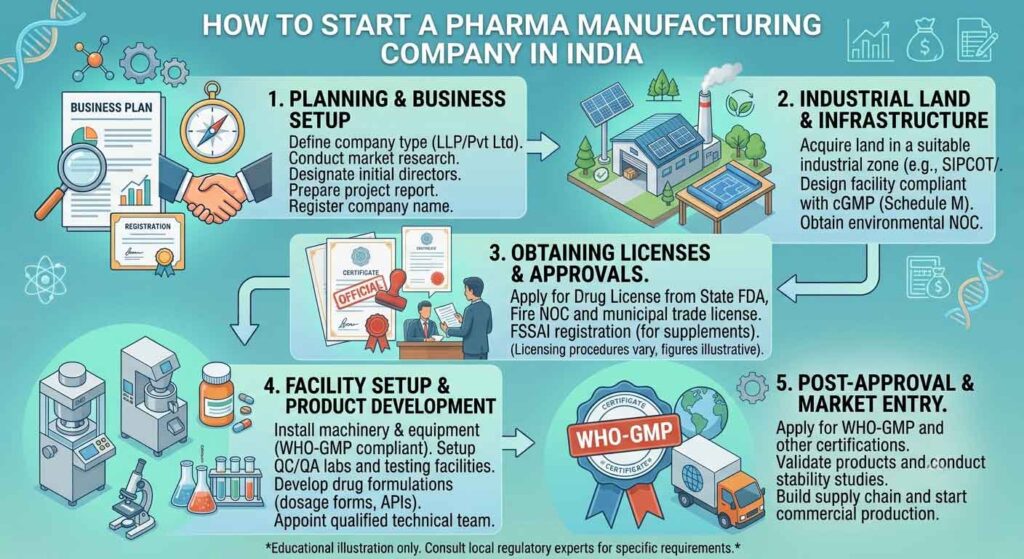
The practical sequence is:
Choose the product category → Prepare a feasibility study → Select an industrial site → Design the plant under revised Schedule M → Obtain environmental and factory approvals → Install and qualify utilities and machinery → Recruit approved technical staff → Establish the pharmaceutical quality system → Apply for manufacturing licences and product permissions → Complete inspection and validation → Begin licensed commercial production
A new promoter should not begin construction before finalizing:
Dosage forms
Production capacity
Product categories
Process requirements
Utility loads
Environmental requirements
Licensing route
Project investment
Target market
What Is a Pharmaceutical Manufacturing Company?
A pharmaceutical manufacturing company converts approved raw materials into finished pharmaceutical products through controlled processes.
Activities may include:
Dispensing
Granulation
Blending
Compression
Capsule filling
Coating
Liquid preparation
Cream or ointment manufacturing
Sterile filling
Packaging
Testing
Batch release
Storage
Distribution
A manufacturer is responsible for ensuring that every released batch:
Contains the approved ingredients
Meets the approved specifications
Is manufactured through validated processes
Is tested using suitable methods
Is packed and labelled correctly
Remains traceable throughout its shelf life
Can be recalled when necessary
First Select the Correct Product Category
Different products are governed by different regulatory frameworks.
Allopathic Pharmaceutical Formulations
Examples include:
Tablets
Capsules
Oral liquids
Powders
Creams
Ointments
Injections
Eye drops
Nasal preparations
Inhalation products
These are primarily governed by the Drugs and Cosmetics Act, Drugs Rules and revised Schedule M.
Active Pharmaceutical Ingredients
API or bulk-drug plants require specialized:
Chemical-processing equipment
Solvent handling
Reaction controls
Effluent treatment
Hazardous-waste systems
Process safety
Environmental approvals
An API plant is substantially different from a formulation plant.
Ayurvedic, Siddha and Unani Medicines
These products have a separate licensing and GMP framework under the relevant AYUSH provisions.
An allopathic Form 25 manufacturing licence does not authorize Ayurvedic production.
Nutraceuticals and Food Supplements
These are regulated under the Food Safety and Standards framework.
A food-supplement plant ordinarily requires:
Applicable FSSAI manufacturing licence
Food-category endorsement
Food GMP and hygiene controls
Product-compliance review
A capsule or syrup does not automatically become a pharmaceutical drug merely because of its dosage form.
Cosmetics
Cosmetic manufacturing is governed under the Cosmetics Rules, 2020.
Medical Devices
Medical-device manufacturing is governed by the Medical Devices Rules, 2017.
A pharmaceutical formulation licence does not automatically authorize medical-device manufacture.
Decide the Manufacturing Model
1. Own Manufacturing Facility
The promoter establishes and operates the complete facility.
The company controls:
Infrastructure
Production
Quality systems
Staff
Machinery
Scheduling
Capacity
Batch release
This requires the highest investment and compliance responsibility.
2. Loan Licence
A loan-licensee obtains permission to manufacture specified products using another licensed manufacturer’s facilities.
It is not the same as simply purchasing finished products.
The loan-licensee normally has direct regulatory responsibilities and must operate within the approved licensing arrangement.
Common application routes include:
Form 24-A for applicable non-biological products
Form 27-A for applicable Schedule C and C(1) products
The final licence forms and requirements depend on the product category.
3. Third-Party or Contract Manufacturing
Under third-party manufacturing, an established licensed manufacturer produces goods for a marketing company or brand owner.
This model avoids investment in:
Land
Factory building
Machinery
Utilities
Manufacturing staff
For a startup whose main objective is to market its own brands, third-party manufacturing is usually more practical than immediately building a plant.
4. Acquisition of an Existing Plant
A promoter may purchase or take over an existing manufacturing facility.
Before acquisition, conduct detailed due diligence covering:
Licence status
Schedule M compliance
Inspection history
Product permissions
Regulatory notices
NSQ history
Recalls
Existing liabilities
Machinery condition
Utility capacity
Environmental approvals
Technical employees
Pending upgrades
Data integrity
Purchasing an old plant without assessing Schedule M gaps may create a large hidden investment.
Prepare a Detailed Project Report
A pharmaceutical plant should begin with a detailed project report rather than a machinery quotation.
The report should cover:
Promoter background
Product categories
Dosage forms
Production capacity
Manufacturing process
Market analysis
Building requirements
Utility requirements
Machinery
Laboratory
Technical staff
Regulatory pathway
Environmental impact
Capital investment
Working capital
Project timeline
Break-even analysis
Risk assessment
Market and Capacity Planning
Before selecting machinery, estimate:
Expected annual sales
Third-party manufacturing demand
Number of batches
Average batch size
Product mix
Seasonal variation
Export plans
Capacity utilization
Do not install very large machinery merely because the supplier recommends it.
A first-time promoter should not treat sterile manufacturing as a simple extension of tablet or syrup production.
Revised Schedule M Compliance
As of 2026, new pharmaceutical manufacturing units should be planned directly under revised Schedule M.
The facility should establish a comprehensive pharmaceutical quality system covering:
Management responsibility
Quality policy
Quality objectives
Quality-risk management
Document control
Training
Deviations
Investigations
Change control
Corrective and preventive action
Out-of-specification results
Product-quality review
Supplier qualification
Validation
Complaints
Recalls
Self-inspection
Pharmacovigilance
The extension granted to eligible smaller manufacturers ended on 31 December 2025. Revised Schedule M applies to smaller manufacturers from 1 January 2026.
Do Not Depend on Old Minimum-Area Tables
Older guides may state fixed minimum areas such as:
30 square metres for liquids
60 square metres for tablets
25 square metres for capsules
150 square metres for parenterals
Such figures should not be used as the complete design basis for a new facility.
The actual plant size must accommodate:
Production capacity
Machinery
Personnel movement
Material movement
Airlocks
Change rooms
Sampling
Dispensing
In-process storage
Cleaning
Equipment washing
Quarantine
Approved materials
Rejected materials
Finished products
Laboratory
Utilities
Documentation
Waste handling
A plant may technically contain the required machine area yet still fail inspection because the flow and contamination controls are unsuitable.
Site-Selection Requirements
Select an industrial location that supports pharmaceutical activity.
Check:
Industrial land use
Building permissions
Approach road
Electricity availability
Water availability
Drainage
Effluent disposal
Fire access
Flood risk
Nearby contamination sources
Labour availability
Logistics
Expansion potential
Avoid locations near uncontrolled sources of:
Dust
Smoke
Odour
Chemical vapour
Sewage
Pest infestation
Ownership or Lease
The premises may be:
Owned
Leased
Rented under an acceptable long-term arrangement
Before investing in a rented building, confirm:
Industrial use is permitted.
Pharmaceutical construction can be carried out.
The lease duration supports the investment.
The owner permits structural and utility modifications.
Drug and environmental authorities will accept the possession documents.
Environmental Approvals
Depending on the project, state and manufacturing process, approvals may include:
Consent to Establish
Consent to Operate
Environmental clearance
Effluent-treatment approval
Hazardous-waste authorization
Air-emission consent
Water-use permission
Groundwater approval
Waste-disposal arrangements
Environmental, forest, wildlife and coastal approvals, where applicable, are processed through the PARIVESH framework. Applicability depends on project type, capacity and location.
A formulation plant with limited wastewater and an API plant using solvents will have very different environmental requirements.
Factory and Labour Approvals
The project should examine applicable requirements relating to:
Factory-plan approval
Factory licence
Occupational health and safety
Employee welfare
Contract labour
Electrical safety
Boiler approval
Pressure vessels
fire safety
Employee insurance
Provident fund
Professional tax
Factory rules are administered by state authorities and may differ between states.
Fire and Safety Requirements
Plan for:
Fire NOC where applicable
Fire extinguishers
Hydrant or sprinkler systems where required
Emergency exits
Alarm systems
Evacuation plan
Chemical-spill controls
Safety showers
Personal protective equipment
Solvent-storage controls
Emergency training
Business Constitution
The manufacturing business may operate as:
Proprietorship
Partnership
LLP
Private Limited Company
Public Limited Company
For a substantial manufacturing investment, an LLP or company structure may provide clearer:
Ownership
Governance
Liability separation
Investment
Banking
Expansion
The legal entity applying for the manufacturing licence should have lawful possession of the premises.
Common Pharmaceutical Manufacturing Licence Forms
Form 24 and Form 25
Form 24 is commonly used to apply for a manufacturing licence in Form 25 for drugs other than those in specialized Schedule C, C(1) and X categories.
Form 27 and Form 28
Form 27 is commonly used to apply for a licence in Form 28 for applicable Schedule C and C(1) drugs.
Loan Licences
Common routes include:
Form 24-A application and Form 25-A licence
Form 27-A application and Form 28-A licence
Schedule X and Specialized Products
Separate application and licence forms apply to Schedule X and other specialized products.
The exact licence combination should be confirmed from:
Drug category
Dosage form
Schedule
State Licensing Authority
Central approval requirements
State drug authorities list Form 24 for a licence in Form 25 and Form 27 for a licence in Form 28 among the common manufacturing routes.
State and Central Regulatory Roles
The State Licensing Authority generally handles manufacturing licences for many routine formulations.
CDSCO or the Central Licensing Authority becomes directly relevant for categories and approvals such as:
New drugs
Certain fixed-dose combinations
Vaccines
Sera
Blood products
Specified biological products
Certain special categories
Clinical-trial products
Import and export-related approvals
Do not assume that a State manufacturing licence alone authorizes an unapproved new drug or FDC.
Product Permissions
A manufacturing licence does not automatically permit every product.
The manufacturer must apply for approval or endorsement of specific products.
Product documentation may include:
Composition
Strength
Dosage form
Specifications
Manufacturing process
Analytical methods
Stability data
Packaging
Labelling
Regulatory status
Pharmacopoeial reference
New-drug approval, where applicable
CDSCO issued guidance on dossier-based licensing in March 2026 to support more uniform product licensing.
Fixed-Dose Combinations
Before developing an FDC, confirm:
Whether it is approved
Whether central permission is required
Whether the exact strength and dosage form are permitted
Whether the combination is prohibited or under review
Do not manufacture an FDC merely because another brand appears to be selling it.
CDSCO continues to publish regulatory action relating to unapproved and prohibited combinations.
Manufacturing for Test or Analysis
Small quantities intended only for examination, testing or analysis follow a separate regulatory route.
Form 29 has traditionally been used for applicable test-manufacturing activity. Regulatory processes were further simplified in 2026 for certain analytical and non-clinical testing categories, but commercial production still requires the applicable manufacturing licence and product permission.
Wholesale Licence
A manufacturing licence authorizes manufacturing activity.
Where the company separately stocks, sells or distributes products through a wholesale establishment, the applicable wholesale-licence structure should also be reviewed.
Forms 20-B and 21-B are commonly used for ordinary allopathic wholesale activities from approved premises.
Do not assume that every branch, depot or warehouse is automatically covered by the factory licence.
GST Registration
The manufacturing entity should establish its GST structure before commercial purchase and sale.
From 22 September 2025:
Most drugs and medicines attract 5% GST.
Specifically notified medicines may be nil-rated.
Other products require classification under their correct HSN.
GST should be checked separately for:
Raw materials
Packing materials
Finished medicines
Job work
Machinery
Services
Nutraceuticals
Cosmetics
Plant Layout
The layout should prevent:
Mix-ups
Cross-contamination
Unauthorized movement
Incorrect material flow
Incorrect personnel flow
Entry of pests
Dust accumulation
Confusion between approved and rejected materials
Typical Facility Areas
A non-sterile formulation plant may require:
Security and reception
Personnel entry
Change rooms
Raw-material receiving
Quarantine
Sampling
Approved raw-material store
Rejected-material store
Dispensing
Manufacturing rooms
In-process storage
Equipment washing
Packaging-material store
Primary packing
Secondary packing
Finished-goods quarantine
Released finished-goods store
Returned-goods area
Recalled-goods area
Quality-control laboratory
Quality-assurance office
Retention-sample area
Stability chambers
Utility area
Engineering workshop
Waste area
Personnel and Material Flow
Create separate and controlled movement wherever required for:
Employees
Visitors
Raw materials
Packing materials
Finished products
Waste
Returned goods
The layout should reduce crossing between:
Clean and unclean movement
Incoming and outgoing material
Approved and rejected stock
Personnel and material routes
HVAC System
HVAC design should be based on:
Product risk
Dust generation
Temperature
Humidity
Pressure differentials
Air changes
Filtration
Cross-contamination risk
Operator safety
The system may include:
Air-handling units
HEPA filtration where required
Return-air controls
Dust extraction
Differential-pressure monitoring
Temperature and humidity monitoring
HVAC should be qualified and maintained—not treated as ordinary comfort air conditioning.
Water System
Depending on the product, the plant may require:
Potable water
Purified water
Water for injection
Clean steam
A pharmaceutical water system may contain:
Pretreatment
Reverse osmosis
Deionization or equivalent treatment
Storage tank
Distribution loop
Sanitization system
Sampling points
The system should be:
Qualified
Monitored
Sanitized
Sampled
Maintained
Other Utilities
Utilities may include:
Compressed air
Nitrogen
Steam
Vacuum
Chilled water
Hot water
Power backup
Dust extraction
Effluent-treatment system
Critical utilities should be qualified and monitored for suitability.
Machinery Selection
Machinery should be selected according to:
Process
Batch size
Capacity
Material of construction
Product-contact surface
Cleanability
Automation
Data recording
Maintenance
Validation
Operator safety
Tablet and Capsule Equipment
Depending on the process:
Sifter
Rapid mixer granulator
Mass mixer
Fluid-bed dryer
Tray dryer
Multi mill
Blender
Tablet compression machine
Capsule-filling machine
Metal detector
Deduster
Coating system
Blister or strip-packing machine
Bottle-packing line
Liquid Equipment
Possible equipment includes:
Manufacturing vessels
Sugar-syrup vessel
Storage vessels
Homogenizer
Colloid mill
Filtration unit
Filling machine
Capping machine
Labelling machine
Bottle-washing system
External-Preparation Equipment
Possible equipment includes:
Manufacturing vessel
Planetary mixer
Homogenizer
Colloid mill
Storage vessel
Tube-filling machine
Jar-filling machine
Quality-Control Laboratory
A plant requires a suitable quality-control system.
Depending on products, the laboratory may include:
Chemical-analysis area
Instrument room
Microbiology area
Stability section
Sample-receiving area
Reference-standard storage
Retention-sample storage
Washing area
Reagent storage
Laboratory Equipment
Equipment may include:
Analytical balances
pH meter
UV-visible spectrophotometer
HPLC
Gas chromatograph where required
Dissolution apparatus
Disintegration tester
Friability tester
Hardness tester
Moisture analyser
Karl Fischer apparatus
Stability chambers
Microbiological equipment
The equipment list should be based on actual product specifications and testing requirements.
Outsourcing Tests
Certain specialized tests may be outsourced to an approved laboratory where legally permitted.
However, outsourcing does not remove the manufacturer’s responsibility for:
Reviewing results
Approving methods
Qualifying the laboratory
Investigating failures
Releasing the batch
Technical Staff
A pharmaceutical plant requires qualified full-time personnel.
Key functions include:
Production
Quality assurance
Quality control
Warehouse
Engineering
Regulatory affairs
Microbiology, where applicable
Validation
Pharmacovigilance
The educational qualification and experience required for licence approval depend on:
Product category
Role
Drugs Rules
State Licensing Authority
Production and Quality Independence
Quality decisions should not be controlled solely by production or sales.
Quality personnel should have authority over:
Material approval
Batch release
Rejection
Deviation investigation
Change control
CAPA
Product complaints
Recall decisions
Pharmaceutical Quality System
Prepare controlled procedures for:
Document control
Record control
Training
Vendor qualification
Material receipt
Sampling
Dispensing
Manufacturing
Packaging
Cleaning
Calibration
Maintenance
Validation
Change control
Deviation
OOS and OOT results
CAPA
Complaints
Recall
Returned goods
Self-inspection
Data integrity
Product-quality review
Pharmacovigilance
Documentation Required
Important documents may include:
Quality manual
Site Master File
Validation Master Plan
Standard operating procedures
Master formula records
Batch manufacturing records
Batch packing records
Specifications
Standard testing procedures
Equipment logbooks
Cleaning records
Training records
Calibration records
Maintenance records
Environmental-monitoring records
Distribution records
An undocumented activity is difficult to prove during inspection.
Qualification and Validation
The plant should qualify and validate:
Building areas
HVAC
Water system
Compressed air
Equipment
Cleaning
Manufacturing processes
Analytical methods
Computerized systems
Hold times
Transport where critical
Typical equipment stages include:
Design qualification
Installation qualification
Operational qualification
Performance qualification
Process Validation
Process validation demonstrates that the process can consistently produce material meeting approved specifications.
It should not be treated as preparation of three retrospective documents after commercial production.
Cleaning Validation
Cleaning validation should consider:
Product potency
Toxicity
Solubility
Equipment design
Batch size
Residue limits
Microbial risk
Cleaning agents
Sampling methods
Data Integrity
Electronic and paper records should be:
Attributable
Legible
Contemporaneous
Original
Accurate
Complete
Consistent
Enduring
Available
Avoid practices such as:
Backdated entries
Uncontrolled Excel files
Shared passwords
Trial injections deleted without explanation
Rewriting records
Uncontrolled correction fluid
Vendor Qualification
Approve suppliers for:
APIs
Excipients
Packing materials
Printed materials
Contract laboratories
Calibration
Pest control
Transport
Waste disposal
Approval should be based on:
Documentation
Quality history
Testing
Audit where required
Regulatory status
Supply capability
Pharmacovigilance
Manufacturers and marketing-authorization holders must establish appropriate systems for collecting, assessing and reporting product-safety information.
CDSCO specifically reinforced implementation of pharmacovigilance systems under Schedule M in June 2026.
The system may cover:
Adverse-event reports
Safety complaints
Medical review
Signal assessment
Regulatory reporting
Periodic safety reports
Record retention
Product Complaints and Recalls
The company should maintain procedures for:
Receiving complaints
Logging complaints
Batch investigation
Trend analysis
Health-risk assessment
Recall classification
Customer notification
Stock reconciliation
Regulatory reporting
Effectiveness checks
Batch distribution records must identify where every batch was supplied.
Application Documents
Exact state requirements vary, but a manufacturing application may require:
Covering letter
Prescribed application form
Fee receipt
Entity documents
Premises ownership or lease
Site plan
Building layout
HVAC design
Machinery list
Laboratory-equipment list
Technical-staff documents
Appointment letters
Product list
Product dossiers
Water-analysis reports
Site Master File
Environmental approvals
Factory approval
Fire documents
Testing arrangements
Declarations and affidavits
The Delhi Drugs Control Department lists plant plans, machinery, testing equipment, technical staff and proposed formulations among the common application requirements.
Application and Inspection Process
Step 1: Pre-Application Meeting
Where possible, discuss the project with:
State Licensing Authority
Pollution Control Board
Factory department
Fire authority
Technical consultant
Step 2: Complete Construction and Utilities
The facility should substantially match the submitted design.
Step 3: Install and Qualify Equipment
Maintain:
Purchase records
Manuals
Qualification documents
Calibration
Maintenance plans
Step 4: Recruit Technical Staff
Submit genuine full-time staff records.
Step 5: Prepare the Quality System
Complete core SOPs, specifications, formats and validation protocols.
Step 6: Submit Application
Applications may be submitted through ONDLS or the applicable State Licensing Authority system.
Step 7: Regulatory Inspection
Inspectors may review:
Premises
Equipment
Utilities
Laboratory
Documentation
Technical staff
Storage
Validation
Product dossiers
Environmental controls
Step 8: Respond to Observations
Prepare:
Root-cause analysis
Corrective actions
Evidence
Revised documents
Completion dates
Step 9: Receive Licence and Product Permissions
Do not begin commercial manufacturing before applicable approvals are granted.
WHO-GMP and CoPP
Schedule M compliance is part of domestic manufacturing requirements.
WHO-GMP certification and Certificate of Pharmaceutical Product requirements are particularly relevant to certain export markets.
Do not describe the plant as WHO-GMP certified merely because:
It follows Schedule M.
The design consultant used WHO terminology.
An application has been submitted.
Certification should be claimed only after formal grant by the competent authority.
Export Planning
For export, additional requirements may include:
Importing-country registration
Product dossier
CoPP
WHO-GMP certificate
Free-sale certificate
Export NOC
Stability for target climatic zone
Country-specific labelling
Serialization
Bioequivalence
Site inspection by foreign regulators
A domestic licence does not automatically authorize market entry in every foreign country.
Manufacturing Process Overview
Tablet Manufacturing
A typical process may involve:
Raw-material receipt
Sampling and approval
Dispensing
Sifting
Granulation or direct compression
Drying
Milling
Lubrication and blending
Compression
Coating, where applicable
Packing
Testing
Batch release
Capsule Manufacturing
A typical process may include:
Dispensing
Sifting
Blending or granulation
Capsule filling
Weight checking
Polishing
Metal detection
Packing
Testing and release
Liquid Manufacturing
A typical process may include:
Water preparation
Raw-material dispensing
Syrup-base preparation
Ingredient addition
Mixing or homogenization
Filtration
Bulk holding
Filling
Capping
Labelling
Packing
Testing and release
Actual processes must follow the approved product formula and validated method.
Investment Required
There is no statutory fixed investment amount.
Investment depends on:
Land
Building
Dosage forms
Capacity
Utilities
Machinery
Laboratory
Automation
Environmental controls
Staff
Working capital
Broad Planning Ranges
These are only preliminary planning ranges.
Facility Type
Broad Illustrative Investment
Focused leased non-sterile unit
₹5–15 crore or more
Multi-dosage non-sterile facility
₹12–40 crore or more
Sterile or injectable facility
₹40–150 crore or more
API or bulk-drug project
₹25 crore to several hundred crores
Land cost may be additional.
A detailed project report and vendor quotations are required before financing.
Main Investment Heads
Fixed Capital
Land or lease deposit
Building
Clean-area construction
HVAC
Water system
ETP
Utilities
Machinery
Laboratory
Warehouse
Electrical system
Power backup
Fire and safety
Software
Pre-Operating Investment
Design
Consultancy
Licensing
Validation
Trial batches
Recruitment
Training
Documentation
Product development
Stability studies
Working Capital
Raw materials
Packing materials
Salaries
Electricity
Testing
Maintenance
Finished stock
Customer credit
Marketing
Contingency
Break-Even Planning
Use:
Break-Even Sales
=
Annual Fixed Cost
÷ Contribution-Margin Percentage
Example:
Annual fixed cost: ₹6 crore
Contribution margin: 20%
Break-Even Sales
= ₹6 crore ÷ 20%
= ₹30 crore annually
The project should test whether expected demand can support the proposed capacity.
Funding Sources
Possible sources include:
Promoter equity
Term loan
Working-capital limits
Investor funding
State industrial incentives
MSME schemes
Technology-upgradation support
PLI schemes for eligible projects
Government incentive schemes have specific eligibility conditions and should not be assumed in the base budget.
Step-by-Step Roadmap
Phase 1: Business Decision
Select product category.
Select dosage forms.
Estimate market demand.
Choose own plant, loan licence or third-party manufacturing.
Phase 2: Feasibility
Prepare detailed project report.
Calculate capacity.
Obtain preliminary machinery and construction estimates.
Calculate fixed and working capital.
Phase 3: Site and Design
Select industrial location.
Confirm zoning and environmental applicability.
Prepare Schedule M-compliant layout.
Finalize utilities and process flow.
Phase 4: Approvals and Construction
Obtain applicable building, pollution and factory approvals.
Construct clean areas and utilities.
Install laboratory and machinery.
Phase 5: Quality System
Recruit technical staff.
Prepare the Site Master File.
Prepare SOPs and specifications.
Qualify utilities and equipment.
Validate processes and cleaning.
Phase 6: Licensing
Apply to the State Licensing Authority.
Submit product dossiers and approvals.
Complete inspection.
Resolve observations.
Obtain manufacturing licence and product permissions.
Phase 7: Commercial Operations
Approve suppliers.
Purchase materials.
Manufacture approved validation and commercial batches.
Complete testing and QA release.
Establish distribution, complaints, recalls and pharmacovigilance.
Common Mistakes
Avoid:
Starting construction without finalizing dosage forms
Using an old Schedule M layout
Depending only on minimum area figures
Selecting land before checking industrial permissions
Underestimating HVAC and utility costs
Buying machinery before capacity planning
Mixing incompatible product sections
Using technical staff only on paper
Manufacturing unapproved FDCs
Treating QC and QA as the same function
Ignoring validation
Maintaining weak data-integrity controls
Ignoring pharmacovigilance
Starting commercial batches before licence approval
Building excessive capacity without confirmed customers
Frequently Asked Questions
1. Which licence is required to manufacture pharmaceutical drugs?
Forms 25 and 28 are common manufacturing licences for applicable allopathic product categories. The correct form depends on the drug schedule and dosage form.
2. Who issues the manufacturing licence?
The relevant State Licensing Authority generally issues many routine formulation manufacturing licences. Certain products also require CDSCO or Central Licensing Authority approval.
3. Is revised Schedule M compulsory?
Yes. From 1 January 2026 it applies to manufacturers with turnover up to ₹250 crore; it was already applicable to larger manufacturers.
4. Is there a fixed minimum plant area?
There is no single area suitable for every plant. The facility must provide adequate space and controlled flow for its products, processes, capacity, equipment and quality systems.
5. Can I start a pharmaceutical plant in a rented building?
Potentially yes, provided the premises is legally suitable, accepted by authorities and can be modified to meet applicable requirements.
6. Is a wholesale drug licence also required?
It depends on how finished products are stored, sold and distributed. Separate wholesale premises or depots generally require the applicable sale licences.
7. Can one plant manufacture tablets, syrups and injections?
Potentially, but each section requires appropriate separation, utilities, equipment, validation and licensing. Sterile products require a substantially different facility.
8. Can I manufacture a product already sold by another company?
Only after confirming that the formulation, strength and dosage form are legally permitted and obtaining the applicable product permission.
9. How much does a small pharmaceutical plant cost?
A new compliant non-sterile project commonly requires several crores. A focused leased facility may begin around ₹5–15 crore, but actual cost depends on the project.
10. Is third-party manufacturing better for a startup?
For promoters mainly interested in brand marketing, third-party manufacturing is usually faster and less capital intensive than building a plant.
11. Is WHO-GMP certification automatic after obtaining Form 25?
No. WHO-GMP and CoPP certification involve a separate regulatory assessment and formal grant.
12. Is a registered pharmacist enough to run the factory?
No. A manufacturing plant requires suitable approved production, quality-control and quality-assurance personnel according to its products and licence.
Final Thoughts
Starting a pharmaceutical manufacturing company is not a machinery-purchase exercise.
It is the establishment of a controlled system combining:
**Facility design
Qualified utilities
Validated processes
Approved products
Competent technical staff
Independent quality control
Documented quality assurance
Regulatory licensing
Pharmacovigilance
Financial sustainability**
The safest approach is:
Start with a detailed project report → Build only the capacity you can sell → Design directly under revised Schedule M → Complete approvals before construction decisions become irreversible → Obtain licences before commercial manufacturing
Entrepreneurs whose primary objective is to launch and market pharmaceutical brands should seriously compare an own plant with:
Third-party manufacturing
Contract manufacturing
Loan licensing
Acquisition of an existing compliant facility
A plant should be established only when expected production volume, technical capability and capital justify the long-term compliance burden.
Looking for Ayurvedic Franchise or Distribution Opportunities?
Looking to start an Ayurvedic franchise, become a distributor, or launch your own herbal product range?
Elzac Herbal India offers:
Ayurvedic & Herbal Product Range
Franchise & Distribution Opportunities
Third-Party Manufacturing Services
Product Development Support
Marketing Guidance
PAN India Business Opportunities
Whether you are an entrepreneur, retailer, distributor, or healthcare professional, our team can help you explore the right business opportunity in the growing Ayurvedic sector.
Ajay Kamboj is an entrepreneur and business owners associated with many Ayurvedic and Pharmaceutical start-ups. With years of experience in Ayurvedic product marketing, pharmaceutical distribution, franchise development, and client relationship management, he regularly shares practical business insights based on real-world experiences. His articles focus on business growth, entrepreneurship, customer management, and lessons learned from the healthcare and wellness industry.
28 responses to “How to Start a Pharmaceutical Manufacturing Company in India”
hi, i want to start a new manufacturing plant in india gujarat for that i need whole detalies like invesment area required and process to start.
I am plan to set up a pharma formulation manufacturing unit in Vasanthnarasapura industrial area, Tumkuru, karnataka. I am looking for a credible partner who has manufacturing or marketing expertise and who can invest. If interested kindly reply to rmanoharrao@gamil.com
I am a pharmacist living in Tanzania ,i am very interested with your website ,and i would like to ask for your help ,as I am looking for a guideline which can help me understanding the procedures and process for opening pharmaceutical manufactures company .
Dear sir, I want to start a pharma manufacturing unit in Uttarakhand, so please help me regarding the cost investment and the procedures. I'll be waiting for your response. 8393839342. amaron.remedies@gmail.com
I read all your details "about the company, it was very good.
I look forward to the pleasure of being an agent for your company in Yemen Aden. If you do not have an agent in Yemen before I want new steps as you can see. I am a hardworking and motivated. Product and prices and want to know your company's certificate
Sir, I am a B.Tech graduate from a reputed central university..I am interested only to serve underprivileged people of the country and my nation.So, I want to start my own pharmaceutical company and make avail the medicines to those who r poor n unable to purchase.. in cheap rate. Sir,please guide me how to start n how much cost it comes …. Waiting for Ur kind and honest reply.
Sir I want start Small Scale company in Dhule District Maharashtra but i confusion in small scale which one is better Sterile or Tablet Capsule production and how many are total cost of product
hi, i want to start a new manufacturing plant in india Maharashtra for that i need whole detalies like invesment area required and process to start.(only tablets and capsules inicialy)e-mail
hi, i want to start a new manufacturing plant in india Maharashtra for that i need whole detalies like invesment area required and process to start.(only tablets and capsules inicialy)e-mail 9987930.ms@gmail.com
I want to start a medicine manufacturing company in Lucknow, UP. As my father had a medicine manufacturing company The Nalanda chemical works in dalmianagar bihar for ointment, lotion n suspensions. i want to restart it plz guide me.
I have a Pharma marketing company. As a expansion plan I want to setup small manufacturing plant for Liquid/Syrup/Suspension and Hand Senitizer . Please guide me…
Dear Sir or Madam,
For Mexican investors I am looking for a US pharma company for sale. Price up to US$ 50M.
Best regards,
Jacques Chanoz jchanoz@hotmail. com 305-335 1234
Hello,
Sir,I have gone through your comment .I want get more details about how I can start-up manufacturing company in medicine in a small scale but it should be worth having it .I am little confused like for which medicine we can go for !How long It will be a profitable ,what about the marketing thing if we produce are own brand !! Etc
Hello Sir,
I want setup small scale chemical industry followed by Pharmaceutical API . I need more details about budget, Licensing procedure, plant setup and marketing.
Please give you reply on my mail for further communication.
My mail ID: shahulmphar@gmail.com
Sir
Your website is very helpful.
I m Jagdish Choudhary from Jodhpur, Rajasthan, India.
I need to know about manufacturing of medicinal mushroom products like capsule and liquid tincture and tablets.
These products are come in which catagory . Should I need for registration for pharmaceutical licence?
Please guide me.
Thanks
With regards
Jagdish Choudhary



hi, i want to start a new manufacturing plant in india gujarat for that i need whole detalies like invesment area required and process to start.
HI I want to start a new pharma company in Hyderabad area surroundings. Please suggest/guide me for the project start all details.
hello,
sir we are planning to develop a new pharmaceutical company in bihar, please advice us.
I am plan to set up a pharma formulation manufacturing unit in Vasanthnarasapura industrial area, Tumkuru, karnataka. I am looking for a credible partner who has manufacturing or marketing expertise and who can invest. If interested kindly reply to rmanoharrao@gamil.com
Thanks and Rgds
Manohar
I am a pharmacist living in Tanzania ,i am very interested with your website ,and i would like to ask for your help ,as I am looking for a guideline which can help me understanding the procedures and process for opening pharmaceutical manufactures company .
Dear sir,
I want to start a pharma manufacturing unit in Uttarakhand, so please help me regarding the cost investment and the procedures.
I'll be waiting for your response.
8393839342.
amaron.remedies@gmail.com
I read all your details "about the company, it was very good.
I look forward to the pleasure of being an agent for your company in Yemen Aden. If you do not have an agent in Yemen before
I want new steps as you can see.
I am a hardworking and motivated. Product and prices and want to know your company's certificate
Sir, I am a B.Tech graduate from a reputed central university..I am interested only to serve underprivileged people of the country and my nation.So, I want to start my own pharmaceutical company and make avail the medicines to those who r poor n unable to purchase.. in cheap rate. Sir,please guide me how to start n how much cost it comes …. Waiting for Ur kind and honest reply.
Sir I want start Small Scale company in Dhule District Maharashtra but i confusion in small scale which one is better Sterile or Tablet Capsule production and how many are total cost of product
These registration when to get – I mean we apply registration after or before buying the machines, construction of building, are all respective items.
hi, i want to start a new manufacturing plant in india Maharashtra for that i need whole detalies like invesment area required and process to start.(only tablets and capsules inicialy)e-mail
hi, i want to start a new manufacturing plant in india Maharashtra for that i need whole detalies like invesment area required and process to start.(only tablets and capsules inicialy)e-mail 9987930.ms@gmail.com
Mr Raj, where can I find your mail I’d details?
I want to srart mine pharma compny
Yes sir,
you can start by completing above procedure…
Sir give me our contact no plzzz
I want to start a medicine manufacturing company in lucknow UP. plz guide me
I want to start a medicine manufacturing company in Lucknow, UP. As my father had a medicine manufacturing company The Nalanda chemical works in dalmianagar bihar for ointment, lotion n suspensions. i want to restart it plz guide me.
I have a Pharma marketing company. As a expansion plan I want to setup small manufacturing plant for Liquid/Syrup/Suspension and Hand Senitizer . Please guide me…
I want to start small setup syrup/liquid manufacturing unit in utter Pradesh.. plz send me details..how much cost and which license issued
Dear Sir or Madam,
For Mexican investors I am looking for a US pharma company for sale. Price up to US$ 50M.
Best regards,
Jacques Chanoz jchanoz@hotmail. com 305-335 1234
Hii can you brief me about requirement for GMP pilot bio batch manufacturing facility for coated Tablet only for bio studies purpose not for sale
Hello,
Sir,I have gone through your comment .I want get more details about how I can start-up manufacturing company in medicine in a small scale but it should be worth having it .I am little confused like for which medicine we can go for !How long It will be a profitable ,what about the marketing thing if we produce are own brand !! Etc
Hello Sir,
I want setup small scale chemical industry followed by Pharmaceutical API . I need more details about budget, Licensing procedure, plant setup and marketing.
Please give you reply on my mail for further communication.
My mail ID: shahulmphar@gmail.com
HI,
I Have very good experience in pharma startup mfg. setup in Hyderabad.
If any one looking for partner , I am ready to work with them, as as CEO /
Director.
Looking forward from you,
Thanking you,
K V S N RAO.
HYDERABAD.
+91-9390823965
hi, i want to start a new manufacturing plant in india gujarat for that i need whole detalies like invesment area required and process to start.
Sir
Your website is very helpful.
I m Jagdish Choudhary from Jodhpur, Rajasthan, India.
I need to know about manufacturing of medicinal mushroom products like capsule and liquid tincture and tablets.
These products are come in which catagory . Should I need for registration for pharmaceutical licence?
Please guide me.
Thanks
With regards
Jagdish Choudhary
Hi, the mentioned required area are considered for how much of scale production ?