For a new pharma or Ayurvedic venture, a name is not only a branding decision. It is also a legal, regulatory, and safety decision. Under the Companies Act, a company name cannot be identical with or too nearly resemble an existing company name, and it cannot be a name whose use would be undesirable in the opinion of the Central Government. The MCA naming rules go further and say that names can be blocked if they include a registered trademark in the same class of goods or services without consent, or if they are otherwise “undesirable.”
Healthcare names face even tighter scrutiny because confusing names can create patient-safety risks. The Supreme Court of India, in Cadila Health Care Ltd. v. Cadila Pharmaceuticals Ltd., emphasized that the test of confusing similarity is stricter for medicinal products because confusion between medicines can have harmful consequences. WHO likewise identifies look-alike, sound-alike medicine names as a recognized cause of medication errors.
This is happening in a crowded trademark environment. IP India’s annual reporting has repeatedly shown that Class 5 is among the most heavily filed and registered classes in India, which means a pharma/Ayurveda founder should assume that obvious names, slight spelling variants, and generic-sounding combinations are already taken or vulnerable to objection.
Separate the different naming jobs before you brainstorm
A common startup mistake is treating “company name,” “brand name,” and “drug name” as if they are the same thing. In practice, they solve different problems.
Naming layer
What it does
Where it matters most
Legal entity name
Identifies the incorporated company
MCA / ROC
Trademark or house mark
Distinguishes your goods or services from others
IP India
Product brand
The name customers, doctors, retailers, or distributors actually buy under
IP India + sector regulation
Generic or pharmacological name
The recognized non-proprietary name of the active ingredient
WHO / drug regulation
IP India defines a trademark as a sign that distinguishes the goods or services of one person from those of others. By contrast, the Companies Act governs the legal name of the incorporated entity. WHO separately warns that trademarks for pharmaceuticals should not be derived from International Non-proprietary Names and should not contain common INN stems, because that can cause confusion.
That means a founder should decide early whether the same coined word will be used as the company name, the house mark, and the product umbrella brand—or whether the entity will carry one name and the products will be sold under another. Inference: for most startups, using one strong house mark and a separate descriptive product system is easier to scale and legally safer than forcing every naming function into one word.
What a strong pharma or Ayurveda name should do
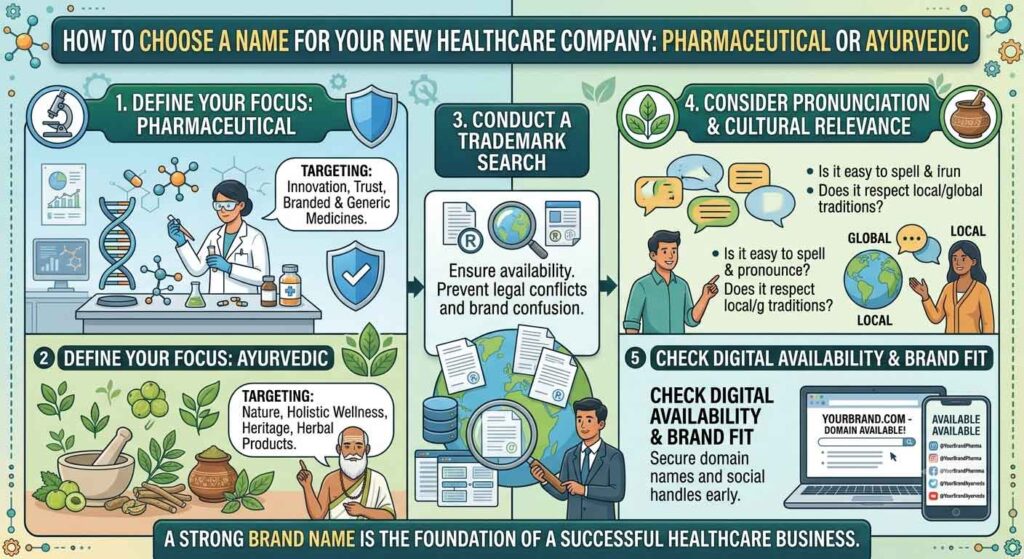
A strong name in this sector should be distinctive first, then easy to say, easy to hear, easy to spell, and flexible enough to grow from one SKU to many. Distinctiveness matters because trademarks exist to distinguish source, and MCA rules also push back against names that are merely descriptive or too close to existing names. The 2019 MCA naming rules explicitly treat purely descriptive, commonly used combinations as problematic.
Pronounceability matters for two reasons. The first is commercial: fluency research shows that names that are easier to process are generally judged more positively. The second is safety: FDA’s proprietary naming guidance and WHO’s medicine-safety work both treat look-alike/sound-alike confusion as a serious risk in drug naming. Inference: for healthcare ventures, “easy to pronounce” is not just a branding preference; it is part of risk reduction.
In practice, the best names in this sector are often coined or semi-coined words rather than plain-English descriptions. A coined root gives you a better chance of clearing MCA and trademark review, and it gives you room to expand from pharma into nutraceuticals, Ayurveda, export, or contract manufacturing later. A name like “Pure Herbal Products India” may explain what you do, but it will usually be weaker and harder to protect than a distinctive root paired with an optional sector descriptor. That conclusion follows directly from IP India’s distinctiveness framework and MCA’s treatment of descriptive names.
A useful rule of thumb is this: the root should be memorable and ownable, while the descriptor should be replaceable. So the real asset is the coined element—not the word “Pharma,” “Herbals,” “Healthcare,” or “Ayurveda.” That is an inference from how source-identifying trademarks work in practice.
What to avoid before you fall in love with a name
The first category to avoid is the near-copy. MCA rules say that when comparing names, authorities may disregard differences such as “Private/Limited,” plural vs singular forms, punctuation, spacing, letter case, tense, phonetic spellings, domain extensions like “.com,” order of words, articles, slight spelling variation, transliteration/translation, place names, and even some numerals. In other words, changing “Pharmatek” to “Pharma-Tec” or adding “India” usually will not rescue a weak name.
The second category is the ingredient-sounding or molecule-derived name. WHO states that trademarks should neither be derived from INNs nor contain common INN stems. For example, names that lean too hard on pharmacological endings or generic-stem fragments can become both unsafe and difficult to defend. This matters especially in prescription products, where similarity in sound or structure can contribute to medication errors.
The third category is the overclaiming name. For allopathic products, the Drugs and Cosmetics Act treats false or misleading statements on labels and accompanying matter as a misbranding issue. For Ayurveda, the Ministry of Ayush has reminded the public that illegal advertisements claiming miraculous or supernatural effects are prohibited, and the Drugs and Magic Remedies law restricts advertisements for certain diseases and conditions. For nutraceuticals and health supplements, FSSAI says labels, presentation, and advertising must not claim to prevent, treat, or cure disease. Inference: names such as “SugarCure,” “CancerMukti,” “BPGone,” or “InstantImmunityDoctor” are commercially tempting but legally risky.
The fourth category is the official-sounding or restricted name. The Companies Act prohibits names likely to suggest government connection or patronage, and MCA’s rules restrict words such as “Board,” “Commission,” “Authority,” “Undertaking,” “National,” “Union,” “Central,” “Federal,” “Republic,” “President,” “Rashtrapati,” and similar expressions without prior approval. For a private healthcare startup, official-sounding words usually create more clearance risk than brand value.
The fifth category is the weakly descriptive stock phrase. In MCA’s own illustrations, names made up of commonly used descriptive words can be refused as descriptive. Inference: combinations like “Quality Pharma Products,” “Best Ayurvedic Remedies,” or “Modern Herbal Healthcare” are not only bland; they are also harder to clear and harder to own.
A practical Indian workflow that actually reduces rejection risk
The best way to choose a name is not to brainstorm one “perfect” word. It is to run a funnel.
First, decide your naming architecture. Will the company, the house mark, and the core product line share one coined root, or will the entity name and the product brands differ? Make that decision before you start searching, because trademark strategy depends on it.
Second, generate a longlist of at least 30 to 50 candidates. Build them from three pools: a distinctive coined root, an optional health-science signal, and an optional sector descriptor. For Ayurvedic businesses, it is often better to signal tradition and trust indirectly than to overuse generic words like “Ayurvedic,” “Herbal,” or “Natural” in the core root. This is an inference from distinctiveness principles and the crowded nature of Class 5.
Third, do a phonetic safety screen. Say each candidate aloud in English and in the Indian languages used by your likely customers or trade partners. If the name can be misheard as an existing therapy area, ingredient, dosage form, or common competitor root, drop it. WHO and FDA both emphasize the safety risk of sound-alike and look-alike medicine names.
Fourth, do the MCA clearance screen. Your test is not “Is the exact spelling taken?” Your test is “Would MCA likely treat this as too nearly resembling an existing name under Rule 8 and undesirable under Rule 8A?” Remember that phonetic spellings, punctuation changes, domain-style additions, and similar tweaks may be disregarded.
Fifth, do the trademark screen. IP India’s official workflow says to search existing trademarks, assess similarity and conflicts, decide whether you are filing a word mark or logo mark, and identify the correct Nice class. For healthcare brands, Class 5 is usually central, and depending on your model you may also need to think about service or trading classes later. Also note a current operational point: the legacy public-search page itself states that it will be decommissioned effective 1 July 2026 and that services are migrating to the upgraded IP India system, so founders should use the active search environment rather than relying on old bookmarks.
Sixth, do the regulatory-claims screen. Ask whether the name itself implies prevention, cure, guaranteed outcome, magical effect, official endorsement, or misleading superiority. This screen is essential for Ayurvedic and nutraceutical naming, but it is also relevant to mainstream drugs because label or accompanying claims can trigger misbranding issues.
Seventh, once you have a winner, reserve it properly. Under the Companies Act, you can apply for name reservation, and the approved name is reserved for twenty days for a proposed company; the rules also provide a web-service route and extension mechanism through MCA web services and SPICe+. If an application is made with wrong information, the reserved name can be cancelled and the applicant can face a penalty of up to one lakh rupees.
Practical naming frameworks and illustrative examples
The most workable frameworks in this sector are usually the following:
Framework
When it works best
Illustrative style
Coined root only
If you want maximum stretch across categories
Avenor, Torixa, Nexora
Coined root + science descriptor
If you want immediate B2B credibility
Avenor Lifesciences, Torixa Labs
Coined root + care descriptor
If you want trade and retail friendliness
Nexora Healthcare, Vestra Care
Heritage root + Ayurveda descriptor
If you want tradition without sounding generic
Suvana Ayurveda, Elzac Herbals
Modern root + wellness descriptor
If you plan Ayurveda plus nutraceuticals
Trunetra Wellness, Alteva Botanics
These examples are illustrative only. They have not been cleared against MCA records, trademark records, or regulatory naming risk, so they should be treated as naming directions rather than ready-to-use names.
A practical pattern for pharma startups is to keep the root neutral and expandable: a name like Nexora can become Nexora Pharma, Nexora Labs, Nexora Vet, or Nexora Remedies depending on later strategy. A practical pattern for Ayurveda is to use roots that suggest tradition, nature, balance, or Sanskritic familiarity without drifting into cure-claim territory. That is an inference from the legal restrictions on misleading claims and the branding benefits of distinctive rather than purely descriptive terms.
The best naming rule for this sector
In pharmaceuticals and Ayurveda, the strongest name is usually not the one that sounds the most “medical,” nor the one that directly promises cure. It is the one that clears four tests at the same time: it is distinctive enough to be protected, pronounceable enough to be remembered, safe enough not to be confused with other medicinal names, and clean enough to survive company-name, trademark, and claims scrutiny. That conclusion follows from MCA naming rules, IP India trademark principles, WHO/FDA medicine-naming safety guidance, and the stricter judicial approach applied to medicinal products in India.
If you want one simple rule to guide every shortlist decision, use this:
Choose the most distinctive name you can still say clearly over a noisy phone call, write without spelling it out, and defend without borrowing from someone else’s mark or a drug ingredient.
Partner with Elzac Herbal India
Looking to start an Ayurvedic franchise, become a distributor, or launch your own herbal product range?
Elzac Herbal India offers:
Ayurvedic & Herbal Product Range
Franchise & Distribution Opportunities
Third-Party Manufacturing Services
Product Development Support
Marketing Guidance
PAN India Business Opportunities
Whether you are an entrepreneur, retailer, distributor, or healthcare professional, our team can help you explore the right business opportunity in the growing Ayurvedic sector.
Ajay Kamboj is an entrepreneur and business owners associated with many Ayurvedic and Pharmaceutical start-ups. With years of experience in Ayurvedic product marketing, pharmaceutical distribution, franchise development, and client relationship management, he regularly shares practical business insights based on real-world experiences. His articles focus on business growth, entrepreneurship, customer management, and lessons learned from the healthcare and wellness industry.
22 responses to “How to Choose a Name for a New Pharmaceutical or Ayurvedic Company”
Please suggest a new and unique name of Phrama profission name of company
I'm reaching out to you seeking help to name my for small business pharmaceutical company. The company is based off of repurposing drugs, which means taking an existing drug that has an expired Patent and figuring out new cures for diseases. I'm looking for to be scientific as well. If you can help please do thank you
Nice to see your article and it has given me a deep insight of choosing a name of a company. Basically i am a pharma guy associated with a MNC company name starts with A. I am dealing with ophthalmic equipment and intra ocular lenses. While middle of my carrier perspective and working for more then 11 years in different pharmaceutical companies, now i want to go a ophthalmic startup.
Can you please suggest me a good name starting with letter "A". I don't know why but i want to adhare on this letter only.
I want to partner with a friend. We will love to use our names to open a pharmaceutical company. Our names are kelechi and osinachi. Please help us a good name from our names. Thank you.
I have decided my company name. But I don't know is it available in market or not. So pls provide ur mail id so I will share u my company name for existing status
Dear Sir,
Thanks for giving valuable information about pharma sector.
Sir my query is that I already have a wholesale license. Now I want to start a new pharma company with a different name. Can we do business on old wholesale license which have different name for new pharma company.
Thank you
Lokesh Brind






Please suggest a new and unique name of Phrama profission name of company
Kindly help me to choose new pharma company name and ITS AVAILABILITY
JYDUS HEALTH CARE
NOVA HEALTH CARE
HEALTHKIND PHARMA
NOVA LIFE SCIENCES
ZYDAS HEALTHCARE
ZYDAS LIFE SCIENCES
ZYDAS PHARMACEUTICALS
ZYDAS PHARMA
I'm reaching out to you seeking help to name my for small business pharmaceutical company. The company is based off of repurposing drugs, which means taking an existing drug that has an expired Patent and figuring out new cures for diseases. I'm looking for to be scientific as well. If you can help please do thank you
Please suggest me new pharmacuetical company name
my whats app no 9416061308
Please suggest me new pharmacuetical company name
my whats app no 9416061308
Nice to see your article and it has given me a deep insight of choosing a name of a company.
Basically i am a pharma guy associated with a MNC company name starts with A. I am dealing with ophthalmic equipment and intra ocular lenses.
While middle of my carrier perspective and working for more then 11 years in different pharmaceutical companies, now i want to go a ophthalmic startup.
Can you please suggest me a good name starting with letter "A". I don't know why but i want to adhare on this letter only.
Also if you can suggest me some other things.
Hello mates, its impressive paragraph concerning teachingand completely explained, keep
it up all the time.
Nice Articles
I want to partner with a friend. We will love to use our names to open a pharmaceutical company. Our names are kelechi and osinachi. Please help us a good name from our names. Thank you.
I have decided my company name. But I don't know is it available in market or not. So pls provide ur mail id so I will share u my company name for existing status
Dear Sir,
Thanks for giving valuable information about pharma sector.
Sir my query is that I already have a wholesale license. Now I want to start a new pharma company with a different name. Can we do business on old wholesale license which have different name for new pharma company.
Thank you
Lokesh Brind
Dear sir plz send me better pharma company name……
Hello, Sir/Ma’am
I Want Start Own Pharma company Please Suggest Best Unique Name Starting Letter P, M or B
i want to open pharma company kindly advise me name.
I want to Start my pharma company Starts from Alphabet K OR N please Suggest me good names
Plz suggest me new company name
Please new name idia suggested of p pharmaceuticals food and drug
I want start pharma company and wholesale distribution kindly refer me for good name
PLEASE SUJJEST NAME FOR ACTIVE PHARMA INGRDIANT MANUFACTURING COMPANY NAME
I want start pharma company and Food company, kindly refer me for good name
Please suggest pharma company name.
Started from A to Z
Easy to speak
English name
Hi iam starting my new company in PHARMA