A good product list can help a company generate regular sales, build doctor confidence, attract distributors and create long-term market presence. A poor product list can block investment in slow-moving stock, increase expiry risk and create pressure on working capital.
For a new pharma company, the question is not only:
“Which products should I launch?”
The real question is:
“Which products should I launch first, according to my budget, market demand, doctor segment and business model?”
Why Product Selection Is Important
After setting up a pharmaceutical company, whether it is a marketing company or manufacturing company, product selection becomes a major factor in success or failure.
New molecules may help you stand apart from competitors, while established running molecules help generate regular sales. A balanced product list should contain both:
Fast-moving molecules
High-margin products
Seasonal products
Prescription-based products
Supportive products
Specialty products
Differentiated products
The best product list is not the longest list. The best product list is the one that sells consistently in your market.
Do Not Start with Too Many Products
Many new companies make the mistake of launching 100 to 200 products in the beginning.
This creates problems such as:
High investment
Slow stock rotation
Expiry risk
Confused sales team
Weak brand focus
Poor inventory control
Difficulty in promotion
Low repeat orders
For beginners, it is better to start with a focused list of 25 to 50 products and expand gradually.
Factors That Affect Product Selection
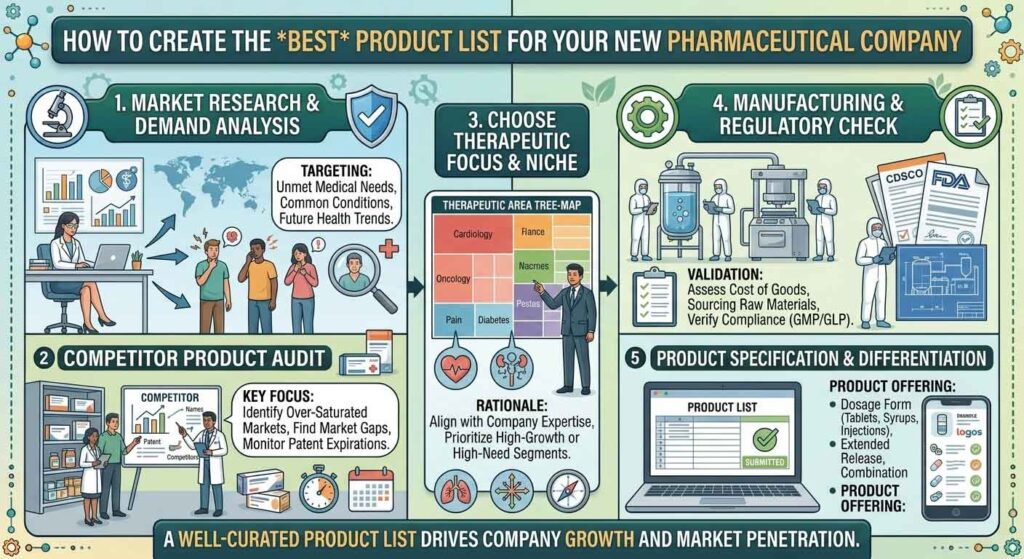
1. Market Demand
Market demand is the first factor.
Before finalizing products, study:
What doctors are prescribing
What chemists are selling
What competitors are promoting
Which brands are fast-moving
Which molecules are growing
Which products are outdated
Which products are in shortage
A product list should be based on actual market demand, not guesswork.
2. Doctor Specialty
Your product list should match the doctors you want to visit.
For example:
General Physicians
Antibiotics
Antacids
Analgesics
Anti-allergic products
Cough and cold products
Multivitamins
Digestive products
Orthopedic Doctors
Painkillers
Muscle relaxants
Calcium supplements
Vitamin D3
Joint support supplements
Anti-inflammatory products
Gynecologists
Iron supplements
Calcium supplements
Pregnancy support products
Protein powders
Folic acid combinations
Uterine tonics where applicable
Pediatric Doctors
Pediatric drops
Dry syrups
Zinc products
Probiotics
Multivitamin syrups
Cough syrups
ENT and Chest Physicians
Anti-allergic products
Cough syrups
Mucolytics
Antibiotics
Montelukast combinations
Dermatologists
Antifungal creams
Anti-acne products
Skin creams
Hair supplements
Antiallergic products
3. Seasonality
Some products sell strongly in a particular season.
Examples:
Cough syrups
Cold and flu products
Anti-allergic products
Antimalarial products
ORS and zinc products
Skin infection products
Seasonal products can boost sales during peak demand, but they can become slow-moving in off-season.
Do not overstock seasonal products unless you have strong demand.
4. Competition Level
Some products have very high competition.
Examples:
Antibiotics
Painkillers
PPIs
Multivitamins
Cough syrups
Calcium supplements
High competition does not mean you should avoid these products. It means you need:
Better brand name
Better packaging
Good quality
Competitive price
Strong field promotion
Doctor confidence
Regular stock availability
5. Profit Margin
Every product does not give the same margin.
Some products are fast-moving but low-margin. Some products sell slowly but give better margin.
A good product list should include:
Fast-moving products for turnover
High-margin products for profitability
Specialty products for brand identity
Supportive products for prescription completion
6. Investment and Inventory
Product selection should match your budget.
Do not select expensive products only because they look attractive. Consider:
Minimum order quantity
Packing material cost
Batch size
Expiry period
Market demand
Repeat order potential
Storage requirement
Promotional cost
Beginners should avoid locking too much money in slow-moving or high-value inventory.
7. Regulatory Status
Before launching any product, confirm:
Whether the molecule is approved
Whether the combination is permitted
Whether it is banned or restricted
Whether it comes under Schedule H or H1
Whether it is under DPCO/price control
Whether manufacturer has product permission
Whether label warnings are correct
Whether prescription-only rules apply
This is very important for antibiotics, steroids, FDCs and high-risk products.
8. DPCO and Price Control
Some medicines come under price control.
If a product is under DPCO/NPPA price control, your pricing, MRP and margin planning must follow applicable rules.
Before finalizing products, check whether the molecule is under price control. This helps avoid pricing mistakes and margin miscalculation.
9. Product Quality and Manufacturer Capability
Do not finalize products only on rates.
Check whether your manufacturer can provide:
Proper COA
Product permission
Stable formulation
Good packaging
Timely delivery
Batch consistency
Quality documentation
Complaint support
A product with poor quality can damage the entire company reputation.
Ideal Product Mix for a New Pharma Company
A balanced product list may include products from these categories:
1. Antibiotics and Antimicrobials
Antibiotics are commonly prescribed and can contribute to good sales volume.
However, they are highly competitive and should be promoted responsibly.
Examples of commonly seen categories:
Azithromycin
Cefixime
Cefpodoxime
Amoxicillin-clavulanate
Cefuroxime
Ofloxacin combinations, where approved
Important: Antibiotics should be selected carefully and sold strictly as per applicable prescription rules.
2. Antacids and PPIs
Antacids and PPIs are fast-moving products because they are commonly prescribed with many treatments.
Common categories include:
Pantoprazole
Rabeprazole
Pantoprazole with domperidone
Rabeprazole with domperidone
Rabeprazole with levosulpiride
These products are useful in general physician, gastro and multi-specialty segments.
3. Pain Management Products
Pain management products are important for general physicians, orthopedic doctors and surgeons.
Common categories include:
Aceclofenac combinations
Diclofenac combinations
Etoricoxib
Muscle relaxant combinations
Serratiopeptidase combinations
Trypsin-chymotrypsin combinations
Select products based on local prescription trends.
4. Multivitamins and Multiminerals
Multivitamin and multimineral products are important for regular prescriptions and better margins.
Common combinations may include:
Multivitamin tablets
Ginseng combinations
Lycopene combinations
Methylcobalamin combinations
Antioxidant combinations
Zinc combinations
Omega combinations
These products often support repeat business.
5. Calcium and Bone Health Products
Calcium products are useful for orthopedic, gynecology and general practice segments.
Common categories include:
Calcium with Vitamin D3
Calcium citrate malate
Calcitriol combinations
Vitamin K2-7 combinations
Cholecalciferol sachets or capsules
Joint support supplements
6. Neuro and Nerve Support Products
These products are commonly used in diabetic neuropathy, nerve weakness and pain-related prescriptions.
Common categories include:
Methylcobalamin
Pregabalin with methylcobalamin
Alpha lipoic acid combinations
Folic acid and B-vitamin combinations
7. Cough, Cold and Allergy Products
These are important seasonal and general practice products.
Common categories include:
Cough syrups
Ambroxol combinations
Levocetirizine
Montelukast combinations
Cold tablets
Pediatric cold preparations
Do not overstock seasonal products without market demand.
8. Liquids and Syrups
Liquids play an important role in establishing a company because they are visible, easy to promote and suitable for pediatric and general practice.
Common categories include:
Multivitamin syrup
Liver tonic
Digestive enzyme syrup
Iron syrup
Calcium syrup
Cough syrup
Appetite support syrup
Protein syrup
9. Dry Syrups
Dry syrups are useful for pediatric practice.
Common categories include:
Antibiotic dry syrups
Pediatric fever and pain syrups
Zinc and probiotic products
Pediatric multivitamin products
These should be selected carefully according to pediatric prescription trends.
10. Injections
Injections have strong consumption in hospitals and clinics but may provide lower margins and require more careful handling.
Beginners may avoid too many injections at the start unless they have hospital supply or institutional network.
Common injection categories include:
Antibiotic injections
PPI injections
Pain injections
Methylcobalamin injections
Iron injections
11. Eye and Ear Drops
Eye and ear drops can give differentiation because many general pharma companies do not include a strong ophthalmic range.
However, this segment requires focused promotion and quality manufacturing.
Common categories include:
Lubricant eye drops
Antibiotic eye drops
Anti-allergic eye drops
Anti-inflammatory eye drops
Ear drops
12. Dermatology and Skin Products
Skin products can provide good opportunity but require careful inventory planning.
Common categories include:
Antifungal creams
Pain relief gels
Skin infection creams
Anti-allergic tablets
Hair and skin supplements
This segment may require dedicated promotion to dermatologists and general physicians.
13. Sachets and Powders
Sachets are useful in orthopedic, gynecology, pediatric and general practice segments.
Examples:
Vitamin D3 sachet
Collagen peptide sachet
ORS
Probiotic sachet
L-arginine sachet
Protein powder
14. Ayurvedic and Herbal Preparations
A good product list may also include selected Ayurvedic or herbal products.
For example:
Liver tonic
Pain relief oil
Cough syrup
Uterine tonic
Digestive syrup
Herbal immunity products
Ayurvedic capsules for joint support
If you are already in Ayurvedic or herbal business, this can become your differentiation.
Suggested Starter Product List for a New Pharma Company
A beginner can start with a balanced list like this:
This is only a sample structure. Final product selection should be based on market survey, doctor segment, investment, manufacturer approvals and regulatory status.
Product List Strategy Based on Budget
Low Budget Startup
Start with 20 to 30 products.
Focus on:
Tablets
Capsules
3 to 5 syrups
2 to 3 sachets
2 to 3 topical products
Few Ayurvedic products
Avoid too many injections, eye drops and slow-moving specialty items.
Medium Budget Startup
Start with 40 to 60 products.
Include:
General range
Ortho range
Gynae support range
Pediatric range
Syrup range
Few injections
Few eye drops
Ayurvedic/herbal products
Higher Budget Startup
Start with 75 to 100 products only if you have:
Strong sales team
Doctor network
Distributor network
Working capital
Stock rotation system
Marketing strategy
Product-wise promotion plan
Do not launch a large product list only to look big.
How to Conduct Market Research Before Finalizing Products
Before finalizing your list, do the following:
1. Visit Chemists
Ask chemists:
Which products sell daily?
Which brands move fast?
Which products have shortage?
Which companies give better schemes?
Which products expire frequently?
2. Study Doctor Prescriptions
Observe prescription trends in your target area.
Check:
Molecules prescribed
Brand preferences
Common combinations
Seasonal prescriptions
Specialty-wise demand
3. Check Competitor Product Lists
Collect product lists from competitors and note:
Common products
Unique products
Pricing
Packaging style
MRP
Promotional strategy
4. Talk to Medical Representatives
Experienced MRs know ground-level market demand.
Ask them:
Which products are easy to promote?
Which products doctors avoid?
Which products give repeat sales?
Which products face high competition?
5. Check Regulatory and Pricing Status
Before finalizing any molecule, check:
Product permission
Banned FDC status
Schedule status
DPCO status
Label requirement
Prescription requirement
Product Selection Mistakes to Avoid
Avoid these mistakes:
Launching too many products at once
Selecting products only by high margin
Ignoring market demand
Copying competitor list blindly
Selecting banned or doubtful combinations
Ignoring DPCO pricing
Choosing only antibiotics
Ignoring supportive products
Not checking manufacturer permission
Ignoring packaging quality
Not planning seasonal inventory
Launching expensive products without sales network
Best Formula for Product List
Use this formula:
40% fast-moving products + 30% high-margin support products + 20% specialty products + 10% seasonal or differentiating products
This creates balance between sales, profitability and identity.
How Many Products Should a New Company Launch?
For most new pharma companies:
20 to 30 products are enough for very small startups.
40 to 50 products are ideal for focused launch.
60 to 80 products can be launched with a sales team.
100+ products should be launched only with strong investment and distribution.
A smaller focused list with regular sales is better than a large list with dead stock.
How to Arrange Products in a Price List
Your product list should be easy to read.
Arrange products category-wise:
Tablets
Capsules
Softgels
Syrups
Dry syrups
Injections
Ointments
Sachets
Powders
Drops
Ayurvedic products
Each product should include:
Brand name
Composition
Pack size
Packing type
MRP
PTR
PTS
Net rate, if applicable
GST
Indication category
Schedule status, where applicable
Final Checklist Before Launch
Before launching a product, confirm:
Is there demand for this product?
Is the molecule approved?
Is the FDC permitted?
Is the product under DPCO?
Is the manufacturer licensed for this product?
Is COA available?
Is packaging suitable?
Is MRP practical?
Is margin workable?
Can the sales team promote it?
Is repeat demand expected?
Is expiry period sufficient?
Is storage easy?
Only products that pass this checklist should be included.
Final Thoughts
Making the best product list for a new pharmaceutical company requires research, planning and balance.
Do not prepare your product list only by copying another company’s list. Study your market, understand doctor demand, check chemist movement, verify regulatory status and calculate investment carefully.
A good product list should include fast-moving products, profitable products, seasonal products and a few differentiated products.
Start small, sell consistently and expand step by step.
The success of a pharma company depends not on the number of products in its list, but on the quality, demand and repeat sale of those products.
Frequently Asked Questions
1. How many products should a new pharma company launch?
A new pharma company can start with 25 to 50 products. Very small startups may begin with 20 to 30 products and expand gradually.
2. Which products are best for a new pharma company?
Fast-moving products such as PPIs, pain management products, multivitamins, calcium supplements, cough syrups and selected antibiotics are commonly included, subject to regulatory approval and market demand.
3. Should a new company launch injections?
Injections may be added if you have hospital or clinic network. Beginners can start with fewer injections because margins and handling requirements may be challenging.
4. Are antibiotics necessary in a pharma product list?
Antibiotics are commonly prescribed, but they are highly competitive and must be promoted responsibly under applicable prescription rules.
5. Should I include Ayurvedic products in a pharma list?
Yes, selected Ayurvedic or herbal products can help differentiate your company, especially liver tonics, pain oils, cough syrups and digestive products.
6. What is the biggest mistake in product selection?
The biggest mistake is launching too many products without market research, resulting in dead stock and expiry loss.
7. How do I know which products are in demand?
Visit chemists, study prescriptions, talk to doctors, observe competitor brands and check local sales trends.
8. Should I choose products with high margin or high sales?
A balanced list should include both. Fast-moving products create turnover, while high-margin products improve profitability.
9. What should I check before launching a combination product?
Check whether the FDC is approved, not banned, manufacturer has permission, label is correct and pricing is compliant.
10. Can I copy another company’s product list?
You can take ideas from competitors, but do not copy blindly. Your final list should match your territory, doctor segment, budget and business plan.
Partner with Elzac Herbal India
Looking to start an Ayurvedic franchise, become a distributor, or launch your own herbal product range?
Elzac Herbal India offers:
Ayurvedic & Herbal Product Range
Franchise & Distribution Opportunities
Third-Party Manufacturing Services
Product Development Support
Marketing Guidance
PAN India Business Opportunities
Whether you are an entrepreneur, retailer, distributor, or healthcare professional, our team can help you explore the right business opportunity in the growing Ayurvedic sector.
Ajay Kamboj is an entrepreneur and business owners associated with many Ayurvedic and Pharmaceutical start-ups. With years of experience in Ayurvedic product marketing, pharmaceutical distribution, franchise development, and client relationship management, he regularly shares practical business insights based on real-world experiences. His articles focus on business growth, entrepreneurship, customer management, and lessons learned from the healthcare and wellness industry.
One response to “How to Make the Best Product List for a New Pharmaceutical Company”
Send me price list at my e-mail abib.1***9@gmail.com





Send me price list at my e-mail abib.1***9@gmail.com