Starting a pharmaceutical company in India does not necessarily mean establishing a medicine-manufacturing plant.
An entrepreneur may start:
A pharmaceutical marketing company
A PCD or franchise company
A wholesale or distribution business
A retail pharmacy
A third-party manufacturing brand
A loan-licence company
A pharmaceutical manufacturing unit
An institutional-supply business
A generic-medicine company
An OTC or consumer-healthcare company
Each model has different licensing, premises, qualification, investment and compliance requirements.
The practical answer for a pharmaceutical marketing company is:
Register a suitable business entity, select the proposed products, finalize a compliant marketing and distribution structure, enter into a written agreement with licensed manufacturers, obtain Forms 20-B and 21-B where the company will purchase, stock, invoice or distribute allopathic medicines, arrange a competent person, obtain GST and other category-specific registrations, and comply with medicine-pricing and ethical-marketing requirements.
There is no single government registration called a:
“Pharmaceutical company licence.”
The licences depend on what the business actually does.
Pharmaceutical Marketing Company vs Manufacturing Company
Pharmaceutical Marketing Company
A pharmaceutical marketing company generally:
Selects products
Selects brand names
Gets medicines manufactured by licensed manufacturers
Places its name and address on the label as marketer
Promotes products
Appoints distributors
Develops PCD franchise territories
Handles product positioning and pricing
May purchase and distribute finished medicines
It does not necessarily own a manufacturing plant.
Pharmaceutical Manufacturing Company
A pharmaceutical manufacturing company:
Owns or operates an approved production facility
Employs technical manufacturing and quality personnel
Holds drug-manufacturing licences
Manufactures medicines
Tests and releases batches
Complies with revised Schedule M
Starting a manufacturing plant requires investment running into several crores and is a different project from starting a marketing company.
Which Business Model Should a Beginner Choose?
For most first-time entrepreneurs, a pharmaceutical marketing company using third-party manufacturing is more practical than establishing an own plant.
It provides:
Lower capital requirement
Faster product launch
Access to several dosage forms
No investment in manufacturing machinery
Reduced technical-management burden
Easier expansion of the product range
However, the marketing company still has legal responsibilities for product quality and regulatory compliance.
Is a Wholesale Drug Licence Compulsory?
The answer depends on the transaction structure.
Wholesale Drug Licence Is Generally Required When the Company:
Purchases medicines from a manufacturer
Receives finished products
Stores medicine stock
Raises invoices to distributors
Supplies retail chemists
Supplies hospitals or institutions
Transfers stock between warehouses
Handles saleable product returns
Operates a pharmaceutical warehouse
Forms 20-B and 21-B are commonly relevant for ordinary allopathic wholesale operations. Form 20-G applies where Schedule X wholesale activity is proposed.
A Wholesale Licence May Not Attach to a Pure Marketing-Only Entity When:
It performs only brand management and promotion.
It never purchases medicine stock.
It never receives or stores medicines.
It does not issue drug-sale invoices.
A licensed manufacturer invoices a licensed distributor directly.
A licensed distributor handles storage, billing and delivery.
This is a regulatory inference based on the distinction between marketing and wholesale sale. The complete structure should be confirmed in writing with the concerned State Licensing Authority before operations begin.
Do not use another company’s wholesale licence casually merely to avoid obtaining your own licence.
Legal Responsibility of a Pharmaceutical Marketer
The Drugs Rules define a marketer as a person who adopts a drug manufactured by another manufacturer under an agreement and affixes the marketer’s name to the label for sale and distribution.
The law requires:
A written marketing agreement
Marketer’s name and address on the label
Joint responsibility of the marketer and manufacturer for quality and regulatory compliance
Therefore, a marketing company cannot avoid liability merely by stating:
“We did not manufacture the product.”
Main Pharmaceutical Marketing Structures
Model 1: Manufacturer-to-Marketing Company
The manufacturer supplies finished medicines to the marketing company.
The marketing company:
Receives stock
Stores products
Raises invoices
Supplies distributors
In this model, the marketing company ordinarily needs the applicable wholesale drug licences.
Model 2: Manufacturer-to-Distributor Direct Supply
The marketing company promotes the brands, but the licensed manufacturer:
Raises the invoice
Dispatches goods directly
Maintains the sale record
Alternatively, a licensed distributor may purchase and invoice the medicines.
This structure may reduce the marketing company’s inventory investment, but commercial agreements, GST treatment, label responsibility and legal roles must be clearly documented.
Model 3: PCD or Franchise Marketing Company
The company gets medicines manufactured under its brands and supplies franchise partners at agreed rates.
The PCD partner may undertake:
Doctor promotion
Distributor development
Retail availability
Territory sales
Collection
Product promotion
Where the marketing company purchases, stocks and invoices the products, it ordinarily requires wholesale licences.
Model 4: Loan-Licence Company
A loan-licensee uses another licensed manufacturer’s facilities through a formal regulatory licence.
A loan licence is not simply another name for third-party manufacturing.
The loan-licensee assumes direct manufacturing and quality responsibilities under its licence and requires a more complex regulatory structure.
Is Any Qualification Required to Own a Pharmaceutical Company?
No specific pharmacy degree is ordinarily required merely to become the:
Proprietor
Partner
Shareholder
Director
Investor
Brand owner
Therefore, the owner may be:
A pharmacist
A doctor
A dentist
A science graduate
A businessperson
A person without a pharmaceutical degree
However, licensed activities must be supervised by the appropriately qualified person.
Qualification Required for a Wholesale Drug Licence
Wholesale medicine operations must be under the supervision of a competent person accepted by the State Licensing Authority.
Common eligibility routes include:
A registered pharmacist
A graduate of a recognized university with at least one year of experience in dealing with drugs
A person who has prescribed examination and has prescribed experience in dealing with drugs
The concerned authority must approve the competent person and may require:
Qualification certificate
Mark sheets
Experience certificate
Appointment letter
Biodata
Identity proof
Affidavit
Proof of previous licensed employment
Official state guidance confirms these qualification-and-experience routes.
Does a Marketing Company Need a Registered Pharmacist?
Not necessarily.
A registered pharmacist is one accepted option for supervising wholesale operations.
A non-pharmacist competent person may also qualify through the prescribed education and experience route, subject to approval by the Licensing Authority.
A registered pharmacist is ordinarily required where the business operates a retail pharmacy and dispenses medicines directly to patients.
Can the Owner Act as the Competent Person?
Yes, where the proprietor, partner or director independently meets the qualification and experience requirements and is approved by the authority.
Otherwise, the company may appoint a full-time competent person.
Avoid:
Borrowing another firm’s competent person
Showing an employee only during inspection
Submitting false experience certificates
Employing a person who continues to work full-time elsewhere
Allowing an unapproved employee to control medicine transactions
Business-Entity Options
A pharmaceutical marketing business may operate as:
Proprietorship
Suitable for:
One owner
Small launch
Simple administration
Local operations
A proprietorship is not a separately incorporated company, but it can obtain licences, GST registration and a current account in its trade name.
Partnership Firm
Suitable where two or more individuals jointly own and manage the business.
The partnership deed should cover:
Capital
Profit sharing
Roles
Banking
Credit approval
Intellectual property
Exit
Dispute resolution
Limited Liability Partnership
An LLP provides:
Separate legal identity
Limited liability
Flexible partner management
Better continuity than an ordinary partnership
Private Limited Company
Suitable where the business plans:
Multiple shareholders
External investment
Multi-state expansion
Formal governance
Several product divisions
Large institutional operations
A private limited company is not compulsory merely because the business is described as a pharmaceutical company.
Select the Product Category First
Do not begin with company registration or packaging design before deciding which products will be marketed.
Each category has different regulatory requirements.
Allopathic Medicines
Allopathic medicines fall under the Drugs and Cosmetics framework.
The company must verify:
Manufacturer’s licences
Product permission
Formula
Dosage form
Drug schedule
Price-control status
Labelling
Prescription category
Ayurvedic Medicines
Ayurvedic products require manufacture under a valid Ayurvedic manufacturing licence and product permission.
A central wholesale drug-sale licence comparable to Forms 20-B and 21-B is not ordinarily prescribed merely for Ayurvedic medicine sale, although state and local business requirements may apply.
Nutraceuticals and Food Supplements
Products such as the following may fall under FSSAI:
Health supplements
Protein powders
Food-category vitamin products
Nutrition gummies
Functional beverages
Food for special dietary use
A brand owner getting food supplements manufactured through a third-party food manufacturer should ordinarily apply under the Relabeller Kind of Business in FoSCoS. The earlier Supplier and Marketer categories have been disabled for new applications.
may fall under the Cosmetics Rules rather than allopathic drug licensing.
The category depends on:
Formula
Claims
Label
Intended use
Medical Devices
Medical devices follow the Medical Devices Rules.
Sale, stocking or distribution of regulated medical devices may require a separate premises registration through the applicable medical-device procedure.
Do not assume Forms 20-B and 21-B cover every healthcare device.
Homoeopathic Medicines
Wholesale homoeopathic activity ordinarily requires Form 20-D.
Retail homoeopathic sale ordinarily requires Form 20-C.
Licences and Registrations Required
A pharmaceutical marketing company may require the following:
1. Business Constitution
Choose proprietorship, partnership, LLP or company.
2. PAN and Current Bank Account
The bank account should be opened in the legal business name used in licences and invoices.
3. Wholesale Drug Licence
Common licences include:
Activity
Licence
Wholesale of drugs other than Schedule C, C(1) and X
Form 20-B
Wholesale of Schedule C and C(1) drugs excluding Schedule X
Form 21-B
Wholesale of Schedule X drugs
Form 20-G
Retail sale of ordinary allopathic drugs
Form 20
Retail sale of Schedule C and C(1) drugs
Form 21
Wholesale homoeopathic medicines
Form 20-D
Applications for Forms 20-B and 21-B are generally made in Form 19. Schedule X activity uses the applicable Form 19-C route.
4. GST Registration
Eligible businesses engaged exclusively in supplying goods may have a registration threshold of up to ₹40 lakh, subject to:
State eligibility
Product exclusions
Compulsory-registration provisions
Nature of supply
Interstate transactions
E-commerce and agency arrangements
Section 24 of the CGST Act contains compulsory-registration situations. The ₹40 lakh exemption is not automatically available to every business in every situation.
Most organized pharmaceutical marketing companies take GST registration from the beginning because they commonly:
Supply registered distributors
Claim input tax credit
Trade interstate
Purchase from manufacturers
Operate through B2B invoices
5. Shop and Establishment Registration
State-specific registration may apply to the:
Office
Warehouse
Employees
Working conditions
6. Municipal or Local Trade Licence
Applicability depends on:
Local authority
Premises
Commercial-use status
City or panchayat rules
7. FSSAI Registration or Licence
Required where the company markets, stores or distributes food-category products.
The correct Kind of Business should be selected according to whether the firm acts as:
Relabeller
Distributor
Wholesaler
Retailer
Storage provider
8. Trademark Registration
Trademark registration is not a drug licence, but it protects the:
Company brand
Product names
Logo
Device mark
Before filing, search for:
Identical marks
Similar marks
Phonetically similar names
Existing pharmaceutical brands
International Non-Proprietary Names
Pharmaceutical goods generally fall within Class 5, while some business, distribution or retail services may involve Class 35. Final class selection should reflect the actual goods and services.
IP India advises searching existing marks, selecting the proper Nice Classification and filing the application in Form TM-A.
9. Udyam Registration
Udyam registration may be useful for an eligible MSME.
It does not replace:
Drug licence
GST registration
FSSAI licence
Trademark
Local permissions
10. Import Export Code
IEC is relevant when the company intends to import or export products.
Importing medicines may require additional CDSCO permissions and product registrations.
Minimum Premises Area
The ordinary minimum area is generally:
Wholesale only: 10 square metres
Retail only: 10 square metres
Combined retail and wholesale: 15 square metres
The premises should be:
Independent
Legally usable
Clean
Dry
Secure
Properly ventilated
Suitable for medicine storage
Official sale-licence guidance confirms the 10-square-metre wholesale minimum and 15-square-metre combined minimum.
Ten square metres is approximately 108 square feet.
Premises Selection
Before signing a rent agreement, check:
Commercial-use permission
State licensing acceptability
Independent entrance
Floor area
Ceiling height
Electricity
Storage conditions
Refrigerator space
Loading access
Fire safety
Pest control
Internet and billing requirements
Do not assume that every residential room, basement or shared office will be approved.
Storage Requirements
The premises should provide:
Racks
Pallets where appropriate
Refrigerator where required
Temperature monitoring
Pest control
Security
Expiry segregation
Rejected-stock area
Returned-goods area
Damaged-stock area
Adequate ventilation
Medicines should not be stored:
Directly on the floor
Against damp walls
In direct sunlight
Near chemicals
At an unlicensed warehouse
In an overheated vehicle
Cold-Chain Products
Where the company handles vaccines, insulin, biologicals or other temperature-sensitive products, it may require:
Pharmaceutical refrigerator
Temperature log
Data logger
Backup power
Cold boxes
Excursion procedure
Controlled transport
A household refrigerator without temperature monitoring may not provide an adequate pharmaceutical cold-chain system.
Wholesale Drug-Licence Documents
The exact checklist varies by state, but common documents include:
Applicant and Entity Documents
Application in Form 19
Prescribed fee receipt
PAN
Aadhaar or identity proof
Photographs
Proprietorship declaration
Partnership deed
LLP documents
Certificate of incorporation
Memorandum and Articles
Board resolution
Authorized-signatory documents
Non-conviction affidavit
Premises Documents
Ownership proof
Rent or lease agreement
Rent receipt
Landlord’s NOC
Electricity bill
Property-tax or utility document
Site plan
Key plan
Commercial-use proof
Premises photographs
Competent-Person Documents
Qualification certificates
Mark sheets
Experience certificate
Appointment letter
Biodata
Identity proof
Photograph
Affidavit
Pharmacy registration where applicable
Previous employer and licence details
Storage Documents
Refrigerator purchase document where required
Storage-facility details
Temperature-control arrangement
Rack layout
Air-conditioning details where applicable
The Delhi licensing authority currently requires online applications, premises documents, firm-constitution documents and qualification and experience records for the competent person.
Where to Apply for a Wholesale Drug Licence
The application is submitted to the concerned State Licensing Authority.
Many states use the Online National Drugs Licensing System:
ONDLS
The exact portal, workflow, fee and document checklist may differ by state.
Delhi currently accepts sale-licence applications through ONDLS.
Drug-Licence Inspection
After application, the authority may inspect:
Premises
Area
Storage arrangements
Refrigerator
Documents
Competent person
Commercial-use status
Record systems
The inspector may raise deficiencies where:
Premises area is inadequate.
Competent-person experience is unsupported.
Storage is unsuitable.
Documents contain inconsistent names.
Commercial use is not permitted.
The competent person is not genuinely employed.
Choosing the Company and Product Names
The legal business name and product brands are different.
Example:
Legal entity: ABC Healthcare Private Limited
Product brand: ABC-Cef Tablet
Before finalization:
Search company-name availability.
Search trademarks.
Search similar medicine brands.
Check International Non-Proprietary Names.
Avoid misleading or prohibited names.
Avoid names resembling government bodies.
Do not print large quantities of packaging before completing the search and compliance review.
Selecting Products
A new marketing company should not launch products merely because they show a large difference between manufacturing cost and MRP.
Evaluate:
Local demand
Prescribing potential
Competitor brands
Product legality
Price control
Manufacturer capability
Minimum order quantity
Shelf life
Expected monthly sale
Repeat-order time
Promotional requirement
Recommended Initial Product Range
A focused startup may begin with approximately:
8–15 products for a lean launch
15–30 products for a structured launch
The exact number depends on:
Capital
Sales team
Product specialty
Territory
Manufacturer MOQ
Launching 100 products immediately can create:
Excess stock
Expiry loss
Packaging obsolescence
Working-capital shortage
Poor product focus
Product Legality and Approval
Before accepting a formula from a manufacturer, verify:
Manufacturing licence
Approved product permission
Exact composition
Strength
Dosage form
Label category
Schedule status
New-drug status
FDC approval
Manufacturer’s approved section
State authorities regulate much routine manufacture and sale, while CDSCO is responsible for central functions such as approval of new drugs and clinical trials.
Do not launch a fixed-dose combination merely because another brand appears in the market.
Certain new drugs, modified dosage forms, new indications and FDCs require central permission.
Selecting a Third-Party Manufacturer
Evaluate the manufacturer’s:
Legal entity
GST registration
Manufacturing licence
Product permission
Revised Schedule M compliance
Dosage-form approval
Quality-control laboratory
Production capacity
Delivery history
Complaint record
Recall system
Product-quality history
Stability support
Documentation
Documents to Obtain From the Manufacturer
Collect:
Manufacturing licence
GMP certificate
Product permission
GST certificate
Product composition
Finished-product specification
Certificate of analysis
Artwork approval
Stability or shelf-life support
Manufacturing agreement
Price quotation
Expiry and replacement policy
Complaint and recall procedure
Do not select a manufacturer only on the lowest quotation.
Third-Party Manufacturing Agreement
The written agreement should cover:
Product names
Formulas
Specifications
Batch size
Manufacturing responsibility
Testing
Packaging
Artwork approval
Delivery period
Payment
Rejected batches
Product complaints
Recalls
Confidentiality
Intellectual property
Expiry
Indemnity
Termination
Remaining printed packaging
The Drugs Rules require a marketing agreement where the marketer’s name is placed on the product.
Packaging and Labelling
A pharmaceutical product label commonly includes applicable particulars such as:
Proper name of the medicine
Brand name
Composition
Strength
Dosage form
Batch number
Manufacturing date
Expiry date
Manufacturing-licence number
Manufacturer’s name and address
Marketer’s name and address
MRP inclusive of taxes
Storage conditions
Schedule warnings
Prescription caution
Net contents
The marketer’s name and address are required where the medicine is marketed by a separate marketer.
Manufactured By and Marketed By
Under ordinary third-party manufacturing:
Manufactured by: The licensed manufacturer’s legal name and manufacturing address
Marketed by: The pharmaceutical marketing company’s legal name and address
The parties should not print misleading or fictitious addresses.
The marketer must have a written agreement and shares responsibility for quality and regulatory compliance.
Pricing and MRP
Before fixing MRP, determine whether the medicine is:
Scheduled
Non-scheduled
A new drug under DPCO
Subject to trade-margin control
Subject to a specific NPPA order
For scheduled formulations, the MRP cannot exceed the applicable ceiling price plus permitted tax.
NPPA monitors scheduled and non-scheduled medicine prices and publishes current price information.
Current GST on Medicines
From 22 September 2025:
Drugs and medicines generally attract 5% GST.
Specifically notified medicines may be nil-rated.
The company should verify the correct HSN and rate product-wise.
MRP, PTR and PTS calculations should therefore use the current 5% rate for ordinary medicines rather than the previous 12% rate.
Ethical Pharmaceutical Marketing
All pharmaceutical companies, their employees, agents and third parties acting on their behalf must comply with the Uniform Code for Pharmaceutical Marketing Practices 2024.
Drug promotion must be:
Consistent with approved product information
Accurate
Balanced
Verifiable
Non-misleading
Supported by evidence
The code also regulates:
Gifts
Samples
Hospitality
Sponsorships
Healthcare-professional interactions
Promotional claims
UCPMP 2024 is described by the Department of Pharmaceuticals as mandatory.
Medical Representatives
There is no universal statutory degree required merely to employ a person in pharmaceutical sales and marketing.
However, representatives should be trained in:
Product information
Indications
Contraindications
Adverse effects
Dosage
Approved claims
UCPMP
Pharmacovigilance
Complaint reporting
A representative should not promote:
Unapproved uses
Unapproved combinations
Misleading comparisons
Guaranteed results
Unsupported safety claims
Pharmacovigilance and Product Complaints
The marketing company should maintain systems for:
Adverse-event reporting
Medical complaints
Quality complaints
Batch investigation
Product recall
Customer communication
Regulatory reporting
Corrective action
Since the marketer shares responsibility for product quality, complaints should not simply be forwarded to the manufacturer and forgotten.
Stock and Distribution Records
Where the company holds stock, maintain:
Purchase register
Sales register
Batch-wise stock register
Expiry register
Returned-goods register
Damage register
Temperature records
Customer licence register
Product-complaint register
Recall register
Credit-note register
Customer Verification
Before wholesale supply, verify:
Customer legal name
Drug-licence number
Licensed address
GSTIN
Delivery address
Contact person
Credit terms
Avoid supply where:
The buyer asks for an invoice in another firm’s name.
Delivery is requested at an unlicensed location.
The buyer refuses to share licence details.
Schedule drugs are requested without a valid business purpose.
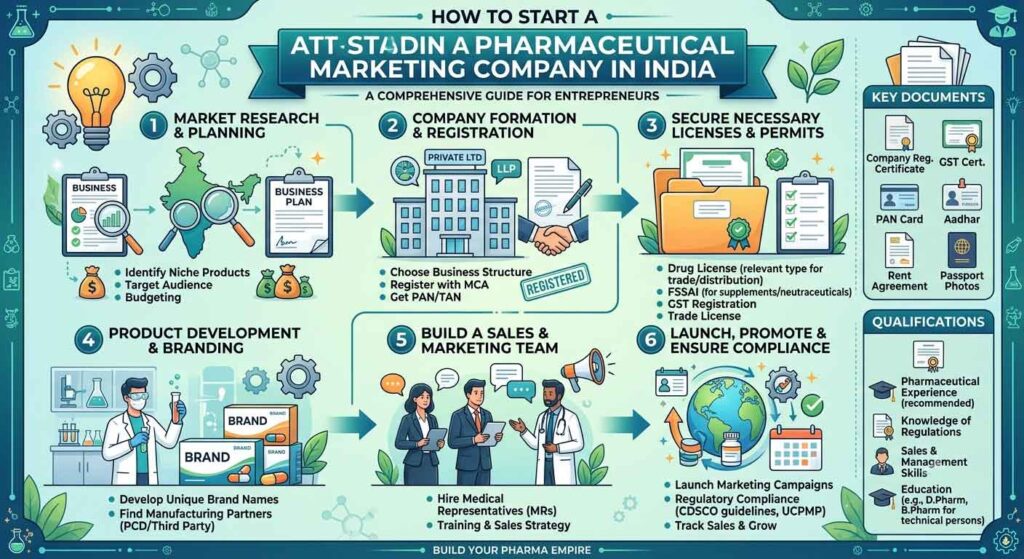
Step-by-Step Procedure to Start a Pharmaceutical Marketing Company
Step 1: Gain Industry Knowledge
Understand:
Product categories
Distribution
Pricing
Credit
Marketing
Licensing
Competition
Experience is not legally compulsory for ownership, but lack of practical knowledge increases business risk.
Step 2: Choose the Business Model
Select:
Branded prescription marketing
Generic marketing
PCD franchise
OTC
Institutional supply
Hospital supply
Export
Online or retail
Step 3: Prepare a Business Plan
Include:
Territory
Product range
Target customers
Investment
Sales projection
Working capital
Break-even point
Marketing strategy
Step 4: Select the Business Entity
Choose proprietorship, partnership, LLP or private company.
Step 5: Select Company and Brand Names
Conduct company-name and trademark searches.
Step 6: Decide the Stock Structure
Choose whether:
Your company will hold and invoice stock.
A licensed distributor will hold stock.
The manufacturer will invoice customers directly.
Step 7: Finalize the Premises
Ensure the area and use are acceptable for the proposed licence.
Step 8: Appoint the Competent Person
Collect genuine qualification and experience documents.
Step 9: Apply for Wholesale Drug Licences
Apply for Forms 20-B and 21-B through the State Licensing Authority or applicable ONDLS process.
Step 10: Obtain GST and Other Registrations
Complete GST, local and category-specific registrations.
Step 11: Select Manufacturers
Verify their licences, product approvals and quality systems.
Step 12: Select Products
Begin with a controlled, commercially viable range.
Step 13: Sign the Manufacturing Agreement
Clearly allocate manufacturing, quality, labelling, pricing and recall responsibilities.
Step 14: Finalize Artwork
Complete legal, medical, trademark and pricing review before printing.
Step 15: Place the Manufacturing Order
Confirm:
MOQ
Rate
GST
Freight
Packaging
Payment
Delivery
Testing
Shelf life
Step 16: Receive and Inspect Stock
Check:
Product
Batch
Quantity
Expiry
MRP
Packing
Certificate of analysis
Transport condition
Step 17: Begin Marketing and Distribution
Supply only eligible customers and use ethical promotional practices.
Step 18: Monitor Business Performance
Review:
Product-wise sales
Customer outstanding
Repeat orders
Expiry
Gross margin
Marketing expenses
Net profit
Investment Required
There is no official fixed minimum investment for a pharmaceutical marketing company.
Investment depends on:
Number of products
Product type
MOQ
Premises
Own or distributor stock
Sales team
Territory
Marketing material
Customer credit
Illustrative Investment Ranges
Business Model
Broad Planning Range
Promotion or commission-only model
₹2–5 lakh
Small PCD or distributor-supported launch
₹5–12 lakh
Own wholesale setup with 10–25 products
₹12–30 lakh
Structured regional marketing company
₹30 lakh–₹1 crore or more
Multi-state company with sales teams
₹1 crore to several crores
These are business-planning estimates, not statutory minimums.
Illustrative Small Marketing-Company Budget
Investment Head
Illustrative Amount
Entity, licences and professional work
₹75,000
Premises deposit and initial rent
₹1,00,000
Racks, refrigerator and storage
₹1,00,000
Computer, printer and software
₹75,000
Trademark, artwork and packaging development
₹1,00,000
Initial product inventory
₹6,00,000
Samples and promotional material
₹1,00,000
Freight and launch expenses
₹50,000
Six-month operating reserve
₹3,00,000
Contingency
₹1,00,000
Illustrative Total
₹16,00,000
Actual quotations and local expenses should replace these assumptions.
Working-Capital Formula
Working Capital Required
=
Inventory
+ Customer Receivables
+ Operating Reserve
+ Reorder Funding
− Supplier Credit
Example
Suppose:
Inventory: ₹8 lakh
Distributor receivables: ₹5 lakh
Operating reserve: ₹4 lakh
Reorder funding: ₹4 lakh
Manufacturer credit: ₹2 lakh
Working Capital
= ₹8 lakh + ₹5 lakh + ₹4 lakh + ₹4 lakh − ₹2 lakh
= ₹19 lakh
Common Mistakes
Avoid:
Assuming one registration creates a pharmaceutical company
Starting without defining the business model
Using another firm’s drug licence
Appointing a competent person only on paper
Taking a premises below 10 square metres
Launching unapproved FDCs
Selecting brands without trademark search
Printing packaging before legal review
Purchasing from unverified manufacturers
Treating FSSAI products as medicines
Using old 12% medicine GST calculations
Ignoring NPPA price control
Making misleading promotional claims
Launching too many products
Giving uncontrolled credit
Maintaining no complaint or recall system
Treating MRP difference as net profit
Frequently Asked Questions
1. Which licence is required for a pharmaceutical marketing company?
Forms 20-B and 21-B are commonly required where the company purchases, stocks, invoices or distributes ordinary allopathic medicines by wholesale.
2. Is there a pharma marketing company licence?
No. The business requires the registrations applicable to its actual activities, such as entity registration, wholesale drug licence, GST and category-specific approvals.
3. Which degree is required to start a pharmaceutical company?
No specific degree is required merely to own the company. Licensed wholesale operations must be supervised by an approved competent person.
4. Can a non-pharmacist start a pharmaceutical company?
Yes. The owner may appoint an eligible pharmacist or competent person for the wholesale licence.
5. Is a registered pharmacist compulsory?
Not necessarily for wholesale operations. A graduate with one year’s drug experience or an eligible qualified person with experience may also be approved.
6. What is the minimum premises area?
The ordinary minimum is 10 square metres for wholesale-only operations and 15 square metres for combined retail and wholesale operations.
7. Can I start from home?
Only where the premises is legally usable, independent and accepted by the State Licensing Authority. An ordinary residential room may not be approved.
8. Can I start without a wholesale drug licence?
A pure promotion-only entity that never purchases, receives, stores, sells or invoices drugs may have a different structure. Obtain confirmation from the State Licensing Authority before relying on this model.
9. Can I get products manufactured under my brand?
Yes. A licensed manufacturer may manufacture approved products under a written marketing or third-party manufacturing agreement.
10. Who is responsible for product quality?
Both the manufacturer and the marketer have regulatory responsibility for quality and compliance.
11. Is GST compulsory?
It depends on turnover, state and compulsory-registration provisions. Most organized pharmaceutical marketing companies take GST registration from the beginning.
12. What is the current GST on medicines?
Drugs and medicines generally attract 5% GST from 22 September 2025, except specifically nil-rated medicines.
13. Is FSSAI required?
FSSAI registration or licensing is required where the company handles food supplements, nutraceuticals or other food-category products.
14. Can a doctor start a pharmaceutical company?
Yes. A doctor may own a pharmaceutical marketing company, subject to the same business, licensing and ethical requirements.
15. Can a dentist start a pharmaceutical company?
Yes. A dentist may own the business but must still arrange the applicable licences, premises and competent person.
16. How many products should be launched initially?
A focused range of approximately 8–20 products is often easier to manage than a very large launch, although the correct number depends on capital and market demand.
17. Can the marketing company fix any MRP?
Not for products subject to NPPA price control. Scheduled formulations and applicable new drugs must comply with DPCO and NPPA requirements.
18. Is trademark registration compulsory?
It is not a drug-licensing condition, but it is strongly advisable for protecting company and product brands.
Final Thoughts
Starting a pharmaceutical marketing company requires the following sequence:
Select the business model → Select the legal entity → Finalize the premises → Appoint the competent person → Obtain wholesale licences where required → Obtain GST and category-specific registrations → Verify manufacturers and products → Sign a written marketing agreement → Approve packaging and pricing → Launch a controlled product range → Follow UCPMP and pharmacovigilance requirements
The most important legal distinction is:
Marketing a brand is not exactly the same activity as purchasing, stocking, selling and distributing medicines.
However, once the company receives stock, maintains inventory or invoices medicines, the applicable wholesale drug-licence requirements become central to the business.
Looking for Ayurvedic Franchise or Distribution Opportunities?
Looking to start an Ayurvedic franchise, become a distributor, or launch your own herbal product range?
Elzac Herbal India offers:
Ayurvedic & Herbal Product Range
Franchise & Distribution Opportunities
Third-Party Manufacturing Services
Product Development Support
Marketing Guidance
PAN India Business Opportunities
Whether you are an entrepreneur, retailer, distributor, or healthcare professional, our team can help you explore the right business opportunity in the growing Ayurvedic sector.
Ajay Kamboj is an entrepreneur and business owners associated with many Ayurvedic and Pharmaceutical start-ups. With years of experience in Ayurvedic product marketing, pharmaceutical distribution, franchise development, and client relationship management, he regularly shares practical business insights based on real-world experiences. His articles focus on business growth, entrepreneurship, customer management, and lessons learned from the healthcare and wellness industry.
36 responses to “How to Start a Pharmaceutical Marketing Company in India: Procedure, Documents, Licences and Qualifications”
I'm a doctor and I wish to enter into Pharma marketing business to launch my own OTC medicine. I have gone through your website and want to meet and discuss the same more. I'm in delhi. Can I have your contact details?
Please guide me to start a pharma trading company in Bihar.and what is the all registration process,how much its cost.where I can contract for manufacturing of medicine.
Dear sir, I want to start pharma marketing company & want to purchase medicine direct from manufacturer & want to sale @ pharmacy. How to start pls reply on
Please provide information about following countries: How to start pharma company in United States of America (USA) How to start pharma company in Britain and other European Union countries
Excellent post!, just what I was looking for the same information to start my business. can I open an bank account in any state whit out a Business Setup in Dubai ?.
Respected sir, I am B.pharma graduate and wan to start my own pharma packaging company in dehradun….What all are the requirements . Please guide from first to last step.
Sir, I have my team of expertise and highly skilled people who are having experience of facing USFDA(twice) and WHO-GMP(more than twice) and successfully getting the certification. How can I get contacts of Pharma companies whom we can help them with their documentation and testing part, so that they can also get certification or licenses.plz help
Hi Sir, Greetings, I am Mangesh Satpute Having a R&D experience near about 5 years and i want to start pharma business, Please guide me regarding Loan licence and third party manufacturing. which one is better for initial start.
TJ Group Marketing Corporation UK (UK TOP 20 MARKETING COMPANY) is announcing the launch of the new website with new services available. It includes Marketing, SEO, Linkbuilding services, Consulting, Social Media Services and more. Official Website
TJ Group Marketing Corporation UK (UK TOP 20 MARKETING COMPANY) is announcing the launch of the new website with new services available. It includes Marketing, SEO, Linkbuilding services, Consulting, Social Media Services and more.
Hello,
I am a foreigner and want start a pharmaceuticals marketing company.
I need a Competent Person, Pharmacist or Experience Person. How can I get this person? I want do my business in Chennai.
People have reported to my ad. However, nobody could show me a proof that he is a trained pharmacist. In India, you get a certificate for a diploma or bachelor? Or is it given by handshake? According to CV all Pharmacist but no one has a certificate.
Every Pharmacist has a qualification certificate along with his/her university degree and diploma and registered pharmacist document. In India after your diploma or degree in pharmacy, you have to get registered under state pharmacy council. I think either you given a wrong ad or you met with wrong peoples. Try to find out better way to get original pharmacists. In India, a Pharmacist has to show three proofs for his pharmacist identification: 1. Diploma or degree qualification certificates 2. Diploma or Degree issued by Technical board or university 3. Registration Proof under State Pharmacy Council
For becoming authorized in Tamil Nadu, you need to migrate your pharmacist registration of Kerala to Tamil Nadu. You have to register yourself at Tamil Nadu State Pharmacy Council and have to leave pharmacist registration of Kerala State Pharmacy Council. Then you will become authorized in Tamil Nadu
You will need to take wholesale drug license to start pharmaceutical marketing company and have to fulfill all requirements we discussed above in article. With basis of your B.Tech graduation, you will not eligible for starting a pharmaceutical marketing company. You should have atleast one year experience in sale or handling of medicines (particularly at pharma wholesaler) for becoming eligible to apply as competent person for wholesale drug license needed for starting pharma marketing company.
I want to start Pharmaceutical marketing medicine business. I had a pharma experienced of 4 years. I want some guidance by you how to start and give me some details and guidance
I wanted to start a won company with own brand name initially around 30 products how much cost ll be needed how much success i can reach i need brief details



I'm a doctor and I wish to enter into Pharma marketing business to launch my own OTC medicine. I have gone through your website and want to meet and discuss the same more.
I'm in delhi.
Can I have your contact details?
Please guide me to start a pharma trading company in Bihar.and what is the all registration process,how much its cost.where I can contract for manufacturing of medicine.
Pls tell me, what is first step to start PHARMA company in delhi
Pls tell me, what is first step to start PHARMA company in delhi
Dear sir,
I want to start pharma marketing company & want to purchase medicine direct from manufacturer & want to sale @ pharmacy. How to start pls reply on
I have a retail drug license to start my own brands manufacturing I have to apply only wholesale license or a New drug wholesale, license.
You have to apply for whole sale drug license for manufacturing of your own brands. You can apply new or add wholesale in your retail license
Please provide information about following countries:
How to start pharma company in United States of America (USA)
How to start pharma company in Britain and other European Union countries
How to start Pharma Company in Pakistan
What are the requirements to start Pharmaceutical Company in UAE (United Arab Emirate
Dear sir
I want register brand name of a surgical product in karnataka what is the procedure
Excellent post!, just what I was looking for the same information to start my business. can I open an bank account in any state whit out a Business Setup in Dubai
?.
Does it require wholesale licence for starting Pharma Marketing Company in India?
Respected sir,
I am B.pharma graduate and wan to start my own pharma packaging company in dehradun….What all are the requirements . Please guide from first to last step.
i will start a ten product,please suggest how many budget satrat'
How will procedure of new pharma company start…
सर मैं 12 वी पास हूं मैं खुद की फार्मा कम्पनी खोलना चाहता हूं कितना खर्चा आऐगा और मुझे क्या करना होगा और मैं आपसे मिलना चाहता हूं
Sir,
I have my team of expertise and highly skilled people who are having experience of facing USFDA(twice) and WHO-GMP(more than twice) and successfully getting the certification. How can I get contacts of Pharma companies whom we can help them with their documentation and testing part, so that they can also get certification or licenses.plz help
Hi Sir,
Greetings,
I am Mangesh Satpute Having a R&D experience near about 5 years and i want to start pharma business, Please guide me regarding Loan licence and third party manufacturing.
which one is better for initial start.
TJ Group Marketing Corporation UK (UK TOP 20 MARKETING COMPANY) is announcing the launch of the new website with new services available.
It includes Marketing, SEO, Linkbuilding services, Consulting, Social
Media Services and more.
Official Website
TJ Group Marketing Corporation UK (UK TOP 20 MARKETING COMPANY) is announcing the launch of the new website with new
services available. It includes Marketing, SEO, Linkbuilding services,
Consulting, Social Media Services and more.
Official
Sir I want to start a pharmaceutical industry. .. I want to know about the graduation and budget for the owner to open industry
Hi.. Can anyone tell me.. What is the required area for starting the pharma franchise business…
you have to fulfill all above requirement to start pharma company. You can’t start pharma company on the basis of your BDS graduation…
Hello,
I am a foreigner and want start a pharmaceuticals marketing company.
I need a Competent Person, Pharmacist or Experience Person. How can I get this person? I want do my business in Chennai.
You can hire a pharmacist by displaying vacancy for a pharmacist at job portals or local news papers of chennai..
People have reported to my ad. However, nobody could show me a proof that he is a trained pharmacist. In India, you get a certificate for a diploma or bachelor? Or is it given by handshake? According to CV all Pharmacist but no one has a certificate.
Every Pharmacist has a qualification certificate along with his/her university degree and diploma and registered pharmacist document. In India after your diploma or degree in pharmacy, you have to get registered under state pharmacy council. I think either you given a wrong ad or you met with wrong peoples. Try to find out better way to get original pharmacists. In India, a Pharmacist has to show three proofs for his pharmacist identification: 1. Diploma or degree qualification certificates 2. Diploma or Degree issued by Technical board or university 3. Registration Proof under State Pharmacy Council
Thanks for the detailed answer. I hope I find a real Pharmacist as soon as possible.
Best Regards
For becoming authorized in Tamil Nadu, you need to migrate your pharmacist registration of Kerala to Tamil Nadu. You have to register yourself at Tamil Nadu State Pharmacy Council and have to leave pharmacist registration of Kerala State Pharmacy Council. Then you will become authorized in Tamil Nadu
You will need to take wholesale drug license to start pharmaceutical marketing company and have to fulfill all requirements we discussed above in article. With basis of your B.Tech graduation, you will not eligible for starting a pharmaceutical marketing company. You should have atleast one year experience in sale or handling of medicines (particularly at pharma wholesaler) for becoming eligible to apply as competent person for wholesale drug license needed for starting pharma marketing company.
aap pharma marketing company kholna chahte hai ya pharma manufacturing company?
Great Blog!
Dear Concerned,
I want to start Pharmaceutical marketing medicine business. I had a pharma experienced of 4 years. I want some guidance by you how to start and give me some details and guidance
I wanted to start a won company with own brand name initially around 30 products how much cost ll be needed how much success i can reach i need brief details
I need guidance for opening new pharma company or firm
Please call