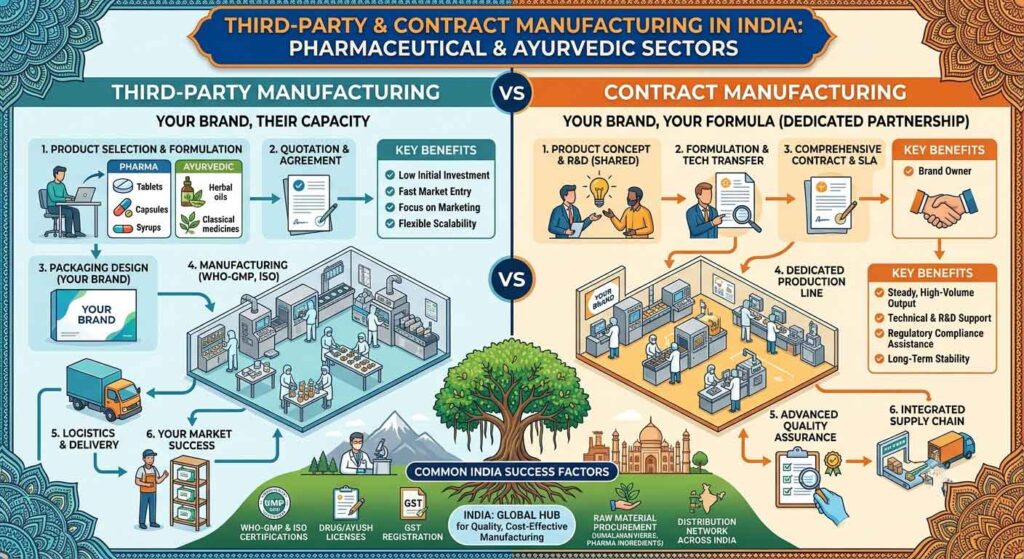
Third-party manufacturing, contract manufacturing, and loan-license manufacturing all describe outsourcing models, but they are not identical. In Indian industry usage, third-party manufacturing usually means a marketer gets products manufactured at a licensed plant under its own brand; contract manufacturing is the broader commercial umbrella covering that outsourcing plus quality, confidentiality, packaging, and service-level commitments; and loan-license manufacturing is the more formal Indian regulatory route where manufacture is carried out in another licensee’s facility under a specific licensing arrangement. In practice, the commercial labels “third-party” and “contract” are often used interchangeably, while “loan license” has distinct legal significance.
For pharmaceuticals, India’s framework is anchored in the Drugs and Cosmetics Act, 1940 and the Drugs Rules, 1945. CDSCO states that manufacture, sale, and distribution are primarily handled by State authorities, while the Central authority handles new drugs, clinical trials, import quality, standards, and coordination; CDSCO also notes that certain specified categories such as blood products, IV fluids, vaccines, and sera are centrally approved. For Ayurvedic, Siddha, and Unani drugs, CDSCO’s “Traditional Drugs” page points to Part XVI of the Rules for manufacture for sale and Part XVII for labeling, packing, and alcohol limits. It also reproduces the statutory definitions of ASU drugs and patent/proprietary medicines.
Operationally, a robust outsourcing model requires much more than a purchase order. It should include commercial and quality agreements, product specifications, approved artwork, sampling plans, master formulae, batch manufacturing and packing records, validation where required, stability commitments, QA release rules, complaint-handling, recall procedures, and clear dispatch documentation. Indicative industry practice from the uploaded operating note shows a typical flow of company setup, licence/GST readiness, molecule and brand selection, quotation, manufacturer selection, artwork approval, advance payment, production, and dispatch, with new products often taking weeks rather than days.
The core commercial advantage of outsourcing is low fixed investment for the marketer: no plant CAPEX, faster launches, and access to dosage-form capabilities you do not own. The core downside is dependence on someone else’s quality system, capacity, and documentation discipline. That is why due diligence on the manufacturer’s licence scope, GMP status, inspection history, QC capability, change-control discipline, and commercial reliability is decisive.
Definitions and business-model differences
In Indian business practice, third-party manufacturing usually means a marketing company or brand owner places an order with a licensed manufacturer, which produces and packs the product under agreed specifications, with the finished pack typically showing “Manufactured by” the plant and “Marketed by” the brand owner.
Contract manufacturing is the wider term. It can include ordinary third-party supply, but it may also include dedicated capacity, product-development support, source-code or formula confidentiality, special packaging, analytical method transfer, private labeling, and agreed service levels on deviations, release, and change control. In other words, third-party manufacturing is often the commercial shorthand; contract manufacturing is the legal-operational framework that should govern it.
Loan-license manufacturing is different because it is not merely descriptive shorthand. In Indian pharmaceutical usage, it refers to manufacturing in another firm’s licensed premises under a formal licensing arrangement recognized by the Drugs Rules. Even when companies casually call a job “loan-license” or “third-party,” the legal consequences depend on the actual licence structure, the dosage form, the product type, and what the state licensing authority has approved. Because terminology is used loosely in the market, agreements should describe the real allocation of responsibility instead of relying only on labels.
For Ayurvedic products, the first threshold question is whether the product is a classical ASU formulation or a patent/proprietary ASU medicine. CDSCO states that ASU drugs are medicines manufactured exclusively in accordance with formulae in the authoritative books listed in the First Schedule, while patent/proprietary ASU medicines are formulations containing only ingredients mentioned in the authoritative books but not being those exact classical formulations, and they exclude parenteral dosage forms. This distinction matters because dossier depth, claims strategy, and licensing scrutiny may differ.
Regulatory framework in India
CDSCO’s official statement of functions is the clearest starting point: regulation of drug manufacture, sale, and distribution is “primarily the concern of the State authorities,” while Central authorities handle new drugs, clinical trials, standards, import quality control, and coordination across states. CDSCO also notes that the DCGI is responsible for approvals in certain categories such as blood and blood products, IV fluids, vaccines, and sera. CDSCO separately maintains a directory of State drug-control websites, which is the practical gateway to manufacturing, wholesale, and related applications state by state.
For pharmaceuticals, the core legal instruments are the Drugs and Cosmetics Act, 1940, the Drugs Rules, 1945, and—where relevant—the New Drugs and Clinical Trials Rules, 2019 hosted by CDSCO on its Acts & Rules pages. For AYUSH drugs, CDSCO’s Traditional Drugs page points specifically to Part XVI for manufacture and Part XVII for labeling/packing/alcohol limits.
The revised Schedule M regime is now a major compliance driver for pharmaceutical manufacturers. Reporting in 2025–2026 describes the revised Schedule M as being aligned to WHO-type GMP expectations and emphasizes cross-contamination prevention, batch testing, and stronger quality systems; by 2026, regulators had moved to full enforcement rather than open-ended extension. For AYUSH plants, GMP compliance is also a licensing expectation in practice, and state enforcement activity shows that state Ayurveda/drug-control authorities are active.
On import/export, DGFT states that an Importer Exporter Code is mandatory for imports and exports, and CDSCO’s import-and-registration division separately handles import/regulatory workflows, including registration/import licences and an export NOC module.
For clinical trials, CDSCO’s Clinical Trial and Ethics Committee portals show that ethics committees must be registered with the Licensing Authority, that registration is valid for three years, and that submissions are routed through SUGAM; CDSCO also lists the NDCTR 2019 rules, GCP guidance, and a 2026 notice on parallel submission and processing by CDSCO and registered ethics committees.
Required licences and authorities
Licence / approval class
Typical applicability
Issuing / supervising authority
Pharmaceutical manufacturing licence
Manufacturer of allopathic drugs
State Licensing Authority under Drugs & Cosmetics framework; CDSCO/CLA involvement for specified categories and central subjects
State authority handling AYUSH/ASU drug manufacture; state structure varies
GMP compliance
Pharmaceutical plants under Schedule M; AYUSH plants under applicable ASU GMP expectations
State licensing/inspection authorities, with CDSCO coordination for pharma
Import registration / import licence
Import of regulated drugs into India
CDSCO import & registration division
IEC
Import/export activity
DGFT
This table is a synthesis of CDSCO’s functions page, state-drug-control directory, Traditional Drugs page, CDSCO import pages, DGFT’s IEC guidance, and state service examples.
Operating procedure from onboarding to dispatch
A practical third-party workflow: choose company name, register the entity, obtain wholesale drug licence where applicable, obtain GST, select molecules and brand names, obtain quotations, choose the manufacturer, provide brand-name / non-resemblance affidavit, provide licence and GST copies, finalize “marketed by” address, approve packing material, pay advance, and then receive dispatch after manufacture. That is a useful commercial sequence, but a compliant operation needs additional GMP and legal controls.
A defensible procedural sequence is:
Commercial and regulatory onboarding. Verify the manufacturer’s licence scope by dosage form, product permissions, GMP status, and recent audit/inspection history. Confirm whether the product is already approved, is a routine generic, a new drug, or an AYUSH classical or patent/proprietary product. Align on “manufactured by” and “marketed by” responsibilities before artwork is drafted.
Agreement package. Sign a master manufacturing agreement plus a separate quality agreement. The agreement should cover exclusivity of brand names, packing-material responsibility, transit insurance, delivery timing, payment terms, market returns due to defects, and termination notice. It should also specify deviations, OOS/OOT handling, change control, analytical responsibility, recall coordination, pharmacovigilance where relevant, data integrity, and audit rights.
Artwork, specs, and materials. Freeze artwork only after regulatory review for labelling language, batch numbering logic, MRP, schedule warnings where applicable, storage conditions, and pack size. The packing-material procurement is often the main early inventory burden and can be managed either by the marketer or the manufacturer.
Execution and release. Material receipt should follow approved vendor qualification, line clearance, in-process controls, batch record execution, reconciliation, sampling, QC testing, deviation closure, and QA release. CDSCO’s strengthened Schedule M enforcement underscores the importance of documented batch testing and quality systems, not just physical production.
Dispatch and post-market controls. Dispatch must include invoice/e-way compliance, transport conditions, COA, and where relevant insurance and cold-chain controls. The uploaded note records common market practice of advance-plus-balance payment, transport at buyer cost unless otherwise agreed, and transit insurance.
Brand owner or marketer
Regulatory and commercial due diligence
Supply agreement and quality agreement
Artwork, specs, BOM, MFR and BMR approval
RM and PM procurement and inward QC
Manufacturing and in-process controls
Finished goods QC and QA release
Dispatch with invoice, COA and transport controls
Distributor or stockist
Market complaints, returns, CAPA and recall loop
Technical setup, documentation, and inventory control
A marketer using third-party manufacture does not need to own a plant, but the manufacturer must have dosage-form-appropriate premises, utilities, equipment, validated processes, and QC capability. Revised Schedule M enforcement has raised expectations around contamination control, batch testing, and quality systems.
Typical machinery by dosage form
Dosage form
Typical core equipment
Tablets
Sifter, blender, granulator or RMG, dryer, mill, compression machine, deduster, metal detector, blister/strip packer
This checklist is representative rather than mandatory word-for-word regulation. It reflects standard dosage-form process architecture, while Schedule M requires appropriate premises, equipment, and quality systems for the licensed operation.
Documentation checklist
Document set
Purpose
Manufacturing licence, wholesale licence, GST, IEC if applicable
Legal operating authority
Product permission / product list / ASU category classification
Scope of lawful manufacture
Master formula record and batch manufacturing / packing record
Controlled batch execution
SOPs for production, QC, QA, warehouse, deviations, change control, recall
Controlled operations
Raw material specs, vendor approvals, inward QC reports
Inventory in outsourced manufacturing is where many new firms fail. The initial inventory often gets trapped in packing material, especially for low-MRP SKUs. Best practice is to qualify vendors, define MOQ and lead times, rotate on FEFO/FIFO, hold safety stock only for true risk items, and separately monitor temperature-sensitive SKUs. DGFT’s import framework and CDSCO’s import workflow become relevant if APIs, packaging, or finished goods are imported.
Inventory KPI table
KPI
Why it matters
Practical trigger
On-time vendor delivery
Protects batch schedule
<95 percent requires vendor review
RM rejection rate
Measures supplier quality
>2–3 percent sustained trend
Packing material ageing
Prevents dead stock
Review every month by expiry/obsolescence
FEFO compliance
Reduces expiry loss
Zero tolerance for expired issue
Days of cover
Balances stockout vs cash lockup
SKU-specific by lead time
Safety stock
Buffers critical items
Use only for variable-demand or long-lead items
Batch release cycle time
Cash conversion and service level
Track from production end to QA release
Expiry / slow-moving percentage
Working capital leakage
CAPA if above internal threshold
Economics, timelines, risks, and practical tools
For the marketer, third-party manufacturing is mainly a working-capital model: entity formation, licences, artwork, packing material, initial stock, testing, freight, and receivables. For the manufacturer, CAPEX is much higher and highly dosage-form dependent; official Indian sources do not publish a standardized “normal” investment figure because costs vary sharply with scale, automation, utilities, cleanroom needs, and validation depth. For AYUSH plants, a 2025 Gujarat industry report quoted a minimum investment of about ₹10 crore for a good Ayurvedic plant, which is directionally useful but not a regulatory benchmark.
Indicative third-party manufacturing timelines are often 30–45 days for a new product and 25–35 days for repeat orders, with key drivers being product approval, packing material, manufacturing, and transport. Those timings are approx., but real projects can stretch due to artwork review, vendor delays, microbiology/QC turnarounds, audit observations, and payment holds.
The most common compliance failures are predictable: using a manufacturer whose licence does not actually cover the dosage form; weak or missing quality agreement; artwork errors; unapproved changes to source or process; inadequate stability support; ambiguous market-complaint ownership; and buying too much printed packing material too early. CDSCO’s recent push on Schedule M and active state enforcement on both pharma and AYUSH underscore that shortcuts create regulatory and commercial risk.
Suggested contract clauses
Use these as a starting matrix, not as legal advice:
scope of products and dosage forms;
IP and trademark ownership; approved specifications and test methods;
batch records and retained samples;
deviations/OOS/OOT/CAPA handling;
change control requiring prior written approval;
release and COA responsibility;
complaint and recall procedure;
market return policy;
audit rights;
confidentiality;
MOQ,
Payment
lead time,
yield and reconciliation;
pricing/tax/freight/insurance;
indemnity;
force majeure;
termination and inventory disposition.
Due-diligence contact checklist for selecting a contract manufacturer
Copy of manufacturing licence with product/dosage-form scope
Recent GMP / inspection status and any major observations
Product permissions and sample artwork for similar SKUs
QC and microbiology capability, outsourced tests if any
Stability program and retain-sample practices
Capacity, lead times, MOQ, and current line loading
Change-control, deviation, and recall SOP summaries
If you are launching as a marketer, first decide whether you need a pharmaceutical pathway or an AYUSH pathway, then shortlist manufacturers by dosage form and licence scope, not by price alone. If you are setting up a manufacturing unit, start with the regulatory map and utilities/quality-system design before you buy machinery. If you are testing a new product concept, determine early whether the product is an already-permissible generic/classical ASU product or whether it triggers new-drug, clinical, or additional evidence requirements.
FAQ
Is third-party manufacturing legal in India? Yes, provided the product is manufactured in a duly licensed facility and the commercial/regulatory arrangement matches the applicable law and licence structure.
Do I need my own manufacturing licence to launch a branded pharma product? Not necessarily if you are outsourcing manufacture, but you will typically still need the right state-level sale/distribution permissions for how you market and distribute the product. The exact structure depends on the product and business model.
For AYUSH, what is the first regulatory classification question? Whether the product is a classical ASU formulation or a patent/proprietary ASU medicine.
Do routine third-party products require clinical trials? Not as a default for standard already-approved products. Clinical-trial obligations arise mainly in new-drug / evidence-generating contexts, and ethics committees must be registered under the CDSCO framework.
What inventory usually locks the most cash in outsourced manufacturing? Printed packing material is often the biggest early trap, especially for low-MRP SKUs or many small launches.
What is the single biggest mistake in selecting a manufacturer? Choosing on rate alone instead of verifying licence scope, quality-system maturity, documentation discipline, and actual release capability.
Partner with Elzac Herbal India
Looking to start an Ayurvedic franchise, become a distributor, or launch your own herbal product range?
Elzac Herbal India offers:
Ayurvedic & Herbal Product Range
Franchise & Distribution Opportunities
Third-Party Manufacturing Services
Product Development Support
Marketing Guidance
PAN India Business Opportunities
Whether you are an entrepreneur, retailer, distributor, or healthcare professional, our team can help you explore the right business opportunity in the growing Ayurvedic sector.
Ajay Kamboj is an entrepreneur and business owners associated with many Ayurvedic and Pharmaceutical start-ups. With years of experience in Ayurvedic product marketing, pharmaceutical distribution, franchise development, and client relationship management, he regularly shares practical business insights based on real-world experiences. His articles focus on business growth, entrepreneurship, customer management, and lessons learned from the healthcare and wellness industry.
7 responses to “Third-Party and Contract Manufacturing in the Pharmaceutical and Ayurvedic Sectors in India”
I want to launch a pharma marketing company with the help of any third party manufacturer .i want to know how can i launch and how much money is required??
IF COMPANY REGISTER ADDRESS AND D.L.No. address are different place, for 'marketed by" address which address manufacturer print on strips/bottle etc. either D.L. OFFICE ADDRESS OR COMPANY REGISTER ADDRESS
Will i have to develope the product formulation before getting it manufactured by the third party or i can simply use the formulations which are in use by the major pharma players??
How do I procure Whole SaleDrug License and could you suggest us any website where the norms and procedures are mentioned? This article was helpful. Thanks a lot.
Dear sir,
I want to know that how I can get for approval for marketing by my firm name if I manufacture my product by third party. Is there any need for approval for marketing purposes



I want to launch a pharma marketing company with the help of any third party manufacturer .i want to know how can i launch and how much money is required??
IF COMPANY REGISTER ADDRESS AND D.L.No. address are different place, for 'marketed by" address which address manufacturer print on strips/bottle etc. either D.L. OFFICE ADDRESS OR COMPANY REGISTER ADDRESS
Will i have to develope the product formulation before getting it manufactured by the third party or i can simply use the formulations which are in use by the major pharma players??
How do I procure Whole SaleDrug License and could you suggest us any website where the norms and procedures are mentioned? This article was helpful. Thanks a lot.
I am genuinely thankful to the holder of this web page who has shared this
great paragraph at at this place.
Some truly nice and utilitarian information on this web site, as well I conceive the style contains excellent features.
Dear sir,
I want to know that how I can get for approval for marketing by my firm name if I manufacture my product by third party. Is there any need for approval for marketing purposes