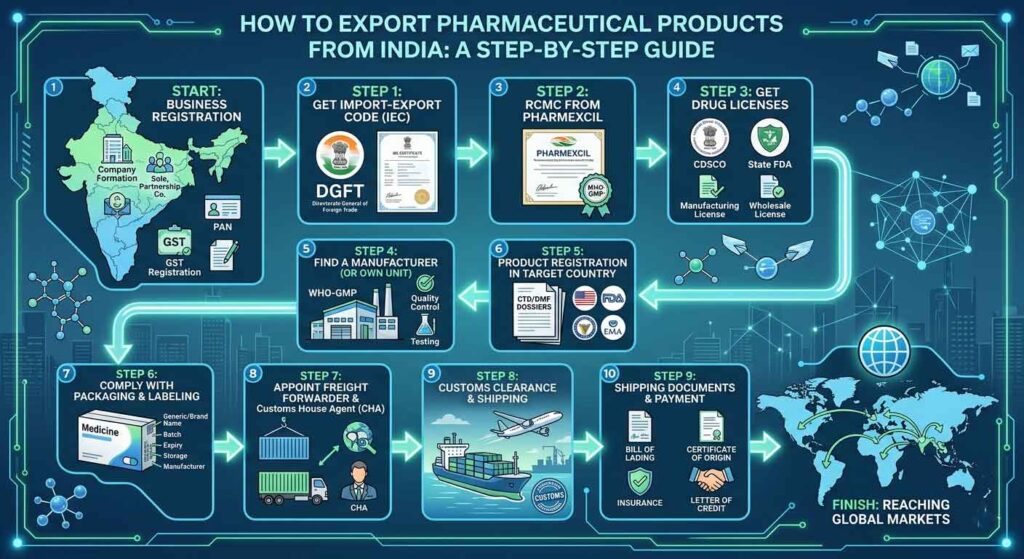
Exporting medicines from India can be a lucrative business opportunity, but it requires careful compliance with both Indian export regulations and the importing country’s requirements. Below is a comprehensive guide covering the key steps, licenses, documentation, and regulatory considerations you need to know.
1. Set Up Your Company and Obtain Basic Registrations
Register your business: Incorporate your company as a Private Limited, LLP, or other legal entity in India.
GST Registration: Even though exports are zero-rated, GST registration is mandatory for taxation purposes and to claim refunds or benefits.
Drug Licenses:
If you’re trading pharmaceuticals, obtain a Wholesale Drug License (Form 20/21) from the State Drug Controller.
If you plan to manufacture products (including via third-party manufacturers), obtain a Manufacturing License (Form 25/28 or 28D) under the Drugs & Cosmetics Act.
Ensure any facility you use (including contract manufacturers) holds valid state manufacturing licenses and follows Good Manufacturing Practices (GMP) standards.
These steps ensure your business is legally recognized and permitted to handle pharmaceutical products.
2. Obtain an IEC (Import-Export Code)
Import-Export Code (IEC): This is a mandatory registration issued by the DGFT. Every exporter in India must have an IEC before exporting any goods.
Apply through the DGFT portal for your jurisdiction. The IEC is a lifetime code needed for customs clearance on exports.
Without an IEC, you cannot proceed with export shipments.
3. Prepare Products and Documentation for Export
3.1 Product Compliance and Quality Certifications
WHO-GMP Certification: While not legally mandatory for all exports, having a WHO-GMP certificate for your manufacturing facility is highly recommended. Many importers and regulators (e.g. African countries, GCC) expect it. It demonstrates that your products meet international quality standards.
USFDA/EU Approvals: If targeting stringent markets (US, EU, Canada, Japan), ensure your manufacturing site is inspected/registered with those authorities. For example, US FDA registration of the facility and listing of the product may be required, though exporting unapproved drugs to the US often requires an approved New Drug Application (NDA) or compliance with FDA regulations.
Product Specifications: For each medicine, have ready:
Certificate of Analysis (CoA): A batch-specific lab certificate showing compliance with pharmacopeial standards.
Quality Test Reports: Issued by NABL-accredited labs for each batch (active ingredients, impurities, dissolution, etc.).
Packaging with Barcodes: As per DGFT rules, all export pharmaceutical products must have barcoding for traceability (2D barcodes with GTIN, batch, expiry, serial) on secondary/tertiary packs. The human-readable details (batch, Mfg/exp date) must appear on primary packs too. This “track and trace” system helps trace every package through the supply chain.
WHO Guidelines for Packaging: Follow WHO Annex 9 guidelines on packaging. In practice, this means using moisture- and tamper-proof materials, labeling with drug name, dosage, batch, Mfg and expiry dates, storage conditions (e.g. “Store at 2–8°C” if needed), and using labels that remain legible throughout the product’s shelf life. For temperature-sensitive products, use refrigerated (cold chain) packing and indicate this on the package.
3.2 Regulatory Approvals in India
Export NOC (No Objection Certificate):
As of early 2026, India is eliminating the requirement of an export NOC for shipments to SRA countries (countries with stringent regulators like US, UK, EU, Japan, Canada, Australia). For these destinations, you can simply notify the DCGI’s (Drug Controller General of India’s) system online and get an auto-acknowledgement instead of a manual NOC.
For other destinations, you may still need to obtain an Export NOC or Certificate of Pharmaceutical Product (CPP) from CDSCO. The CPP is the WHO-recommended certificate that attests your product is registered (or at least manufactured) according to Indian regulations. You can apply for CPP/CoPP online via the CDSCO SUGAM portal.
Certificate of Pharmaceutical Product (CPP/CoPP): Most importing countries require a CPP (sometimes called Certificate of Export). This is based on the WHO Model Certificate format and issued by the DCGI’s office. It establishes the status of the product in India and often the GMP compliance. A valid CPP is typically required for each product you export.
Product Registration in Importing Country: Indian law does not mandate this, but practically, many importers require that your products be registered or approved by their local health authorities. For example, importing into African nations may require registration with that country’s drug authority or a registration via a local agent. For Europe, you need an EU marketing authorization (through a local partner). For the US, an importer must hold an FDA-approved ND or ANDA. Always verify the target country’s requirements and handle registrations before export.
3.3 Agreements with Manufacturers or Suppliers
If you are trading (not manufacturing), enter a contract with a manufacturing firm who will supply products for export under your brand. Ensure the contract covers:
Compliance with export packaging (barcodes, labeling) and quality control.
Ownership of trademarks and marketing rights (you should own your brand via trademark registration).
Contingencies if the manufacturer’s products fail standards or deliveries.
4. Identify Export Markets and Buyers
Market Research: Determine which countries have demand for your type of products. Indian generics are in high demand in Africa, South America, CIS, and Asia. Highly regulated markets (US, EU, Canada) require strict compliance, but offer higher prices. Emerging markets (Africa, Middle East, Latin America) often have fewer entry barriers for generics.
Trade Fairs and B2B Portals: Participate in pharma trade shows (e.g. CPhI Worldwide) and use global trade portals (Global Sources, pharmafranchisehelp.org) to connect with international buyers. Form partnerships with local distributors who understand their country’s regulations.
Contracts and Incoterms: Once you find a buyer, sign a purchase contract or proforma invoice specifying terms. Decide on incoterms (e.g. FOB, CIF) and payment terms (typically Letter of Credit, Advance TT, or Documentary Collections). Clear terms prevent misunderstandings at customs and payment.
5. Complete Export Documentation and Customs Clearance
Prepare the following core documents for each shipment:
Commercial Invoice: Must list exporter/importer details, product description, HS code, quantity, unit price, total value, currency, and payment terms.
Packing List: Details the contents of each package or container.
Bill of Lading or Airway Bill: Issued by the shipping or airline company.
Shipping Bill: The official customs export declaration. In India, this is filed online via ICEGATE. Use Shipping Bill – Export (you’ll need your IEC, invoice, packing list, etc.).
Export License (if applicable): Indian pharma exports of non-controlled substances typically don’t need a separate DGFT export license, but check if any items are restricted.
Certificate of Origin: Often required by customs or the buyer (obtainable from a Chamber of Commerce).
Certificate of Pharmaceutical Product (CPP): As discussed, issued by CDSCO.
Export NOC/CoPP (if required): If exporting to non-SRA countries or if product is not on Indian market, include the CDSCO Export NOC or proof of application/acknowledgement.
Bill of Exchange/Letter of Credit: Financial documents for payment (one copy if LC is used).
Insurance Certificate: If shipment is insured (recommended).
Other Certificates: Some countries require fumigation certificates (for wooden crates), or other sanitary/phytosanitary certificates (usually not for pharmaceuticals, but check if any ingredients are controlled like plant extracts requiring CITES/Wildlife NOC).
HS Code: Classify your product under the correct 8-digit ITC (HS Code). Pharmaceutical products generally fall under Chapter 30 of the ITC(HS). For example, paracetamol tablets might use code 30049011 (subject to change, verify current codes). Proper HS code classification ensures correct duties or duty-exempt status.
Barcode Documentation: Keep records of your barcode numbering system (GS1 certificates) in case customs inquire about product traceability.
At export clearance:
Submit the Shipping Bill and all documents to the Customs House.
Customs may examine the consignment and documents. Once cleared, they will provide a Let Export Order (LEO) and endorse the Shipping Bill with an export permit number.
Three copies of the Shipping Bill are printed: for exporter, for customs, and for RBI (via bank).
After Customs:
Forward the shipment via the nominated carrier.
Send the final documents (Bill of Lading, invoice, Packing List, certificates, LEO copy) to your buyer’s agent for release at destination.
Remember: Always maintain a file with copies of all export documents for at least five years, as regulatory authorities may audit export compliance.
6. Post-Export Compliance
Reserve Bank Reporting: For foreign exchange regulations, report the export shipment to RBI through the EEFC (Electronic Export) system. If payment is via Letter of Credit, your bank will file the required export proceeds realization.
GST Refunds: Claim IGST or GST refunds if any taxes were paid, under an LUT (Letter of Undertaking) or bond. Exports from India are zero-rated, meaning taxes paid on inputs can be refunded.
Quality Feedback: Keep communication with your buyer open. Address any quality complaints promptly. Good after-sales support encourages repeat orders.
7. Key Points and Tips
Regulatory Updates: Regulations can change. For example, in 2026 India eased rules by removing the mandatory Export NOC for exports to major regulated markets. Always verify current CDSCO and DGFT notifications.
Packaging Requirements: Ensure compliance with both Indian and destination labelling laws. Some countries may require labelling in English or local language and specific formats.
Tariff and Duties: India usually imposes no export duty on pharmaceutical products (Schedule 2 – Chapter 30). However, the import duty and local taxes of the destination country should be checked.
Insurance: Always insure your shipments (marine insurance for sea freight) to cover loss or damage in transit.
Working Capital: Export payments often involve longer credit. Use secure payment methods (confirmed LC) to manage risk.
Record-keeping: Maintain meticulous records of contracts, shipments, and payments to ensure compliance and for future audits.
References
Indian DGFT Public Notice on Track-and-Trace Barcoding for Exports
Export licensing requirements (IEC, Drug License, NOC, GST)
Ease-of-doing-business update: No Export NOC required for SRA countries
These resources provide official guidance on Indian export rules and illustrate the paperwork and processes involved in pharmaceutical exports.
Partner with Elzac Herbal India
Looking to start an Ayurvedic franchise, become a distributor, or launch your own herbal product range?
Elzac Herbal India offers:
Ayurvedic & Herbal Product Range
Franchise & Distribution Opportunities
Third-Party Manufacturing Services
Product Development Support
Marketing Guidance
PAN India Business Opportunities
Whether you are an entrepreneur, retailer, distributor, or healthcare professional, our team can help you explore the right business opportunity in the growing Ayurvedic sector.
Ajay Kamboj is an entrepreneur and business owners associated with many Ayurvedic and Pharmaceutical start-ups. With years of experience in Ayurvedic product marketing, pharmaceutical distribution, franchise development, and client relationship management, he regularly shares practical business insights based on real-world experiences. His articles focus on business growth, entrepreneurship, customer management, and lessons learned from the healthcare and wellness industry.
4 responses to “How to Export Pharmaceutical Products from India: A Step-by-Step Guide”
I am Msc Chemistry degree holder and work in one pharma company, can I start my own pharma export company and how much capital required for it? What is procedure for that?
Recently, I have secured an order to supply some ayurvedic and medical products to Bangladesh. It seems I have to do the product registration (SVC/PRC) in Bangladesh with the Ministry of Health in that country as a first step. I am reaching out to you to know if you will be able to render this type of service or if you can direct me to a registered agent who can do the registration process on my behalf. Please advise ASAP.




How to sell your products outside India?
By this mean can we export pharma products at any country
I am Msc Chemistry degree holder and work in one pharma company, can I start my own pharma export company and how much capital required for it? What is procedure for that?
Hello Sir/Madam,
Recently, I have secured an order to supply some ayurvedic and medical products to Bangladesh. It seems I have to do the product registration (SVC/PRC) in Bangladesh with the Ministry of Health in that country as a first step. I am reaching out to you to know if you will be able to render this type of service or if you can direct me to a registered agent who can do the registration process on my behalf. Please advise ASAP.
Thank you for your time and consideration.
Best regards,
Arvind Manohar