A trademark is one of the most valuable intellectual-property assets of a business.
It can protect the identity under which a business sells or promotes its:
Products
Services
Company brands
Product brands
Logos
Taglines
Packaging identifiers
For pharmaceutical, Ayurvedic, cosmetic, nutraceutical and healthcare businesses, trademark clearance should ideally be completed before:
Finalizing the company brand
Applying for product approval
Printing packaging material
Placing a manufacturing order
Appointing distributors
Launching advertisements
Creating a website or social-media presence
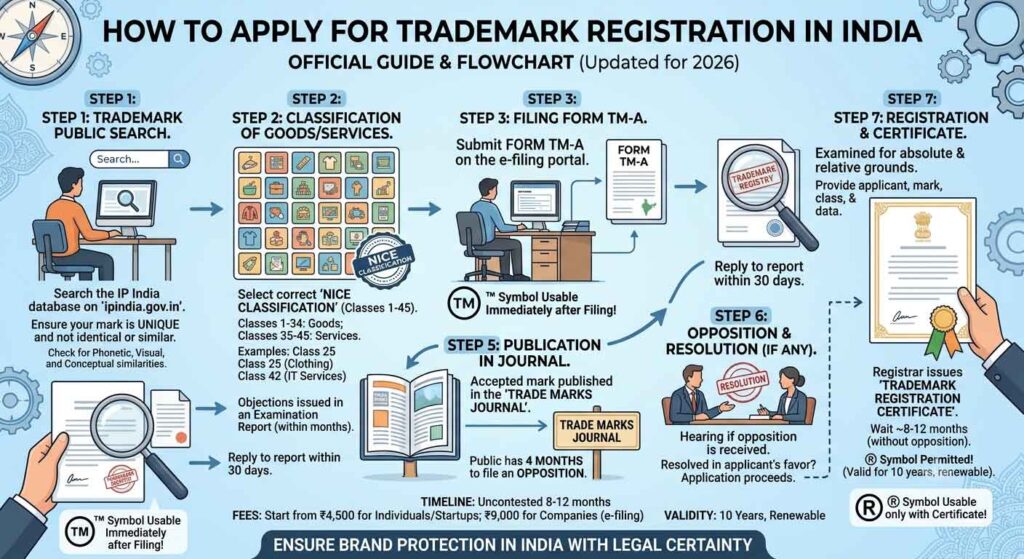
The basic procedure is:
Select the mark → Identify the owner → Select the correct class → Conduct availability searches → Prepare Form TM-A → File the application and pay the fee → Respond to examination objections → Complete hearing, where required → Obtain journal publication → Defend opposition, where filed → Receive registration → Renew every ten years
Trademark registration in India is governed principally by:
Trade Marks Act, 1999
Trade Marks Rules, 2017
Current notifications and Registry procedures
What Is a Trademark?
A trademark is a mark capable of distinguishing the goods or services of one person from those of another.
A trademark may consist of:
Word
Name
Brand
Signature
Letter
Numeral
Logo
Label
Device
Packaging
Shape of goods
Combination of colours
Combination of these elements
For example, a pharmaceutical business may have:
A company or house brand
Individual medicine brands
Division names
Logos
Product-series names
Healthcare-service brands
Each may require separate protection depending on how it is used.
Trademark, Trade Name and Company Name
These terms are related but different.
Company Name
A company name is registered through the corporate-registration process.
Example:
ABC Healthcare Private Limited
Company incorporation allows the entity to operate under that legal name, but it does not necessarily grant complete trademark protection for the brand.
Trade Name
A trade name is the commercial name under which a business operates.
Example:
ABC Healthcare
Product Trademark
A product trademark identifies a specific product or product range.
Example:
ABC-LIV Syrup
Logo Trademark
A logo registration protects the mark in its submitted visual form.
Registering a company with the Ministry of Corporate Affairs does not automatically replace trademark registration. Trademark rights and company-name approval operate under different legal frameworks.
What Can Be Registered?
Subject to legal requirements, registration may be sought for:
Company brand
Product brand
Logo
Tagline
Device mark
Label
Shape mark
Colour combination
Service brand
Collective mark
Certification mark
Series mark
The mark must be capable of distinguishing the applicant’s goods or services.
Marks That Commonly Face Refusal
A mark may face objection where it is:
Descriptive
Generic
Common to the trade
Devoid of distinctive character
Misleading
Prohibited by law
Identical to an earlier mark
Deceptively similar to an earlier mark
Likely to cause public confusion
Contrary to morality or public order
Connected with protected emblems or names
An International Non-Proprietary Name
Section 9 of the Trade Marks Act deals with absolute grounds such as lack of distinctiveness, descriptive character and customary trade expressions.
Special Care for Pharmaceutical Trademarks
Pharmaceutical trademarks require a more careful search than many ordinary consumer brands.
Confusion between two medicine brands can potentially result in:
Incorrect dispensing
Incorrect dosage
Use of the wrong active ingredient
Patient injury
Serious medical consequences
A pharmaceutical brand should therefore be checked for similarity in:
Appearance
Pronunciation
Spelling
Prefix
Suffix
Syllables
Overall impression
Product category
Therapeutic use
Do not assume that changing one letter makes a medicine brand safe.
International Non-Proprietary Names
A pharmaceutical mark should not be identical or deceptively similar to an International Non-Proprietary Name, commonly called an INN.
INNs identify pharmaceutical substances internationally and are intended for public use rather than private ownership.
The Trade Marks Act prohibits registration of notified INNs and marks deceptively similar to them. IP India maintains an official INN resource for trademark searches.
Before finalizing a medicine brand, search:
Exact INN
INN stem
Similar chemical or generic name
Phonetic variations
Existing pharmaceutical brands
Who Can Apply for a Trademark?
An application may be filed by a person or entity claiming to be the proprietor of the mark, including:
Individual
Proprietorship
Partnership firm
LLP
Private Limited Company
Public Limited Company
Startup
Small enterprise
Trust
Society
Foreign applicant
The application may be filed directly or through a registered trademark agent or attorney.
Correct Ownership Is Important
The applicant should be the person or entity that genuinely owns or intends to own and control the mark.
For example:
A proprietorship mark may be filed in the proprietor’s name trading under the business name.
A partnership mark may be filed in the name of the partnership firm.
A company mark should normally be filed in the company’s legal name.
A promoter filing before incorporation should consider how ownership will later be assigned to the company.
Incorrect applicant details can create difficulties during:
Examination
Enforcement
Investment
Assignment
Company restructuring
Brand sale
Licensing
Word Mark vs Logo Mark
Word-Mark Application
A word-mark filing protects the submitted word or name without limiting it to a particular logo design, subject to the registration granted.
This is usually the most important filing where the commercial value lies mainly in the name.
Logo or Device Application
A device-mark application protects the submitted graphical representation.
It may include:
Font
Symbol
Shape
Graphic
Colour arrangement
Stylized lettering
Should Both Be Filed?
Where the budget permits and both the name and logo are commercially important, separate applications may be considered for:
The word mark
The logo or device mark
One application should not be assumed to give the broadest possible protection to every future variation of a logo.
Trademark Classes
Trademark protection is granted for specified goods or services.
The Nice Classification contains:
Classes 1–34 for goods
Classes 35–45 for services
Choosing the correct class and accurately drafting the specification are essential.
Classes Commonly Relevant to Healthcare Businesses
Activity or product
Commonly relevant class
Pharmaceutical preparations
Class 5
Ayurvedic and medicinal herbal preparations
Class 5
Veterinary medicines
Class 5
Dietary supplements
Class 5
Medicated shampoo, soap or toothpaste
Class 5
Non-medicated cosmetics
Class 3
Non-medicated shampoo and personal-care products
Class 3
Medical devices and instruments
Class 10
Retail and wholesale store services
Class 35
Advertising and business-promotion services
Class 35
Pharmaceutical research and development
Class 42
Medical-clinic and healthcare services
Class 44
Pharmaceutical contract-manufacturing services
Class 40 may be relevant
Food and beverage products
Product-specific Classes 29, 30, 32 or others
Class 5 principally includes pharmaceutical, medical and veterinary preparations and dietary supplements. Class 35 includes advertising, business-management and retail or wholesale outlet services.
Important Correction About Class 35
Class 35 is not automatically the class for every company name.
The class is selected according to the goods or services for which the mark is used.
For example:
Pharmaceutical Manufacturer Using Its Brand on Medicines
The important goods registration will generally be in:
Class 5
Pharmaceutical Wholesale or Retail Service Brand
Protection for retail or wholesale services may be sought in:
Class 35
Company Manufacturing Medicines and Operating an Online Store
It may consider:
Class 5 for medicines
Class 35 for online retail, wholesale or distribution services
The correct classes depend on actual and intended commercial use.
Single-Class and Multi-Class Applications
An application may cover one or more classes.
However:
The fee is charged for each class.
Goods and services must be described separately for each class.
Opposition or objection in one class can complicate a multi-class application.
The applicant should not claim unnecessarily broad goods or services.
The Rules permit one application for a mark covering multiple classes, but the class fee applies separately to each class.
Proposed to Be Used vs Prior Use
A trademark application may be filed as:
Proposed to Be Used
Choose this where the applicant has not yet used the mark but genuinely intends to use it.
Used Since a Particular Date
Choose this where the mark was already being used before filing.
When prior use is claimed, the applicant must file a user affidavit and supporting evidence.
Evidence of Prior Use
Possible evidence includes:
Sales invoices
Purchase orders
Advertisements
Product packaging
Printed brochures
Website records
Social-media promotion
Distributor agreements
GST invoices
Trade-fair records
Transport documents
Drug-licence or product-approval records showing the mark
Evidence should connect:
The mark
The claimed applicant
The relevant goods or services
The claimed date
Do not claim an old use date without adequate evidence.
Trademark Search
A trademark search should be conducted before:
Company incorporation
Product approval
Packaging design
Printing
Manufacturing
Product launch
IP India provides an official public-search facility. The search system includes wordmark, phonetic and device or Vienna-code search functions.
Types of Search
Wordmark Search
Search the exact mark and variations.
Example:
ELZAC
EL-ZAC
ELZAK
ELZAC HERBAL
ELZAC HEALTH
Phonetic Search
A phonetic search helps identify marks that sound similar even where the spelling differs.
For pharmaceutical brands, phonetic search is particularly important.
Vienna-Code Search
A logo containing a visual device may need a Vienna Classification search.
Examples include:
Leaf
Human figure
Sun
Shield
Animal
Medical cross
Plant
Geometric shape
Search in Related Classes
Do not search only one class without considering the business.
For a healthcare brand, relevant searches may include:
Class 5 for medicines
Class 3 for cosmetics
Class 10 for medical devices
Class 35 for retail or wholesale services
Class 44 for medical services
However, every applicant does not need to file in all these classes.
Search Is Not a Guarantee
A public search reduces risk but does not guarantee registration.
The Registry may still identify:
Similar pending applications
Similar registered marks
Well-known marks
Descriptive objections
Prohibited marks
Earlier rights not easily identified
Common-law use by another business
A professional clearance search may examine more than exact online matches.
Documents and Information Required
A basic trademark application generally requires:
Applicant Information
Legal name
Entity type
Nationality
Complete address
Email
Mobile number
Trademark Information
Word mark or logo
Clear image of device mark
Description where necessary
Translation or transliteration
Colour claim where applicable
Goods and Services
Correct class
Clear specification
Business activities covered
Use Information
Proposed-to-be-used status, or
Prior-use date
User affidavit and evidence where prior use is claimed
Authorization
Where an agent or attorney files the application:
Authorization or power of attorney
Agent details
Fee-Category Evidence
Where a reduced fee is claimed as a:
Startup
Small enterprise
the applicable supporting status document should be retained and submitted as required.
IP India’s current filing guide identifies applicant details, mark representation, specification, user affidavit where applicable and power of attorney where an agent is used as key filing documents.
Translation and Transliteration
Where the mark contains a word in a language other than English or Hindi, the application may need:
Translation into English
Transliteration in Roman characters
Language identification
Example:
A Sanskrit, Arabic, Urdu, Punjabi or regional-language word should be correctly translated and transliterated.
Government Fee for Form TM-A
As of August 2026, the official application fee is:
Applicant category
E-filing fee
Physical filing fee
Individual, startup or small enterprise
₹4,500
₹5,000
All other applicants
₹9,000
₹10,000
The fee applies per mark, per class.
Fee Example
Suppose a private limited company that is not eligible for the startup or small-enterprise concession applies for:
One word mark
In Class 5
Through e-filing
Government fee:
₹9,000
If it applies for the same mark in Classes 5 and 35:
₹9,000 × 2 = ₹18,000
If it separately applies for both the word mark and logo in two classes:
2 marks × 2 classes × ₹9,000 = ₹36,000
Professional-search, drafting, reply, hearing and legal fees are additional.
How to File the Application
A new trademark application is filed in:
Form TM-A
The general e-filing procedure is:
Create or access the applicant or agent account.
Select Form TM-A.
Enter applicant details.
Enter the trademark.
Select the class.
Draft the goods or services specification.
Declare use status.
Upload supporting documents.
Complete authentication required by the portal.
Pay the prescribed fee.
Save the application number and electronic receipt.
The official workflow confirms that new applications are filed in Form TM-A after class selection, document preparation and payment through the e-filing system.
Application Number
After successful filing, the electronic system provides an acknowledgement or receipt with an application number.
The application number should be used to:
Track status
View correspondence
File replies
Attend hearings
Monitor publication
Verify registration
There is no need to state that the number will necessarily take three working days.
Common Application Statuses
An application may show statuses such as:
New Application
Send to Vienna Codification
Formalities Check Pass
Formalities Check Fail
Marked for Examination
Objected
Accepted and Advertised
Advertised Before Accepted
Opposed
Registered
Refused
Abandoned
Withdrawn
The meaning of each status should be checked before taking action.
Examination of the Application
The Registry examines the application and searches earlier pending and registered marks.
Possible outcomes include:
Accepted without objection
Examination report issued
Acceptance subject to conditions
Hearing required
Refusal
Under Rule 33, where an examination report is issued, the applicant generally has one month from receipt to respond. Failure to respond may cause the application to be treated as abandoned.
Common Examination Objections
Section 9 Objection
Section 9 concerns absolute grounds for refusal.
Examples include:
Descriptive mark
Generic mark
Non-distinctive mark
Customary expression
Deceptive indication
Prohibited matter
Example:
“Best Cough Medicine”
for a cough medicine may be considered descriptive and promotional rather than distinctive.
Consent or coexistence material, where legally appropriate
Limitation of specification
The reply should address every objection individually.
Trademark Hearing
Where the written reply does not satisfy the Examiner, a show-cause hearing may be scheduled.
At the hearing, the applicant or representative may present:
Legal arguments
Case law
Use evidence
Market evidence
Product evidence
Distinguishing factors
After the hearing, the Registrar may:
Accept the application
Accept it with limitations
Require an amendment
Refuse the application
Objection vs Opposition
This distinction is important.
Point
Objection
Opposition
Raised by
Trade Marks Registry
A third party
Stage
Examination stage
After journal publication
Main form
Examination reply; TM-M where applicable
TM-O
Common grounds
Sections 9 and 11
Earlier rights and other legal grounds
Nature
Administrative examination
Contested legal proceeding
What Is a Trademark Objection?
An objection is raised by the Registry during examination.
It is not normally filed by a third party.
A third party may own the earlier mark cited by the Examiner, but the examination objection itself is issued by the Registry.
What Is Trademark Opposition?
After acceptance, the application is published in the Trade Marks Journal.
Any person may file a notice of opposition in Form TM-O within four months from the publication or re-publication date.
Common grounds include:
Earlier registered mark
Earlier use
Passing-off rights
Deceptive similarity
Bad-faith filing
Lack of distinctiveness
Prohibited matter
Copyright claim
Well-known trademark rights
Opposition Procedure
The general process includes:
Notice of opposition in Form TM-O
Service on the applicant
Counterstatement by the applicant
Opponent’s evidence
Applicant’s evidence
Reply evidence, where applicable
Hearing
Decision
The applicant must generally file the counterstatement in Form TM-O within two months of receiving the opposition. Failure to do so can result in abandonment of the application.
Opposition Fee
The current e-filing government fee for a notice of opposition or counterstatement is:
₹2,700 per class
The physical filing fee is:
₹3,000 per class.
Professional legal fees are additional.
Publication in the Trade Marks Journal
Where an application is accepted, it is advertised in the Trade Marks Journal.
The journal publication allows third parties to review and oppose the mark.
If:
No opposition is filed within the prescribed period, or
An opposition is filed but dismissed,
the application may proceed to registration, subject to other legal requirements.
Trademark Registration Certificate
After registration, the applicant becomes the registered proprietor for the approved:
Mark
Class
Goods or services
Conditions and limitations
Registration provides the exclusive statutory right to use the mark in relation to the registered goods or services, subject to the Act and any limitations recorded in the register.
Validity of Registration
A trademark registration is valid for:
Ten years from the date of application
It may be renewed indefinitely for further periods of ten years.
Trademark Renewal
Renewal is filed in:
Form TM-R
A renewal request may be filed up to one year before expiry.
The current e-filing renewal fee is:
₹9,000 per class
The physical filing fee is:
₹10,000 per class.
Late Renewal and Restoration
Where renewal is missed:
Late renewal with surcharge may be available within six months after expiry.
Restoration and renewal may be requested within the applicable period, generally within one year from expiry.
Additional government fees apply.
Businesses should maintain a trademark-renewal calendar rather than relying only on Registry notices.
TM, SM and ® Symbols
TM Symbol
The TM symbol is commonly used to indicate that the user claims the word or device as a trademark.
It does not by itself prove that:
An application has been filed.
The mark has been accepted.
The mark is registered.
It may be used before registration, but it should not be represented as proof of government approval.
SM Symbol
The SM symbol means service mark in general commercial usage.
It may be used for service-related brands, although Indian trademark law generally uses the broader term “trademark” for both goods and services.
Registered Symbol: ®
The ® symbol should be used only after the mark is actually registered and only in relation to goods or services covered by that registration.
Falsely representing an unregistered mark as registered is prohibited under Section 107 of the Trade Marks Act.
Can the Mark Be Used While the Application Is Pending?
Yes, the applicant may generally continue using the mark while the application is pending, but filing does not guarantee registration or establish that the mark is free from third-party rights.
Use may still expose the applicant to:
Opposition
Passing-off action
Infringement proceedings
Packaging loss
Product recall
Rebranding expenses
This is why clearance should occur before a large commercial launch.
Advantages of Trademark Registration
1. Statutory Rights
A valid registration gives the proprietor exclusive rights in relation to the registered goods or services and permits an infringement action under the Act.
2. Stronger Enforcement
An unregistered owner may rely on passing-off rights, but registered rights are generally clearer and easier to identify from the public register.
The Act preserves passing-off remedies for unregistered marks but does not provide an infringement action for an unregistered trademark.
3. Brand Value
A registered trademark can become a commercial asset used in:
Licensing
Franchising
Distribution
Investment
Business sale
Company valuation
Loan arrangements
4. Market Confidence
Registration may strengthen confidence among:
Distributors
Manufacturers
Investors
Franchise partners
Online marketplaces
Customers
5. Nationwide Statutory Registration
Trademark registration is granted under central law rather than through separate state registrations.
6. International Expansion
An Indian applicant may later consider international protection through:
Direct national filings
Madrid Protocol
Regional systems
India is a member of the Madrid Protocol, which permits eligible applicants to seek international protection through a centralized filing route.
Trademark Registration Does Not Protect Everything
A Class 5 registration for pharmaceutical products does not automatically protect:
Cosmetic products in Class 3
Medical devices in Class 10
Retail services in Class 35
Clinic services in Class 44
Unrelated goods and services
Rights depend on:
Registered mark
Registered class
Specification
Limitations
Similarity
Reputation
Actual legal circumstances
Assignment of a Trademark
A registered or pending trademark may be assigned or transferred through an appropriate legal document.
Assignment may occur due to:
Sale of brand
Business transfer
Company restructuring
Partnership conversion
Proprietorship-to-company transfer
Merger
Changes in ownership should be recorded with the Trade Marks Registry through the prescribed procedure.
Licensing a Trademark
A proprietor may allow another party to use the trademark under a written licence agreement.
The agreement should address:
Products
Territory
Quality control
Duration
Royalty
Packaging
Advertising
Infringement
Termination
Remaining stock
This is particularly important for:
Franchise businesses
Third-party manufacturing
Contract manufacturing
Distribution networks
Clinic chains
Pharmaceutical Third-Party Manufacturing
Where a pharmaceutical manufacturer produces goods for a marketing company, the parties should clearly establish:
Who owns the brand
Who has applied for the trademark
Whether the manufacturer can use the artwork
What happens after termination
Who owns printed packaging
Who handles infringement
Whether similar brands can be manufactured
The brand owner should normally control the trademark application rather than allowing the contract manufacturer to register the brand in its own name.
Trademark and Drug-Product Approval
Trademark registration and drug-product permission are different.
Trademark Registration
Protects the brand under intellectual-property law.
Drug-Product Permission
Authorizes manufacture or marketing of the approved medicine under the Drugs and Cosmetics framework.
Obtaining one does not guarantee the other.
A pharmaceutical company should therefore complete both:
Trademark clearance
Drug-regulatory brand and label review
Trademark and Domain Name
Registering a domain name does not create trademark registration.
Likewise, trademark filing does not automatically provide ownership of:
Domain name
Social-media username
Marketplace seller name
Search and secure important digital identifiers early.
Trademark and Copyright
A logo may contain an artistic work eligible for copyright protection.
Where copyright registration is sought for an artistic work used or capable of being used with goods or services, a TM-C search certificate may be required under the applicable copyright procedure.
Expedited Trademark Processing
After receiving the application number, an eligible applicant may request expedited processing in:
Form TM-M
The current e-filing government fee is:
Applicant
Expedited-processing fee
Individual, startup or small enterprise
₹20,000 per class and mark
Other applicants
₹40,000 per class and mark
Under Rule 34, expedited applications are ordinarily examined within three months, after which subsequent stages are also handled expeditiously subject to applicable guidelines and Registry capacity.
Expedited processing does not guarantee registration.
How Long Does Registration Take?
There is no reliable fixed period for every application.
The time depends on:
Formality compliance
Examination queue
Objections
Reply quality
Hearing
Journal publication
Opposition
Evidence
Adjournments
Registry workload
An uncomplicated application may progress relatively quickly, while an opposed application may take much longer.
Do not promise registration within a fixed number of months or years.
Can a Person Apply Without an Agent?
Yes. An applicant may file directly through the official system.
However, professional assistance may be useful where:
The mark is pharmaceutical.
Similar marks exist.
Several classes are involved.
Prior use is claimed.
An objection is issued.
Opposition is filed.
Ownership is complicated.
An international filing is planned.
Applicants should distinguish between:
Government fee
Search fee
Professional filing fee
Examination-reply fee
Hearing fee
Opposition fee
Renewal fee
A very low advertised filing price may cover only initial data entry and not later proceedings.
What to Confirm Before Hiring an Agent
Ask for written clarity regarding:
Search scope
Number of classes
Government fee
Professional fee
Application drafting
User affidavit
Examination reply
Hearing appearance
Opposition handling
Status monitoring
Certificate delivery
Renewal reminders
Do not assume that an initial filing package includes objections, hearings or opposition.
Step-by-Step Procedure
Step 1: Select a Distinctive Mark
Prefer an invented, arbitrary or suggestive mark over a purely descriptive name.
Step 2: Identify the Correct Owner
Decide whether the applicant will be:
Individual
Proprietorship
Partnership
LLP
Company
Step 3: Identify Goods and Services
Prepare a precise list of current and genuinely intended activities.
Step 4: Select the Class
Use the current Nice Classification and Registry index.
Step 5: Conduct Clearance Searches
Search:
Exact name
Phonetic variations
Spelling variations
Similar prefixes and suffixes
Logos
Related classes
INNs for pharmaceutical brands
Step 6: Decide the Filing Strategy
Consider:
Word mark
Logo
Single-class or multi-class
Proposed use or prior use
India-only or international plans
Step 7: Prepare Documents
Collect:
Applicant details
Mark representation
Goods or service specification
User affidavit and evidence
Authorization
Startup or small-enterprise proof
Step 8: File Form TM-A
Submit the application and pay the government fee.
Step 9: Monitor the Application
Track:
Formalities
Examination
Correspondence
Hearing
Journal publication
Opposition
Step 10: Reply to Examination
Submit the reply within the prescribed period.
Step 11: Attend Hearing
Appear where the Registry schedules a hearing.
Step 12: Monitor Journal Publication
Track the four-month opposition period.
Step 13: Defend Opposition
File the counterstatement and evidence within prescribed deadlines.
Step 14: Obtain Registration
Verify:
Proprietor
Mark
Class
Specification
Application date
Registration status
Step 15: Use and Enforce the Mark
Maintain evidence of use and monitor similar applications.
Step 16: Renew the Registration
Renew every ten years using Form TM-R.
Common Mistakes
Avoid:
Filing without a phonetic search
Searching only exact spelling
Treating company registration as trademark protection
Assuming every company belongs in Class 35
Filing the mark in the wrong owner’s name
Claiming an unsupported prior-use date
Filing only a logo when the name is commercially important
Choosing a descriptive brand
Using an INN-like medicine name
Printing packaging before clearance
Using ® before registration
Missing the examination-reply deadline
Ignoring journal publication
Missing an opposition notice
Failing to renew after ten years
Assuming the lowest filing quotation covers all proceedings
Frequently Asked Questions
1. Which form is used for a new trademark?
A new application is filed in Form TM-A.
2. What is the government fee?
For e-filing, the fee is ₹4,500 per mark per class for an individual, startup or small enterprise and ₹9,000 for other applicants.
3. Is trademark registration compulsory?
It is not generally a prerequisite for starting every business, but it is strongly advisable before investing substantially in a brand.
4. Can a company apply before launching the product?
Yes. The application may be filed on a proposed-to-be-used basis.
5. Can I claim earlier use?
Yes, but a user affidavit and supporting evidence are required.
6. Which class covers pharmaceutical products?
Pharmaceutical and medicinal preparations ordinarily fall in Class 5.
7. Does a pharmaceutical company also need Class 35?
Only where protection is required for relevant Class 35 services, such as retail, wholesale, advertising or business-promotion services. It is not automatic.
8. Which class covers cosmetics?
Non-medicated cosmetics generally fall in Class 3. Medicated cosmetics may fall in Class 5, depending on the product.
9. Can one application cover several classes?
Yes, but the fee is payable for every class.
10. What is an objection?
An objection is raised by the Trade Marks Registry during examination.
11. What is an opposition?
An opposition is filed by a third party after the application is published in the Trade Marks Journal.
12. How much time is available for opposition?
An opposition may be filed within four months from journal publication or re-publication.
13. Can TM be used before filing?
TM is a general claim symbol and does not prove filing. It may be used for an unregistered mark, but the user should not falsely claim registration.
14. When can ® be used?
Only after the trademark is registered and in connection with the goods or services covered by the registration.
15. How long is the registration valid?
It is valid for ten years from the application date and may be renewed indefinitely for additional ten-year periods.
16. Can I apply myself?
Yes. An applicant may file directly or appoint a registered trademark agent or attorney.
17. Does filing guarantee registration?
No. The application may face formal objections, examination objections, hearings or third-party opposition.
18. Can another person use an unregistered brand?
The earlier user may have passing-off rights, but registration provides clearer statutory infringement rights.
19. Is a product approval the same as a trademark?
No. Product permission and trademark registration are separate regulatory and intellectual-property processes.
20. Can I register a generic drug name?
A notified INN or a mark deceptively similar to it cannot be registered. Descriptive or generic names may also face refusal.
Final Conclusion
The correct trademark-registration strategy is:
Choose a distinctive name → Identify the correct owner → Search exact and phonetic variations → Check the INN list for pharmaceutical brands → Select only relevant classes → File Form TM-A → Respond to objections on time → Monitor the Journal → Defend opposition where necessary → Use ® only after registration → Renew every ten years
For pharmaceutical and healthcare brands, trademark clearance should be completed before:
Product approval
Packaging printing
Third-party manufacturing
Distributor appointment
Large-scale promotion
The cost of a proper search and filing is usually far lower than the cost of:
Destroying printed packaging
Changing an approved brand
Recalling products
Losing distributors
Defending infringement proceedings
Rebuilding market recognition
Looking for Ayurvedic Franchise or Distribution Opportunities?
Looking to start an Ayurvedic franchise, become a distributor, or launch your own herbal product range?
Elzac Herbal India offers:
Ayurvedic & Herbal Product Range
Franchise & Distribution Opportunities
Third-Party Manufacturing Services
Product Development Support
Marketing Guidance
PAN India Business Opportunities
Whether you are an entrepreneur, retailer, distributor, or healthcare professional, our team can help you explore the right business opportunity in the growing Ayurvedic sector.
Ajay Kamboj is an entrepreneur and business owners associated with many Ayurvedic and Pharmaceutical start-ups. With years of experience in Ayurvedic product marketing, pharmaceutical distribution, franchise development, and client relationship management, he regularly shares practical business insights based on real-world experiences. His articles focus on business growth, entrepreneurship, customer management, and lessons learned from the healthcare and wellness industry.
2 responses to “How to Apply for Trademark Registration in India”
Hi,
I like your article but i need some more clarification.
1.How many chances of getting objections Or oppose?
2.Is there any cances of rejection of applications?
3. Is any additional charges other than 4,500?






Hi,
I like your article but i need some more clarification.
1.How many chances of getting objections Or oppose?
2.Is there any cances of rejection of applications?
3. Is any additional charges other than 4,500?
Trademark registration