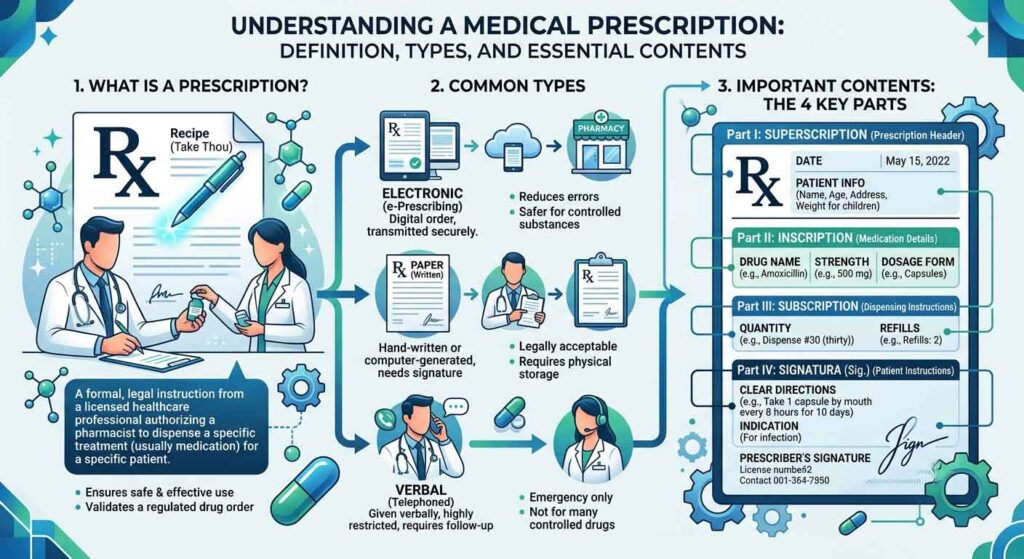
A prescription is one of the most important documents in medical practice. It acts as a written instruction from a qualified medical practitioner to a pharmacist for dispensing a medicine to a specific patient.
In simple words, a prescription tells the pharmacist which medicine to give, in what quantity, in what strength, and how the patient should use it.
Prescriptions are used in all major healthcare systems, including allopathic medicine, dentistry, veterinary practice, Ayurveda, and other recognized systems of medicine where authorized practitioners prescribe medicines.
What Is a Prescription?
A prescription is a written, printed, or electronic instruction issued by a Registered Medical Practitioner or other legally authorized healthcare professional to a pharmacist, directing the pharmacist to dispense or compound a specific medicine for a specific patient.
The prescription may be issued by professionals such as:
Registered Medical Practitioner
Dentist
Veterinarian
Ayurvedic Practitioner
Other authorized healthcare professionals, as permitted by law
A prescription is often written with the symbol Rx or ℞, which is commonly used in medical practice to indicate a prescription order.
Prescription Definition
A prescription can be defined as:
A legal and professional document issued by an authorized healthcare practitioner that instructs a registered pharmacist to dispense, compound, or supply a specific medicine in a specific quantity for a particular patient.
It is also a communication tool between the doctor, pharmacist, and patient.
Why Is a Prescription Important?
A prescription is important because it helps ensure safe, accurate, and responsible use of medicines.
It provides:
Legal authorization to dispense prescription medicine
Clear instructions for the pharmacist
Correct dosage information for the patient
Record of treatment
Safety instructions
Information about duration and quantity
Protection against misuse of prescription drugs
A properly written prescription reduces the risk of medication errors and improves patient safety.
Prescription Under the Drugs Rules in India
In India, prescription requirements are covered under the Drugs and Cosmetics Act and Rules.
As per the Drugs Rules, a prescription should generally include:
It should be in writing
It should be signed by the person issuing it
It should be dated
It should mention the name and address of the patient
In veterinary cases, it should mention the name and address of the animal owner
It should indicate the total quantity of medicine to be supplied
It should mention the dose to be taken
These requirements are important for proper dispensing, record keeping, and legal compliance.
Main Contents of a Prescription
A complete medical prescription usually contains the following parts:
1. Prescriber Information
This section contains details of the healthcare professional issuing the prescription.
It may include:
Name of prescriber
Qualification
Registration number
Clinic or hospital name
Address
Contact number
Signature
This information helps verify the authenticity of the prescription.
2. Patient Information
This section identifies the patient for whom the medicine is prescribed.
It may include:
Patient name
Age
Sex
Address
Patient reference number, if applicable
Weight, especially in children or veterinary cases
Correct patient details are important to avoid confusion and medication errors.
3. Date of Prescription
The date shows when the prescription was issued.
This is important because many prescription medicines should not be dispensed after an unreasonable time gap. For certain medicines, the date is also important for legal record keeping.
4. Rx Symbol or Superscription
The symbol Rx is traditionally written at the beginning of a prescription.
This part is known as the superscription.
It indicates that the document is a prescription order.
5. Inscription
The inscription is the main part of the prescription.
It contains details of the medicine prescribed, such as:
Medicine name
Strength
Dosage form
Quantity
Combination details, if any
For example:
Tablet ABC 500 mg Take one tablet twice daily for five days.
The inscription part tells the pharmacist which medicine has to be supplied.
6. Subscription
The subscription contains instructions for the pharmacist.
It may include:
Quantity to dispense
Compounding instructions
Dispensing directions
Special packing instructions
Labeling instructions
This section is especially important when the pharmacist has to prepare or compound a medicine.
7. Signa or Directions for the Patient
This part contains instructions for the patient.
It may include:
Dose
Frequency
Route of administration
Duration of treatment
Timing with food
Special precautions
Example:
Take one tablet twice daily after meals for five days.
The patient must follow this section carefully.
8. Refill and Special Instructions
Some prescriptions may include refill instructions or special warnings.
Examples include:
Do not repeat
Refill once
Shake well before use
Keep in a cool place
For external use only
Complete the full course
Take after meals
Avoid alcohol
Refill instructions depend on medicine type and applicable regulations.
9. Prescriber Signature
The prescription should be signed by the prescriber.
The signature confirms that the medicine has been prescribed by an authorized practitioner.
For certain medicines, registration number and other legal details may also be required.
Parts of a Prescription
Traditionally, a prescription is divided into the following parts:
1. Superscription
This includes the Rx symbol.
2. Inscription
This includes the medicine name, strength, and dosage form.
3. Subscription
This includes directions to the pharmacist.
4. Signa
This includes directions for the patient.
Understanding these parts is useful for pharmacy students, medical representatives, pharmacists, and healthcare professionals.
Types of Prescriptions
Prescriptions may be classified into different types based on the nature of the medicine and preparation.
The common types are:
Prescription for extemporaneous preparation
Prescription for official preparation
Prescription for patent or proprietary preparation
1. Prescription for Extemporaneous Preparation
Extemporaneous preparations are medicines prepared specifically for an individual patient.
These are compounded by a pharmacist when a suitable ready-made medicine is not available in the required form, strength, or combination.
Examples may include:
Special pediatric dose
Customized ointment
Liquid preparation for a patient unable to swallow tablets
Modified strength preparation
Such preparations require professional care because incorrect compounding may affect safety, quality, and efficacy.
2. Prescription for Official Preparation
Official preparations are medicines prepared according to recognized pharmacopoeial standards or official formulas.
These may not require special modification for every patient if already available in a standard form.
The pharmacist dispenses the medicine as per the prescription and applicable standards.
3. Prescription for Patent or Proprietary Preparation
Patent or proprietary preparations refer to branded medicines or formulations manufactured and marketed by pharmaceutical companies.
In this type of prescription, the doctor generally prescribes a specific brand name or proprietary product.
Example:
Tablet Brand Name 500 mg One tablet twice daily after meals.
This is one of the most common types of prescriptions used in regular medical practice.
Prescription vs OTC Medicine
Not every medicine requires a prescription.
Some products may be sold as OTC, or over-the-counter medicines, depending on applicable law and product category.
However, medicines listed under prescription drug schedules, such as Schedule H, H1, or X, should be sold only as per applicable prescription requirements.
Pharmacists and retailers must follow the relevant drug rules while dispensing such medicines.
Common Prescription Abbreviations
Some common prescription-related terms include:
Term
Meaning
Rx
Prescription
OD
Once daily
BD
Twice daily
TDS
Three times daily
QID
Four times daily
SOS
When required
HS
At bedtime
AC
Before food
PC
After food
PO
By mouth
Patients should not guess the meaning of prescription abbreviations. If there is any doubt, they should ask the doctor or pharmacist.
Important Points for Patients
Patients should always:
Read the prescription carefully
Take medicine exactly as advised
Ask questions if instructions are unclear
Complete the prescribed course, especially for antibiotics
Avoid sharing prescription medicines with others
Avoid self-medication with prescription drugs
Keep prescriptions safely for future reference
Inform the doctor about allergies and existing medicines
Important Points for Pharmacists
Pharmacists should ensure that:
Prescription is clear and valid
Patient details are mentioned
Medicine name and strength are readable
Dose and quantity are properly mentioned
Prescription drug rules are followed
Substitution is done only where legally and professionally appropriate
Patient is counseled properly
Required records are maintained for applicable schedules
Frequently Asked Questions
1. What is a prescription?
A prescription is a written, printed, or electronic instruction from an authorized healthcare practitioner to a pharmacist to dispense or compound medicine for a specific patient.
2. What is the meaning of Rx in pharmacy?
Rx means prescription. It is commonly used at the beginning of a prescription.
3. Which part of the prescription contains medicine information?
The inscription part contains information about the medicine, including name, strength, dosage form, and quantity.
4. Which part of the prescription is called subscription?
The subscription part contains directions for the pharmacist, such as dispensing or compounding instructions.
5. How many types of prescriptions are there?
Commonly, prescriptions may be classified into three types: extemporaneous preparations, official preparations, and patent or proprietary preparations.
6. Is a prescription a legal document?
Yes. A prescription is considered an important legal and professional document because it authorizes dispensing of medicines and provides treatment instructions.
7. Can prescription medicines be sold without prescription?
Prescription medicines should be sold according to applicable drug rules. Medicines under prescription schedules should not be sold casually without proper prescription requirements.
Final Thoughts
A prescription is more than a note written by a doctor. It is a legal, medical, and professional document that connects the prescriber, pharmacist, and patient.
A properly written prescription helps ensure correct medicine use, patient safety, proper dispensing, and legal compliance.
For healthcare professionals, understanding prescription format and contents is essential. For patients, following prescription instructions carefully is equally important.
Looking for Ayurvedic Franchise or Distribution Opportunities?
Looking to start an Ayurvedic franchise, become a distributor, or launch your own herbal product range?
Elzac Herbal India offers:
Ayurvedic & Herbal Product Range
Franchise & Distribution Opportunities
Third-Party Manufacturing Services
Product Development Support
Marketing Guidance
PAN India Business Opportunities
Whether you are an entrepreneur, retailer, distributor, or healthcare professional, our team can help you explore the right business opportunity in the growing Ayurvedic sector.
Ajay Kamboj is an entrepreneur and business owners associated with many Ayurvedic and Pharmaceutical start-ups. With years of experience in Ayurvedic product marketing, pharmaceutical distribution, franchise development, and client relationship management, he regularly shares practical business insights based on real-world experiences. His articles focus on business growth, entrepreneurship, customer management, and lessons learned from the healthcare and wellness industry.




Leave a Reply
You must be logged in to post a comment.