Starting a pharmacy, chemist shop or medical store can be a stable healthcare business, but it is not the same as opening an ordinary retail shop.
Medicines are regulated products. A person cannot legally sell, stock, exhibit, offer for sale or distribute drugs except under and according to the conditions of the applicable drug licence.
A pharmacy business therefore requires:
Suitable premises
Retail drug licence
Registered pharmacist
Proper medicine-storage facilities
Purchase from authorized suppliers
Prescription and sale-record compliance
Proper billing and inventory control
Quick Answer
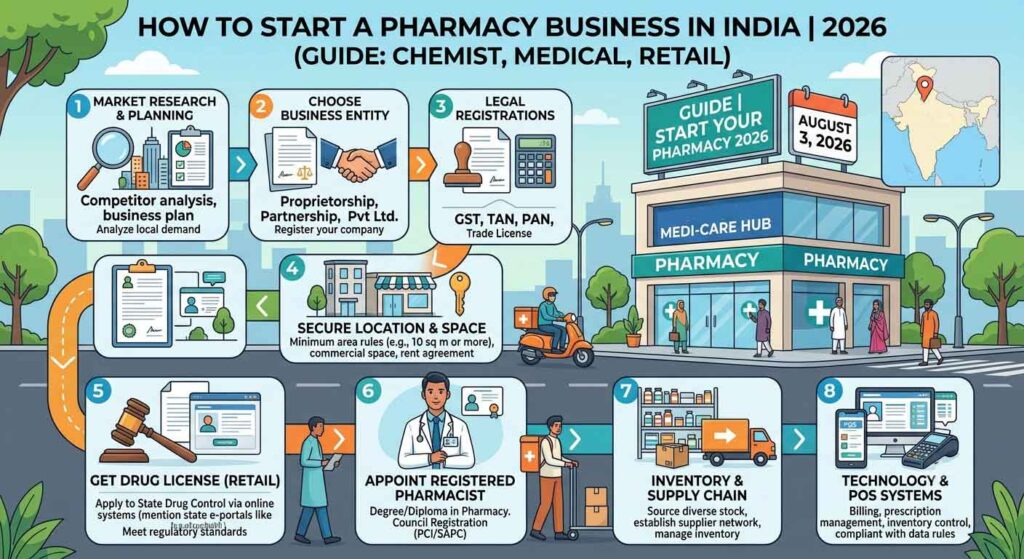
To start a retail pharmacy in India, follow these basic steps:
Select a suitable location.
Register your business entity.
Arrange independent premises of at least 10 square metres.
Appoint a registered pharmacist.
Install proper medicine-storage facilities.
prepare the required premises and pharmacist documents.
Apply to the State Drug Control Department.
Complete inspection of the premises.
Obtain the retail drug licence.
Purchase stock only from licensed suppliers.
Start sale after licence approval.
A non-pharmacist may own a pharmacy business, but the pharmacy must appoint a registered pharmacist who genuinely supervises dispensing.
What Is a Pharmacy Business?
A pharmacy business is a licensed retail establishment that sells medicines and related healthcare products directly to patients or consumers.
Different product categories may require separate compliance in addition to the retail drug licence.
Pharmacy, Chemist Shop and Medical Store: Is There Any Difference?
In everyday business language, the following terms are often used interchangeably:
Pharmacy
Chemist shop
Medical store
Drug store
Dispensing chemist
Under the Drugs Rules, the nomenclature displayed by a licensed outlet may depend on whether it maintains facilities for compounding medicines against prescriptions.
A premises using descriptions such as “Pharmacy” or “Dispensing Chemist” is traditionally associated with dispensing and compounding facilities. A “Chemists and Druggists” outlet generally employs a registered pharmacist but may not maintain a compounding pharmacy.
In modern retail practice, however, most outlets primarily dispense commercially manufactured and pre-packed medicines.
Who Can Own a Pharmacy?
A pharmacy may generally be owned through:
Proprietorship
Partnership firm
Limited Liability Partnership
Private limited company
Society or trust, where applicable
Hospital or healthcare organization
The business owner does not necessarily have to hold a pharmacy qualification.
However, the business must appoint a registered pharmacist for retail dispensing.
Can a Non-Pharmacist Open a Medical Store?
Yes.
A non-pharmacist may own a medical store, provided that:
The firm obtains a valid retail drug licence.
A registered pharmacist is appointed.
The pharmacist is genuinely associated with the shop.
The pharmacist is available during medicine-dispensing operations.
All licence and storage conditions are fulfilled.
The pharmacist’s registration should not be hired or “rented” only for documentation.
Who Is a Registered Pharmacist?
A registered pharmacist is a person who:
Possesses an approved pharmacy qualification, and
Has his or her name entered in the register maintained by the concerned State Pharmacy Council.
Recognized qualifications may include:
Diploma in Pharmacy
Bachelor of Pharmacy
Pharm.D
Other qualifications approved for registration
Completing a pharmacy course does not by itself make a person a registered pharmacist. Registration with the State Pharmacy Council is also required.
Is Pharmacist Registration the Same as Drug Licence?
No.
These are two different approvals.
Pharmacist registration
It is a personal professional registration issued by a State Pharmacy Council.
Retail drug licence
It is a business licence issued for specific premises by the State Drug Control Department.
A registered pharmacist cannot open a medical store merely on the basis of personal registration. The shop must separately obtain a retail drug licence.
Can One Pharmacist Work for Multiple Medical Stores?
One registered pharmacist should not be shown as the responsible full-time pharmacist for multiple retail outlets operating at the same time.
Each pharmacy outlet should have:
Its own retail drug licence
Its own approved premises
Its own registered pharmacist arrangement
Separate stock and sale records
One person cannot genuinely supervise dispensing at several different locations simultaneously.
Which Drug Licence Is Required?
For an ordinary allopathic retail pharmacy, the commonly applicable retail licences include:
Form 20
Form 21
The exact licence or combination of licences depends on the categories of medicines to be sold.
Additional or separate permission may be needed for:
Schedule X drugs
Homoeopathic medicines
Veterinary medicines
Certain biological products
Wholesale supply
Special controlled categories
The applicant should select the licence category with the concerned State Drug Control Department.
Do You Need Wholesale Licence Also?
Not necessarily.
Retail licence is sufficient when:
You sell medicines directly to patients or final consumers.
Wholesale licence may be required when:
You supply medicines to:
Other chemists
Hospitals
Clinics
Institutions
Distributors
Retail pharmacies
If you plan to conduct both retail and wholesale business from the same premises, apply for both sets of licences.
Minimum Area Required
The commonly applicable minimum area is:
Business activity
Minimum area
Retail pharmacy
10 square metres
Wholesale drug business
10 square metres
Combined retail and wholesale
15 square metres
Ten square metres is approximately 108 square feet.
State and local authorities may also prescribe conditions relating to:
Minimum height
Independent access
Commercial use
Ventilation
Storage
Building approval
Location
Do not finalize a small shop merely because it is described as “100 square feet.” Confirm its carpet area in square metres.
Premises Requirements
The pharmacy premises should generally be:
Independent
Easily accessible
Clean
Dry
Well ventilated
Properly illuminated
Protected from dust and pests
Suitable for medicine storage
Legally permitted for commercial use
Available for Drug Inspector inspection
The premises should have adequate space for:
Medicine racks
Refrigerator
Dispensing counter
Billing counter
Pharmacist workspace
Customer movement
Quarantined products
Returned products
Expired medicines
Records and invoices
A Drug Control Department may refuse premises that are unsuitable, shared improperly with residential activity or not permitted for commercial use.
Can a Pharmacy Be Opened from Home?
A home-based pharmacy may be considered only when the proposed premises is:
Completely independent
Approved for commercial or permissible mixed use
Accessible without passing through family living areas
Of adequate area
Properly equipped
Accepted by the State Licensing Authority
A normal bedroom, drawing room or household storage room is unlikely to be suitable.
Always consult the local Drug Inspector before investing in home-based premises.
Is a Refrigerator Compulsory?
A pharmacy should have adequate facilities for products requiring special storage conditions.
A refrigerator is normally required where the shop stocks medicines such as:
Insulin
Vaccines
Certain injections
Biological products
Temperature-sensitive preparations
The refrigerator should be used for medicines and not for domestic food storage.
Maintain:
Temperature monitoring
Power backup, where necessary
Cleaning records
Proper segregation
No overloading
Prompt action during temperature excursions
Is Air Conditioning Compulsory?
Air conditioning is not a universal replacement for proper storage.
The premises must maintain the storage conditions stated on medicine labels and required under licence conditions.
Depending on climate, product range and premises design, the authority may expect:
Air conditioning
Ventilation
Temperature monitoring
Humidity control
Refrigerator
Deep freezer
Power backup
Confirm the required setup with the local Drug Inspector.
Documents Required for Retail Drug Licence
The exact checklist differs by state, but commonly requested documents include:
Business documents
Proprietorship declaration
Partnership deed
LLP documents
Certificate of incorporation
Memorandum and Articles of Association
Board resolution, where applicable
PAN
Identity proof of proprietor, partners or directors
Address proof
Non-conviction declaration or affidavit
Premises documents
Registered rent or lease agreement
Ownership proof
Landlord’s NOC, where required
Electricity bill
Property-tax receipt, where applicable
Commercial-use proof, where required
Site plan
Key plan
Premises photographs
Pharmacist documents
Pharmacy qualification certificate
Mark sheets
State Pharmacy Council registration
Registration-renewal proof, where applicable
Appointment letter
Bio-data
Identity proof
Passport-size photographs
Full-time employment affidavit or declaration
Facility documents
Refrigerator purchase bill or details
Storage-facility declaration
Temperature-control arrangement
Computerized billing details, where requested
Application documents
Prescribed application
Government fee receipt
Declarations and affidavits
Online application acknowledgement
Any additional state-specific form
All documents should be current, legible and consistent in name and address.
Step-by-Step Procedure to Open a Pharmacy
Step 1: Conduct Local Market Research
Before taking premises, study:
Population of the area
Nearby hospitals and clinics
Number of existing pharmacies
Doctor-prescribing patterns
Customer purchasing power
Delivery demand
Local competition
Availability of distributors
Parking and access
Shop visibility
Night-service demand
A pharmacy near a busy clinic can perform well, but competition and rent may also be higher.
Step 2: Select Your Business Structure
Choose between:
Proprietorship
Partnership
LLP
Private limited company
For a single small store, proprietorship is usually simpler. For multiple founders or future expansion, partnership, LLP or company structure may be more suitable.
Step 3: Select the Premises
Before signing a long lease, confirm:
Carpet area
Commercial-use permission
Independent access
Water and electricity
Ventilation
Storage suitability
Local municipal rules
Drug-licence acceptability
Show the premises photographs and documents to the local licensing office where possible.
Step 4: Appoint the Pharmacist
If the owner is not a registered pharmacist, appoint one before submitting the drug-licence application.
Agree in writing on:
Salary
Working hours
Attendance
Professional duties
Leave arrangement
Notice period
Compliance responsibility
Do not appoint a pharmacist who is already shown as full-time pharmacist at another outlet.
Step 5: Prepare the Shop Layout
Plan separate areas for:
Prescription counter
OTC products
Refrigerator
Billing
Customer waiting
Controlled medicines, where applicable
Returned goods
Expired medicines
Records
General healthcare products
The site plan should match the actual premises.
Step 6: Install Basic Infrastructure
Arrange:
Storage racks
Counter
Refrigerator
Thermometer
Computer
Printer
Billing software
Barcode scanner
Internet connection
Fire extinguisher
CCTV, where appropriate
Power backup
Pest-control arrangement
Signboard
Avoid excessive interior spending before licence approval.
Step 7: Apply for Retail Drug Licence
Submit the application to the concerned State Drug Control Department through its online portal or prescribed process.
The sale and distribution of drugs are mainly regulated by State authorities, although the Drugs and Cosmetics Act and Rules provide the national framework.
Step 8: Complete Inspection
A Drug Inspector may inspect:
Carpet area
Premises independence
Storage facilities
Refrigerator
Pharmacist documents
Business documents
Layout
Commercial use
Cleanliness
Accessibility
Record-maintenance arrangements
The pharmacist may also be asked about qualifications, employment and proposed duties.
Step 9: Correct Any Deficiencies
If the authority identifies deficiencies, you may need to submit:
Revised document
Corrected site plan
Additional affidavit
Better storage arrangement
Commercial-use proof
Clarification of pharmacist employment
Corrected premises details
Respond within the prescribed period.
Step 10: Obtain the Licence
Start medicine sale only after the licence has been formally granted.
Display the required licence and pharmacist details at the premises.
Step 11: Open Accounts with Distributors
Purchase medicines only from authorized and appropriately licensed suppliers.
Collect and verify:
Supplier drug licence
GST details
PAN
Purchase invoice
Company authorization, where relevant
Return and expiry policy
Credit terms
Avoid buying medicines without proper invoices.
Step 12: Purchase Initial Stock
Do not purchase every available product.
Begin with:
Fast-moving prescription medicines
Common chronic-disease medicines
Fever and pain products
Gastrointestinal medicines
Dermatology products
First-aid products
Common OTC products
Baby-care products
Selected supplements
Basic surgical items
Study local prescriptions before purchasing large quantities.
Step 13: Start Billing and Record Systems
Your software should preferably track:
Product name
Batch number
Expiry date
MRP
Purchase rate
Sale rate
GST
Supplier
Quantity
Prescription category
Reorder level
Return
Expired stock
Use the FEFO method: First Expiry, First Out.
Investment Required to Start a Pharmacy
There is no single fixed amount.
Investment depends on:
City
Location
Rent and security deposit
Shop size
Interior
Pharmacist salary
Initial inventory
Product range
Software
Delivery service
Working capital
Credit availability from distributors
Illustrative Small-Pharmacy Budget
The following is only a planning estimate and not a government-prescribed cost:
Expense
Illustrative range
Rent deposit and advance
₹50,000–₹2,00,000
Basic interiors and racks
₹1,00,000–₹3,00,000
Refrigerator, computer and equipment
₹75,000–₹2,00,000
Licence, professional and documentation expenses
₹20,000–₹1,00,000
Initial medicine stock
₹3,00,000–₹10,00,000
Working capital
₹2,00,000–₹5,00,000
A practical small setup may therefore require approximately ₹7 lakh to ₹20 lakh, excluding the purchase price of property.
The amount can be lower in a small town with rented premises and distributor credit, or much higher in a prime urban location.
How Much Medicine Stock Should You Purchase?
Avoid both overstocking and understocking.
Stock planning should consider:
Local prescriptions
Seasonal demand
Chronic medicines
Fast-moving brands
Distributor delivery frequency
Product expiry
Credit terms
Available working capital
Generic versus branded demand
Nearby hospital specialization
Keep low quantities of expensive and slow-moving products until demand is established.
Profit Margin in a Pharmacy
There is no guaranteed fixed margin for every product.
Retail margin varies according to:
Product category
Manufacturer
Brand
Price-control status
Distributor scheme
Purchase volume
Generic or branded product
OTC category
Cosmetic or supplement category
Discount offered to customers
Expiry and breakage losses
Prescription medicines often have moderate trade margins. Generic medicines, cosmetics, supplements and personal-care products may offer higher gross margins, but they may also have different demand and competition.
Gross Margin Is Not Net Profit
From gross margin, you still have to pay:
Rent
Pharmacist salary
Other staff salary
Electricity
Software
Delivery
Expiry losses
Discounts
Interest
Maintenance
Tax and compliance costs
A shop with high sales can still make low net profit if rent, discounts and expiry losses are uncontrolled.
FSSAI Licence
A pharmacy needs FSSAI registration or licence when it operates as a food business by selling products such as:
Health supplements
Nutraceuticals
Protein supplements
Functional foods
Food for special dietary use
Food for special medical purpose
Packaged foods or beverages
FSSAI registration does not replace the retail drug licence.
Select the correct FSSAI category through FoSCoS according to turnover, business type and product range.
Is GST Registration Required?
GST registration depends on:
Aggregate turnover
Interstate supply
E-commerce activity
Business structure
Applicable compulsory-registration provisions
Types of products sold
Many pharmacies take GST registration from the beginning because it helps with:
Distributor purchases
Tax invoices
Input-tax credit
Business accounting
Interstate procurement
Marketplace onboarding
However, GST applicability should be confirmed with a chartered accountant instead of assuming that every small pharmacy is automatically required to register.
Shops and Establishments Registration
State-specific Shops and Establishments registration may be required.
It may regulate:
Opening and closing hours
Weekly holiday
Employee records
Working hours
Leave
Display certificate
Employment conditions
Check the labour-department requirements applicable in your state.
Other Registrations That May Apply
Depending on the business, you may also need:
Municipal trade licence
Commercial-use permission
Professional tax registration
Udyam registration
Fire-safety compliance
Weights and measures compliance
Local signage permission
Biomedical or hazardous-waste compliance, where applicable
Not every registration applies to every shop.
Inspection After Licence Approval
Inspection is not limited to the initial application stage.
Drug Inspectors may later check:
Pharmacist presence
Purchase invoices
Prescription records
Schedule H1 records
Expiry stock
Refrigerator temperature
Storage conditions
Licence display
Unauthorized products
Sale without prescription
Controlled-drug records
Pharmacist change
Premises changes
Bills and stock records
Maintain compliance every day, not only during application.
Prescription-Medicine Compliance
Schedule H, Schedule H1 and Schedule X medicines are subject to prescription and record requirements.
A pharmacy should not:
Sell prescription medicines casually
Refill restricted prescriptions indefinitely
Alter a prescription
Substitute medicines without proper authority
Sell controlled drugs without required records
Supply excessive quantities
Accept clearly forged prescriptions
Schedule H1 sale records are required to be maintained for the prescribed period.
What Records Should a Pharmacy Maintain?
Maintain records such as:
Purchase invoices
Sales invoices
Stock register
Schedule H1 register
Schedule X records, where applicable
Prescription records, where required
Refrigerator-temperature records
Expiry register
Return register
Supplier licence copies
Pharmacist attendance
Complaint records
Recall records
Damaged-goods register
Disposal records
Digital records should be backed up regularly.
How to Handle Expired Medicines
Expired medicines should be:
Removed from saleable stock immediately
Clearly marked
Stored separately
Recorded batch-wise
Returned to the authorized supplier where possible
Destroyed only through a lawful process
Never sold or donated for patient use
Check expiry dates regularly.
Can a Pharmacy Offer Home Delivery?
A licensed retail pharmacy may offer delivery subject to applicable rules, prescription requirements and state directions.
The pharmacy should ensure:
Order is processed through licensed premises.
Prescription is checked by the pharmacist.
Invoice is generated.
Delivery maintains storage conditions.
Patient information remains confidential.
Cold-chain medicines are handled properly.
Controlled medicines are not supplied casually.
A separate nationwide e-pharmacy model requires additional legal and operational review.
Can a Pharmacy Sell Ayurvedic Medicines?
Yes, a retail pharmacy may sell lawfully manufactured Ayurvedic medicines.
Check:
AYUSH manufacturing licence
Product label
Batch and expiry details
Purchase invoice
Therapeutic claims
Proper storage
Do not sell unlabelled or unlicensed preparations.
Cosmetic sales may improve overall pharmacy margin.
Can a Pharmacy Sell Medical Devices?
Yes, but check the current regulatory status of each medical-device category.
Examples include:
Glucometers
Test strips
Thermometers
Blood-pressure monitors
Nebulizers
Masks
Syringes
Dressings
Orthopaedic supports
Buy regulated devices only from authorized suppliers.
Choosing the Best Location
A good pharmacy location may be near:
Hospital
Nursing home
Clinic cluster
Residential colony
Market
Diagnostic centre
Bus stand
Senior-citizen population
Area without adequate pharmacy service
Do not evaluate location only by the number of doctors.
Also study:
Existing competition
Rent
Customer access
Parking
Visibility
Night demand
Prescription volume
Population
Delivery potential
How to Make a Pharmacy Successful
Focus on:
Genuine medicines
Pharmacist availability
Fast service
Proper stock
Fair pricing
Expiry control
Home delivery
Chronic-patient refill service
Clean premises
Digital billing
Customer counselling
Reliable product sourcing
Ethical business practices
Do not build the business around unauthorized discounts, prescription commissions or medicine substitution.
Common Mistakes to Avoid
Avoid these mistakes:
Treating pharmacist registration as a shop licence
Starting sale before licence approval
Taking premises below the required area
Renting pharmacist registration
Buying medicines without invoices
Selling expired medicines
Ignoring refrigerator temperatures
Stocking too many slow-moving products
Selling prescription drugs without prescription
Using one pharmacist for multiple shops
Starting retail and wholesale activity under only one licence
Selling supplements without checking FSSAI requirements
Assuming GST is automatically optional or compulsory
Making structural changes without informing the licensing authority
Depending only on large discounts to attract customers
Practical Startup Checklist
Before opening, confirm:
Business entity registered
Location surveyed
Premises area measured
Commercial use checked
Rent agreement completed
Registered pharmacist appointed
Site plan prepared
Refrigerator installed
Storage racks installed
Retail drug-licence application submitted
Inspection completed
Licence received
GST checked
FSSAI checked
Shop registration checked
Distributor accounts opened
Billing software installed
Initial stock planned
Expiry-control system created
Pharmacist and staff trained
Final Answer
To start a pharmacy, chemist shop or medical store in India, you need an independent and suitable premises, a retail drug licence and a registered pharmacist.
A pharmacy owner does not necessarily have to be a pharmacist, but prescription dispensing must be conducted under genuine pharmacist supervision.
A retail pharmacy generally requires at least 10 square metres of premises. A combined retail-and-wholesale setup generally requires at least 15 square metres.
The safest process is to select the location, verify the premises with the local Drug Control Department, appoint a pharmacist, prepare all documents, apply for the licence, complete inspection and start medicine sales only after approval.
Success depends not only on licence and investment, but also on location, stock planning, pharmacist service, expiry control, ethical dispensing and customer trust.
Frequently Asked Questions
1. Can a non-pharmacist open a pharmacy?
Yes. A non-pharmacist may own the business but must appoint a registered pharmacist.
2. Is B.Pharmacy compulsory for opening a medical store?
No. The owner need not personally hold B.Pharmacy, but the shop must have a registered pharmacist.
3. What is the minimum area required?
Retail pharmacy generally requires at least 10 square metres. Retail-cum-wholesale generally requires at least 15 square metres.
4. Can I open a pharmacy in a rented shop?
Yes. Submit a valid rent agreement, ownership documents and NOC where required.
5. Can I open a pharmacy from home?
Only if the premises is independent, commercially permissible, adequately equipped and approved by the licensing authority.
6. Is a refrigerator compulsory?
Proper cold storage is required when the pharmacy stocks temperature-sensitive medicines. In practice, retail-licence authorities generally expect appropriate refrigerator or cold-storage facilities.
7. Is GST compulsory?
It depends on turnover, interstate supply and other GST provisions. Confirm with a chartered accountant.
8. Is FSSAI required?
It is required when the pharmacy sells food products, nutraceuticals or health supplements covered by food law.
9. Can I do wholesale and retail from the same shop?
Yes, subject to obtaining both licences, providing at least the required combined area and fulfilling both compliance requirements.
10. Can one pharmacist be used for two pharmacies?
One pharmacist should not be shown as the responsible full-time pharmacist for two simultaneously operating outlets.
11. Can a pharmacy sell medicines without prescription?
Only products that may lawfully be sold without prescription can be supplied without one. Schedule H, H1 and X medicines are subject to prescription requirements.
12. How much investment is required?
A small rented pharmacy may require approximately ₹7 lakh to ₹20 lakh, depending on location, stock, interiors and working capital. This is only a planning estimate.
13. What is the profit margin?
Margins vary by product and supplier. Gross margin is not the same as net profit after rent, salaries, discounts and expiry losses.
14. Who issues the retail drug licence?
The concerned State Drug Control Department or State Licensing Authority issues the licence.
15. Can an existing pharmacy start online delivery?
Yes, subject to licence conditions, prescription review, pharmacist supervision, billing, privacy and delivery requirements.
Looking for Ayurvedic Franchise or Distribution Opportunities?
Looking to start an Ayurvedic franchise, become a distributor, or launch your own herbal product range?
Elzac Herbal India offers:
Ayurvedic & Herbal Product Range
Franchise & Distribution Opportunities
Third-Party Manufacturing
Product Development Support
Marketing Guidance
PAN India Business Opportunities
Whether you are an entrepreneur, retailer, distributor, or healthcare professional, our team can help you explore the right business opportunity in the growing Ayurvedic sector.
Ajay Kamboj is an entrepreneur and business owners associated with many Ayurvedic and Pharmaceutical start-ups. With years of experience in Ayurvedic product marketing, pharmaceutical distribution, franchise development, and client relationship management, he regularly shares practical business insights based on real-world experiences. His articles focus on business growth, entrepreneurship, customer management, and lessons learned from the healthcare and wellness industry.
4 responses to “How to Start a Pharmacy Business in India: Chemist Shop, Medical Store or Retail Pharmacy”
I want to open pharmacy in assam, please help me out
it is a nice article. Actually, after reading this blog everyone has gotten a little bit idea about the how to start the chemist shop. What document required to start a medical shop. This Detailed is very useful to each person who can start his chemist shop. Thanks for the published this important information for us.




I want to open pharmacy in assam, please help me out
What are the requirements to open pharmacy in Delhi. Please provide me detail
it is a nice article. Actually, after reading this blog everyone has gotten a little bit idea about the how to start the chemist shop. What document required to start a medical shop. This Detailed is very useful to each person who can start his chemist shop. Thanks for the published this important information for us.
I really really like you informative blog about chemist shop in delhi keep uploading