A pharmaceutical stockist, wholesaler or distributor purchases, stores and supplies medicines and healthcare products to legally eligible buyers such as:
Retail chemists
Other wholesalers
Hospitals
Nursing homes
Institutional pharmacies
Government procurement agencies
Approved healthcare establishments
This business is an essential link between pharmaceutical manufacturers or marketing companies and the outlets that ultimately supply medicines to patients.
A common query is:
“How can I start a pharmaceutical stockist, wholesale or distributor business in India? Which licences, premises, competent person, investment, products and distribution systems are required?”
The practical answer is:
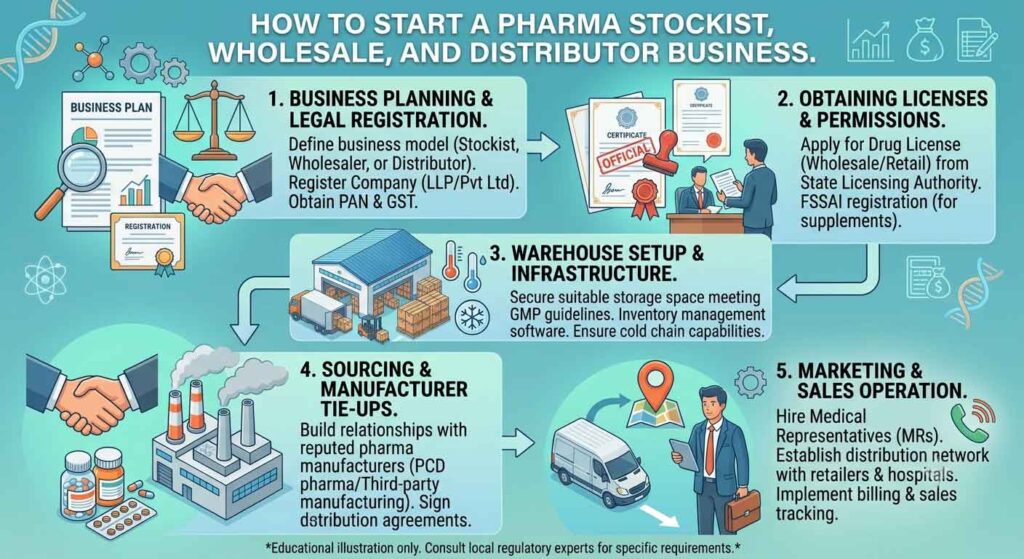
To start an allopathic pharmaceutical wholesale business, establish a legal business entity, arrange an approved commercial premises, obtain the applicable wholesale drug licences, appoint an eligible competent person, complete GST and local registrations, install proper storage and inventory systems, and purchase medicines only from authorized sources.
The exact requirements vary according to:
State
Product category
Business model
Premises
Customer type
Whether cold-chain products are stocked
Whether food supplements or medical devices are included
Whether retail sales are also planned
How the Pharmaceutical Distribution Chain Works
A commonly used distribution structure is:
Manufacturer or marketing company → C&F agent → Stockist or distributor → Retail chemist or hospital → Patient
However, every company does not use every level.
Alternative structures include:
Manufacturer → Distributor → Retailer
or:
Marketing company → Stockist → Retailer
or:
Manufacturer → Hospital or institutional buyer
The selected structure depends on:
Territory size
Sales volume
Product type
Delivery frequency
Customer concentration
Company policy
Credit arrangements
Stockist, Wholesaler and Distributor: What Is the Difference?
These expressions are frequently used interchangeably in the pharmaceutical market. They do not necessarily represent three separate statutory licences.
Pharmaceutical Wholesaler
A wholesaler generally purchases medicines in commercial quantities and supplies them to:
Retail pharmacies
Other wholesalers
Hospitals
Institutions
Distributors
A wholesaler may handle products from numerous manufacturers and marketing companies.
Pharmaceutical Stockist
A stockist usually keeps stock for one or more pharmaceutical companies within an assigned territory.
Its responsibilities may include:
Maintaining agreed stock levels
Supplying retail chemists
Executing orders generated by company representatives
Collecting payments
Managing returns
Reporting sales and inventory
A stockist may be appointed for:
A city
District
Group of districts
Product division
Hospital channel
Pharmaceutical Distributor
A distributor usually focuses on market coverage and regular delivery to customers.
The distributor may:
Purchase stock
Maintain inventory
Supply retailers
Extend controlled credit
Collect payments
Handle returns
Provide secondary-sales data
Service a defined territory
Agency
“Pharmaceutical agency” is a commercial expression often used for a wholesale medicine business representing one or more companies.
It does not create a separate drug-licence category.
C&F Agent
A carrying and forwarding agent normally stores company-owned stock and dispatches it according to the company’s instructions.
A genuine C&F arrangement differs from distributorship because:
Stock may remain owned by the principal company.
The agent may earn service charges rather than a trading margin.
The company may issue the customer invoices.
Commercial and GST treatment depends on the agency agreement.
Super Stockist
A super stockist generally purchases larger quantities and supplies district-level distributors or stockists.
It ordinarily requires:
Larger warehouse
Greater working capital
Wider territory
Strong logistics
Detailed credit control
Is There a Separate Distributor Licence?
There is generally no licence titled:
Pharma distributor licence
Stockist licence
Medicine agency licence
Pharmaceutical franchise licence
The principal licence is based on the activity performed.
For wholesale sale, stocking and distribution of allopathic medicines, the applicable wholesale drug licences are required.
Wholesale Drug-Licence Forms
Form 20-B
Form 20-B is commonly used for wholesale sale, stocking or distribution of allopathic drugs other than those specified in Schedules C, C(1) and X.
Form 21-B
Form 21-B is commonly used for wholesale sale, stocking or distribution of drugs specified in Schedules C and C(1), excluding Schedule X.
Many ordinary pharmaceutical wholesalers require both:
Form 20-B
Form 21-B
Form 20-G
Form 20-G applies to wholesale activity involving Schedule X drugs.
Schedule X operations involve stricter controls concerning:
Purchase
Storage
Records
Invoicing
Customer eligibility
Security
A new wholesaler should not include Schedule X products unless there is a genuine commercial requirement and a suitable compliance system.
Application Form
Applications for Forms 20-B and 21-B are generally made through Form 19.
Schedule X applications use the applicable prescribed form.
The application process is administered by the State Drug Control or State Licensing Authority.
Wholesale vs Retail Drug Licence
Wholesale Licence
A wholesale licence authorizes eligible business-to-business supply from the approved premises.
Typical customers include:
Licensed retail chemists
Licensed wholesalers
Hospitals
Institutions
Government agencies
Other legally eligible purchasers
Retail Licence
A retail licence is required when medicines are supplied directly to patients or consumers.
Common retail licences include:
Form 20
Form 21
Retail pharmacy activity generally requires the services of a registered pharmacist.
Important Distinction
A wholesale firm may supply a licensed retail medical store.
It should not dispense a strip or bottle directly to a patient merely on the basis of its wholesale licence.
Where both retail and wholesale activity are planned, the firm should obtain both sets of applicable licences.
Minimum Premises Area
The ordinary minimum area generally applicable is:
Wholesale only: at least 10 square metres
Retail only: at least 10 square metres
Combined retail and wholesale: at least 15 square metres
These figures are minimum licensing requirements—not recommended warehouse sizes.
A serious distributor handling:
Hundreds of products
Several batches
Returns
Expired stock
Promotional material
Cold-chain products
will normally require substantially more space.
Selecting the Premises
The proposed premises should be:
Legally usable for commercial activity
Independent
Clean
Dry
Secure
Well ventilated
Protected from direct sunlight
Accessible for loading and delivery
Suitable for medicine storage
Accepted by the State Licensing Authority
Avoid selecting a premises only because its rent is low.
Consider:
Retailer concentration
Transport access
Courier availability
Parking
Electricity
Internet
Flood risk
Fire risk
Staff availability
Expansion space
Premises Documents
Common premises documents may include:
Registered or valid rent agreement
Ownership documents
Landlord’s no-objection certificate
Electricity or utility bill
Property-tax document
Commercial-use permission, where applicable
Site plan
Key plan
Premises photographs
Rent receipt
Proof of possession
The exact state checklist should be followed.
Competent Person for Wholesale Operations
Wholesale drug operations must be supervised by a competent person accepted by the Licensing Authority.
Commonly considered eligibility routes may include:
Registered pharmacist
Graduate with prescribed practical experience in dealing with drugs
Person with the prescribed educational qualification and longer relevant experience
Exact qualification and experience requirements should be verified from the concerned State Licensing Authority.
The competent person should be:
Genuinely employed
Available during operations
Properly documented
Familiar with medicine storage and distribution
Capable of supervising records and compliance
Avoid:
Borrowing another firm’s competent person
Showing an employee only during inspection
Submitting false experience certificates
Allowing an untrained billing employee to control all drug transactions
Business-Entity Options
The business may be established as:
Proprietorship
Partnership
LLP
Private Limited Company
Proprietorship
Suitable where:
One person owns the business.
Setup is relatively small.
Management is simple.
The proprietor has personal liability for business obligations.
Partnership Firm
Suitable where two or more persons jointly invest or operate.
The partnership deed should clearly cover:
Capital contribution
Profit sharing
Roles
Banking authority
Credit approval
Exit
Dispute resolution
LLP
An LLP provides a separate legal identity and limited-liability structure with partnership-style management.
Private Limited Company
Suitable for a business planning:
Multiple branches
Several investors
Institutional contracts
Large distribution
Multiple states
Formal governance
Do not create a complicated company structure merely to appear larger.
Core Registrations
Depending on activities, common registrations include:
PAN
Current bank account
Wholesale drug licence
GST registration
Shop and Establishment registration
Local trade or municipal registration
Udyam registration, where suitable
Professional-tax and labour registrations, where applicable
Fire-safety compliance
Import Export Code, if importing or exporting
Each registration has a different function.
A GST certificate does not replace a drug licence.
A drug licence does not replace GST registration.
GST Registration
GST registration requirements depend on:
Aggregate turnover
State
Interstate taxable supplies
Agency activity
E-commerce activity
Other compulsory-registration provisions
An exemption up to ₹40 lakh may apply to certain businesses exclusively supplying goods, but it is subject to:
State eligibility
Product exclusions
Compulsory-registration provisions
Nature of supplies
Pharmaceutical wholesalers frequently obtain GST registration from the beginning because they commonly:
Purchase interstate
Sell interstate
Supply registered businesses
Claim input tax credit
Deal with pharmaceutical companies requiring GST invoices
Operate as an agent or appointed distributor
Obtain professional GST advice based on the actual transaction flow.
Current GST on Medicines
From 22 September 2025:
Drugs and medicines generally attract 5% GST.
Specifically exempt medicines may be nil-rated.
Medical devices generally attract 5%, subject to specific exemptions.
Food supplements, cosmetics and other products require separate HSN classification.
Do not assume that every healthcare product attracts 5% merely because it is sold through a medicine distributor.
FSSAI Requirement for Nutraceuticals and Food Supplements
A wholesale drug licence does not cover food products.
When distributing products licensed as:
Health supplements
Nutraceuticals
Protein supplements
Food for special dietary use
Functional foods
Food beverages
the business requires the applicable FSSAI registration or licence under the correct Kind of Business.
FoSCoS separately recognizes activities such as:
Wholesaler
Distributor
Retailer
Storage
Transporter
Current general eligibility includes:
Food Wholesaler
Up to ₹12 lakh annual turnover: registration
Above ₹12 lakh and up to ₹30 crore: State licence
Above ₹30 crore: Central licence
Food Distributor
Up to ₹12 lakh annual turnover: registration
Above ₹12 lakh and up to ₹20 crore: State licence
Above ₹20 crore: Central licence
The exact product categories should be endorsed on the licence.
Medical-Device Distribution
Medical devices are regulated separately under the Medical Devices Rules, 2017.
A person intending to sell, stock, exhibit, offer for sale or distribute applicable medical devices should examine:
Premises registration
Form MD-41 application
Form MD-42 registration certificate
Storage requirements
Competent technical staff requirements
Product manufacturer or importer licences
Do not assume that Forms 20-B and 21-B automatically cover every medical device.
Ayurvedic Medicines
Ayurvedic, Siddha and Unani medicines are governed by separate provisions relating to traditional medicines.
The wholesale sale-licence structure applicable to allopathic medicines should not automatically be applied to every Ayurvedic product.
However, the business must still verify:
Manufacturer’s valid AYUSH manufacturing licence
Product category
Label compliance
GST
Local business requirements
Storage conditions
State-specific requirements
A distributor handling both allopathic and Ayurvedic products should maintain clear category-wise records.
Homeopathic Medicines
Wholesale sale of homeopathic medicines commonly requires the applicable licence in Form 20-D.
This should be applied for according to the concerned state procedure.
Decide the Distribution Model
Before taking premises or purchasing inventory, decide which business you intend to operate.
1. Branded Prescription-Medicine Stockist
The company’s medical representatives generate prescriptions and orders.
The stockist normally handles:
Stock
Retail supply
Billing
Delivery
Collection
Returns
Success depends on:
Company sales team
Product demand
Retailer service
Payment discipline
Stock availability
2. Generic or Trade-Generic Wholesaler
This model is more rate- and availability-driven.
Customers may compare:
Net rate
Scheme
MRP
Product manufacturer
Expiry
Delivery
Credit
It may offer higher gross percentages but can involve:
Strong price competition
Large schemes
Higher expiry risk
Credit pressure
Product-quality concerns
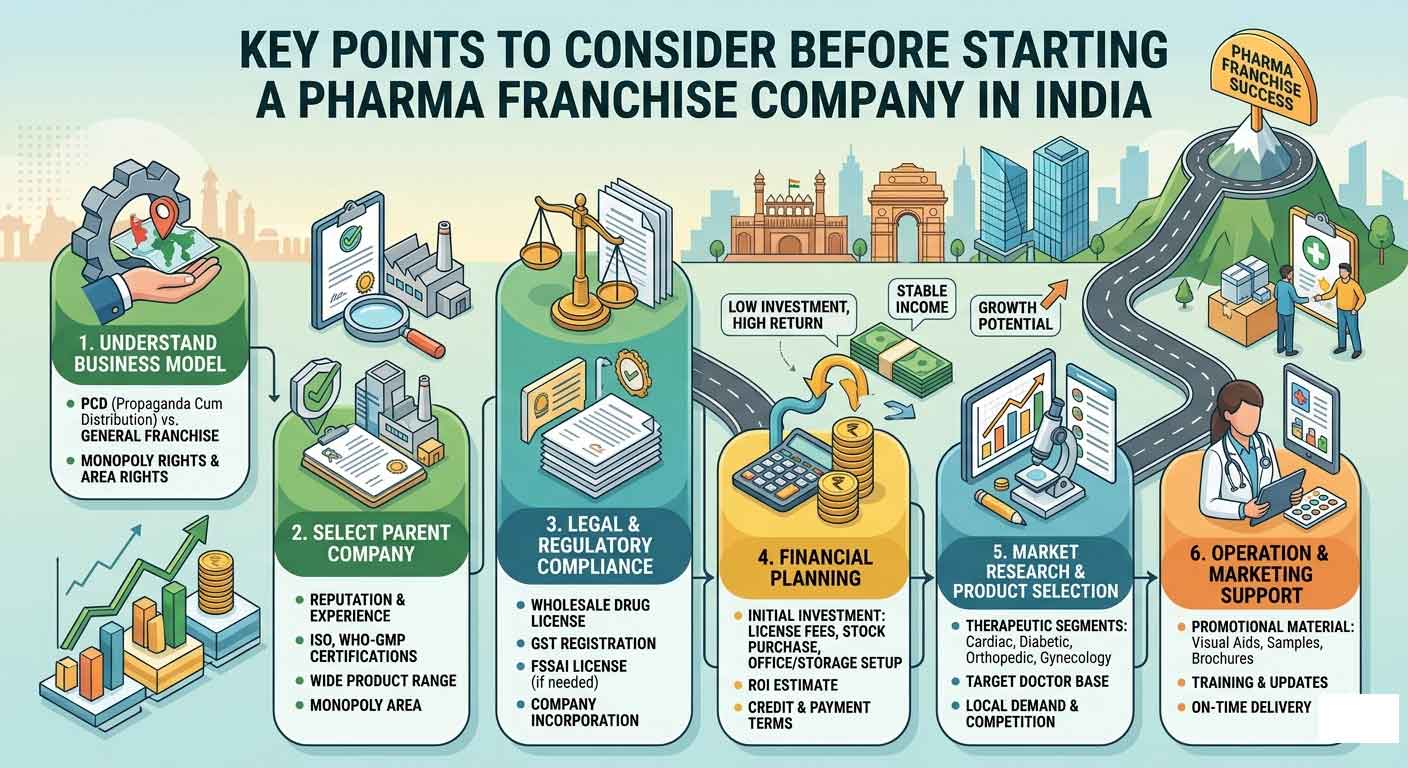
3. PCD or Franchise Distributor
The distributor may perform both:
Marketing
Distribution
It may handle:
Doctor promotion
Product selection
Stock
Retail availability
Payment collection
Sales staff
Promotional expenses
A high difference between MRP and purchase rate should not be treated as pure profit because the franchisee bears marketing and operating expenses.
4. Institutional Supplier
Customers may include:
Hospitals
Nursing homes
Clinics
Charitable institutions
Corporate healthcare organizations
Government departments
This model may involve:
Vendor registration
Quotations
Tenders
Longer credit
Batch documentation
Product replacements
Strict delivery schedules
5. OTC and Consumer-Healthcare Distributor
This model may focus on:
Non-prescription medicines
Consumer-health products
Personal-care products
Wellness products
It often requires stronger retailer coverage and product visibility.
6. Cold-Chain and Specialty Distributor
This may involve products requiring controlled temperatures.
The model requires:
Pharmaceutical refrigerator or cold room
Calibrated temperature monitoring
Data loggers
Backup power
Cold boxes
Transport controls
Excursion management
Higher investment and stronger controls are required.
7. Mixed Healthcare Distributor
A mixed business may distribute:
Allopathic medicines
Ayurvedic medicines
Nutraceuticals
Cosmetics
Medical devices
This provides a wider range but creates multiple compliance obligations.
Do not begin every category simultaneously unless the business can manage:
Separate licences
Product classification
Storage
Tax rates
Supplier verification
Inventory records
Market Survey Before Starting
Study the proposed territory before committing funds.
Retailer Survey
Visit retail chemists and determine:
Number of active retailers
Leading distributors
Delivery expectations
Credit practices
Main product categories
Frequently unavailable products
Return and expiry expectations
Hospital Survey
Study:
Major hospitals
Purchase departments
Hospital pharmacies
Vendor-registration processes
Payment cycles
Tender opportunities
Competitor Survey
Identify:
Existing wholesalers
Their product range
Delivery speed
Credit terms
Schemes
Market reputation
Weak service areas
Supplier Survey
Contact:
Pharmaceutical companies
C&F agents
Super stockists
Manufacturers
Importers
Authorized distributors
Determine:
Appointment conditions
Opening-order requirement
Security deposit
Territory
Credit
Margins
Expiry policy
Freight
Minimum purchase
Product availability
How to Contact Pharmaceutical Companies
Distribution appointments are generally managed through:
Medical representatives
Area sales managers
Regional managers
Distribution managers
C&F agents
Company websites
Official business-development teams
Prepare a distributor profile containing:
Firm name
Promoter experience
Territory
Drug licences
GST
Warehouse area
Cold-storage facilities
Retail coverage
Delivery vehicles
Existing company portfolio
Financial capacity
Market references
Do not approach a company only with:
“Send agency details.”
Due Diligence Before Taking Distribution
Verify the pharmaceutical company before investing.
Check:
Legal entity
GST registration
Drug licences
Product manufacturers
Product permissions
Product quality history
Market presence
Existing distributors
Expiry policy
Payment reputation
Product availability
Complaint handling
Recall system
Speak with existing distributors where possible.
Distributor Appointment Agreement
A written agreement should include:
Legal names
Territory
Products
Appointment period
Exclusive or non-exclusive status
Purchase rates
Margin
Schemes
Payment terms
Credit limit
Minimum stock
Sales targets
Freight
Delivery responsibility
Expiry returns
Breakage
Product complaints
Recall
Termination
Closing stock
Dispute resolution
Do not depend solely on a verbal appointment or an undated authorization letter.
Warehouse Layout
A professional pharmaceutical warehouse should contain separate areas for:
Goods receiving
Inward verification
Saleable stock
Cold-chain stock
Quarantine stock
Returned goods
Rejected goods
Expired goods
Recalled stock
Packing and dispatch
Documents and billing
Promotional materials
Storage Requirements
Provide:
Strong racks
Pallets
Adequate air circulation
Temperature monitoring
Refrigerator where required
Power backup
Pest control
Fire-safety arrangements
Clean loading area
Security system
Do not store medicines:
Directly on the floor
Against damp walls
In direct sunlight
At an unlicensed location
In a residence without approval
In a vehicle overnight
With chemicals or unsuitable materials
Temperature Monitoring
Maintain:
Room-temperature register
Refrigerator-temperature register
Data-logger records where required
Calibration records
Excursion reports
Corrective-action records
Stock quantity alone is not enough.
A product exposed to unacceptable temperature may remain physically available but may not be suitable for sale.
Inventory Software
The software should support:
Product codes
Batch number
Manufacturing date
Expiry date
MRP
Purchase rate
GST
Free quantity
Schemes
Supplier
Customer
FEFO
Near-expiry alerts
Sales returns
Purchase returns
Credit notes
Recall reports
Outstanding payments
Avoid software that records only product name and total quantity without batch details.
FEFO
FEFO means:
First Expiry, First Out
The batch with the earliest acceptable expiry should generally be supplied first.
However, check the customer’s minimum shelf-life requirement.
Do not dispatch near-expiry stock merely because it expires first.
Customer Verification
Before regular wholesale supply, collect and verify:
Customer’s legal name
Drug-licence number
Licensed address
GSTIN
Contact person
Delivery address
Credit approval
Bank details where required
Be cautious when:
Delivery address differs from the licensed premises.
Licence details cannot be verified.
Customer asks for supply without invoice.
Schedule medicines are requested for an unsuitable premises.
A buyer asks to use another firm’s licence.
Who Can a Wholesaler Supply?
A wholesale drug-licensed business may generally supply medicines to:
Licensed retail chemists
Licensed wholesalers
Eligible hospitals
Government authorities
Medical, educational or research institutions
Other purchasers specifically permitted under the Drugs Rules
The precise buyer eligibility and documentation should be checked for the product involved.
A wholesale firm should not use its licence for ordinary direct retail dispensing to patients.
Purchase Only from Authorized Sources
Medicines should be purchased under proper invoices from:
Licensed manufacturers
Licensed wholesalers
Authorized distributors
Eligible importers
Do not purchase unexplained discounted stock from:
Unknown brokers
Unlicensed parties
Social-media sellers
Dealers refusing to issue invoices
Parties unable to provide batch and source details
Inward-Goods Procedure
When medicines arrive:
Check the supplier.
Check the invoice.
Count packages.
Inspect transport damage.
Verify product names.
Verify quantities.
Verify batches.
Verify expiry dates.
Verify MRP.
Check storage conditions.
Enter stock in software.
Segregate discrepancies.
Report shortages promptly.
Do not sign an unrestricted “received in good condition” acknowledgement before inspection.
Sales and Dispatch Procedure
Receive customer order.
Verify licence and credit status.
Check available stock.
Select batch using FEFO.
Verify remaining shelf life.
Prepare invoice.
Pick and check stock.
Pack securely.
Generate e-way bill where applicable.
Record dispatch.
Share tracking details.
Obtain proof of delivery.
Records to Maintain
A pharmaceutical wholesaler should maintain suitable records such as:
Purchase register
Sales register
Batch-wise stock register
Dispatch register
Customer licence register
Temperature register
Refrigerator register
Sales-return register
Purchase-return register
Expiry register
Damage register
Complaint register
Recall register
Destruction register
Debit-note register
Credit-note register
Outstanding-payment report
Additional records apply to specific schedules and product categories.
Product Returns
Returned goods should be placed in a segregated area.
Record:
Customer
Original invoice
Product
Batch
Expiry
Quantity
Return reason
Storage history
Pack condition
Credit-note status
Final decision
Do not automatically place returned medicines back into saleable stock.
Expiry Management
Generate reports for stock expiring within:
12 months
9 months
6 months
3 months
1 month
Take early action by:
Stopping repeat purchase
Informing the supplier
Transferring stock where permitted
Collecting retailer returns
Claiming replacement or credit
Segregating expired stock
Product Complaints and Recalls
The system should identify every customer who received a particular batch.
A recall procedure should include:
Stop further sale.
Block the affected batch.
Identify customers.
Inform customers.
Arrange returns.
Reconcile quantities.
Segregate recalled stock.
Report to supplier.
Follow regulatory instructions.
Close the recall with records.
Credit Management
Pharmaceutical distribution is often affected more by payment delays than by low sales.
Create:
Customer credit limit
Maximum credit period
Overdue-blocking policy
Cheque-return policy
Approval hierarchy
Collection responsibility
Avoid giving equal credit to every retailer.
Working-Capital Cycle
Money may remain blocked in:
Opening inventory
Supplier advances
Retailer credit
Hospital payments
Expiry claims
Sales returns
GST timing differences
Security deposits
Calculate:
Working Capital Required
= Inventory Investment
+ Customer Receivables
+ Operating Reserve
− Supplier Credit
Investment Required
There is no fixed statutory investment amount.
Investment depends on:
Territory
Product range
Number of companies
Supplier credit
Retail credit
Warehouse size
Cold chain
Sales volume
Hospital business
Opening-stock requirement
Main Investment Heads
Fixed Investment
Premises deposit
Civil work
Racks and pallets
Refrigerator
Air conditioning
Power backup
Computers
Printers
Barcode equipment
Billing software
Fire and security equipment
Licensing and professional expenses
Working Capital
Opening stock
GST
Freight
Staff salaries
Rent
Electricity
Delivery
Customer credit
Expiry and damage reserve
Marketing expenses
Illustrative Small-Distributor Budget
The following is only a planning example—not a legal minimum:
Investment Head
Illustrative Amount
Premises deposit and initial rent
₹1,00,000
Racks, furniture and storage
₹1,25,000
Refrigerator, AC and power backup
₹1,00,000
Computers, printer and software
₹75,000
Licensing, registration and professional work
₹50,000
Initial inventory
₹5,00,000
Delivery and operating reserve
₹2,00,000
Illustrative total
₹11,50,000
The actual amount may be much lower or considerably higher.
A large branded stockist, institutional supplier or cold-chain distributor may require substantially more capital.
Start With a Focused Product Range
A new distributor should not purchase every product offered by every company.
Begin with products that have:
Established local demand
Adequate shelf life
Regular supply
Acceptable margins
Reliable manufacturer
Manageable competition
Control:
Number of brands per molecule
Number of slow-moving items
Number of short-expiry products
Number of low-value products requiring frequent delivery
Profit Margin
There is no fixed distributor margin applicable to every company or product.
Commercial earnings may include:
Trade margin
Quantity scheme
Cash discount
Turnover incentive
Freight support
Annual incentive
Promotional support
Actual profitability depends on expenses such as:
Rent
Salaries
Delivery
Fuel
Software
Interest
Expiry
Damage
Bad debt
Credit-note delay
Gross Margin vs Net Profit
Suppose:
Monthly net sales excluding GST: ₹10,00,000
Gross trading margin: 10%
Gross earning: ₹1,00,000
Monthly expenses:
Expense
Amount
Rent and utilities
₹20,000
Salaries
₹30,000
Delivery and fuel
₹15,000
Expiry, damage and bad-debt provision
₹15,000
Total expenses
₹80,000
Net operating profit:
₹1,00,000 − ₹80,000 = ₹20,000
Net margin on sales:
₹20,000 ÷ ₹10,00,000 × 100 = 2%
A distributor may show a 10% gross margin but earn only 2% after expenses.
Break-Even Sales
Formula:
Break-Even Monthly Sales
= Monthly Fixed and Operating Cost
÷ Gross Margin Percentage
Example:
Monthly operating cost: ₹1,20,000
Gross margin: 10%
Break-even sales
= ₹1,20,000 ÷ 10%
= ₹12,00,000 per month
Below this level, the business may operate at a loss.
Important Performance Indicators
Monitor:
Monthly sales
Gross margin
Net profit
Inventory value
Stock cover
Near-expiry value
Customer outstanding
Overdue percentage
Delivery time
Return percentage
Damage percentage
Supplier fill rate
Customer-wise profitability
Product-wise profitability
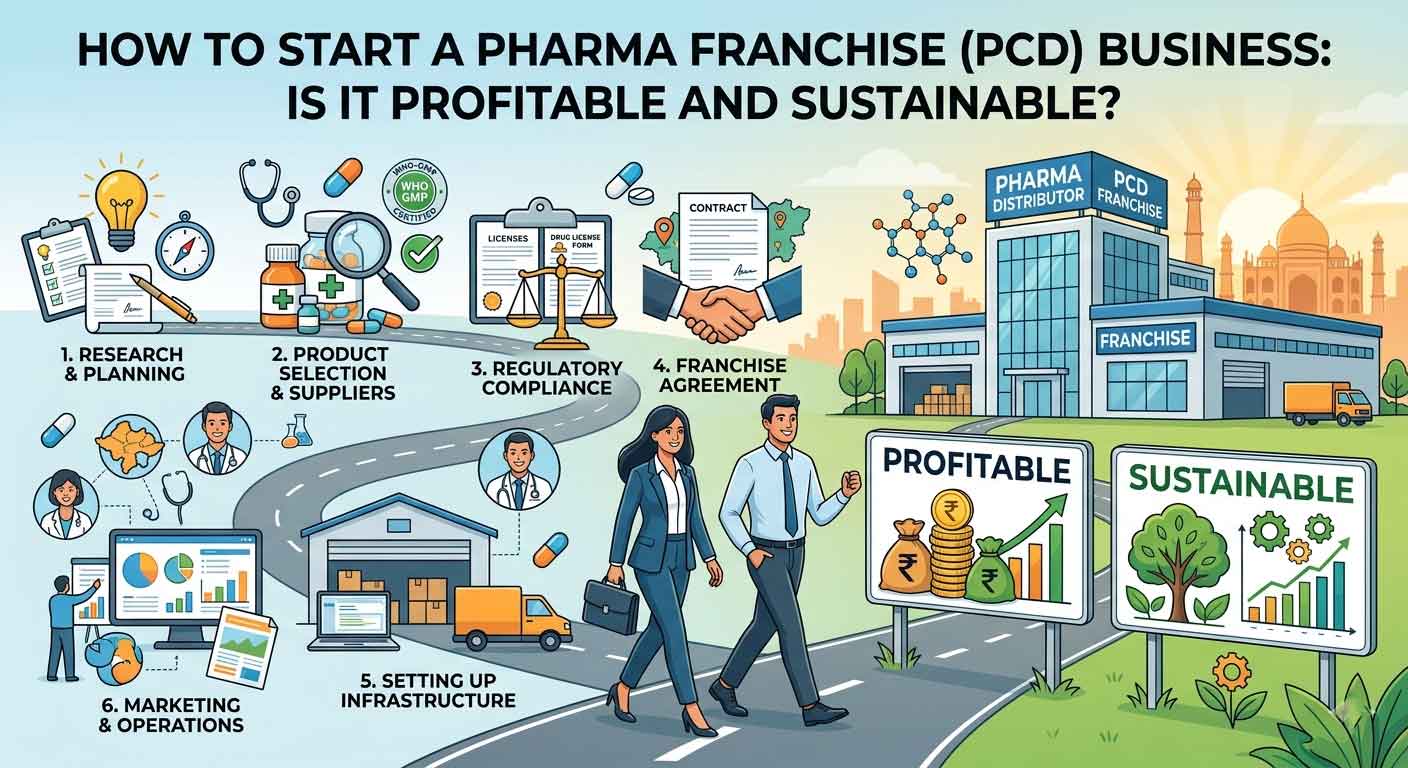
Step-by-Step Procedure
Step 1: Select the Business Model
Choose:
Branded stockist
Generic wholesaler
PCD distributor
Institutional supplier
OTC distributor
Cold-chain distributor
Mixed healthcare distributor
Step 2: Conduct Market Research
Survey retailers, hospitals, competitors and suppliers.
Step 3: Prepare a Business Plan
Estimate:
Territory
Customers
Sales
Margins
Expenses
Working capital
Break-even point
Step 4: Register the Business Entity
Select proprietorship, partnership, LLP or company.
Step 5: Finalize Premises
Confirm commercial suitability and licensing acceptability before committing major expenditure.
Step 6: Appoint the Competent Person
Collect qualification, experience, identity and appointment documents.
Step 7: Apply for Wholesale Drug Licence
Apply through the applicable State Licensing Authority portal or ONDLS.
Step 8: Complete GST and Local Registrations
Use a tax professional to determine the correct state and transaction structure.
Step 9: Install Storage and Software
Arrange racks, refrigerator, monitoring, computers and batch-wise software.
Step 10: Prepare Procedures and Registers
Cover receipt, storage, sale, return, expiry, complaint and recall.
Step 11: Obtain Distribution Appointments
Verify companies and sign written agreements.
Step 12: Register Customers
Collect customer licences and commercial information.
Step 13: Purchase Opening Stock
Purchase a controlled, demand-based product range.
Step 14: Begin Supply
Use proper invoices, batch allocation, dispatch and credit controls.
Step 15: Review Monthly Performance
Track sales, outstanding payments, expiry and profitability.
Common Mistakes
Avoid:
Starting without the applicable drug licence
Assuming GST alone permits medicine sale
Using another person’s licence
Employing a competent person only on paper
Taking an unsuitable residential premises
Purchasing too much opening stock
Giving unlimited retailer credit
Buying from unauthorized brokers
Ignoring batch and expiry
Mixing returned stock with saleable stock
Treating gross margin as net profit
Stocking food supplements without FSSAI
Treating medical devices as automatically covered
Supplying unverified buyers
Operating direct retail sales under only a wholesale licence
Accepting verbal expiry policies
Maintaining no recall records
Depending completely on one large customer
Frequently Asked Questions
1. Which licence is required for pharmaceutical wholesale business?
Forms 20-B and 21-B are commonly required for ordinary allopathic wholesale activity. Form 20-G applies where Schedule X wholesale activity is included.
2. Is a registered pharmacist compulsory for wholesale business?
Wholesale operations require an eligible competent person accepted by the Licensing Authority. A registered pharmacist is one possible route, but state authorities may recognize other prescribed qualification-and-experience routes.
3. What is the minimum shop area?
The ordinary minimum is generally 10 square metres for wholesale-only premises and 15 square metres for combined retail and wholesale operations.
4. Can a wholesaler sell directly to retail chemists?
Yes, subject to the retailer holding the applicable licence and the supply being made from the licensed wholesale premises.
5. Can a wholesaler sell directly to patients?
Not as ordinary retail dispensing under only a wholesale licence. The applicable retail drug licences and pharmacist requirements are needed.
6. Is GST registration compulsory?
It depends on turnover, state, interstate transactions and compulsory-registration provisions. Most organized pharmaceutical distributors obtain GST registration from the beginning.
7. Is FSSAI required for nutraceutical distribution?
Yes, the applicable FoSCoS registration or licence is required for food supplements and nutraceuticals.
8. Does a wholesale drug licence cover medical devices?
Not automatically. Applicable medical-device sale and distribution activities require examination under the Medical Devices Rules, including MD-41 and MD-42 premises registration.
9. How much money is needed?
There is no fixed amount. Investment depends on premises, inventory, customer credit, product range, cold chain and territory.
10. What profit margin can be expected?
Margins vary by company and business model. Net profit is often much lower than gross trade margin after rent, staff, delivery, expiry and bad debt.
11. Can one distributor handle several pharmaceutical companies?
Yes, subject to available space, licence scope, agreements, conflicts, inventory capacity and working capital.
12. Is wholesale medicine business profitable?
It can be profitable when the business has adequate turnover, disciplined credit, reliable suppliers, controlled inventory and low expiry losses.
Final Thoughts
A successful pharmaceutical distribution business requires more than obtaining a licence.
The complete business system is:
Market research → Business plan → Legal entity → Approved premises → Competent person → Wholesale drug licence → GST and category-specific registrations → Supplier appointments → Batch-wise inventory → Reliable delivery → Credit control → Expiry management → Sustainable profit
The strongest distributors are not necessarily those carrying the largest product range.
They are those that provide:
Genuine products
Consistent availability
Fast delivery
Accurate invoices
Controlled credit
Batch traceability
Clear expiry handling
Professional customer service
Looking for Ayurvedic Franchise or Distribution Opportunities?
Looking to start an Ayurvedic franchise, become a distributor, or launch your own herbal product range?
Elzac Herbal India offers:
Ayurvedic & Herbal Product Range
Franchise & Distribution Opportunities
Third-Party Manufacturing Services
Product Development Support
Marketing Guidance
PAN India Business Opportunities
Whether you are an entrepreneur, retailer, distributor, or healthcare professional, our team can help you explore the right business opportunity in the growing Ayurvedic sector.
Ajay Kamboj is an entrepreneur and business owners associated with many Ayurvedic and Pharmaceutical start-ups. With years of experience in Ayurvedic product marketing, pharmaceutical distribution, franchise development, and client relationship management, he regularly shares practical business insights based on real-world experiences. His articles focus on business growth, entrepreneurship, customer management, and lessons learned from the healthcare and wellness industry.
39 responses to “How to Start a Stockist, Wholesale and Distributor Business in the Pharmaceutical Sector”
I am a B.com graduate and working for a pharma company since one year , can i obtain a wholesale drug licence ?
I would like to know if the owner of a cancer drug manufacturer has a doctor son, would it amount to conflict of interest as per Food and drug admin or Medical Council of India
I am Naresh Pujari from Mumbai was planing to start at business of pharma distributor. My question was I am a commerce graduate and hold master degree in business administration. Can with this knowledge and degree Can I open or get the distributor ship for pharma product
Hello sir, I am post graduate in chemistry. I wants to take drug licence, what is the procedure. I wants to prepare 4 to 5 generic medicines from any pharma manufacturer and then sell these medicine from my own brand name. So what type of license we required. My brother is masters in physiotherapy and his own clenic since 10 years. Is he sutable for taking drug licence?? Please describe…. And what is the average cost.
Hello sir, I am post graduate in chemistry. I wants to take drug licence, what is the procedure. I wants to prepare 4 to 5 generic medicines from any pharma manufacturer and then sell these medicine from my own brand name. So what type of license we required. My brother is masters in physiotherapy and his own clenic since 10 years. Is he sutable for taking drug licence?? Please describe….
I work in a company which has warehouse in various states. I am B.Com & MBA with focused experience of 4 yrs in Pharma Sector. I have worked as RBM for a Pharma company for 1 yr previously.
I have 2 question.
1. Am I a competent person for getting the licence in my name? If yes, What I have to do to get the licence in my name?
2. My company wishes to start wholesale business of pharma in all its warehouse. What I have to do to obtain the licenses at different locations? Will the licence will be in the Company name for Different locations?
My company wishes to apply for Wholesale Drug licence at various places,For example : Ahmedabad , Gurgaon, Pune, Bangalore, Delhi and more.
1. Is the procedure and documentation same for each state?
2. what is the fees structure for each state? We would like to apply for licence 20 -B , 21 -B and 20 -G.
3. Any more additional fees other then for the above mentioned forms?
4. We will be only keeping drugs at our warehouse, only supplying logistics solution to the distributors or C&F or companies. We will not be dealing in Drugs. Do we still require the Licence 20-B , 21-B, 20-G ?
I m graduated in B.A. currently i m in Saudi Arabia, i want do wholesale business of pharmacutical, i want to know what is process and how much money will be invest for taking an one company.
Pls Advise me
Your Advice will be appreciable& important for me.
Hello sir, I am post graduate in chemistry. I wants to take drug licence, what is the procedure? can i become a distributor of drugs? i'm working in pharma company as a research analyst (analytical development ) from last one and half year. And also wanted to know if i started pharmacist shop do i need any certification or my M.Sc degree will be used.
I am running a partnership stockist.Now my partner wants break partnership in stockist business.My questions is ,Can I run this stockist business with previous Drug licence number.What is processed ? Electric connection,bank account,rent paper all on my name.If my partner gives affadebite that he leaves partnership in stockist then Can I run this stockist ?
How to finalize the deal with pharma companies and C&F after we get the license for distribution.
Can we get any deals with pharma companies and C&F through online, and kindly contact at 97xxxxxxxx/e.mail:baxxxxxxxx12@gmail.com if any pharma company or C&F looking for distributors.
We want start e pharmacy business india. So how can i deal directly to indian Pharmaceutical companies & which license required to start e pharmacy in india.
Dear All,
we want to become a stat wholesale business in medicines. how to to i start this and how to get license and all type requirements. please suggest n reply
Good Evening Sir,
My Self Abhimanyu Yadav. Sir me local me retail counter se orders lekar products ki supply kar ke kese profit earned kar sakta hu.Aur Mujhe products kaha se lena padega.
Email ID abhimanyu4337@gmail.com
9709185863
7488518667
Hi, I am a pharmacist. I wanna start a distribution business in surgical dressings and other disposable supplies. I need some clarity in that, like what products can be taken for distribution, how to know highly demand and new products n market….Do suggest

I am a B.com graduate and working for a pharma company since one year , can i obtain a wholesale drug licence ?
I would like to know if the owner of a cancer drug manufacturer has a doctor son, would it amount to conflict of interest as per Food and drug admin or Medical Council of India
i wan to know if parent of qualified doctor is allowed to acquire pharmaceutical drug manufacturing license??
I am Naresh Pujari from Mumbai was planing to start at business of pharma distributor.
My question was
I am a commerce graduate and hold master degree in business administration.
Can with this knowledge and degree
Can I open or get the distributor ship for pharma product
Hello sir, my name is Akshay babar I did B pharmacy and want to start medicine wholesale business can you pls help me how to start
Hello sir,
I am post graduate in chemistry.
I wants to take drug licence, what is the procedure.
I wants to prepare 4 to 5 generic medicines from any pharma manufacturer and then sell these medicine from my own brand name. So what type of license we required.
My brother is masters in physiotherapy and his own clenic since 10 years.
Is he sutable for taking drug licence??
Please describe….
And what is the average cost.
Hello sir,
I am post graduate in chemistry.
I wants to take drug licence, what is the procedure.
I wants to prepare 4 to 5 generic medicines from any pharma manufacturer and then sell these medicine from my own brand name. So what type of license we required.
My brother is masters in physiotherapy and his own clenic since 10 years.
Is he sutable for taking drug licence??
Please describe….
Hi,
I work in a company which has warehouse in various states.
I am B.Com & MBA with focused experience of 4 yrs in Pharma Sector. I have worked as RBM for a Pharma company for 1 yr previously.
I have 2 question.
1. Am I a competent person for getting the licence in my name? If yes, What I have to do to get the licence in my name?
2. My company wishes to start wholesale business of pharma in all its warehouse. What I have to do to obtain the licenses at different locations? Will the licence will be in the Company name for Different locations?
Kindly help me on a very URGENT basis.
Thanks.
Hi,
Thanks for your reply.
I have further question:
My company wishes to apply for Wholesale Drug licence at various places,For example : Ahmedabad , Gurgaon, Pune, Bangalore, Delhi and more.
1. Is the procedure and documentation same for each state?
2. what is the fees structure for each state? We would like to apply for licence 20 -B , 21 -B and 20 -G.
3. Any more additional fees other then for the above mentioned forms?
4. We will be only keeping drugs at our warehouse, only supplying logistics solution to the distributors or C&F or companies. We will not be dealing in Drugs. Do we still require the Licence 20-B , 21-B, 20-G ?
Kindly help on urgent basis.
Thanks
Dear Sir,
Good Morning
I m graduated in B.A. currently i m in Saudi Arabia, i want do wholesale business of pharmacutical, i want to know what is process and how much money will be invest for taking an one company.
Pls Advise me
Your Advice will be appreciable& important for me.
Hello sir,
I am post graduate in chemistry.
I wants to take drug licence, what is the procedure?
can i become a distributor of drugs? i'm working in pharma company as a research analyst (analytical development ) from last one and half year.
And also wanted to know if i started pharmacist shop do i need any certification or my M.Sc degree will be used.
Sir please tell me out of wholesale drug licence option which sector is the most profitable sector ?? On a big scale?
I am running a partnership stockist.Now my partner wants break partnership in stockist business.My questions is ,Can I run this stockist business with previous Drug licence number.What is processed ? Electric connection,bank account,rent paper all on my name.If my partner gives affadebite that he leaves partnership in stockist then Can I run this stockist ?
Can a twelth pass is capable of doing pharma wholesale business
Can a twelth pass is capable of doing business wholesale
If twelth pass has 4 year experience at wholesale drug firm as sales man. He/She could be capable of starting wholesale business
How to finalize the deal with pharma companies and C&F after we get the license for distribution.
Can we get any deals with pharma companies and C&F through online, and kindly contact at 97xxxxxxxx/e.mail:baxxxxxxxx12@gmail.com if any pharma company or C&F looking for distributors.
i have 2000sq/ft house plese contact me 9031480543 i want cipla delar sheep in shc bihar pin no 852201. contact me.
Hi,
Please suggest if I need Drug License only for medical grade gloves wholesale dealership.
Thanks.
Yes… You can purchase directly from CNF
We want start e pharmacy business india. So how can i deal directly to indian Pharmaceutical companies & which license required to start e pharmacy in india.
check out complete detail about e pharmacy in our article: How to start E-Pharmacy business in India?
Thanks very nice blog!|
i want to become a stat wholesale business in medicines. how to to i start this and how to get license and all type requirements.
Dear All,
we want to become a stat wholesale business in medicines. how to to i start this and how to get license and all type requirements. please suggest n reply
Good Evening Sir,
My Self Abhimanyu Yadav. Sir me local me retail counter se orders lekar products ki supply kar ke kese profit earned kar sakta hu.Aur Mujhe products kaha se lena padega.
Email ID abhimanyu4337@gmail.com
9709185863
7488518667
Aap products distributors se purchase krke supply kr skte hai
Sir i want to open a pharma company buy i dont have any warehouse and shop drug inspecter is asking for a shop so what should i do
Hi, I am a pharmacist. I wanna start a distribution business in surgical dressings and other disposable supplies. I need some clarity in that, like what products can be taken for distribution, how to know highly demand and new products n market….Do suggest
Hi Sir, i am BE graduate and don’t have any experience in medical line, still i can run this business…
I want to start chain of Pharmacies.
Looking for consultants to be assisting to get licence, GST REGN. etc.
kindly explain what is cnf and how to get a cnf licence and
I am a B.com graduate and working for a pharma company since one year , can i obtain a wholesale drug licence ?
No, Your qualification and experience isn’t eligible for wholesale drug license
Hi
I am interested in surgical items
I want Distributar for Bokaro Steel City 827003
I’m interested
The information shared is of top quality which has to get appreciated at all levels. Well done…