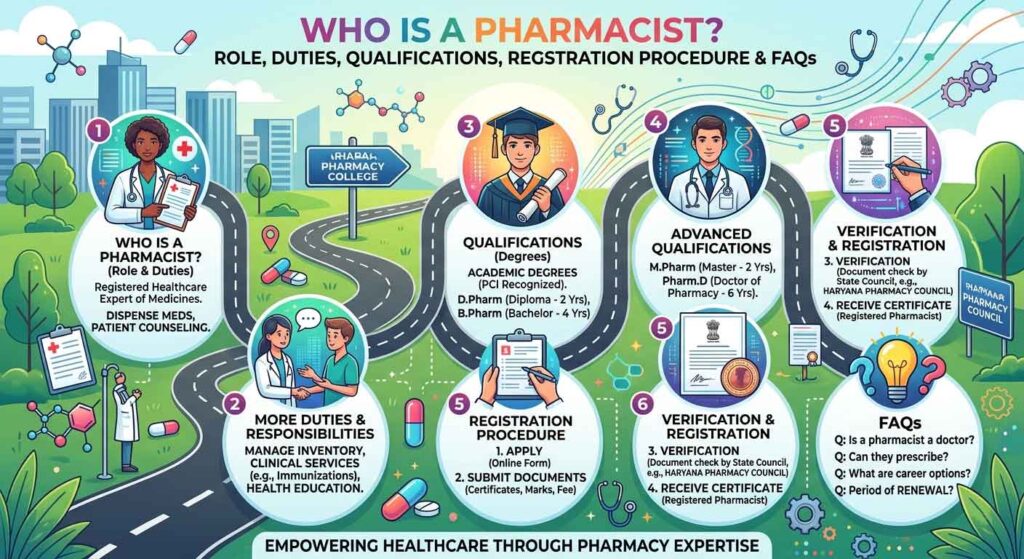
A pharmacist is a healthcare professional educated and trained in medicines, their proper use, dosage, storage, interactions, adverse effects, dispensing and pharmaceutical care.
Pharmacists work between:
Patients
Doctors
Hospitals
Pharmaceutical companies
Drug-distribution systems
Regulatory authorities
Their role extends beyond simply handing medicines to patients.
In a community or hospital setting, pharmacists help ensure that medicines are:
Correctly dispensed
Properly labelled
Safely stored
Used according to the prescription
Supplied with appropriate patient information
The Pharmacy Practice Regulations recognise activities such as prescription interpretation, dispensing, patient counselling, pharmaceutical care, drug-storage responsibility and maintenance of records as parts of pharmacy practice.
Quick Answer
A Registered Pharmacist is a person whose name is entered in the register maintained by the appropriate State Pharmacy Council under the Pharmacy Act, 1948.
For fresh registration, PCI currently identifies the principal approved qualifications as:
D.Pharm – 2 years plus 500 hours of practical training after 10+2
B.Pharm – 4 years after 10+2
Pharm.D – 6 years after 10+2
The qualification and institution/examination must satisfy PCI approval requirements. Registration itself is granted by the State Pharmacy Council.
For D.Pharm candidates, PCI states that the Diploma in Pharmacy Exit Examination Regulations, 2022 apply from the 2022–23 D.Pharm batch, subject to the applicable current implementation directions.
Who Is a Registered Pharmacist?
A Registered Pharmacist is a person whose name is currently entered in the register maintained by a State Pharmacy Council.
The Pharmacy Act requires each State Council to maintain a register containing information such as:
Name
Residential address
Date of first registration
Qualification
Professional address
Employer details where applicable
Registration is therefore different from merely passing D.Pharm, B.Pharm or Pharm.D.
Pharmacy Graduate vs Registered Pharmacist
A person may have:
B.Pharm Degree
but if the person has not obtained registration with the appropriate State Pharmacy Council, the person should not describe themselves as a Registered Pharmacist for professional dispensing purposes.
In simple terms:
Pharmacy qualification + State Pharmacy Council registration = Registered Pharmacist
Pharmacist Is Not Necessarily the Pharmacy Owner
The pharmacy business owner and the registered pharmacist can be different persons.
The Pharmacy Practice Regulations specifically contemplate a pharmacy owner appointing a registered pharmacist. The professional pharmacist is responsible for the pharmacy functions requiring pharmaceutical judgment and prescription dispensing.
For example:
Owner: ABC Medical Store, owned by Mr. X Registered Pharmacist: Ms. Y, B.Pharm, State Pharmacy Council Registration No. XXXX
The owner is responsible for operating the licensed business, while the pharmacist carries out the professional responsibilities required under pharmacy law and practice rules.
Who Can Dispense Prescription Medicines?
Section 42 of the Pharmacy Act provides that no person other than a registered pharmacist may compound, prepare, mix or dispense medicine on the prescription of a medical practitioner, subject to the statutory exceptions for medical practitioners.
Following the Jan Vishwas amendments, contravention of Section 42 can currently attract imprisonment of up to three months, a fine up to ₹2 lakh, or both.
Qualifications Required to Become a Registered Pharmacist
PCI currently identifies the following main qualifications approved for registration to practise pharmacy.
Qualification
General Duration
Registration Relevance
D.Pharm
2 years + prescribed practical training
Eligible subject to current requirements
B.Pharm
4 years
Eligible
Pharm.D
6 years
Eligible
The course and examination must be appropriately approved under the Pharmacy Act.
Is M.Pharm Required?
No.
M.Pharm is a postgraduate qualification after B.Pharm and is not required merely to obtain basic pharmacist registration.
A B.Pharm graduate can seek pharmacist registration based on the approved B.Pharm qualification.
However, postgraduate qualifications may be useful for specialised careers.
For example, the Pharmacy Practice (Amendment) Regulations, 2025 added M.Pharm (Pharmacy Practice) alongside Pharm.D for the specified Clinical Pharmacist position under the Pharmacy Practice Regulations.
D.Pharm Practical Training
PCI’s current FAQ specifies 500 hours of practical training as part of the D.Pharm route.
The practical training must satisfy the applicable Education Regulations and approved training arrangements.
It should not be assumed that:
Every B.Pharm graduate needs the same D.Pharm practical training, or
Training must always be completed only in a Primary Health Centre.
Requirements should be checked according to the course and State Pharmacy Council procedure.
D.Pharm Exit Examination
PCI states that the Diploma in Pharmacy Exit Examination Regulations, 2022 are applicable beginning with the 2022–23 D.Pharm batch.
After satisfying the applicable exit-examination requirements, the candidate may become eligible to seek registration subject to Section 32(2) of the Pharmacy Act and other applicable requirements.
Because PCI has issued subsequent implementation updates, current-batch students should check the latest PCI and State Pharmacy Council notices before applying.
Basic Eligibility for Pharmacist Registration
Under Section 32(2) of the Pharmacy Act, as summarised by PCI, an applicant generally must:
Have attained 18 years of age
Pay the prescribed fee
Reside or carry on the business/profession of pharmacy in the State
Have passed an approved examination, possess an approved qualification under Section 14, or be a registered pharmacist in another State
Registration is handled by the concerned State Pharmacy Council, not directly by PCI.
How to Apply for Pharmacist Registration
Step 1: Check Your Pharmacy College
Before applying, verify that:
The course was approved.
The institution had applicable PCI approval.
The examination was recognised for the relevant purpose.
PCI maintains lists of approved pharmacy institutions.
Step 2: Complete the Course
Complete the applicable:
D.Pharm
B.Pharm
Pharm.D
requirements.
Step 3: Complete Practical Training Where Required
D.Pharm students must satisfy the prescribed practical-training requirements.
Step 4: Complete Exit Examination Requirements Where Applicable
D.Pharm students covered by the 2022 regulations should verify their current exit-examination status.
Step 5: Select the Appropriate State Pharmacy Council
Apply to the Council for the State where you satisfy the applicable residence/professional requirements.
Step 6: Register on the State Council Portal
Many State Pharmacy Councils now provide online facilities for:
New registration
Renewal
Transfer
NOC
Additional qualification
Duplicate certificate
The exact system varies by State. PCI expressly states that registration, renewal and transfer are matters for State Pharmacy Councils.
Step 7: Upload the Required Documents
Commonly requested documents may include:
Photograph
Signature
Aadhaar/identity proof
Address proof
10th certificate
12th certificate
Pharmacy marksheets
Diploma/degree certificate
Provisional certificate
Practical-training certificate for D.Pharm
Affidavit or undertaking where required
Character certificate where required
Existing registration certificate for transfer cases
The exact checklist varies between State Councils.
Step 8: Pay the Prescribed Fee
Registration and renewal fees are fixed under the applicable State Pharmacy Council rules.
Step 9: Verification
The Council may verify:
Qualification
Institution approval
Examining authority
Practical training
Identity
Address
Previous registration
Step 10: Registration Certificate
After approval, the candidate’s name is entered in the State register and the registration certificate/number is issued.
Renewal of Pharmacist Registration
Registration validity and renewal procedures vary by State Pharmacy Council, and PCI advises candidates to approach the respective Council for current requirements.
The Pharmacy Practice Regulations also contain continuing-education expectations for renewal, including refresher-course provisions.
Therefore, pharmacists should not assume that obtaining a certificate once means no future action is ever required.
Keep updated with:
Renewal dates
Continuing-education requirements
Address changes
Employment changes
Additional qualifications
Transfer of Pharmacist Registration from One State to Another
Suppose a pharmacist is registered in State X but permanently moves to State Y.
Registration transfer/migration is handled through the relevant State Pharmacy Councils. PCI does not carry out the transfer itself.
The process can involve:
NOC
Previous registration certificate
Qualification documents
Address proof
Application
Verification between Councils
Surrender/migration formalities
Do not simply start using the old registration certificate in another State without checking the new State Council’s requirements.
Can a Pharmacist Have Registration in More Than One State?
The Pharmacy Act recognises a person already registered in another State when seeking registration, while PCI says registration and transfer are handled by State Pharmacy Councils. Individual councils may impose migration and surrender procedures.
For example, Haryana State Pharmacy Council currently expressly states that applicants should hold registration with only one State Pharmacy Council and should surrender another registration if they hold one.
Therefore, the practical advice is:
Use the official transfer/migration procedure of the two State Pharmacy Councils instead of maintaining multiple active registrations without confirmation.
Types of Pharmacists
The Pharmacy Practice Regulations recognise four important pharmacy-practice categories.
1. Community Pharmacist
A Community Pharmacist works in a community or retail pharmacy.
Main responsibilities include:
Prescription dispensing
Medicine supply
Patient counselling
Proper storage
Checking prescriptions
Providing medicine information
Community pharmacists are often the most easily accessible healthcare professionals for the public.
2. Hospital Pharmacist
A Hospital Pharmacist works within a hospital pharmacy service.
Responsibilities may include:
Inpatient medicine supply
Outpatient dispensing
Stock management
Drug information
Medicine-use monitoring
Collaboration with doctors and nurses
Adverse drug reaction reporting
Specialised preparations
The Pharmacy Practice Regulations describe hospital pharmacists as contributing to the safe, appropriate and cost-effective use of medicines.
3. Drug Information Pharmacist
A Drug Information Pharmacist provides reliable information regarding:
Dosage
Adverse effects
Drug interactions
Storage
Administration
Compatibility
Medicine use
Information may be supplied to:
Patients
Doctors
Dentists
Nurses
Other healthcare professionals
4. Clinical Pharmacist
A Clinical Pharmacist works more directly with patient-care teams to optimise medicine therapy.
Activities may include:
Medication review
Drug-interaction review
Therapeutic monitoring
Patient counselling
Drug information
Adverse-effect monitoring
Working with physicians and other healthcare professionals
The 2025 amendment specifically recognises Pharm.D or M.Pharm (Pharmacy Practice) in the relevant Clinical Pharmacist qualification provision.
Other Pharmacy Career Areas
Pharmacy graduates can also work in areas such as:
Pharmaceutical manufacturing
Quality Assurance
Quality Control
Regulatory Affairs
Pharmacovigilance
Clinical research
Research and Development
Medical affairs
Pharmaceutical marketing
Supply chain
Academia
Drug regulatory administration
However, these are career areas for pharmacy graduates, not necessarily separate legal categories of “Registered Pharmacist” under the Pharmacy Practice Regulations.
Main Roles and Duties of a Registered Pharmacist
1. Verify the Prescription
The pharmacist should assess whether the prescription is:
Legally valid
Complete
Appropriate for dispensing
The Pharmacy Practice Regulations require pharmaceutical assessment of prescriptions.
2. Check Patient Details
The pharmacist should consider information such as:
Patient identity
Age
Weight where relevant
Previous medication
Relevant patient factors
3. Check Dosage Form and Route
The prescription should be reviewed for appropriate:
Strength
Dosage form
Dose
Route
Duration of therapy
4. Check Medicine Compatibility
The pharmacist should consider possible:
Drug-drug interactions
Contraindications
Duplicate therapies
Adverse reactions
Potential misuse
5. Dispense the Correct Medicine
Actual dispensing to the patient is a professional responsibility of the registered pharmacist after verification.
The pharmacist should ensure:
Correct drug
Correct strength
Correct quantity
Valid expiry
Appropriate package
Correct label
6. Do Not Unilaterally Substitute a Prescription
This is another important point.
The Pharmacy Practice Regulations state that a registered pharmacist should dispense the medicine prescribed by the Registered Medical Practitioner and should not substitute the prescription. Unauthorised substitution is also listed as professional misconduct.
Therefore, a pharmacist should not automatically replace:
Brand A
with:
Brand B
simply because the composition appears the same, without following applicable prescription and professional requirements.
7. Patient Counselling
Counselling may include:
Medicine name
Dose
Dosage form
Route
Duration
Intended use
Special instructions
Precautions
Important interactions
Adverse effects
Storage
Missed-dose advice
Refill information
The Pharmacy Practice Regulations expressly recognise these elements of pharmacist counselling.
8. Promote Rational Use of Medicines
The pharmacist should support rational medicine use through:
Appropriate prescription review
Reliable drug information
Continuing education
Patient education
Critical assessment of medicine information
9. Maintain Patient Confidentiality
Patient and prescription information should be treated confidentially.
10. Maintain Records
The Pharmacy Practice Regulations provide for maintenance of medical/prescription records for five years and contain provisions for making records available upon valid request.
Separate requirements under the Drugs Rules may also apply to particular categories such as Schedule H1 or Schedule X medicines.
11. Proper Storage of Medicines
A pharmacist should help ensure medicines are stored according to:
Label requirements
Temperature
Moisture protection
Light protection
Security requirements
12. Identify Expired or Unsuitable Stock
Medicines should be checked for:
Expiry
Damage
Packaging integrity
Storage excursion
Recall status
13. Report Medicine-Related Problems
Depending on the workplace, pharmacists may participate in:
Adverse drug reaction reporting
Medication-error reporting
Product complaint reporting
Pharmacovigilance activities
Can Pharmacy Assistants Dispense Medicines?
Support staff may perform certain preparatory activities under proper supervision, but the Pharmacy Practice Regulations distinguish those activities from the actual dispensing of medicines to the patient, which is to be performed by the Registered Pharmacist after verification.
A store should therefore not display a pharmacist’s registration certificate while allowing unqualified sales staff to independently perform prescription dispensing.
Can a Pharmacist Give His Registration Certificate to a Medical Store Without Working There?
No.
The Pharmacy Practice Regulations expressly identify as professional misconduct:
Allowing a pharmacy owner to use the pharmacist’s registration certificate when the pharmacist does not attend the pharmacy
Giving the pharmacist’s registration certificate to more than one pharmacy
This practice is sometimes called certificate lending and should be avoided.
How Many Pharmacy Licences Can Use One Pharmacist Registration?
A registered pharmacist’s professional registration should not be used to provide simultaneous pharmacist coverage to multiple pharmacies.
The Pharmacy Practice Regulations specifically classify giving one’s pharmacist registration certificate at more than one pharmacy as professional misconduct.
Can a Registered Pharmacist Work Somewhere Else?
A pharmacist appointed as the responsible pharmacist at a pharmacy must actually be available to perform the required professional functions.
He or she cannot simultaneously:
Be shown as pharmacist-in-charge at two different pharmacies during the same working hours, or
Lend the certificate while working elsewhere.
Whether a pharmacist can undertake another non-conflicting job outside pharmacy hours depends on:
Employment contract
State Pharmacy Council rules
Drug-licence conditions
Government-service rules, if applicable
Does the Pharmacist Personally Apply for a Drug Licence?
Not necessarily.
A retail drug licence may be applied for by the:
Proprietor
Partnership
Company
Society/trust
Other eligible business entity
The business then appoints the required Registered Pharmacist for professional dispensing.
So:
Drug licence = licence for the business/premises
while:
Pharmacist registration = professional registration of the individual
They are related but they are not the same document.
Is Pharmacy Qualification Alone Enough for Working as a Pharmacist?
No.
For professional practice as a Registered Pharmacist, merely holding the degree/diploma is not enough.
The candidate must obtain registration through the appropriate State Pharmacy Council under the Pharmacy Act.
Pharmacist vs Chemist vs Pharmacy Owner
Term
Meaning
Pharmacist
Pharmacy professional
Registered Pharmacist
Person entered in the State Pharmacy Council register
Pharmacy
Professional practice/place where pharmacy services are provided
Pharmacy owner
Person/entity owning the pharmacy business
Chemist/Druggist
Drug retail establishment terminology used in the Drugs Rules/licensing context
Wholesale competent person
Person approved for applicable wholesale-drug supervision; not necessarily the same concept as Registered Pharmacist
A pharmacy owner does not become a pharmacist simply by obtaining a drug licence.
Pharmacist Registration Documents
Because each State Pharmacy Council has its own application procedure, applicants should not rely on one nationwide checklist.
Common requirements may include:
Application form
Photograph
Signature
Date-of-birth proof
10th certificate
12th certificate
Pharmacy course marksheets
Diploma/degree certificate
Practical-training certificate for D.Pharm
Identity proof
Address proof
Aadhaar details where required
Affidavit/undertaking where prescribed
Transfer/NOC documents for migration cases
Registration fee
PCI specifically advises candidates to contact the concerned State Pharmacy Council regarding registration, renewal and transfer procedures.
Frequently Asked Questions About Pharmacists
1. Who is a pharmacist?
A pharmacist is a trained healthcare professional specialising in medicines, dispensing, drug information, patient counselling and pharmaceutical care.
2. Who is a Registered Pharmacist?
A person whose name is entered in the register maintained by the appropriate State Pharmacy Council.
3. Who registers pharmacists in India?
The State Pharmacy Councils, not the Pharmacy Council of India, carry out individual pharmacist registration. PCI regulates pharmacy education standards and performs its statutory functions under the Pharmacy Act.
4. What is the minimum qualification?
PCI currently recognises D.Pharm, B.Pharm and Pharm.D as principal approved routes for registration, subject to approval and applicable requirements.
5. Is 500-hour training required for B.Pharm?
The 500-hour practical-training statement in PCI’s registration FAQ relates to the D.Pharm route. It should not be presented as a blanket requirement for all pharmacy graduates.
6. Is an exit exam required after D.Pharm?
PCI states that the Diploma in Pharmacy Exit Examination framework applies from the 2022–23 D.Pharm batch. Candidates should check the latest implementation directions for their batch before registration.
7. Can a B.Pharm graduate work as a pharmacist without registration?
Not as a Registered Pharmacist for functions legally reserved for registered pharmacists. State Pharmacy Council registration is required.
8. Can a pharmacist register in another State?
The Pharmacy Act recognises registration in another State as relevant to registration eligibility, and State Pharmacy Councils handle transfer/migration procedures.
9. Can one pharmacist registration be used at two chemist shops?
The Pharmacy Practice Regulations list giving one’s registration certificate at more than one pharmacy as professional misconduct.
10. Can a pharmacist lend the registration certificate to a pharmacy?
No. Allowing the registration certificate to be used without actually attending the pharmacy is expressly treated as professional misconduct.
11. Can a non-pharmacist own a pharmacy?
The professional pharmacist and pharmacy-business owner are not necessarily the same person. The pharmacy must appoint the required Registered Pharmacist for professional functions.
12. Can a pharmacist change one brand to another generic brand?
A pharmacist should not unilaterally substitute the prescription; the Pharmacy Practice Regulations specifically prohibit prescription substitution.
13. Can a pharmacist prescribe medicines?
Registration as a pharmacist should not be confused with registration as a medical practitioner. A pharmacist’s professional role includes dispensing, pharmaceutical assessment, counselling and pharmaceutical care according to applicable law and regulations.
14. Can a pharmacist diagnose disease?
A pharmacist can identify medicine-related concerns and provide pharmaceutical care, but pharmacist registration does not automatically confer the same diagnosis and prescribing authority as registration as a medical practitioner.
15. Is M.Pharm required to become a pharmacist?
No. Approved D.Pharm, B.Pharm and Pharm.D routes are recognised for registration. M.Pharm is a postgraduate qualification.
16. What qualification is recognised for a Clinical Pharmacist position?
The Pharmacy Practice Regulations were amended in 2025 so that the relevant Clinical Pharmacist provision recognises Pharm.D or M.Pharm (Pharmacy Practice).
17. Does pharmacist registration expire?
Validity and renewal rules vary among State Pharmacy Councils. Check the concerned Council rather than assuming one national renewal period.
18. Can a pharmacist work in another State using the old certificate?
The pharmacist should first comply with the registration/transfer requirements of the State Pharmacy Council where the profession is to be practised. PCI directs pharmacists to the State Councils for transfer procedures.
Career Opportunities After Pharmacy Education
Community and Healthcare
Community Pharmacist
Hospital Pharmacist
Clinical Pharmacist
Drug Information Pharmacist
Pharmacy Manager
Medication-safety roles
Pharmacovigilance
Pharmaceutical Industry
Production
Quality Assurance
Quality Control
Regulatory Affairs
Research and Development
Formulation development
Clinical research
Medical affairs
Pharmacovigilance
Pharmaceutical marketing
Product management
Government and Regulatory Sector
Opportunities may include recruitment for posts such as:
Government Pharmacist
Drug Inspector
Regulatory positions
Government hospitals
Public-health programmes
Eligibility for Drug Inspector, Drug Controller or similar posts is determined by the applicable recruitment and service rules; pharmacist registration alone does not automatically qualify a person for every such post. PCI itself states that recruitment eligibility is determined by the relevant government/private recruiting organisation.
Academics and Research
Career options may also include:
Teaching
Academic research
Clinical research
Drug information
Medical writing
Pharmaceutical research
Qualifications differ according to the position.
Final Thoughts
A pharmacist should not be viewed simply as the person whose certificate is needed to obtain a medical-store licence.
The profession has a much broader healthcare role:
Prescription → Pharmaceutical assessment → Correct dispensing → Patient counselling → Safe medicine use → Monitoring and documentation
The registered pharmacist helps connect the prescriber, medicine and patient.
At the same time, pharmacy owners should understand an important legal distinction:
Owning a pharmacy is a business activity. Practising as a pharmacist is a regulated healthcare profession.
Both must comply with their respective requirements.
Looking for Ayurvedic Franchise or Distribution Opportunities?
Looking to start an Ayurvedic franchise, become a distributor, or launch your own herbal product range?
Elzac Herbal India offers:
Ayurvedic & Herbal Product Range
Franchise & Distribution Opportunities
Third-Party Manufacturing
Product Development Support
Marketing Guidance
PAN India Business Opportunities
Whether you are an entrepreneur, retailer, distributor, or healthcare professional, our team can help you explore the right business opportunity in the growing Ayurvedic sector.
Ajay Kamboj is an entrepreneur and business owners associated with many Ayurvedic and Pharmaceutical start-ups. With years of experience in Ayurvedic product marketing, pharmaceutical distribution, franchise development, and client relationship management, he regularly shares practical business insights based on real-world experiences. His articles focus on business growth, entrepreneurship, customer management, and lessons learned from the healthcare and wellness industry.
3 responses to “Who Is a Pharmacist? Role, Duties, Qualifications, Registration Procedure & FAQs”
hi. I am post-graduate in msc organic chemistry…can I get a license for wholesale drug distribution
Iam a Pharmacist and have experience as a Pharmacisat since 3 years. I have good knowledge in pahrma distribution. I have good friends as medical representatives. I want to start to my own Pharmaceutical company.





hi. I am post-graduate in msc organic chemistry…can I get a license for wholesale drug distribution
Hi..I am science graduate in chemistry,so can I got wholesale drug distributor business licence.
Iam a Pharmacist and have experience as a Pharmacisat since 3 years. I have good knowledge in pahrma distribution. I have good friends as medical representatives. I want to start to my own Pharmaceutical company.