Consistency is one of the most important requirements in pharmaceutical manufacturing.
Every batch of a product should be manufactured using the same approved:
Formula
Raw materials
Equipment
Processing sequence
In-process controls
Yield limits
Packaging instructions
Storage conditions
A Master Formula Record provides the approved manufacturing instructions required to maintain this consistency.
It acts as the standard manufacturing document from which the batch-specific manufacturing and packaging records are prepared.
Quick Answer
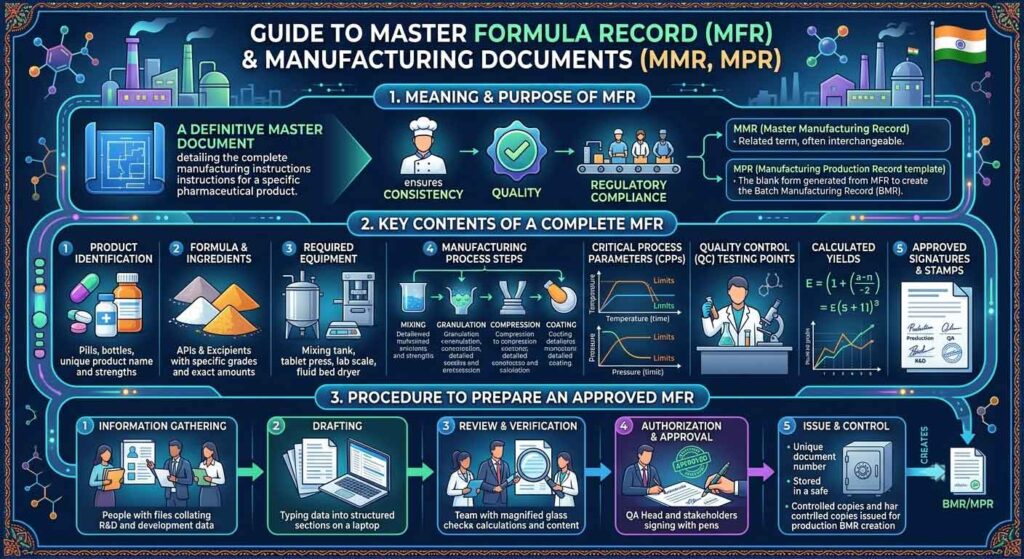
A Master Formula Record, or MFR, is an approved and controlled document containing the complete formula and step-by-step instructions for manufacturing and packing a defined product and batch size.
It normally includes:
Product details
Batch size
Complete composition
Material specifications
Equipment requirements
Processing instructions
In-process controls
Expected yields
Hold times
Packaging instructions
Storage conditions
Safety precautions
Approval and revision history
The MFR is the standard instruction. The Batch Manufacturing Record is the completed evidence showing what actually happened during the manufacture of one particular batch.
What Is a Master Formula Record?
A Master Formula Record can be defined as:
An authorized document containing the approved formula, materials, equipment, manufacturing instructions, in-process controls, yield limits, packaging requirements and precautions necessary to manufacture a specific product at a specified batch size.
It is also referred to in different companies as:
Master Formula
Master Manufacturing Record
Master Production Record
Manufacturing Master Formula
Master Processing Instructions
Master Batch Manufacturing Record
These terms are sometimes used interchangeably, but their exact meaning should be defined in the company’s documentation SOP.
Are MFR, MMR and MPR the Same?
The terms are closely related, but they are not automatically identical in every company.
Master Formula Record – MFR
The MFR normally focuses on:
Product formula
Manufacturing instructions
Material quantities
Processing parameters
In-process checks
Expected yields
Packaging requirements
Master Manufacturing Record – MMR
MMR is often used as another name for the approved manufacturing master.
In some companies, it may include both:
Manufacturing instructions
Packaging instructions
In other companies, the packaging instructions are controlled separately.
Master Production Record – MPR
MPR is another term used for the authorized master document from which batch production records are generated.
Some quality systems use MPR as a broader document covering:
Manufacturing
Processing
Packaging
Testing references
Recordkeeping instructions
Important Documentation Rule
A company should not use MFR, MMR and MPR randomly.
Its SOP should clearly define:
What each abbreviation means
Which document is considered the official master
Who prepares it
Who reviews it
Who approves it
How controlled copies are issued
How revisions are managed
Why Is a Master Formula Record Important?
An MFR helps ensure that:
Every batch follows the approved process.
Material quantities are calculated correctly.
Operators perform the steps in the correct order.
Critical parameters remain controlled.
In-process tests are performed at the correct stage.
Expected yield is monitored.
Deviations can be identified.
New employees receive standardized instructions.
Batch records are prepared consistently.
Product quality remains reproducible.
Manufacturing activities are traceable.
Without an approved master formula, different operators may manufacture the same product differently.
This can result in:
Batch-to-batch variation
Weight variation
Assay failure
Dissolution failure
Stability problems
Microbial contamination
Incorrect yield
Packaging errors
Regulatory observations
Product rejection or recall
Difference Between MFR and BMR
MFR and BMR are not the same documents.
Point
Master Formula Record
Batch Manufacturing Record
Purpose
Provides approved instructions
Records actual batch execution
Nature
Master or template document
Batch-specific completed record
Batch number
Normally blank or variable
Contains the actual batch number
Material quantities
Standard theoretical quantities
Actual issued and consumed quantities
Process parameters
Approved ranges or targets
Actual observations and results
Signatures
Prepared, reviewed and approved
Signed by operators and checking personnel
Deviations
Gives approved process
Records actual deviations
Frequency
Revised when necessary
Generated for every batch
Status
Controlled master
Executed GMP record
The BMR should be generated from the currently effective MFR.
An operator should not manufacture a commercial batch using:
An uncontrolled photocopy
An expired version
A handwritten formula
An unofficial spreadsheet
A previous batch record used as a master
Difference Between MFR and BPR
A Batch Production Record may include the complete record of:
Dispensing
Manufacturing
Processing
In-process testing
Packing
Reconciliation
Yield
Batch release review
In some companies:
BMR covers manufacturing.
BPR covers packaging or complete production.
BPR may mean Batch Packaging Record.
The company’s SOP should clearly define the terminology.
Difference Between MFR and SOP
An MFR is product- and batch-size-specific.
An SOP explains how to perform a general activity.
MFR Example
“Add 25 kg of ingredient A to the granulator and mix for 10 minutes at the approved speed.”
SOP Example
“Procedure for operating and cleaning the rapid mixer granulator.”
The MFR can refer to an approved SOP instead of reproducing every general operating instruction.
Difference Between MFR and Bill of Materials
A Bill of Materials primarily lists:
Raw materials
Packaging materials
Required quantities
Material codes
An MFR contains the Bill of Materials but also includes:
Manufacturing sequence
Equipment
Processing parameters
In-process controls
Yield
Precautions
Storage instructions
A Bill of Materials alone is not a complete Master Formula Record.
Who Prepares the Master Formula Record?
The MFR is generally prepared through cooperation between several departments.
Production Department
Production may prepare or provide:
Manufacturing sequence
Equipment details
Operating parameters
Processing times
In-process checks
Theoretical yields
Practical processing precautions
Research and Development
R&D may provide:
Approved formulation
Product-development report
Process-development data
Overages
Critical process parameters
Scale-up information
Hold-time recommendations
Quality Control
Quality Control may review or provide:
Raw-material specifications
In-process test methods
Finished-product specifications
Sampling instructions
Analytical references
Acceptance limits
Quality Assurance
Quality Assurance generally controls:
Document format
Document number
Review
Approval
Version control
Issuance
Retrieval
Change control
Archiving
QA should ensure that the document is consistent with:
Product approval
Validation status
Specifications
Applicable procedures
Regulatory commitments
Warehouse
The warehouse may provide input regarding:
Material codes
Dispensing units
Storage conditions
Material status
Container requirements
Material handling
Engineering
Engineering may verify:
Equipment identification
Equipment capacity
Utilities
Calibration requirements
Environmental requirements
Packaging Development
Packaging personnel may provide:
Pack configuration
Material specifications
Packaging sequence
Coding details
Reconciliation requirements
Artwork references
Who Approves the MFR?
The approval system depends on the company’s quality system.
The document is commonly approved by authorized representatives from:
Production
Quality Control
Quality Assurance
Additional review may be required from:
Research and Development
Regulatory Affairs
Packaging Development
Engineering
Safety or EHS
Quality Assurance should normally issue the document only after all required approvals are complete.
When Is a Separate MFR Required?
A separate approved master should normally be available for each:
Product
Strength
Dosage form
Batch size
Manufacturing process
Pack type, where relevant
Manufacturing location, where processes differ
For example, separate or formally linked master documents may be required for:
Paracetamol Tablets 500 mg – 1 lakh tablets
Paracetamol Tablets 500 mg – 5 lakh tablets
Paracetamol Tablets 650 mg – 1 lakh tablets
Paracetamol Suspension – 60 ml bottle
Paracetamol Suspension – 100 ml bottle
A simple mathematical multiplication of quantities may not be adequate when equipment, mixing time, drying time, granulation or yield changes with scale.
Contents of a Master Formula Record
A complete MFR may contain the following sections.
1. Document-Control Details
Include:
Document title
MFR number
Product code
Version number
Effective date
Superseded version
Page number
Copy number, where applicable
Department
Prepared by
Reviewed by
Approved by
2. Product Details
Include:
Brand or proprietary name
Generic name
Pharmacopoeial status
Dosage form
Strength
Product code
Product category
Batch size
Standard pack size
Theoretical batch quantity
3. Product Description
Mention the expected physical description, such as:
Colour
Shape
Odour
Appearance
Tablet identification
Capsule colour
Coating
Scoring
Printing or embossing
This should agree with the approved finished-product specification.
4. Complete Composition
The formula should include:
Active ingredients
Excipients
Processing aids
Solvents
Coating materials
Colours
Flavours
Preservatives
Purified water or other process media
For every material, mention:
Material name
Material code
Pharmacopoeial or internal grade
Quantity per unit
Quantity per batch
Unit of measurement
Specification reference
5. Ingredients That Disappear During Processing
Special mention should be made of materials that may be:
Evaporated
Removed
Consumed
Neutralized
Lost during drying
Used only as processing aids
Examples may include:
Purified water used for granulation
Organic solvent used in coating
Processing gases
Volatile flavours
These should still appear in the master formula even when they are not present in the same quantity in the finished product.
6. Overages
Any overage should be:
Clearly identified
Scientifically justified
Approved
Consistent with the product registration or permission
Supported by development or stability data
An overage should not be added merely to compensate for poor manufacturing control.
7. Raw-Material Calculation
The document should explain calculations relating to:
Potency correction
Moisture correction
Assay adjustment
Salt-equivalent calculation
Loss on drying
Excess quantity
Standardization of herbal extracts
Batch-size conversion
The formula should specify who performs and verifies the calculation.
8. Equipment and Processing Area
List the major equipment required, such as:
Sifter
Blender
Rapid mixer granulator
Fluid-bed dryer
Multimill
Compression machine
Coating machine
Capsule-filling machine
Manufacturing vessel
Homogenizer
Filling machine
Mention, where applicable:
Equipment identification
Capacity
Screen or mesh size
Tooling
Filter
Manufacturing area
Environmental classification
9. Equipment-Preparation Requirements
The MFR should include or refer to approved procedures for:
Cleaning
Line clearance
Assembly
Calibration
Sanitization
Sterilization
Leak testing
Filter integrity
Equipment-status verification
10. Environmental Conditions
Where relevant, specify requirements for:
Temperature
Relative humidity
Differential pressure
Air classification
Light protection
Nitrogen atmosphere
Microbial controls
Actual values should be recorded in the batch document.
11. Step-by-Step Manufacturing Instructions
Instructions should be written in the actual order of performance.
Each step should state:
What is to be done
Which material is used
Which equipment is used
Quantity to be added
Order of addition
Mixing speed
Mixing time
Temperature
Pressure
pH
Screen size
Drying endpoint
Holding condition
Operator and checker requirements
Avoid vague instructions such as:
“Mix properly”
“Heat sufficiently”
“Dry as required”
“Add slowly”
“Maintain suitable temperature”
Where these terms are used, measurable limits should be provided.
12. Critical Process Parameters
Critical parameters may include:
Mixing time
Mixing speed
Granulation endpoint
Drying temperature
Moisture content
Compression force
Tablet weight
Coating weight gain
Solution pH
Homogenization speed
Sterilization time and temperature
Filtration pressure
Filling volume
Parameters should agree with process-development and validation data.
13. In-Process Controls
The MFR should identify:
Test to be performed
Stage of sampling
Sampling quantity
Test frequency
Acceptance limit
Responsible department
Action if results are outside limits
Examples include:
Blend uniformity
Moisture
Tablet weight
Hardness
Thickness
Friability
Disintegration
Capsule fill weight
pH
Viscosity
Fill volume
Leak test
Appearance
14. Hold Times
Where applicable, define limits for holding:
Dispensed materials
Granules
Blends
Coating solution
Bulk liquid
Uncoated tablets
Coated tablets
Unpacked product
Intermediate material
Hold times should be supported by approved studies or risk assessment.
15. Intermediate Yield
The MFR should provide expected yield and acceptable limits at important stages.
Examples:
Granulation yield
Dried granule yield
Blend yield
Compression yield
Coating yield
Bulk liquid yield
Filling yield
16. Final Yield
Mention:
Theoretical yield
Expected yield
Acceptable yield range
Reconciliation requirement
Action for yield outside the limit
A significant unexplained yield difference should be investigated.
17. Sampling Instructions
Include or refer to procedures for:
In-process sampling
Finished-product sampling
Microbiological sampling
Retention samples
Stability samples
Environmental samples
18. Storage Conditions
Mention conditions for storing:
Intermediate product
Bulk product
Unpacked product
Finished product
Light-sensitive material
Moisture-sensitive material
Include:
Container type
Closure
Temperature
Humidity
Maximum hold time
Special protection
19. Safety Precautions
Include precautions relating to:
Potent materials
Hormones
Cytotoxic materials
Antibiotics
Solvents
Flammable materials
Dust exposure
Allergens
Corrosive substances
Personal protective equipment
20. Packaging Instructions
The packaging section may be included in the MFR or maintained as a separate Master Packaging Record.
It may contain:
Pack size
Container type
Closure type
Foil
Label
Carton
Insert
Measuring device
Desiccant
Shipper
Packaging-material codes
Standard quantities
Coding requirements
Reconciliation limits
Specimen or reference to approved artwork
21. Label and Coding Instructions
Mention:
Batch-number format
Manufacturing date
Expiry date
MRP
Licence details
Storage statement
Schedule warning
Barcode or QR code
Special caution
Coding location
The MFR should refer only to currently approved artwork.
22. Reprocessing and Recovery
The normal master formula should not automatically authorize unplanned reprocessing.
Where reprocessing or recovery is permitted, it should be handled through:
Approved procedure
Quality-risk assessment
Investigation
Written authorization
Defined limits
Traceable documentation
23. Attachments and References
The MFR may refer to:
Equipment SOPs
Cleaning SOPs
Specifications
Test methods
Artwork
Validation protocol
Safety data sheets
Environmental requirements
Sampling procedures
Calculation sheets
Procedure to Prepare a Master Formula Record
Step 1: Confirm the Approved Product Formula
Collect the authorized formula from:
Product development
Technology transfer
Product permission
Regulatory dossier
Validated existing process
Do not prepare a commercial MFR from an unapproved trial formula.
Step 2: Define the Product and Batch Size
Confirm:
Product name
Strength
Dosage form
Batch size
Manufacturing site
Manufacturing area
Pack sizes
The selected batch size should be compatible with equipment capacity and process validation.
Step 3: Collect Development and Scale-Up Data
Review:
Development batches
Pilot batches
Scale-up batches
Process-validation data
Stability data
Equipment trials
Deviation history
Previous process knowledge
Step 4: Prepare the Material List
Prepare a complete list of:
Active ingredients
Excipients
Processing aids
Coating ingredients
Solvents
Packaging materials
Use approved material names and codes.
Step 5: Calculate Batch Quantities
Calculate:
Standard batch quantity
Potency adjustment
Assay correction
Moisture correction
Overage
Theoretical yield
Unit quantity
All calculations should be independently checked.
Step 6: Select Equipment
Confirm that the equipment:
Has adequate capacity
Is qualified
Is suitable for the product
Is compatible with the process
Can achieve the required controls
Is covered by approved cleaning procedures
Step 7: Write the Manufacturing Sequence
Write instructions in the order in which operators will perform them.
A person unfamiliar with product development should be able to understand the process without guessing.
Step 8: Add Process Parameters
Include approved:
Time
Speed
Temperature
Pressure
pH
Mesh size
Moisture limit
Mixing sequence
Endpoint
Hold time
Step 9: Define In-Process Controls
Identify:
What will be tested
When it will be tested
Who will test it
The required limit
What to do if the result fails
Step 10: Define Yield Limits
Set:
Intermediate-yield limits
Final-yield limits
Reconciliation limits
Yield limits should be realistic and supported by process history or validation.
Step 11: Prepare Packaging Instructions
Include:
Complete packaging-material list
Packaging sequence
Coding instructions
Online checks
Reconciliation
Line-clearance requirements
Specimen labels or approved artwork references
Step 12: Cross-Functional Review
Circulate the draft to relevant departments.
Review should confirm that:
Formula is correct.
Specifications are current.
Equipment is suitable.
Process parameters are justified.
Tests are adequate.
Packaging is approved.
Safety requirements are included.
Regulatory commitments are followed.
Step 13: Execute Trial or Validation Batches
Where required, confirm the instructions through:
Exhibit batch
Scale-up batch
Process-validation batch
Packaging trial
Any necessary correction should follow documented review and approval.
Step 14: Approve the Master
The final document should be:
Signed
Dated
Assigned a version number
Given an effective date
Entered into document control
Issued by Quality Assurance
Step 15: Generate the Batch Record
A controlled batch-specific record should be prepared from the approved master.
It should include blank spaces for entering:
Actual batch number
Material batch numbers
Actual quantities
Equipment numbers
Processing times
Observations
Test results
Yields
Signatures
Deviations
Step 16: Train the Employees
Relevant employees should be trained before the new or revised MFR becomes effective.
Training may include:
Document changes
New process parameters
New equipment
New in-process limits
Safety requirements
Recording practices
Step 17: Withdraw the Previous Version
Once a revised version is effective:
Previous controlled copies should be retrieved.
Obsolete copies should be marked or destroyed.
One archival copy may be retained according to SOP.
Electronic access to superseded versions should be restricted.
Document Numbering Example
A company may adopt a numbering system such as:
MFR/TAB/PCM500/100K/003
Where:
MFR = Master Formula Record
TAB = Tablet
PCM500 = Product and strength
100K = Batch size
003 = Version or document sequence
The numbering system should be explained in the documentation SOP.
Suggested MFR Format
Header
Company name
Manufacturing site
Document title
Product name
Product code
MFR number
Batch size
Version number
Effective date
Page number
Approval
Function
Name
Signature
Date
Prepared by – Production
Reviewed by – QC
Reviewed by – QA
Approved by
Formula
S. No.
Material
Code
Specification
Qty./Unit
Qty./Batch
Unit
Equipment
S. No.
Equipment
Capacity
Equipment ID/Type
SOP Reference
Processing Instructions
Step
Instruction
Parameter
Limit
Reference
In-Process Controls
Stage
Test
Frequency
Limit
Responsibility
Yield
Stage
Theoretical Yield
Acceptable Range
Packaging Materials
S. No.
Material
Code
Specification
Standard Quantity
Revision History
Version
Effective Date
Change Description
Change-Control No.
Electronic vs Paper Master Formula Record
An MFR may be controlled through:
Paper documentation
Electronic document-management system
Validated manufacturing software
Validated ERP or MES system
Regardless of format, the system should ensure:
Only the current approved version is used.
Access is controlled.
Changes are traceable.
Electronic signatures are authorized.
Records are protected from deletion or unauthorized alteration.
Backup and recovery arrangements exist.
Printed copies are identified and controlled.
Operators can access the instructions at the point of use.
A printout from an electronic system should not be treated as an uncontrolled ordinary photocopy.
How to Correct an Error in an MFR
An approved master document should not be casually corrected by handwriting.
If an error is identified:
Stop issuing the incorrect version where necessary.
Assess the impact on batches already manufactured.
Raise a deviation or document-correction request.
Initiate change control where applicable.
Revise the master document.
Obtain required reviews and approval.
Issue the new version.
Withdraw the old version.
Train affected employees.
Corrections to an executed batch record should follow the company’s good-documentation-practice SOP.
When Should an MFR Be Revised?
Revision may be required following:
Formula change
Raw-material change
Specification change
Batch-size change
Equipment change
Manufacturing-site change
Process change
Parameter change
Packaging change
Artwork change
Validation outcome
Stability finding
Deviation trend
Regulatory requirement
Corrective or preventive action
A change should be evaluated through the formal change-control system before implementation.
Common MFR Preparation Mistakes
Avoid:
Copying an MFR from another product
Using unofficial material names
Missing material codes
Incorrect batch calculations
Unjustified overages
Vague processing instructions
Missing equipment capacity
Missing process parameters
Missing hold times
Unrealistic yield limits
Outdated specifications
Missing packaging reconciliation
Uncontrolled specimen labels
Issuing the document without QA approval
Using one MFR for incompatible batch sizes
Revising the process without change control
Allowing blank or excessive spaces
Failing to identify critical steps
Master Formula Record for Ayurvedic Products
The same documentation principle is useful for Ayurvedic manufacturing.
An Ayurvedic MFR may additionally include:
Sanskrit and common ingredient names
Botanical name
Part used
Raw-herb specifications
Extract ratio
Extractive value
Decoction or kwath preparation
Bhavana details
Shodhana procedure
Marana procedure
Number and duration of processing cycles
Mesh size
Drying conditions
Marker compounds
Raw-material standardization
Permitted preservative
Classical reference
Patent or proprietary formulation status
For herbal extracts, clarify whether quantities refer to:
Raw-herb equivalent
Native extract
Standardized extract
Extract with carrier
Dry extract
Soft extract
The approved Ayurvedic manufacturing licence, applicable pharmacopoeial standards and the manufacturer’s quality system should be followed.
Responsibilities During Batch Execution
Production
Production should:
Follow the current master.
Record activities at the time they occur.
Enter actual quantities and parameters.
Report deviations immediately.
Calculate yields.
Sign each required step.
Quality Control
QC should:
Perform required testing.
Record results.
Report out-of-specification results.
Ensure approved test methods are used.
Quality Assurance
QA should:
Issue the controlled batch record.
Verify line clearance.
Review deviations.
Review the completed record.
Confirm reconciliation.
Approve or reject the batch according to procedure.
Frequently Asked Questions
1. What is the full form of MFR?
MFR stands for Master Formula Record.
2. Is MFR the same as BMR?
No. MFR is the approved master instruction, while BMR is the completed record for a specific batch.
3. Who prepares an MFR?
Production or an authorized technical function commonly drafts it using approved development and process data. QA, QC and other relevant departments review and approve it according to company procedure.
4. Is a separate MFR required for every batch?
A new master is not prepared for every batch. A controlled batch record is generated from the approved MFR for each batch.
5. Is a separate MFR required for different batch sizes?
Normally, each approved batch size should have an appropriate master document unless a scientifically justified and controlled scalable system is used.
6. Can an MFR be maintained electronically?
Yes, provided the electronic system is appropriately controlled, secure and validated, and the authorized instructions are available at the point of use.
7. Can production change the MFR during manufacturing?
Production cannot make an unauthorized change. Any departure should be documented and approved according to deviation and change-control procedures.
8. What is a master packaging record?
It is the approved document containing packaging materials, pack configuration, packaging instructions, coding, online checks and reconciliation requirements.
9. What is theoretical yield?
Theoretical yield is the quantity expected from the formula before considering normal process loss.
10. Why are acceptable yield limits required?
Yield limits help identify abnormal material loss, process failure, calculation error or possible mix-up.
11. Should cleaning instructions be written fully in the MFR?
The MFR may include the instructions directly or refer to the relevant approved cleaning and equipment-operation SOPs.
12. How long should an MFR be retained?
The current approved master and superseded versions should be retained according to applicable regulatory requirements and the company’s record-retention SOP.
Final Thoughts
The Master Formula Record is one of the most important controlled documents in a pharmaceutical manufacturing facility.
It converts product-development knowledge into a standardized commercial manufacturing process.
A good MFR should be:
Accurate
Clear
Detailed
Approved
Traceable
Practical
Consistent with validation
Easy for trained operators to follow
Protected through document control
The document should provide enough information to manufacture the product consistently without requiring the operator to guess.
Looking for Ayurvedic Franchise or Distribution Opportunities?
Looking to start an Ayurvedic franchise, become a distributor, or launch your own herbal product range?
Elzac Herbal India offers:
Ayurvedic & Herbal Product Range
Franchise & Distribution Opportunities
Third-Party Manufacturing
Product Development Support
Marketing Guidance
PAN India Business Opportunities
Whether you are an entrepreneur, retailer, distributor, or healthcare professional, our team can help you explore the right business opportunity in the growing Ayurvedic sector.
Ajay Kamboj is an entrepreneur and business owners associated with many Ayurvedic and Pharmaceutical start-ups. With years of experience in Ayurvedic product marketing, pharmaceutical distribution, franchise development, and client relationship management, he regularly shares practical business insights based on real-world experiences. His articles focus on business growth, entrepreneurship, customer management, and lessons learned from the healthcare and wellness industry.
One response to “Master Formula Record: Meaning, Contents and Procedure to Prepare an MFR, MMR or MPR”
Dear sir
Please give standard format om my given email(bimal1963@gmail.com) of the following as-
Product name – Paracetamol Tabs.I.P. 500 mgs.
B.Size – 100,000 Tabs.
Avg. wt- 600Mgs.Round beveled with single break line in one side
With regards
Bimal nath jha.




Dear sir
Please give standard format om my given email(bimal1963@gmail.com) of the following as-
Product name – Paracetamol Tabs.I.P. 500 mgs.
B.Size – 100,000 Tabs.
Avg. wt- 600Mgs.Round beveled with single break line in one side
With regards
Bimal nath jha.