Batch number and Batch Manufacturing Record are two of the most important parts of pharmaceutical and Ayurvedic manufacturing documentation.
Every medicine, Ayurvedic product, supplement, syrup, tablet, capsule, oil, cream, or other dosage form manufactured in a licensed unit should be traceable from raw material to finished product. This traceability is mainly maintained through the batch number and batch manufacturing record.
A properly maintained batch record helps the manufacturer prove:
What was manufactured
When it was manufactured
Which raw materials were used
Who performed the manufacturing steps
Which machines were used
What quality checks were performed
How much product was produced
Whether the batch passed quality standards
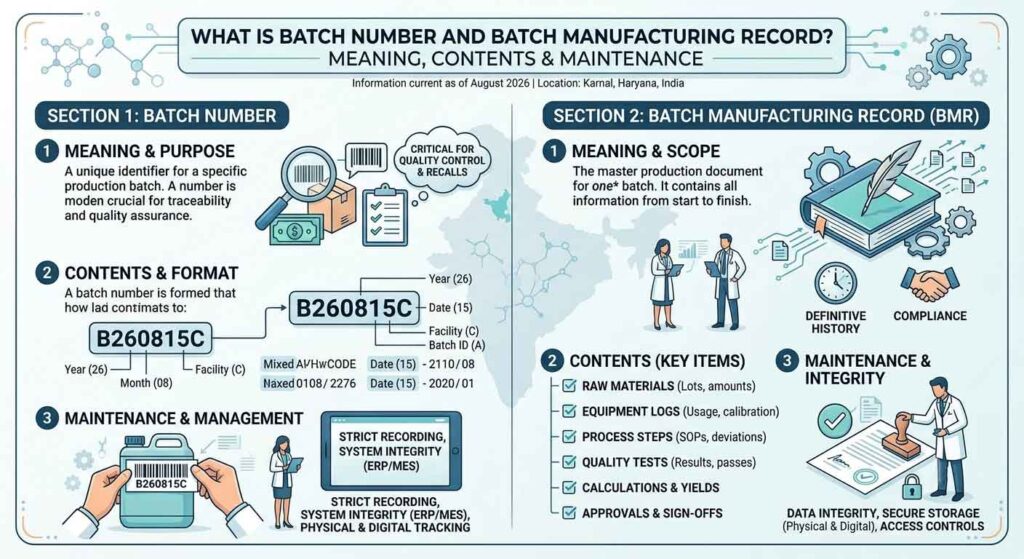
In simple words, a batch number identifies the product batch, and the Batch Manufacturing Record explains the complete history of that batch.
What Is Batch Number?
A batch number is a unique identification number assigned to a specific quantity of product manufactured in one manufacturing cycle.
It helps identify and trace a particular batch from manufacturing to distribution.
A batch number may help track:
Date of manufacturing
Product name
Batch size
Raw materials used
Manufacturing process
Quality control results
Packing details
Expiry details
Distribution details
Complaint or recall history
If any quality complaint arises in the market, the batch number helps identify which batch is involved and where that batch was supplied.
Simple Definition of Batch Number
A batch number is a unique code given to a specific batch of product so that its complete manufacturing, testing, packing, and distribution history can be traced.
Example of Batch Number
Suppose a company manufactures 5,000 bottles of an Ayurvedic liver syrup on 10 August 2026.
The batch number may be written as:
Batch No.: ALS-0826-01
This can be understood as:
ALS = Ayurvedic Liver Syrup
08 = Month of manufacturing
26 = Year of manufacturing
01 = First batch of that month
This is only an example. Every company should follow its own approved Batch Numbering SOP.
What Is Batch Manufacturing Record?
Batch Manufacturing Record, commonly called BMR, is a controlled document that contains the complete manufacturing history of a particular batch.
It records every important step from raw material dispensing to manufacturing, in-process checks, yield calculation, quality control sampling, packing, and batch release.
A BMR is not the same as a Master Formula Record.
The Master Formula Record is the approved standard formula and process for a product.
The Batch Manufacturing Record is the actual record of one specific batch manufactured according to that Master Formula Record.
Simple Definition of BMR
Batch Manufacturing Record is a document that records all manufacturing activities, raw material details, process steps, in-process checks, yield, deviations, and approvals related to one specific batch of a product.
Batch Number vs Batch Manufacturing Record
Point
Batch Number
Batch Manufacturing Record
Meaning
Unique identification code
Complete manufacturing document
Purpose
Identifies the batch
Records batch history
Used on label
Yes
No, maintained in factory records
Contains details
Limited code only
Full process details
Helps in recall
Yes
Yes
Maintained by
Production/QA system
Production, QC and QA departments
What Is Lot Number?
In many companies, batch number and lot number are used in a similar way. However, technically, a lot may sometimes refer to a specific quantity or subdivision of a batch.
For practical purposes in many pharma and Ayurvedic companies, batch number and lot number both help identify and trace a manufactured quantity of product.
Why Is Batch Number Important?
Batch number is important for:
Product traceability
Quality control
Market complaint investigation
Product recall
Stock management
Expiry tracking
Distribution records
Regulatory inspection
Legal compliance
Customer confidence
Without batch number, it becomes difficult to identify which product was manufactured when and under what conditions.
Why Is BMR Important?
BMR is important because it provides documentary proof that the product was manufactured according to approved process and quality standards.
A BMR helps verify:
Correct raw materials were used
Correct quantities were dispensed
Manufacturing process was followed
Equipment was cleaned and used properly
In-process tests were conducted
Yield was within acceptable limit
Deviations were recorded
Product was approved before release
In pharmaceutical manufacturing, if it is not recorded, it is generally treated as not done.
Contents of Batch Manufacturing Record
A BMR may vary according to dosage form and company procedure, but generally includes the following details:
1. BMR Control Details
This section identifies the document.
It may include:
BMR number
Product name
Product code
Batch number
Batch size
Page number
Version number
Effective date
Superseded version details
Controlled copy number
2. Product Details
This section contains product identity details.
It may include:
Brand name
Generic name
Dosage form
Strength
Pack size
Product category
Manufacturing licence number
Marketed by details, if applicable
3. Batch Details
Batch details may include:
Batch number
Lot number, if applicable
Batch size
Manufacturing date
Expiry date
Manufacturing start date
Manufacturing completion date
Packing start date
Packing completion date
4. Master Formula Reference
The BMR should refer to the approved Master Formula Record.
It may include:
MFR number
MFR version
Standard batch size
Product formula
Manufacturing process reference
Theoretical yield
Permissible yield limits
5. Raw Material Details
This section records every raw material used in the batch.
It may include:
Name of raw material
Grade
Quantity required
Quantity issued
Quantity used
AR number or control number
Supplier batch number
Manufacturer name
QC status
Weighed by
Checked by
Date and time of dispensing
For Ayurvedic products, botanical identity, part used, and quality status of herbs may also be recorded.
6. Packing Material Details
Packing material details may include:
Printed carton
Label
Foil
Bottle
Cap
Tube
Inner carton
Outer shipper
Leaflet
Quantity issued
Quantity used
Quantity returned
Quantity destroyed
Reconciliation details
Packing material reconciliation is important because printed material carries batch number, expiry date, MRP, and product identity.
7. Equipment and Machinery Details
The BMR should record the equipment used during manufacturing.
Examples:
Blender
Mixer
Granulator
Dryer
Compression machine
Coating pan
Filling machine
Sealing machine
Labeling machine
Pulverizer
Filter
Storage tank
The record may include:
Equipment ID
Cleaning status
Cleaning record reference
Calibration status, where applicable
Operator name
Production officer signature
8. Manufacturing Process Record
This is the main body of the BMR.
It records each step of manufacturing, such as:
Raw material dispensing
Sifting
Mixing
Grinding
Granulation
Drying
Blending
Compression
Coating
Filling
Filtration
Heating
Cooling
Packing
For each step, the following should be recorded:
Date
Start time
End time
Operator name
Supervisor name
Observations
Process parameters
Signature of responsible person
9. In-Process Quality Control Checks
In-process checks vary according to dosage form.
Examples include:
Tablets
Average weight
Weight variation
Hardness
Thickness
Friability
Disintegration time
Capsules
Average fill weight
Locking
Appearance
Weight variation
Liquids and Syrups
pH
Volume
Appearance
Specific gravity
Clarity
Fill volume
Creams, Ointments and Gels
Appearance
pH
Fill weight
Homogeneity
Leakage test
Ayurvedic Products
Colour
Odour
Taste, where applicable
Physical characteristics
Moisture
Extractive values
Microbial limits, where applicable
Heavy metals, where applicable
10. Environmental Condition Record
Where applicable, environmental conditions should be recorded.
This may include:
Temperature
Humidity
Differential pressure
Cleanliness status
Area clearance
Pest-control status
Water quality record, if relevant
Environmental records are especially important for sensitive products and controlled manufacturing areas.
11. Yield Calculation
Yield is the quantity of product obtained after manufacturing.
Maintains raw material, packing material, and finished goods movement records.
BMR in Third-Party Manufacturing
In third-party manufacturing, the actual BMR is maintained by the manufacturer because manufacturing is carried out at the manufacturer’s licensed premises.
The marketing company should ask for:
Batch number
Manufacturing date
Expiry date
Certificate of Analysis
Product label specimen
Invoice details
Dispatch details
Testing report, where applicable
For internal records, the marketing company should maintain batch-wise purchase, sale, complaint, and recall details.
Final Thoughts
Batch number and Batch Manufacturing Record are essential for traceability, quality assurance, compliance, and product safety.
A batch number identifies the product batch, while the BMR records the complete manufacturing history of that batch.
Every licensed pharmaceutical and Ayurvedic manufacturer should maintain accurate batch records, follow approved SOPs, record entries at the time of activity, and review BMR before batch release.
Good documentation is not only a regulatory requirement. It is also a strong foundation for quality, trust, and long-term business growth.
Frequently Asked Questions
1. What is batch number?
A batch number is a unique identification code assigned to a specific batch of product for traceability.
2. What is Batch Manufacturing Record?
Batch Manufacturing Record is a complete document that records all manufacturing details of a specific batch, including raw materials, process steps, equipment, tests, yield, deviations, and approvals.
3. Why is batch number important?
Batch number helps trace the product during quality checks, complaints, recalls, expiry tracking, and distribution.
4. What is the difference between batch number and BMR?
Batch number is the identification code of the batch. BMR is the complete manufacturing record of that batch.
5. Who prepares BMR?
BMR is usually issued by QA and filled by production, QC, store, and other concerned departments during manufacturing and batch release.
6. Can BMR be filled after manufacturing?
No. BMR should be filled during the manufacturing process at the time each activity is performed.
7. What records are attached with BMR?
Common attachments include raw material records, packing material records, cleaning records, in-process test records, QC reports, yield calculations, and packing specimens.
8. Does Ayurvedic manufacturing require BMR?
Yes. Ayurvedic, Siddha, and Unani manufacturing units are also required to maintain batch manufacturing records for manufactured batches.
9. What is Master Formula Record?
Master Formula Record is the approved standard formula and manufacturing process for a product and batch size. BMR records the actual manufacturing of one batch.
10. Who approves final batch release?
Final batch release is usually approved after review by Production, Quality Control, and Quality Assurance as per company procedure.
Looking for Ayurvedic Franchise or Distribution Opportunities?
Looking to start an Ayurvedic franchise, become a distributor, or launch your own herbal product range?
Elzac Herbal India offers:
Ayurvedic & Herbal Product Range
Franchise & Distribution Opportunities
Third-Party Manufacturing
Product Development Support
Marketing Guidance
PAN India Business Opportunities
Whether you are an entrepreneur, retailer, distributor, or healthcare professional, our team can help you explore the right business opportunity in the growing Ayurvedic sector.
Ajay Kamboj is an entrepreneur and business owners associated with many Ayurvedic and Pharmaceutical start-ups. With years of experience in Ayurvedic product marketing, pharmaceutical distribution, franchise development, and client relationship management, he regularly shares practical business insights based on real-world experiences. His articles focus on business growth, entrepreneurship, customer management, and lessons learned from the healthcare and wellness industry.






Leave a Reply
You must be logged in to post a comment.