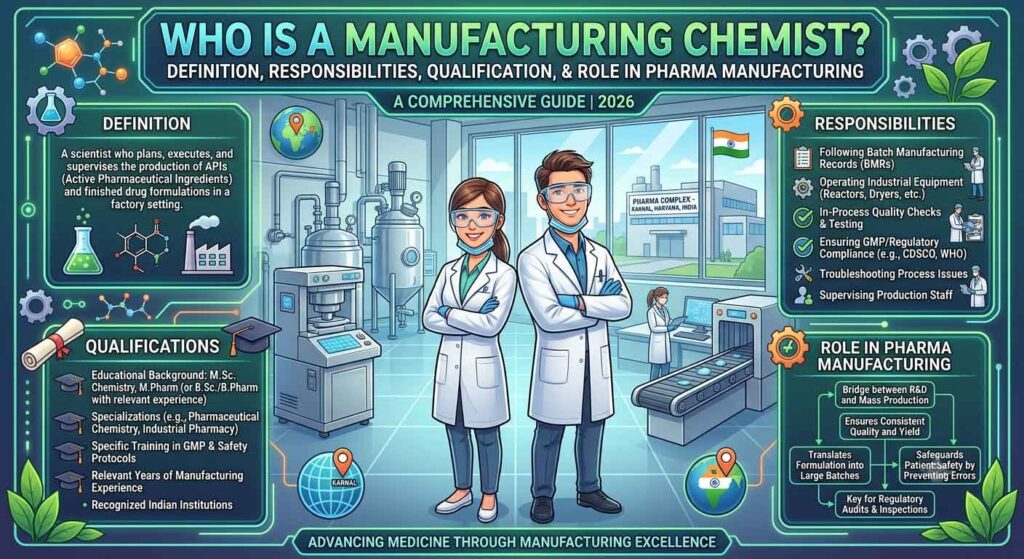
A manufacturing chemist is one of the most important technical persons in a pharmaceutical manufacturing unit. He or she is responsible for supervising the manufacturing process, maintaining production standards, following approved procedures, and ensuring that every batch is manufactured according to required quality and regulatory norms.
In many pharmaceutical units, a manufacturing chemist is also called a Production Chemist or Production Officer.
Without the involvement and approval of competent production staff, a manufactured batch cannot move properly from production to further stages such as quality control, packing, finished goods store, or dispatch.
What Is a Manufacturing Chemist?
A manufacturing chemist is an authorized technical person responsible for conducting, supervising, and controlling manufacturing activities in a pharmaceutical production unit.
The manufacturing chemist ensures that medicines are manufactured:
As per approved Master Formula Record
As per Standard Operating Procedures
In a GMP-compliant environment
With proper documentation
Under controlled manufacturing conditions
According to required quality standards
The role is not limited to physically making the product. A manufacturing chemist also guides workers, supervises production activities, checks process parameters, coordinates with quality departments, and maintains batch records.
Simple Definition of Manufacturing Chemist
A manufacturing chemist is a qualified and approved technical person who supervises the manufacturing of pharmaceutical products and ensures that production is carried out according to approved procedures, regulatory requirements, and quality standards.
Manufacturing Chemist vs Production Chemist
In practical industry language, both terms are often used for similar roles.
Manufacturing Chemist
This term is commonly used in licensing, regulatory, and technical documents.
Production Chemist
This term is commonly used in day-to-day factory operations and job descriptions.
In many companies, the same person may be referred to as both manufacturing chemist and production chemist.
Why Is a Manufacturing Chemist Important?
Pharmaceutical manufacturing is a regulated activity. Medicines directly affect human and animal health, so their production must be controlled at every step.
A manufacturing chemist helps ensure:
Correct raw materials are used
Manufacturing process is followed properly
Equipment is operated correctly
Batch records are maintained
Production workers follow instructions
GMP and hygiene standards are maintained
Deviations are reported
Product quality is not compromised
A small mistake in manufacturing can affect product quality, patient safety, and company reputation. That is why the role of a manufacturing chemist is highly responsible.
Main Job Responsibilities of a Manufacturing Chemist
The job responsibilities of a manufacturing chemist may vary according to company size, dosage form, and product category, but commonly include the following:
1. Supervision of Manufacturing Activities
The manufacturing chemist supervises day-to-day production activities such as:
Dispensing of raw materials
Mixing
Granulation
Compression
Coating
Filling
Sealing
Packing coordination
Cleaning and line clearance support
2. Following Master Formula Record
Every product has an approved Master Formula Record. The manufacturing chemist ensures that the batch is manufactured according to this approved formula and process.
3. Maintaining Batch Manufacturing Records
Batch Manufacturing Record, also known as BMR, is one of the most important documents in pharmaceutical production.
The manufacturing chemist records and verifies:
Raw material details
Batch number
Quantity used
Processing steps
Machine details
Process timings
Yield
In-process checks
Deviations, if any
4. Coordination with QA and QC Departments
Manufacturing does not work alone. The manufacturing chemist coordinates with:
Quality Assurance department
Quality Control department
Store department
Packing department
Maintenance department
This coordination helps maintain smooth production and product quality.
5. Ensuring GMP Compliance
A manufacturing chemist must ensure that production is carried out under Good Manufacturing Practices.
This includes:
Proper hygiene
Clean equipment
Correct area conditions
Proper documentation
Prevention of contamination
Line clearance before production
Following SOPs
6. Guiding Workers and Supervisors
The manufacturing chemist instructs factory workers, operators, and supervisors about:
Production process
Machine operation
Safety precautions
Cleaning procedures
Handling of materials
Documentation requirements
7. Technical Support During Manufacturing
During production, technical issues may arise. The manufacturing chemist helps resolve practical problems related to:
Mixing
Granules
Tablet weight variation
Machine setting
Filling volume
Product appearance
Process timing
Yield variation
8. Maintaining Production Records
Documentation is a major part of pharmaceutical manufacturing.
A manufacturing chemist may maintain or verify:
Batch Manufacturing Record
Equipment logbook
Cleaning record
Production planning record
Line clearance record
Yield record
Deviation record
SOP compliance record
9. Reporting Deviations
If any process does not follow the approved method, the manufacturing chemist must report it to the concerned department.
Examples include:
Wrong quantity
Process delay
Machine breakdown
Yield loss
Mixing issue
Environmental variation
Any abnormal observation during production
10. Supporting Regulatory Inspections
During inspections by drug authorities, the manufacturing chemist may need to explain production procedures, batch records, SOPs, and manufacturing practices.
Qualification Required for Manufacturing Chemist
For a pharmaceutical production unit, a registered pharmacist alone is not enough.
A person may become a registered pharmacist after D.Pharm, B.Pharm, or higher pharmacy qualification, but manufacturing approval requires specific qualification and practical experience as per applicable rules and licensing authority requirements.
In general, the commonly accepted qualification pattern for manufacturing chemist approval is:
For Allopathic Pharmaceutical Manufacturing
A person may generally be eligible if he or she has:
B.Pharm or degree in Pharmaceutical Chemistry with required manufacturing experience
or
B.Sc. with Chemistry or Microbiology, with longer practical experience in pharmaceutical manufacturing
or
Other applicable science, medicine, engineering, or technical qualification as permitted for specific product categories by the licensing authority
Commonly discussed industry requirement:
B.Pharm with minimum 18 months practical experience in pharmaceutical manufacturing
or
B.Sc. with minimum 3 years practical experience in pharmaceutical manufacturing
However, the final approval depends on the State Drug Licensing Authority and product category.
Is B.Pharm Enough to Open a Pharma Manufacturing Unit?
B.Pharm qualification is important, but qualification alone is not always enough.
For a pharma production unit, you need:
Approved manufacturing chemist
Approved analytical chemist
Suitable premises
Required machinery
Quality control arrangement
Drug manufacturing licence
GMP compliance
Proper documentation
Approval from the concerned licensing authority
If you have B.Pharm but no required manufacturing experience, you may not be approved as a manufacturing chemist immediately.
Difference Between Registered Pharmacist and Manufacturing Chemist
Many beginners confuse these two terms.
Registered Pharmacist
A registered pharmacist is a person registered with the State Pharmacy Council and is generally required for retail or wholesale drug sale-related activities.
Manufacturing Chemist
A manufacturing chemist is a qualified and approved technical person responsible for manufacturing activities in a pharmaceutical production unit.
A registered pharmacist qualification may be sufficient for certain marketing, distribution, retail, or wholesale activities, but it is not automatically sufficient for running a manufacturing unit.
Manufacturing Chemist and Analytical Chemist: Difference
A manufacturing chemist and analytical chemist both are important in a pharma manufacturing unit, but their roles are different.
Manufacturing Chemist
Responsible for production and manufacturing process.
Analytical Chemist
Responsible for testing, analysis, quality control, and release-related testing of raw materials, in-process materials, and finished products.
In simple words:
Manufacturing Chemist makes the product. Analytical Chemist tests the product.
Skills Required for a Good Manufacturing Chemist
A good manufacturing chemist should have:
Technical knowledge of dosage forms
Understanding of GMP
Knowledge of SOPs
Documentation skills
Production planning ability
Team handling skills
Problem-solving ability
Knowledge of machines and process flow
Coordination ability with QA and QC
Attention to detail
Common Departments Where Manufacturing Chemists Work
Manufacturing chemists may work in different dosage form sections such as:
Tablet section
Capsule section
Liquid oral section
Dry syrup section
Ointment and cream section
Injection section
Powder section
External preparation section
Ayurvedic manufacturing section
Nutraceutical manufacturing section
The required experience and approval may vary according to the product category.
Final Thoughts
A manufacturing chemist is a key technical person in any pharmaceutical manufacturing unit.
He or she is responsible for supervising production, maintaining quality systems, following GMP, guiding workers, coordinating with quality departments, and ensuring that each batch is manufactured according to approved procedures.
For anyone planning to start a pharma manufacturing unit, appointing a qualified and approved manufacturing chemist is one of the most important licensing and operational requirements.
A pharma marketing company may require a drug licence and registered pharmacist support, but a pharma manufacturing unit requires approved technical staff, including a manufacturing chemist and analytical chemist.
Frequently Asked Questions
1. Who is a manufacturing chemist?
A manufacturing chemist is a qualified technical person responsible for supervising pharmaceutical manufacturing activities and ensuring that products are manufactured according to approved procedures and quality standards.
2. Is manufacturing chemist the same as production chemist?
In many companies, both terms are used for similar roles. Manufacturing chemist is more commonly used in regulatory and licensing context, while production chemist is commonly used in factory operations.
3. What is the minimum qualification for manufacturing chemist?
Commonly, B.Pharm with required practical manufacturing experience or B.Sc. with longer manufacturing experience may be considered. Final approval depends on the product category and State Drug Licensing Authority.
4. Is B.Pharm enough to become a manufacturing chemist?
B.Pharm is an important qualification, but practical manufacturing experience is generally required for approval as a manufacturing chemist.
5. Can a registered pharmacist become a manufacturing chemist?
A registered pharmacist may not automatically qualify as a manufacturing chemist. Manufacturing approval requires specific qualification and practical experience.
6. What is the role of manufacturing chemist in batch production?
The manufacturing chemist supervises production, follows the Master Formula Record, maintains batch records, guides workers, and ensures GMP compliance.
7. Can a pharma manufacturing unit run without a manufacturing chemist?
No. A pharmaceutical manufacturing unit requires approved competent technical staff for manufacturing activities.
Looking for Ayurvedic Franchise or Distribution Opportunities?
Looking to start an Ayurvedic franchise, become a distributor, or launch your own herbal product range?
Elzac Herbal India offers:
Ayurvedic & Herbal Product Range
Franchise & Distribution Opportunities
Third-Party Manufacturing Services
Product Development Support
Marketing Guidance
PAN India Business Opportunities
Whether you are an entrepreneur, retailer, distributor, or healthcare professional, our team can help you explore the right business opportunity in the growing Ayurvedic sector.
Ajay Kamboj is an entrepreneur and business owners associated with many Ayurvedic and Pharmaceutical start-ups. With years of experience in Ayurvedic product marketing, pharmaceutical distribution, franchise development, and client relationship management, he regularly shares practical business insights based on real-world experiences. His articles focus on business growth, entrepreneurship, customer management, and lessons learned from the healthcare and wellness industry.
5 responses to “Who Is a Manufacturing Chemist? Definition, Responsibilities, Qualification and Role in Pharma Manufacturing”
Sir I am Bsc electronic but I have experience of manufacturing in pharmaceutical from last 5 years can I become manufacturing chemist




Sir I am Bsc electronic but I have experience of manufacturing in pharmaceutical from last 5 years can I become manufacturing chemist
Can an analytical chemist having a work experience of 8 years become a manufacturing chemist?
NO Sir,
Analytical chemist can’t be consider as manufacturing chemist after any number of years expereince
can an Industrial chemist become a manufacturing chemist?
I have many years working as a jungle chemist in Bolivia. Can I become a manufacturing chemist in India?