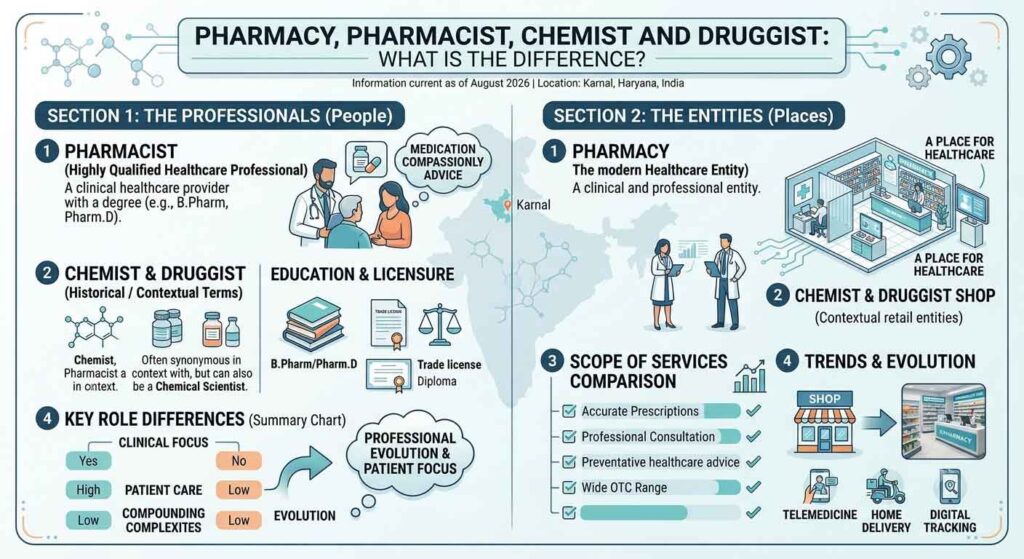
The words pharmacy, pharmacist, chemist, druggist and drugstore are commonly used in the Indian pharmaceutical sector. Although people often use these terms interchangeably, they do not mean exactly the same thing.
The simplest distinction is:
A pharmacy is a place, facility or professional field associated with preparing, dispensing and supplying medicines.
A pharmacist is a qualified and registered healthcare professional.
A chemist and druggist is generally a licensed medicine retail establishment that employs a registered pharmacist but does not maintain facilities for compounding prescriptions.
A drugstore is a description used for a licensed premises where the applicable licence does not require the services of a registered pharmacist.
Understanding these differences is useful for pharmacy students, retail medicine-shop owners, entrepreneurs and consumers.
Quick Comparison
Term
What It Refers To
Person or Premises?
Main Function
Pharmacy
Professional field or licensed premises
Field/place
Dispensing, preparing or compounding medicines
Pharmacist
Qualified and registered professional
Person
Supervises and performs professional pharmacy services
Chemist and Druggist
Licensed medicine retail establishment
Business premises
Sells and dispenses medicines without maintaining a compounding pharmacy
Drugstore
Licensed premises under the applicable category
Business premises
Stocks and sells drugs allowed under its licence
Pharmaceutical Chemist
Description connected with a pharmacy maintaining compounding facilities
Professional/business description
Preparation, compounding and dispensing
What Is Pharmacy?
The word pharmacy can have more than one meaning.
Pharmacy as a Profession
Pharmacy is the healthcare profession concerned with:
Medicines
Their preparation
Safe storage
Quality
Dispensing
Correct use
Patient counselling
Prevention of medication-related problems
Pharmacy education includes subjects such as pharmaceutics, pharmacology, medicinal chemistry, pharmacognosy, pharmaceutical analysis and pharmacy practice.
Pharmacy as a Place
A pharmacy may also mean a licensed store, hospital department or other facility where medicines are dispensed, prepared or compounded.
Under the Drugs Rules, the term covers a shop or place where activities such as the following are carried out:
Drugs are measured, weighed, prepared or supplied.
Prescriptions are compounded.
Medicines are prepared.
Signs such as “Pharmacy,” “Pharmacist,” “Dispensing Chemist” or “Pharmaceutical Chemist” are displayed in connection with these activities.
Therefore, “pharmacy” refers not merely to a shop selling packaged medicines, but historically and legally to premises equipped to perform professional dispensing and compounding functions.
What Is a Pharmacist?
A pharmacist is a person, not a shop.
A registered pharmacist is someone whose name is entered in the register maintained by the State Pharmacy Council of the state where the person resides or practises the profession of pharmacy.
Recognised pharmacy qualifications may include:
Diploma in Pharmacy
Bachelor of Pharmacy
Doctor of Pharmacy
However, completing a pharmacy course does not by itself complete the legal process. The qualified person must also obtain registration from the appropriate State Pharmacy Council before practising as a registered pharmacist.
What Does a Pharmacist Do?
Depending on the workplace and applicable rules, a pharmacist may:
Review prescriptions.
Dispense medicines.
Check the medicine, strength and dosage form.
Explain how medicines should be taken.
Warn patients about relevant precautions.
Maintain prescription and sales records.
Store medicines under suitable conditions.
Supervise the sale of prescription medicines.
Monitor expiry dates and stock.
Assist in identifying possible medication errors.
Compound or prepare medicines where appropriate facilities are maintained.
Pharmacists may work in:
Community pharmacies
Hospitals
Pharmaceutical manufacturing
Quality assurance
Quality control
Regulatory affairs
Clinical research
Distribution
Academics
Government departments
What Is a Chemist or Druggist?
In everyday Indian usage, a chemist commonly means a retail medicine shop.
The expression “Chemists and Druggists” is used for licensed establishments that:
Employ the services of a registered pharmacist; but
Do not maintain a pharmacy for compounding medicines against prescriptions.
Such shops mainly sell finished medicines manufactured and packed by pharmaceutical companies.
They commonly deal in:
Prescription medicines
Non-prescription medicines
Medical and surgical products
Health products
Certain cosmetics
Medical devices permitted under their licences
The word “chemist” can also mean a scientist trained in chemistry. However, in the Indian retail-pharmacy context, “chemist” usually refers to a medicine shop.
What Is a Druggist?
A druggist is a person or business involved in selling drugs and medicines.
In India, the term is generally seen as part of the description:
Chemists and Druggists
It is not normally used to describe the professional qualification of a pharmacist.
Therefore:
Pharmacist refers to the qualified and registered professional.
Druggist commonly refers to the medicine seller or retail business description.
What Is a Drugstore?
Under the Drugs Rules, the description “Drugstore” applies to licensees who do not require the services of a registered pharmacist under the conditions of their licence.
This should not be misunderstood to mean that any general shop can freely sell all types of medicines without a pharmacist.
The products that may be stocked and sold depend on:
The type of licence
The drug category
Applicable exemptions
Prescription requirements
State drug-control conditions
Prescription medicines cannot be treated in the same way as ordinary consumer goods.
Legal Difference Between the Shop Descriptions
The Drugs Rules distinguish the descriptions broadly as follows.
Drugstore
The description “Drugstore” may be displayed by a licensee whose applicable licence does not require the services of a registered pharmacist.
Chemists and Druggists
The description “Chemists and Druggists” may be displayed by a licensee who:
Employs a registered pharmacist; but
Does not maintain a pharmacy for compounding prescriptions.
Pharmacy, Pharmacist, Dispensing Chemist or Pharmaceutical Chemist
These descriptions may be displayed by a licensee who:
Employs a registered pharmacist; and
Maintains a pharmacy for compounding medicines against prescriptions.
Pharmacy vs Chemist and Druggist
The principal legal distinction relates to compounding facilities.
Pharmacy
A pharmacy:
Employs a registered pharmacist.
Maintains the required pharmacy arrangements.
Can undertake professional dispensing and compounding activities, subject to the applicable licence and rules.
Chemist and Druggist
A chemist and druggist:
Employs a registered pharmacist.
Dispenses or supplies manufactured medicines.
Does not maintain a pharmacy for compounding prescriptions.
In modern retail practice, most medicine shops primarily sell finished medicines rather than preparing individual formulations. As a result, the distinction is not always obvious to customers.
Pharmacy vs Pharmacist
These two words cannot be used interchangeably.
Pharmacy
Pharmacy is:
A profession
A branch of healthcare
A place where pharmacy services are provided
Pharmacist
A pharmacist is:
An individual
Professionally qualified
Registered with the appropriate State Pharmacy Council
Responsible for providing and supervising professional pharmacy services
A pharmacy is the place or profession; a pharmacist is the professional working within it.
Pharmacist vs Chemist
In common speech, people may say, “Ask the chemist about this medicine.” Professionally, however, it is better to distinguish the terms.
Pharmacist
Holds a recognised pharmacy qualification.
Is registered with a State Pharmacy Council.
Has professional responsibilities related to dispensing and medicine use.
Chemist
May refer to a retail medicine shop in common Indian usage.
May also refer to a scientist specialising in chemistry.
Does not automatically mean a registered pharmacist.
A shop owner may be a businessperson without being a pharmacist, provided the establishment employs the required registered pharmacist and complies with its licence conditions.
Can a Pharmacy Owner and Pharmacist Be Different People?
Yes.
The owner of a retail medicine business does not necessarily have to be the pharmacist personally, subject to the ownership and licensing requirements applicable in the state.
However, the establishment must employ the services of a registered pharmacist where the licence and product categories require one.
The owner is responsible for the business, while the registered pharmacist is responsible for professional dispensing and supervision during the hours for which their services are required.
A pharmacist should not merely lend a registration certificate without actually performing the required professional role.
Can a Medical Store Use the Word “Pharmacy”?
A medicine shop should use a description that corresponds with:
Its drug licence
Its premises
The services of a registered pharmacist
Its compounding arrangements
The applicable Drugs Rules
Conditions imposed by the State Licensing Authority
A licence holder should not select a signboard description merely because it sounds more professional.
Before displaying “Pharmacy,” “Chemists and Druggists,” “Drugstore,” “Dispensing Chemist” or a similar term, the licence holder should confirm the permitted description with the State Drug Control Department.
What Is Dispensing?
Dispensing is more than handing over a medicine.
It may include:
Receiving a prescription
Interpreting it
Selecting the correct medicine
Checking its strength and dosage form
Measuring or preparing it where required
Labelling it appropriately
Supplying it to the patient
Providing relevant usage instructions
Professional dispensing should be performed or supervised by a registered pharmacist as required by law.
What Is Compounding?
Compounding means preparing a medicine specifically for a patient according to a prescription.
It may involve:
Weighing ingredients
Measuring liquids
Mixing substances
Preparing powders
Making ointments
Preparing solutions or suspensions
Dividing a medicine into prescribed doses
Compounding was historically a major activity of pharmacies. Today, most medicines are manufactured industrially, but compounding remains relevant in certain hospitals, specialised pharmacies and patient-specific situations.
Why Does the Difference Matter?
Understanding these terms is important for several reasons.
Patient Safety
A registered pharmacist has professional training in medicines and dispensing.
Legal Compliance
The shop description, pharmacist employment and activities must correspond with the drug licence and applicable rules.
Consumer Awareness
Customers should understand whether they are dealing with a qualified healthcare professional or only referring informally to a medicine shop as a “chemist.”
Professional Identity
A pharmacist is a regulated healthcare professional and should not be treated merely as a medicine seller.
Business Licensing
Entrepreneurs planning to open a medical store must understand the difference before selecting premises, employing staff and installing a signboard.
Simple Example
Suppose Mr A owns a licensed medical shop but is not personally a pharmacist.
He employs Ms B, who is a registered pharmacist.
Mr A is the business owner.
Ms B is the pharmacist.
The shop may operate as a chemist and druggist or another permitted retail establishment according to its licence.
It should use “Pharmacy” only when the applicable requirements, including compounding arrangements, are fulfilled.
This example shows why the business owner, the professional and the premises should not be described as the same thing.
Common Misunderstandings
“Every chemist is a pharmacist.”
Incorrect. “Chemist” may refer to a shop or, in another context, a chemistry professional. Only a person registered with the State Pharmacy Council is a registered pharmacist.
“A B.Pharm graduate is automatically a registered pharmacist.”
Not automatically. The graduate must complete registration with the appropriate State Pharmacy Council.
“A pharmacy is simply any medicine shop.”
Not necessarily. The legal use of the description may depend on the facilities, registered pharmacist and compounding arrangements maintained by the licensee.
“The shop owner must personally be a pharmacist.”
Not in every ownership structure. However, a registered pharmacist must be employed and genuinely available wherever required under the retail drug licence.
“A drugstore can sell every medicine without a pharmacist.”
Incorrect. The medicines that may be stocked or sold depend on the licence, drug category and applicable legal conditions.
Final Difference in Simple Words
The distinction can be remembered as follows:
Pharmacy: The profession or properly equipped place where medicines are dispensed, prepared or compounded.
Pharmacist: The qualified and registered professional responsible for pharmacy services.
Chemist and Druggist: A licensed retail medicine establishment employing a registered pharmacist but not maintaining a compounding pharmacy.
Drugstore: A licensed premises where the applicable licence does not require the services of a registered pharmacist.
Frequently Asked Questions
1. Is a chemist the same as a pharmacist?
No. In common Indian usage, a chemist may mean a medicine shop. A pharmacist is a professionally qualified person registered with a State Pharmacy Council.
2. Is every medical shop a pharmacy?
Not necessarily. The legal description depends on the licence, availability of a registered pharmacist and whether the premises maintain compounding facilities.
3. Can a person without B.Pharm own a medical shop?
Ownership and professional supervision are separate matters. A non-pharmacist may be able to own the business under an eligible legal structure, but the shop must employ a registered pharmacist wherever required by its licence.
4. Who can call themselves a pharmacist?
A person whose name is entered in the register maintained by the appropriate State Pharmacy Council can use the professional designation of registered pharmacist.
5. Is registration required after B.Pharm?
Yes. A recognised qualification establishes educational eligibility, but the person must apply to the appropriate State Pharmacy Council for registration.
6. Who is allowed to dispense a prescription?
Prescription dispensing, compounding, preparation and mixing of medicines must be carried out by a registered pharmacist as required under the Pharmacy Act and applicable rules.
7. What is a dispensing chemist?
The expression refers to a licensed establishment maintaining a pharmacy, employing a registered pharmacist and providing dispensing or compounding services according to the applicable requirements.
8. What is the difference between dispensing and selling medicine?
Selling may refer to the commercial supply of a packaged product. Dispensing involves professionally reviewing and supplying medicine against a prescription, including appropriate checks and instructions.
9. Can a shop use “Pharmacy” on its signboard without a pharmacist?
The shop description must comply with its licence and the Drugs Rules. A licence holder should obtain confirmation from the State Licensing Authority before using a regulated description.
10. Where can pharmacist registration be verified?
Registration is maintained by the respective State Pharmacy Council. Verification facilities and procedures differ between states.
Looking for Ayurvedic Franchise or Distribution Opportunities?
Looking to start an Ayurvedic franchise, become a distributor, or launch your own herbal product range?
Elzac Herbal India offers:
Ayurvedic & Herbal Product Range
Franchise & Distribution Opportunities
Third-Party Manufacturing
Product Development Support
Marketing Guidance
PAN India Business Opportunities
Whether you are an entrepreneur, retailer, distributor, or healthcare professional, our team can help you explore the right business opportunity in the growing Ayurvedic sector.
Ajay Kamboj is an entrepreneur and business owners associated with many Ayurvedic and Pharmaceutical start-ups. With years of experience in Ayurvedic product marketing, pharmaceutical distribution, franchise development, and client relationship management, he regularly shares practical business insights based on real-world experiences. His articles focus on business growth, entrepreneurship, customer management, and lessons learned from the healthcare and wellness industry.
One response to “Pharmacy, Pharmacist, Chemist and Druggist: What Is the Difference?”
Sildenafil Citrate 120mg element is used for treating male sexual operate issues (impotence or erectile dysfunction) by blocking a sure enzyme (phosphoiesterase-PDES) within the physique. The medication works together with sexual stimulation.Fildena Sturdy works by serving to the blood circulate into the penile to realize and maintain penile erection for longer session of constructing love.
Taking Sildenafil Citrate 120mg
Consume this Fildena Robust, erectile dysfunction treating medication approx.
Half-hour earlier than session of creating love. Keep away from taking excessive fats meals or alcohol with this ED medication. Foods excessive in fats can decelerate the effectiveness of this remedy. The drugs in typical pill kind is to be swallowed as entire with out chewing or crushing. Merely swallow it with plain glass of water in presence of full sexual stimulation.
Who mustn't take Fildena Robust?
Avoid taking Sildenafil Citrate 120mg, if both anybody has allergies or taking any type of glycerin or these who've had a coronary heart assault, stroke, extreme excessive or low blood stress or life threatening coronary heart irregularities.
Cautions earlier than taking ED Pill
Component Sildenafil Citrate 120mg is a prescription answer, man must share complete medical historical past with a physician to ensure it's an acceptable remedy. Keep away from taking the medication greater than as soon as day by day and seek the advice of your physician or pharmacist for extra info. Keep away from alcohol or excessive fats meals together with Erectile Dysfunction treating medication. ED resolution is to be consumed solely as soon as in a day.
Some unwanted side effects with Sildenafil Citrate 120mg
Fildena Robust composed of Sildenafil Citrate 120mg is extremely efficient ED treating medication. There are some uncommon uncomfortable side effects have been acknowledged embody complications, stomach upset, diarrhea, flu-like signs and nausea. These mild results are nothing to fret about as they don't final for longer time. Nonetheless, extreme negative effects could happen in uncommon and excessive instances of overdose.
Make a observe that Erectile Dysfunction drugs works properly for males solely when it's consumed in presence of full sexual stimulation. Order the highly effective pill on-line at greatest costs and door supply.




Sildenafil Citrate 120mg element is used for treating male
sexual operate issues (impotence or erectile dysfunction) by blocking a sure enzyme (phosphoiesterase-PDES) within the
physique. The medication works together with sexual stimulation.Fildena Sturdy
works by serving to the blood circulate into the penile
to realize and maintain penile erection for longer session of constructing love.
Taking Sildenafil Citrate 120mg
Consume this Fildena Robust, erectile dysfunction treating medication approx.
Half-hour earlier than session of creating love. Keep away
from taking excessive fats meals or alcohol with this
ED medication. Foods excessive in fats can decelerate the
effectiveness of this remedy. The drugs in typical pill kind
is to be swallowed as entire with out chewing or crushing.
Merely swallow it with plain glass of water in presence of full sexual stimulation.
Who mustn't take Fildena Robust?
Avoid taking Sildenafil Citrate 120mg, if both anybody has allergies or taking any type of glycerin or these who've had a coronary heart assault, stroke, extreme excessive or low blood stress or life
threatening coronary heart irregularities.
Cautions earlier than taking ED Pill
Component Sildenafil Citrate 120mg is a prescription answer,
man must share complete medical historical past with a physician to ensure
it's an acceptable remedy. Keep away from taking the medication greater than as
soon as day by day and seek the advice of your physician or pharmacist for extra info.
Keep away from alcohol or excessive fats meals together
with Erectile Dysfunction treating medication. ED resolution is to be consumed solely as soon as in a day.
Some unwanted side effects with Sildenafil Citrate 120mg
Fildena Robust composed of Sildenafil Citrate 120mg is extremely efficient ED treating medication. There are some uncommon uncomfortable side effects
have been acknowledged embody complications, stomach upset, diarrhea, flu-like signs
and nausea. These mild results are nothing to fret about
as they don't final for longer time. Nonetheless, extreme negative
effects could happen in uncommon and excessive instances of overdose.
Make a observe that Erectile Dysfunction drugs
works properly for males solely when it's consumed
in presence of full sexual stimulation. Order the highly effective pill on-line at greatest costs and door supply.