Online ordering, digital prescriptions, home delivery and medicine-refill services have created significant opportunities in the Indian pharmacy sector.
However, an e-pharmacy is not an ordinary e-commerce website.
You cannot legally start selling medicines online merely by:
Registering a company
Developing a website
Creating a mobile application
Opening a seller account on an online marketplace
Hiring a delivery partner
An e-pharmacy must be supported by a properly licensed pharmacy premises, a registered pharmacist, compliant prescription processing, lawful procurement, secure storage, proper invoicing and a reliable delivery system.
Quick Answer
To start an e-pharmacy business in India, you generally need:
A legally registered business
An approved physical pharmacy premises
Retail drug licence for that premises
A registered pharmacist
GST registration, where applicable
Website, mobile application or online-ordering system
Prescription-upload and pharmacist-verification system
Proper purchase and sale records
Secure storage and cold-chain arrangements
E-commerce disclosures and grievance mechanism
Data privacy and cybersecurity controls
Compliant delivery and return procedures
As of August 2, 2026, the proposed dedicated central e-pharmacy registration rules remain in draft form. Therefore, an e-pharmacy should presently operate through valid conventional drug-sale licences and comply with the existing Drugs and Cosmetics Act and Rules, Pharmacy Act, State Drug Control requirements and applicable digital-commerce laws.
What Is an E-Pharmacy?
An e-pharmacy is an online system through which customers can order medicines and healthcare products using:
A website
A mobile application
An online marketplace
A pharmacy-ordering portal
A digitally enabled local pharmacy
A subscription or medicine-refill platform
The medicines are ultimately dispensed and supplied through a licensed pharmacy.
An e-pharmacy may also offer:
Prescription upload
Pharmacist consultation
Medicine reminders
Refill management
Order tracking
Home delivery
OTC product ordering
Healthcare-product sales
Digital payment
Customer support
Is There a Separate E-Pharmacy Licence in India?
At present, there does not appear to be a separately operational central e-pharmacy registration comparable to the proposed Form 21AA framework.
The Central Government published Draft G.S.R. 817(E) in 2018 proposing:
Central registration of e-pharmacies
Application in Form 18AA
Registration in Form 21AA
Central registration fee
Customer-support requirements
Pharmacist validation
Prescription and transaction records
Prohibition of certain controlled medicines
Periodic inspection
Complaint-redressal system
However, CDSCO continues to describe this notification as a draft rather than a final notification.
Therefore, do not assume that filing Form 18AA or paying the proposed fee presently replaces the requirement for a State retail drug licence.
Can an Existing Medical Store Start an E-Pharmacy?
Yes, an existing licensed retail pharmacy may develop an online-ordering and delivery system, subject to:
Its drug-licence conditions
State Drug Control requirements
Pharmacist supervision
Prescription requirements
Storage conditions
Invoice and record requirements
E-commerce laws
Data-protection requirements
Delivery restrictions
This is usually the simplest and safest e-pharmacy model.
A licensed pharmacy can gradually add:
WhatsApp or telephone ordering
Website ordering
Prescription upload
Local delivery
Mobile application
Refill subscriptions
Wider delivery coverage
The pharmacy should obtain written professional advice before starting interstate or multi-state operations.
Main E-Pharmacy Business Models
1. Own-Inventory E-Pharmacy
In this model, you own and operate the licensed pharmacy.
You:
Purchase medicines from licensed suppliers
Store medicines at your licensed premises
Receive online orders
Verify prescriptions
Issue invoices
Pack medicines
Arrange delivery
This model gives greater control but requires stock investment, licence compliance and operational infrastructure.
2. Omnichannel Pharmacy
An omnichannel pharmacy operates both:
A physical medical store
An online ordering and delivery service
Customers may:
Visit the store
Upload prescriptions online
Order through an app
Request home delivery
Collect orders from the pharmacy
This model is practical for existing chemist shops.
3. Marketplace Model
A marketplace connects customers with licensed pharmacies.
The platform may handle:
Customer interface
Prescription upload
Payment
Order routing
Customer support
Delivery coordination
The actual medicine should be sold and dispensed by an appropriately licensed pharmacy.
Marketplace structures require careful legal planning because the role of the platform, seller, dispensing pharmacy, payment collector and delivery partner must be clearly defined.
4. Hyperlocal Pharmacy-Delivery Model
In this model, orders are routed to a nearby licensed pharmacy.
The local pharmacy:
Reviews the prescription
Prepares the order
Generates the invoice
Hands over the order to the delivery partner
This model can reduce delivery time and inventory investment.
5. Franchise E-Pharmacy Model
A central brand may provide:
Technology
Website or app
Brand name
Customer support
Marketing
Standard operating procedures
Licensed franchise pharmacies fulfil orders in their respective areas.
Each outlet should have its own applicable premises licence and pharmacist arrangement.
6. Prescription-Management Platform
Some platforms primarily provide:
Prescription storage
Refill reminders
Pharmacy discovery
Order transmission
Delivery coordination
If the platform does not buy, sell, stock or dispense medicines, its licensing position may differ from an inventory-owning pharmacy.
However, merely describing the business as a technology platform does not automatically remove regulatory responsibility. The exact contractual and operational model should be reviewed by a qualified regulatory professional.
Who Can Start an E-Pharmacy?
An e-pharmacy business may be owned by:
Proprietor
Partnership firm
LLP
Private limited company
Existing pharmacy owner
Pharmacist
Healthcare entrepreneur
Hospital group
Pharmacy chain
Technology company working with licensed pharmacies
The owner does not necessarily have to be a pharmacist.
However, the retail pharmacy must appoint a qualified registered pharmacist who genuinely performs professional duties.
Is a Registered Pharmacist Compulsory?
Yes, registered-pharmacist involvement is essential for prescription dispensing.
Section 42 of the Pharmacy Act states that no person other than a registered pharmacist shall compound, prepare, mix or dispense medicine on the prescription of a medical practitioner. PCI also says a registered pharmacist must dispense only the medicines prescribed by the Registered Medical Practitioner and should not independently substitute the prescription.
The pharmacist’s e-pharmacy responsibilities may include:
Reviewing uploaded prescriptions
Checking medicine name and strength
Checking dose and duration
Checking patient details
Checking prescription date
Checking prescriber details
Identifying unclear or incomplete prescriptions
Preventing unauthorized substitution
Approving the order for dispensing
Counselling customers
Recording pharmacist review
Handling medicine-related queries
The pharmacist should not be appointed only on paper.
Do You Need a Physical Pharmacy?
The safest current model requires a physical licensed pharmacy or licensed fulfilment pharmacy.
The physical premises is needed for:
Drug-licence inspection
Medicine storage
Pharmacist supervision
Stock records
Invoice generation
Order packing
Returns and quarantined stock
Cold-chain products
Regulatory inspection
Customer complaints and recalls
A website or app cannot itself replace the licensed premises.
Minimum Area Required
A conventional retail drug-licence premises generally requires at least 10 square metres of carpet area.
Where retail and wholesale licences are both required from the same premises, the commonly applied minimum is 15 square metres.
The premises should also be independent, accessible and equipped with appropriate storage facilities, including refrigeration or cold storage where required. State and local premises requirements may add further conditions.
Is Air Conditioning Compulsory?
Air conditioning is not a universal substitute for proper storage control.
The premises should maintain the storage conditions required for the products handled.
Depending on the product range and local climate, you may need:
Air conditioner
Refrigerator
Deep freezer
Temperature monitor
Data logger
Humidity monitor
Power backup
Cold boxes
Insulated delivery packs
The Drug Inspector may examine whether the proposed arrangements are adequate for preserving medicine quality.
Licences and Registrations Required
1. Retail Drug Licence
A retail drug licence is the main licence required for selling medicines directly to customers.
Different licence forms apply to different categories of drugs. Common retail licences include Form 20 and Form 21, while additional permission is required for certain restricted categories.
The appropriate forms and application process should be confirmed with the State Drug Control Department.
2. Wholesale Drug Licence
A wholesale drug licence may also be required if the business:
Supplies other pharmacies
Supplies hospitals or institutions
Operates a central warehouse
Transfers stock to other licensed outlets
Runs a wholesale-distribution activity
If the same premises will conduct both retail and wholesale operations, apply for the appropriate licences for both activities.
3. GST Registration
GST registration depends on turnover, interstate transactions, marketplace structure and e-commerce provisions.
In practice, an e-pharmacy usually obtains GST registration because it commonly deals with:
Taxable products
Online payments
Interstate supplies
E-commerce marketplaces
Input tax credit
Digital invoices
Multiple product categories
CBIC explains that e-commerce operators and suppliers using certain e-commerce operators may have compulsory-registration obligations, while the treatment of own-account sales and marketplace sales differs. Obtain advice from a chartered accountant for your exact structure.
4. Business Registration
You may operate through:
Proprietorship
Partnership
LLP
Private limited company
Choose the structure according to investment, number of founders, funding plans and business scale.
5. Shops and Establishments Registration
State-specific Shops and Establishments registration may be required for your pharmacy, office or fulfilment premises.
6. Trademark Registration
Apply for trademark protection for:
Pharmacy name
Website name
App name
Logo
Brand identity
Check trademark and domain availability before investing in technology and advertising.
7. FSSAI Licence
FSSAI registration or licence may be required if your online pharmacy also sells:
Food supplements
Health supplements
Nutraceuticals
Protein products
Functional foods
Oral nutrition products
FSSAI registration does not replace a drug licence for medicines.
8. Medical-Device Compliance
If you sell regulated medical devices, check whether:
The product is properly licensed or registered
The supplier is authorized
Your activity needs any additional licence
Storage and traceability requirements apply
9. Cosmetic Compliance
Cosmetics may be sold online, but they should be lawfully manufactured or imported and properly labelled under the applicable Cosmetics Rules.
Documents Commonly Required for Retail Drug Licence
Requirements differ between states, but commonly requested documents include:
Drug-licence application
Government fee receipt
Constitution documents of the firm
PAN card
Identity and address proof of owners/directors
Rent agreement or ownership proof
Landlord’s ownership documents
No-objection certificate, where required
Site plan
Key plan
Premises photographs
Registered pharmacist qualification
State Pharmacy Council registration
Pharmacist appointment letter
Pharmacist affidavit or declaration
Refrigerator details
Storage-facility details
Non-conviction affidavit
GST registration, where requested
Local-use or commercial-use documents
Electricity bill
Board resolution, in case of company
The State Licensing Authority may ask for additional documents.
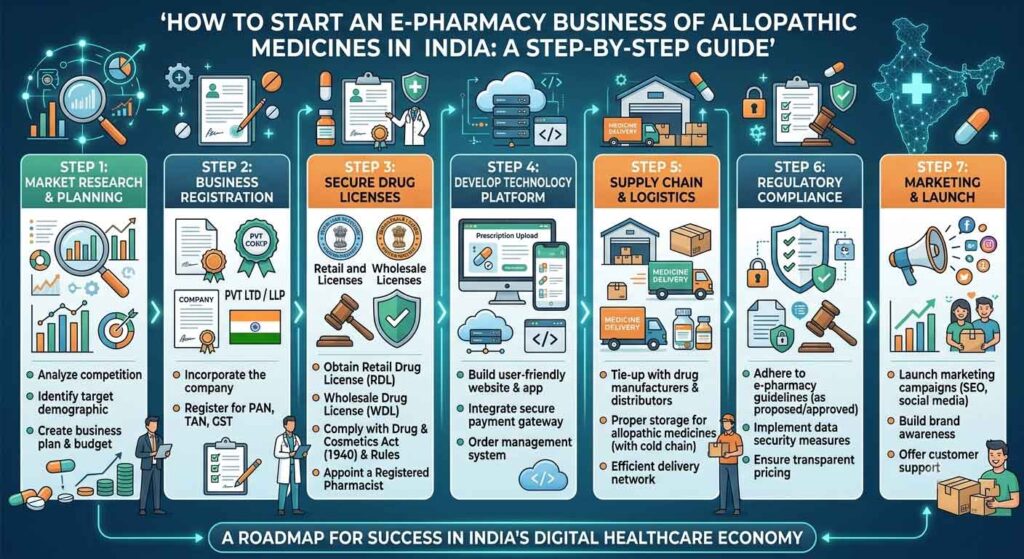
How to Start an E-Pharmacy: Step-by-Step Process
Step 1: Select the Business Model
Decide whether you will operate as:
Own-inventory pharmacy
Existing chemist shop going online
Hyperlocal pharmacy
Marketplace
Franchise network
Prescription and order-routing platform
Do not develop an expensive app before finalizing the legal structure.
Step 2: Register the Business
Create the business entity and obtain:
PAN
Bank account
Business address
Incorporation or partnership documents
GST registration, where applicable
Step 3: Select Suitable Premises
The premises should:
Meet minimum-area requirements
Be legally usable for pharmacy business
Have proper entry and access
Have medicine-storage facilities
Have electricity and power backup
Have refrigerator where required
Be suitable for inspection
Have packing and dispatch space
Be separate from residential activity where local rules require
Step 4: Appoint a Registered Pharmacist
Appoint a pharmacist registered with the concerned State Pharmacy Council.
Prepare:
Qualification documents
Registration certificate
Appointment letter
Identity proof
Bio-data
Declaration or affidavit
Attendance and employment records
Step 5: Apply for Retail Drug Licence
Apply through the concerned State Drug Control portal or licensing office.
The premises will normally be inspected before approval.
Do not purchase large medicine stock or begin online sale until the applicable licence has been granted.
Step 6: Prepare Pharmacy Infrastructure
Arrange:
Medicine racks
Refrigerator
Temperature monitoring
Computer
Billing software
Barcode scanner
Printer
Internet connection
Power backup
Packing table
Quarantine area
Expired-goods area
Returned-goods area
Fire extinguisher
Pest-control system
CCTV, where appropriate
Step 7: Select Technology Platform
You may choose:
Basic e-commerce website
Custom pharmacy website
Progressive web application
Android/iOS application
Software-as-a-service pharmacy platform
Marketplace integration
Hyperlocal ordering platform
Start with functions that are operationally necessary rather than building too many features initially.
Step 8: Build Prescription Workflow
Your system should allow customers to:
Upload prescription
Enter patient details
Select delivery address
Submit medicine request
Receive pharmacist query, if required
Confirm approved order
Make payment
Receive invoice
Track delivery
The pharmacist should review the prescription before prescription medicines are packed and dispatched.
Step 9: Develop Standard Operating Procedures
Prepare written SOPs for:
Prescription receipt
Pharmacist verification
Order approval
Medicine substitution restrictions
Picking and packing
Billing
Cold-chain handling
Delivery
Returns
Customer complaints
Product recalls
Data access
Password management
Expired medicines
Damaged products
Adverse-event reporting
Cybersecurity incidents
Step 10: Partner With Licensed Suppliers
Buy medicines only from authorized and licensed sources.
Maintain:
Supplier drug-licence copies
GST details
Purchase invoices
Product batch records
Expiry records
Credit notes
Return documents
Do not buy medicines from unknown online sellers or unauthorized traders.
Step 11: Arrange Delivery System
You may use:
Your own delivery staff
Local courier
Hyperlocal logistics partner
Specialized cold-chain transporter
Marketplace logistics
Delivery staff should be trained in:
Package identification
Address confidentiality
Temperature protection
No package tampering
Proof of delivery
Failed-delivery handling
Return-to-pharmacy process
Patient privacy
Step 12: Test the System
Before public launch, test:
Prescription upload
Pharmacist review
Inventory accuracy
Payment
Invoice generation
GST calculation
Product picking
Batch and expiry capture
Delivery tracking
Refunds
Customer support
Data security
Backup and recovery
Step 13: Launch in a Limited Area
Start with a manageable delivery radius.
For example:
One locality
One town
One district
A limited number of pin codes
Expand only after your prescription, inventory, delivery and complaint-handling systems are stable.
Website and Mobile-App Features Required
A practical e-pharmacy website or app should include:
Business legal name
Pharmacy address
Contact details
Drug-licence details
Pharmacist-support details
Prescription-upload facility
Secure customer login
Product search
Medicine information
Stock status
Price and tax details
Delivery charges
Estimated delivery time
Order tracking
Digital invoice
Cancellation policy
Return/refund policy
Terms and conditions
Privacy policy
Grievance-redressal details
Customer-support channel
Complaint-registration system
Consumer Protection (E-Commerce) Rules apply to e-commerce entities and require transparent seller, pricing, grievance and consumer-information practices.
Prescription Requirements
Prescription medicines should not be sold merely because the customer selected them online.
A prescription-review process should check:
Patient name
Patient age, where relevant
Prescriber name
Prescriber registration details
Prescription date
Medicine name
Strength
Dosage form
Dose
Duration
Quantity
Signature or valid electronic issuance
Alteration or tampering
Duplicate or repeated use
Potential misuse
Where a compliant telemedicine consultation generates an electronic prescription, the prescription should be issued by a Registered Medical Practitioner under the applicable telemedicine framework. Technology platforms themselves cannot prescribe medicines; prescribing decisions must remain with the RMP.
Can Schedule H and H1 Medicines Be Sold Online?
Schedule H and Schedule H1 medicines should be supplied only against a valid prescription and according to applicable record and sale requirements.
The platform should not:
Allow automatic checkout without prescription
Reuse an old prescription indefinitely
Increase prescribed quantity
Substitute medicine without proper authority
Accept visibly altered prescriptions
Supply prescription medicines merely on customer request
For Schedule H1 products, maintain all records required under the Drugs Rules.
Can Schedule X or Narcotic Medicines Be Sold Online?
Schedule X, narcotic and psychotropic medicines involve substantially stricter controls.
A standard e-pharmacy should exclude such products from its ordinary online catalogue unless it has:
All required licences
Specific authorizations
Secure-storage arrangements
Compliant prescription and record systems
Specialist regulatory advice
A legally reviewed distribution process
The NDPS Act regulates possession, sale, purchase, transport and warehousing of narcotic drugs and psychotropic substances and requires compliance with applicable licences, permits and authorizations.
Can OTC Medicines Be Sold Without Prescription?
Medicines that lawfully do not require a prescription may be offered without prescription, subject to:
Correct product classification
Applicable drug-sale licence
Proper labelling
Safe quantity controls
Pharmacist availability
No misleading claims
Age or misuse controls where appropriate
Do not classify a medicine as OTC merely because it is commonly sold without a prescription.
India does not have a single simple OTC list covering every marketed product in the manner some other countries do. Product schedule and licence status should be checked carefully.
Patient Data and Privacy Requirements
An e-pharmacy handles sensitive information such as:
Patient name
Phone number
Address
Prescription
Doctor details
Health condition
Medicine history
Payment information
Delivery records
This information should be collected only for legitimate purposes and protected against unauthorized use.
India notified the Digital Personal Data Protection Rules, 2025, together with an enforcement timeline. An e-pharmacy should obtain current legal advice on which obligations are applicable at each stage of implementation.
Your privacy system should include:
Clear privacy notice
Lawful consent where required
Purpose limitation
Restricted employee access
Encryption
Secure prescription storage
Strong passwords
Two-factor authentication
Vendor-security checks
Data-retention policy
Data-deletion process
Incident-response plan
Customer grievance channel
Backup and recovery
Do not use patient prescription data for unrelated advertising without a lawful basis.
Cybersecurity Requirements
Basic cybersecurity controls should include:
HTTPS certificate
Encrypted database
Secure cloud configuration
Access logs
Role-based permissions
Regular security updates
Malware protection
Secure payment gateway
API security
Employee access controls
Periodic vulnerability testing
Backup systems
Data-breach response plan
A small e-pharmacy should not treat cybersecurity as an optional technology expense.
Medicine Storage and Inventory Management
Your inventory system should record:
Product name
Batch number
Expiry date
Purchase price
MRP
GST rate
Supplier
Quantity received
Quantity sold
Returned quantity
Damaged quantity
Expired quantity
Storage condition
Follow FEFO, meaning First Expiry, First Out.
Keep separate areas for:
Saleable stock
Quarantined stock
Returned stock
Damaged stock
Expired stock
Recalled stock
Cold-chain stock
Cold-Chain Medicines
Products such as insulin, vaccines and some biological medicines may require strict temperature control.
For these products, arrange:
Qualified refrigerator
Continuous temperature monitoring
Power backup
Alarm system
Insulated packaging
Validated cold packs
Temperature-controlled delivery
Failed-delivery procedure
Temperature-excursion handling
Staff training
Do not sell temperature-sensitive products online unless the complete storage and delivery chain can protect product quality.
Invoice and Transaction Records
Every order should generate a proper invoice or cash/credit memo containing applicable details such as:
Pharmacy name
Address
Drug-licence details
GSTIN, where applicable
Invoice number
Invoice date
Product name
Quantity
Batch details, where recorded
Expiry details, where appropriate
MRP
Selling price
Tax
Customer information
Pharmacist or dispensing reference
Maintain electronic and physical records according to applicable rules and licence conditions.
Return and Refund Policy
Medicines cannot be treated exactly like clothes or ordinary consumer goods because storage conditions and tampering affect patient safety.
Your policy should clearly cover:
Wrong product supplied
Damaged package
Expired medicine
Product recall
Delivery failure
Temperature excursion
Sealed versus opened products
Refund timeline
Prescription cancellation
Customer-order error
Returned medicine should not automatically be placed back into saleable stock.
It should first be quarantined and evaluated under a written SOP.
Advertising and Promotion
An e-pharmacy should not make misleading claims such as:
Guaranteed cure
Permanent treatment
No side effects
100% safe
Doctor not required
Best medicine for every patient
Instant cure
Guaranteed weight loss
Guaranteed sexual performance
Medicine advertising must comply with the Drugs and Magic Remedies (Objectionable Advertisements) Act and other applicable advertising and consumer-protection laws.
Avoid direct promotional advertising of prescription-only medicines to the general public.
Your platform may display factual information necessary for ordering, but product pages should be reviewed for legal and medical accuracy.
Do not assume that every herbal product is automatically unrestricted.
Can You Sell Nutraceuticals Online?
Nutraceuticals and food supplements may be sold online subject to FSSAI and e-commerce requirements.
Check:
FSSAI licence of manufacturer or importer
Your own FSSAI requirement
Product-category approval
Label declarations
Claims
Recommended usage
Allergen information
Veg/non-veg declaration
Customer-care details
Keep food products and drug products properly classified in your system.
Can You Sell Cosmetics Online?
Cosmetics may be sold through an e-pharmacy, provided they are properly manufactured or imported and comply with applicable cosmetic and labelling rules.
Avoid turning cosmetic claims into unapproved disease-treatment claims.
Can You Sell Medical Devices Online?
Medical devices may be sold online, but check:
Device classification
Manufacturer or importer licence
Seller licence requirement
Product registration
Storage requirements
Installation or calibration
Warranty and service
Complaint reporting
Some devices require professional installation or specialized handling.
Can You Start Through an Existing Marketplace?
Yes, an existing licensed pharmacy may apply to sell through an e-pharmacy or healthcare marketplace.
The marketplace may request:
Drug licence
GST certificate
PAN
Business registration
Pharmacist documents
Cancelled cheque
Bank details
Premises address
Product catalogue
Purchase invoices
FSSAI licence for food products
Medical-device documents
Brand authorization
Marketplace onboarding does not replace your statutory licences.
Interstate Sale and Delivery
Interstate medicine delivery presents additional questions relating to:
Drug-licence jurisdiction
GST
Prescription validity
State-level enforcement
Storage during transit
Delivery time
Product returns
Customer complaints
Because India’s dedicated e-pharmacy rules remain in draft, obtain written regulatory and legal advice before operating a nationwide model.
A safer starting strategy is to begin through a licensed pharmacy with a limited local delivery area and expand gradually.
Estimated Investment
The investment depends on your business model.
Small Local E-Pharmacy
Main expenses may include:
Existing pharmacy setup
Drug licence
Pharmacist salary
Basic website
Billing software
Delivery arrangement
Initial stock
Digital marketing
Packaging
Working capital
Medium Omnichannel Pharmacy
Additional expenses may include:
Custom ordering platform
Mobile application
Larger inventory
More staff
Warehouse or additional premises
Customer support
Delivery fleet
Data security
Advertising
Large Marketplace or Multi-City Platform
Major expenses may include:
Technology development
Regulatory and legal team
Multi-pharmacy integration
Cloud infrastructure
Cybersecurity
Data governance
Customer support
Logistics
Marketing
Working capital
Quality assurance
Audit and compliance
Do not invest heavily in software before confirming the licensing and operational model.
How Does an E-Pharmacy Earn Money?
Common income sources include:
Retail medicine margin
OTC product margin
Cosmetic margin
Nutraceutical margin
Medical-device margin
Delivery charges
Subscription or refill plans
Marketplace commission
Technology service fee
Franchise fee
Pharmacy software fee
Any consultation fee should be earned through a properly structured and compliant healthcare-service arrangement.
Advantages of E-Pharmacy
An e-pharmacy can offer:
Home delivery
Better access for elderly patients
Refill convenience
Digital records
Wider product availability
Price transparency
Improved inventory management
Prescription reminders
Customer support
Better reach in underserved areas
Challenges of E-Pharmacy
Major challenges include:
Regulatory uncertainty
Prescription misuse
Counterfeit products
Data privacy
Cold-chain delivery
High customer-acquisition cost
Low medicine margins
Returns and cancellations
Delivery delays
Inventory expiry
Pharmacist availability
Multi-state compliance
Competition from established platforms
Common Mistakes to Avoid
Avoid these mistakes:
Starting only with a website and no licensed pharmacy
Selling medicines without retail drug licence
Appointing pharmacist only on paper
Selling prescription medicines without prescription
Reusing prescriptions without review
Allowing automatic substitution
Selling Schedule X or controlled drugs casually
Buying from unauthorized suppliers
Ignoring cold-chain requirements
Failing to protect prescription data
Making misleading medical claims
Not displaying grievance details
Sending medicines without invoice
Mixing returned medicines with saleable stock
Expanding nationwide before testing compliance
Treating draft e-pharmacy registration rules as final law
Practical Low-Risk Startup Model
A practical way to start is:
Open or use an existing licensed retail pharmacy.
Appoint a registered pharmacist.
Obtain GST and other business registrations.
Start with a simple website or ordering portal.
Add secure prescription upload.
Deliver only within a limited local area.
Exclude controlled and high-risk medicines.
Maintain batch, expiry, invoice and prescription records.
Create privacy, return and grievance policies.
Expand only after compliance and operations are stable.
Final Answer
Starting an e-pharmacy in India requires much more than creating a website or mobile application.
The core requirement is a properly licensed physical pharmacy supported by a registered pharmacist, compliant prescription processing, lawful medicine procurement, secure storage, proper invoicing and safe delivery.
As of August 2, 2026, the proposed dedicated central e-pharmacy registration system under Draft G.S.R. 817(E) has not been identified as a final operational framework. Therefore, an e-pharmacy should currently be structured under existing State drug-sale licences and all other applicable pharmacy, e-commerce, GST, consumer and data-protection laws.
The safest approach is to begin as a licensed local or omnichannel pharmacy, establish strong pharmacist and prescription systems, and obtain regulatory advice before expanding into marketplace, interstate or nationwide operations.
Frequently Asked Questions
1. Can I start an e-pharmacy without a physical medical store?
The safest current model requires a licensed physical pharmacy or licensed fulfilment pharmacy. A website or app alone is not sufficient.
2. Is a separate central e-pharmacy licence available?
As of August 2, 2026, CDSCO continues to list the proposed 2018 e-pharmacy rules as a draft. A final dedicated central e-pharmacy registration system has not been identified.
3. Is retail drug licence compulsory?
Yes. A pharmacy dispensing and selling medicines directly to customers generally requires the applicable retail drug licence.
4. Is a registered pharmacist required?
Yes. Prescription dispensing should be performed by a registered pharmacist.
5. Can a non-pharmacist own an e-pharmacy?
A non-pharmacist may own the business, but the licensed pharmacy must have a qualified registered pharmacist.
6. Can prescription medicines be sold online?
They may be supplied only against a valid prescription and after proper pharmacist review, subject to applicable laws and licence conditions.
7. Can Schedule X medicines be sold through an ordinary e-pharmacy?
They should be excluded from a normal e-pharmacy catalogue unless the business has all special licences, authorizations and legally reviewed systems.
8. Is GST compulsory for an e-pharmacy?
GST depends on turnover, interstate supply and the e-commerce model. In practice, most e-pharmacies obtain GST registration.
9. Can an existing medical store start online delivery?
Yes. An existing licensed pharmacy can add online ordering and delivery after establishing compliant prescription, invoicing, privacy and delivery systems.
10. Can medicines be sold through WhatsApp?
WhatsApp may be used as an ordering channel, but it does not remove drug-licence, prescription, pharmacist, invoice, privacy or delivery requirements.
11. Can an e-pharmacy sell Ayurvedic and nutraceutical products?
Yes, but the products must comply with their respective AYUSH, FSSAI, cosmetic, medical-device or other applicable regulatory requirements.
12. How much area is required for an e-pharmacy?
A retail pharmacy generally requires at least 10 square metres. Retail-cum-wholesale premises generally require at least 15 square metres, subject to state and local requirements.
13. Can an e-pharmacy operate from home?
Only where the premises is legally acceptable, independent, properly equipped and approved for a retail drug licence. A normal residential room is usually not enough.
14. Can I join an existing e-pharmacy marketplace?
Yes, but you will normally need valid drug licence, pharmacist details, GST and other onboarding documents.
15. What is the best model for a beginner?
An existing or newly licensed local pharmacy offering online ordering and limited-area home delivery is usually the most manageable starting model.
Looking for Ayurvedic Franchise or Distribution Opportunities?
Looking to start an Ayurvedic franchise, become a distributor, or launch your own herbal product range?
Elzac Herbal India offers:
Ayurvedic & Herbal Product Range
Franchise & Distribution Opportunities
Third-Party Manufacturing Services
Product Development Support
Marketing Guidance
PAN India Business Opportunities
Whether you are an entrepreneur, retailer, distributor, or healthcare professional, our team can help you explore the right business opportunity in the growing Ayurvedic sector.
Ajay Kamboj is an entrepreneur and business owners associated with many Ayurvedic and Pharmaceutical start-ups. With years of experience in Ayurvedic product marketing, pharmaceutical distribution, franchise development, and client relationship management, he regularly shares practical business insights based on real-world experiences. His articles focus on business growth, entrepreneurship, customer management, and lessons learned from the healthcare and wellness industry.
8 responses to “How to Start an E-Pharmacy Business in India”
I want to start EPharmacy ,
But where I register for 18AA ??
ayurvedic medicines come under over the counter medicines and doesn’t require prescription to sell online or offline. You don’t need prescription to sell ayurvedic medicines online
I really appreciate the author for sharing such a helpful or informative article with us. I like your site and love to read these kinds of articles. Thanks for sharing with us.



I want to start EPharmacy ,
But where I register for 18AA ??
ayurvedic medicines come under over the counter medicines and doesn’t require prescription to sell online or offline. You don’t need prescription to sell ayurvedic medicines online
Sir mughe by medicine ke liye
Android aap bana na hai to uske liye
Mere pass koi license nhi hai kiya bana skta hu
HOW CAN I GET A VETENARY PHARMACY LICENSE ??
no sir
HI I WANT START E PHARMACY BUSINESS
I really appreciate the author for sharing such a helpful or informative article with us. I like your site and love to read these kinds of articles. Thanks for sharing with us.
Hello ,
Want to sell my all products online on your website can you tell me the process how to onboard on your portal