Starting a bulk drug or Active Pharmaceutical Ingredient manufacturing unit is substantially more complex than establishing an ordinary pharmaceutical formulation plant.
An API project may involve:
Chemical reactions
Hazardous raw materials
Flammable solvents
High temperature or pressure
Toxic intermediates
Solvent recovery
Controlled crystallization
Impurity removal
Drying and milling
Hazardous effluent
Air emissions
Occupational exposure risks
Therefore, the project must combine:
**Drug licensing
Revised Schedule M compliance
Chemical-process engineering
Environmental clearance
Pollution control
Factory and fire safety
Qualified technical staff
Quality control
Process validation
Financial feasibility**
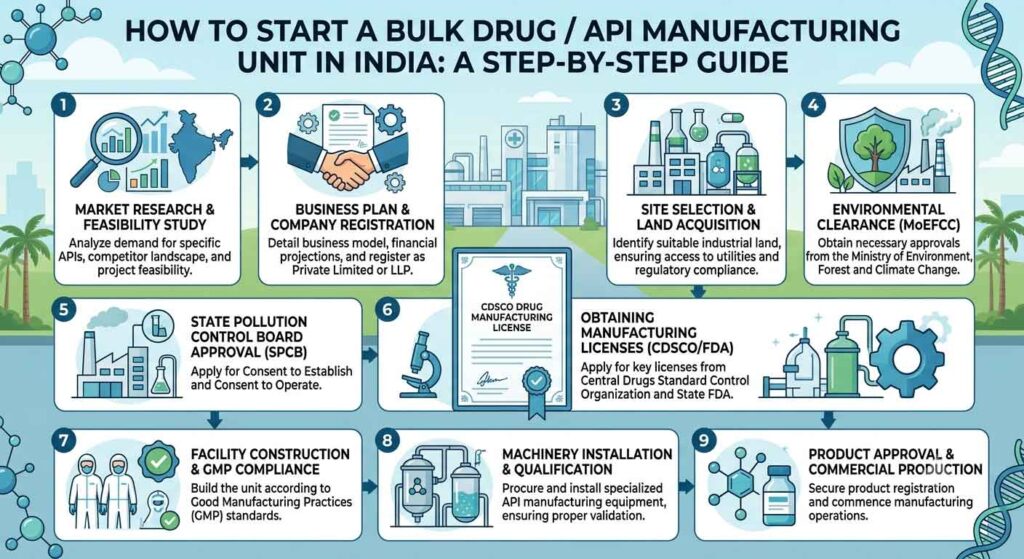
The practical procedure is:
Select the API → Confirm regulatory status → Develop the manufacturing process → Conduct market and financial feasibility → Select an industrial location → Obtain environmental approvals → Design the plant and containment systems → Install utilities, machinery and laboratory → Recruit qualified technical personnel → Establish the pharmaceutical quality system → Apply for manufacturing licence and product permission → Qualify and validate the facility → Manufacture commercial batches only after approval
What Is a Bulk Drug or API?
An Active Pharmaceutical Ingredient is the substance intended to provide pharmacological activity in a finished pharmaceutical product.
Examples include substances used to manufacture:
Tablets
Capsules
Oral liquids
Injections
Ointments
Inhalation products
Other finished medicines
The revised Schedule M defines API manufacturing broadly. It includes:
Receipt of materials
Production
Packaging
Repacking
Labelling
Relabelling
Quality control
Batch release
Storage
Distribution
API manufacturing under Part XII covers chemical synthesis, extraction, fermentation, cell culture, recovery from natural sources and combinations of these processes.
API, Intermediate and Starting Material
These terms should not be used interchangeably.
API Starting Material
An API starting material is a raw material, intermediate or API incorporated as a significant structural fragment into the final API.
The manufacturer must define and scientifically justify the stage at which API production begins for GMP purposes.
Intermediate
An intermediate is a material produced during API processing that undergoes further molecular change or purification before becoming the final API.
Active Pharmaceutical Ingredient
The API is the final active substance meeting the approved:
Identity
Strength
Purity
Impurity profile
Physical characteristics
Microbiological requirements, where applicable
Types of API Manufacturing Units
1. Synthetic API Plant
The API is produced through one or more chemical-reaction stages.
Possible operations include:
Reaction
Distillation
Extraction
Phase separation
Neutralization
Filtration
Crystallization
Centrifugation
Drying
Milling
Blending
2. Fermentation-Based API Plant
Products may be produced using:
Microorganisms
Fermentation media
Bioreactors
Cell separation
Extraction
Purification
Such facilities require stronger microbiological and biological-process controls.
3. Extraction-Based API Plant
The active substance may be recovered from:
Plant material
Animal sources
Natural substances
Fermentation broth
4. High-Potency API Facility
High-potency APIs may require:
Occupational exposure limits
Closed processing
Isolators
Dedicated HVAC
Negative-pressure containment
Specialized cleaning validation
Personnel monitoring
5. Sterile API Facility
Part XII applies to sterile APIs only up to the stage immediately before the API is rendered sterile. Sterilization and aseptic processing must follow the applicable GMP requirements for sterile products.
6. Biological or Biotechnology-Derived API
Certain biological substances fall under different or additional licensing arrangements.
Part XII does not itself cover every biological category, such as vaccines, whole cells, whole blood, plasma derivatives and gene-therapy APIs. The exact central and state approval route must therefore be confirmed product-wise.
First Select the API Products
Do not construct a multipurpose API factory before deciding which products will be manufactured.
For every proposed API, evaluate:
Domestic demand
Export demand
Existing manufacturers
Patent position
Raw-material availability
Number of reaction stages
Yield
Solvent requirement
Waste generation
Energy consumption
Impurity risks
Occupational hazards
Selling price
Customer qualification requirements
Pharmacopoeial status
API Selection Matrix
A practical comparison may include:
Factor
API A
API B
API C
Annual market demand
Expected selling rate
Overall process yield
Number of reaction stages
Raw-material availability
Solvent recovery potential
Waste per kilogram
Patent risk
Required containment
Expected gross contribution
A product with a high selling price may still be commercially weak where:
Yield is low.
Raw materials are imported.
Waste-treatment cost is high.
Several purification stages are required.
Competition forces rapid price reductions.
Existing API vs New Drug Substance
The first regulatory question is whether the proposed API is:
An established approved drug substance
A subsequent new drug
A new drug substance
An investigational substance
An export-only unapproved product
A controlled or specially regulated substance
CDSCO separately processes approvals concerning new drug substances and drug products. A bulk drug approved within the applicable new-drug period may require central review before the State Licensing Authority can grant or endorse the manufacturing permission.
Do not assume that a State manufacturing licence alone authorizes manufacture of a completely new API.
Manufacturing-Licence Forms
The licence form depends on the drug category.
Ordinary APIs Not Falling Under Schedule C, C(1) or X
The common route is:
Application in Form 24
Manufacturing licence in Form 25
Schedule X APIs Not Falling Under Schedule C or C(1)
The common route is:
Application in Form 24-F
Manufacturing licence in Form 25-F
Drugs Falling Under Schedule C and C(1)
The applicable route may involve:
Application in Form 27
Licence in Form 28
The correct form depends on the product’s schedule, biological status and licence classification. Official State Licensing Authority guidance lists Form 25 under Rule 71 and Form 28 under Rule 76, read with Schedule M.
Who Issues the API Manufacturing Licence?
For many ordinary APIs, the manufacturing licence is granted by the concerned State Licensing Authority under the Drugs and Cosmetics Act and Drugs Rules.
CDSCO or the Central Licensing Authority becomes involved where the project concerns matters such as:
New drug substances
Certain biological products
r-DNA products
Investigational products
Import permissions
Specially controlled products
Export of unapproved drugs
The final licensing route should be confirmed before preparing the regulatory dossier.
Test and Development Batches
Commercial sale cannot begin under a development or testing permission.
From January 2026, the New Drugs and Clinical Trials Rules introduced a prior-intimation system for manufacturing certain categories of drugs for analytical and non-clinical testing, while specified high-risk categories remain subject to permission requirements.
The manufacturer should identify separately:
Laboratory-development batches
Pilot batches
Validation batches
Commercial batches
Export-only batches
Revised Schedule M Requirements
As of 1 January 2026, revised Schedule M applies to manufacturers with turnover up to ₹250 crore as well as larger manufacturers.
A new API plant should therefore be designed directly under:
Part I: General GMP principles
Part XII: Specific requirements for APIs
Other applicable product-specific parts
Applicable sterile-manufacturing requirements
The revised framework requires systems covering:
Pharmaceutical quality system
Quality-risk management
Qualification
Validation
Change control
CAPA
Product-quality review
Supplier qualification
Data integrity
Outsourced activities
Environmental Clearance
API and bulk-drug projects may fall under item 5(f)—Synthetic Organic Chemicals Industry, which includes bulk drugs and related synthetic organic chemical operations.
Official environmental-clearance records show API projects being processed under item 5(f) as Category A, B1 or B2 depending on project characteristics, applicable notifications, location and other conditions.
The project should determine whether it requires:
Prior Environmental Clearance
Terms of Reference
Environmental Impact Assessment
Public consultation
State-level appraisal
Central-level appraisal
Exemption applicable to an approved industrial estate
This assessment should be completed before construction.
Pollution Control Board Consents
An API unit likely to discharge trade effluent or emit air pollutants requires prior consent from the State Pollution Control Board under the Water and Air Acts.
The usual approval sequence is:
Consent to Establish
Construction and installation
Compliance verification
Consent to Operate
The national Online Consent Management and Monitoring System explains that an industry likely to discharge trade effluent or operate in an air-pollution-control area cannot be established or operated without the State Board’s prior consent.
Other Approvals
Depending on the chemistry and location, the project may also need:
Factory-plan approval
Factory licence
Fire NOC
Hazardous-waste authorization
Boiler approval
Pressure-vessel approval
Solvent-storage permission
Petroleum or explosive-storage approval
Groundwater permission
Electrical approval
Building approval
Local industrial-development approval
Public-liability insurance
Import Export Code
Applicability must be determined from the process, solvent inventory, pressure systems and state requirements.
Select the Correct Industrial Location
An API unit should normally be established in an approved chemical or pharmaceutical industrial area.
Before purchasing land, verify:
Permitted industrial use
Environmental-clearance status of the estate
Distance from residential areas
Water availability
Electricity and fuel
CETP availability
Hazardous-waste disposal facilities
Solvent and tanker access
Fire-station access
Future expansion
Local groundwater restrictions
Flood risk
Availability of technical staff
Do not select a low-cost plot before confirming that the proposed chemical processes are allowed there.
Prepare a Detailed Project Report
The project report should contain:
Proposed APIs
Manufacturing routes
Reaction chemistry
Batch sizes
Annual production capacity
Material balance
Solvent balance
Water balance
Energy balance
Waste generation
Equipment capacity
Utility requirements
Environmental-control systems
Staffing
Capital investment
Working capital
Sales projection
Break-even analysis
Project risks
Process Development
The process-development package should identify:
Starting materials
Reagents
Catalysts
Solvents
Reaction conditions
Critical parameters
Intermediates
Work-up steps
Purification
Crystallization
Drying
Milling
Packaging
Expected yield
Impurity profile
Waste streams
Material Balance
For every batch, prepare a material balance:
Inputs
=
Starting materials
+ Reagents
+ Solvents
+ Process water
Outputs
=
API
+ Recovered solvent
+ By-products
+ Effluent
+ Solid waste
+ Process loss
An economically attractive laboratory process may become commercially unsuitable when scaled up because of:
Low recovery
Excess solvent use
Difficult filtration
Long drying time
High effluent load
Unstable intermediates
Process-Safety Review
Before scale-up, evaluate:
Exothermic reactions
Runaway-reaction risk
Gas evolution
Pressure generation
Toxic releases
Flammability
Static electricity
Dust explosion
Incompatible chemicals
Thermal decomposition
Emergency quenching
The project may require:
Reaction calorimetry
Hazard and Operability Study
Process Hazard Analysis
Safety-integrity review
Explosion-protection study
Emergency-response planning
Factory Layout
A multipurpose synthetic API facility may include:
Raw-material receiving
Raw-material quarantine
Approved-material storage
Solvent tank farm
Hazardous-material storage
Dispensing
Reaction blocks
Centrifuge areas
Drying rooms
Milling and sifting
Blending
API packing
Intermediate storage
Finished-API quarantine
Released API store
Rejected-material area
Quality-control laboratory
Stability section
Utility block
Solvent-recovery plant
Effluent-treatment plant
Hazardous-waste storage
Engineering workshop
Change rooms and decontamination areas
Personnel and Material Flow
The layout should control the movement of:
Employees
Contractors
Raw materials
Solvents
Intermediates
Finished APIs
Recovered solvents
Waste
Returned materials
Crossing between clean product movement and waste movement should be minimized.
Utilities
Critical utilities may include:
Steam
Thermic fluid
Chilled water
Cooling water
Brine
Vacuum
Compressed air
Nitrogen
Purified water
Process water
HVAC
Dust extraction
Scrubbers
Power backup
Schedule M requires utilities capable of affecting product quality to be qualified, appropriately monitored and supported by available drawings.
Water Requirements
Water quality depends on its intended use.
Part XII requires water used in API manufacture to be demonstrated as suitable for its intended purpose. Unless otherwise justified, process water should at least meet potable-water quality; tighter chemical, microbiological or endotoxin controls may be necessary for particular operations.
For a non-sterile API intended for further manufacture of sterile finished products, water used in final isolation and purification may require control for:
Total microbial count
Objectionable organisms
Endotoxins
Containment
Dedicated facilities or equipment may be required for highly sensitizing substances such as:
Penicillins
Certain cytotoxic drugs
Sex hormones
Highly potent substances
The revised API requirements call for dedicated areas where appropriate and controls against cross-contamination between dedicated and non-dedicated operations.
Major Manufacturing Equipment
There is no universal API machinery list.
Equipment must be selected according to:
Reaction chemistry
Corrosiveness
Temperature
Pressure
Solvent
Batch size
Containment
Product purity
Cleaning requirements
Possible equipment includes:
Reaction Equipment
Stainless-steel reactors
Glass-lined reactors
Hastelloy or special-alloy reactors
Pressure reactors
Hydrogenators
Fermenters
Extraction vessels
Separation Equipment
Centrifuges
Nutsche filters
Filter presses
Sparkler filters
Decanters
Phase separators
Drying Equipment
Vacuum tray dryers
Rotary cone vacuum dryers
Agitated Nutsche filter dryers
Fluid-bed dryers
Tray dryers
Freeze dryers, where required
Size-Reduction Equipment
Multi mill
Cone mill
Pin mill
Air-jet mill
Pulverizer
Sifter
Solvent-Recovery Equipment
Distillation columns
Condensers
Receivers
Fractionation units
Vacuum systems
Solvent-storage tanks
Packing Equipment
Controlled dispensing booth
Weighing balances
Liner-sealing equipment
Drum-closing equipment
Label and QR-code printing or verification system
Material of Construction
The correct material may include:
SS 316L
Glass-lined steel
Hastelloy
PTFE-lined equipment
Rubber-lined equipment
Other compatible materials
SS 304 or SS 316 cannot be prescribed universally.
Compatibility must be demonstrated against:
Acids
Alkalis
Halogenated solvents
Oxidizing agents
Temperature
Pressure
Cleaning chemicals
Quality-Control Laboratory
The laboratory should be designed around the specifications of the proposed APIs.
Possible sections include:
Wet chemistry
Instrumental analysis
Stability
Microbiology
Reference standards
Retention samples
Controlled substances
Glassware washing
Laboratory reagents
Possible Laboratory Instruments
Depending on the product, the laboratory may require:
HPLC
Gas chromatograph
FTIR
UV-visible spectrophotometer
Karl Fischer apparatus
Polarimeter
Melting-point apparatus
pH meter
Analytical balances
Particle-size analyser
X-ray diffraction
ICP-MS or atomic-absorption equipment
LC-MS
GC-MS
Total organic carbon analyser
Stability chambers
Microbiological equipment
Endotoxin-testing equipment
Not every API laboratory needs every instrument.
The equipment should follow the approved:
Specification
Pharmacopoeial monograph
Impurity method
Residual-solvent method
Customer requirement
Regulatory dossier
Outsourced Testing
Specialized testing may be outsourced to an approved testing laboratory where permitted.
Possible outsourced tests include:
Genotoxic impurities
Nitrosamines
Elemental impurities
X-ray diffraction
Mass spectrometry
Specialized microbiology
The API manufacturer remains responsible for:
Qualifying the laboratory
Approving the method
Reviewing results
Investigating failures
Releasing the batch
Technical Personnel
An API plant requires separate competent personnel for:
Production
Quality assurance
Quality control
Engineering
Safety and environment
Warehouse
Regulatory affairs
The manufacturing and testing technical staff must possess qualifications and experience accepted by the State Licensing Authority under the applicable rules.
Depending on the licence category, recognized backgrounds may include:
Pharmacy
Pharmaceutical chemistry
Chemistry
Microbiology
Chemical engineering
Other approved equivalent qualifications
The qualification list should be checked with:
Current consolidated Drugs Rules
Proposed licence form
Product category
State Licensing Authority checklist
Exact post-qualification experience
Official licensing guidance requires submission of qualification, experience, biodata, appointment and full-time employment records for manufacturing and testing personnel.
Independent Quality Unit
The quality unit should remain independent of production for decisions involving:
Raw-material release
Intermediate release
API release
Rejection
Deviations
OOS investigations
CAPA
Change control
Validation
Complaints
Recalls
Pharmaceutical Quality System
The plant should prepare controlled systems for:
Document control
Training
Vendor qualification
Material receipt and sampling
Manufacturing
In-process controls
Cleaning
Calibration
Maintenance
Qualification
Process validation
Analytical-method validation
Cleaning validation
Change control
Deviations
OOS and OOT results
CAPA
Stability
Complaints
Recall
Self-inspection
Data integrity
API Specifications
The finished API specification may include:
Description
Identification
Assay
Related substances
Individual impurities
Total impurities
Residual solvents
Water or loss on drying
Residue on ignition
Elemental impurities
Particle size
Polymorphic form
Bulk density
Microbial limits
Endotoxins, where applicable
Impurity Control
Impurity management is central to API manufacturing.
The company should evaluate:
Process impurities
Degradation impurities
Residual starting materials
Residual reagents
Residual solvents
Elemental impurities
Genotoxic impurities
Nitrosamine risks
Isomeric impurities
Changes to:
Supplier
Starting material
Solvent
Catalyst
Reaction conditions
Purification
Drying
may alter the impurity profile and should pass through change control.
Qualification and Validation
The plant should establish a Validation Master Plan covering:
Design qualification
Installation qualification
Operational qualification
Performance qualification
Utility qualification
Process validation
Cleaning validation
Analytical-method validation
Computerized-system validation
Transport validation
Revalidation
Process Validation
Commercial API processes should demonstrate reproducibility in:
Reaction completion
Yield
Impurity removal
Crystallization
Drying
Milling
Blending
Final quality
Critical process parameters may include:
Temperature
Pressure
pH
Addition rate
Mixing speed
Reaction time
Moisture
Cooling rate
Seeding
Drying endpoint
Cleaning Validation
Cleaning validation should consider:
Potency
Toxicity
Solubility
Batch size
Equipment surface area
Occupational exposure
Cross-contamination risk
Cleaning-agent residues
Swab recovery
Rinse recovery
Recovered Solvents and Materials
Recovered solvents may be reused only under controlled and justified conditions.
Controls should address:
Identity
Purity
Water content
Cross-contamination
Number of recovery cycles
Approved use
Traceability
Testing
Stability and Retest Period
APIs commonly use a justified:
Retest date, or
Expiry date where appropriate
The company should establish the period through a documented stability programme covering:
Packaging
Storage condition
Analytical methods
Stability-indicating parameters
Ongoing batches
Adverse trends
API Packaging and QR Code
Every API or bulk drug manufactured or imported in India must carry a QR code on its label at each level of packaging to facilitate tracking and tracing.
The stored data must include prescribed information such as:
Unique product identification code
Batch number
Manufacturing date
Expiry date
Other required particulars
Manufacturing Application Documents
A typical application may require:
Legal Documents
Covering letter
Form 24, 24-F or 27 as applicable
Fee receipt
Entity constitution documents
Board resolution
Authorized-signatory documents
Identity proofs
Non-conviction declarations
Premises Documents
Ownership document
Lease or rent agreement
Owner’s NOC
Site plan
Key plan
Plant layout
Industrial-use permission
Building approval
Technical Documents
Technical-staff qualifications
Experience certificates
Appointment letters
Biodata
Full-time employment declarations
Departmental responsibilities
Plant Documents
Site Master File
Machinery list
Laboratory-equipment list
Process-flow diagrams
HVAC and ventilation drawings
Water-system drawings
Utility diagrams
Solvent-storage details
Effluent-treatment details
Validation Master Plan
Product Documents
API list
Regulatory status
Process summary
Master formula
Specifications
Analytical methods
Impurity profile
Stability data
Packing details
Proposed labels
Central approval where applicable
Supporting Approvals
Environmental Clearance
Consent to Establish
Factory approval
Fire NOC
Hazardous-waste authorization
Water-analysis report
Safety approvals
Official State Licensing Authority guidance lists the site and key plans, machinery, testing equipment, technical staff and product information among the principal manufacturing-licence documents.
Inspection Process
The regulatory inspection may review:
Approved layout
Building construction
Reaction areas
Containment
Utilities
Solvent storage
Quality-control laboratory
Technical staff
Documentation
Material controls
Validation status
Environmental permissions
Safety systems
Product dossiers
The company should respond to observations using:
Root-cause analysis
Corrective action
Preventive action
Documentary evidence
Completion dates
Effectiveness checks
Step-by-Step Procedure
Step 1: Select APIs
Prepare a commercial and technical shortlist.
Step 2: Confirm Regulatory Status
Determine whether each substance is:
Established
New
Controlled
Biological
Export-only
Patent-protected
Step 3: Develop the Process
Complete laboratory development, scale-up studies and preliminary impurity characterization.
Step 4: Conduct Feasibility
Calculate:
Raw-material cost
Yield
Utility cost
Solvent recovery
Waste treatment
Labour
Selling price
Working capital
Step 5: Select the Site
Confirm industrial, environmental and safety acceptability.
Step 6: Obtain Environmental Approvals
Determine EC, Consent to Establish and hazardous-waste requirements before construction.
Step 7: Prepare Detailed Engineering
Finalize:
Process flow
Equipment
Piping
Instrumentation
Utilities
Containment
ETP
Safety systems
Step 8: Construct and Install
Build according to the approved design and licensing layout.
Step 9: Recruit Technical Staff
Appoint genuine full-time production, QA, QC, engineering and safety personnel.
Step 10: Establish the Quality System
Prepare the Site Master File, quality manual, SOPs, master records and validation plans.
Step 11: Qualify the Plant
Qualify:
Equipment
Utilities
Laboratory instruments
HVAC
Water
Computerized systems
Step 12: Submit the Licence Application
Apply to the concerned State Licensing Authority and obtain central permission where applicable.
Step 13: Complete Inspection
Close regulatory and environmental observations.
Step 14: Validate the Process
Manufacture approved validation batches and establish consistency.
Step 15: Obtain Commercial Approval
Begin commercial manufacture only after the licence and API endorsement are granted.
Step 16: Operate Under Continued Verification
Monitor:
Yield
Impurities
Deviations
Stability
Complaints
Environmental performance
Product-quality review
Investment Required
There is no fixed statutory investment amount.
API project cost depends on:
Chemistry
Capacity
Land
Number of products
Reaction stages
Materials of construction
Containment
Solvent recovery
Effluent treatment
Laboratory
Safety systems
Working capital
The following are only broad internal planning estimates:
Project type
Illustrative project range
Small brownfield or specialized API addition
₹25–75 crore
Greenfield multipurpose synthetic API plant
₹75–250 crore or more
High-potency, sterile or fermentation project
₹150 crore to several hundred crores
Large integrated bulk-drug complex
Project-specific; potentially several hundred crores
Land, imported technology, product-development cost and working capital may be additional.
Main Investment Heads
Fixed Capital
Land
Civil construction
Reactors
Separation equipment
Dryers
Solvent-recovery plant
Utilities
ETP
QC laboratory
Warehouses
Tank farm
Fire and safety
Automation
Pre-Operating Expenses
Process development
Environmental studies
Engineering
Consultancy
Licensing
Validation
Trial batches
Stability
Recruitment
Training
Working Capital
Starting materials
Solvents
Catalysts
Packaging
Salaries
Utilities
Waste treatment
Inventory
Customer credit
Break-Even Formula
Break-Even Sales
=
Annual Fixed Cost
÷ Contribution Margin Percentage
The calculation should use realistic:
Process yield
Batch rejection
Solvent loss
ETP cost
Financing cost
Customer credit
Capacity utilization
Export Requirements
Export-oriented API manufacturers may require:
Importing-country registration
Drug Master File
Certificate of Suitability, where applicable
Written Confirmation for EU exports
GMP inspection
Stability data
Customer audits
Elemental and genotoxic impurity controls
Supply-chain traceability
Change-notification procedures
A domestic manufacturing licence does not automatically authorize market entry in another country.
Common Mistakes
Avoid:
Using the obsolete Part 1F reference
Purchasing land before environmental assessment
Assuming Form 25 covers every API category
Manufacturing a new API without central approval
Buying machinery before finalizing chemistry
Underestimating effluent-treatment cost
Ignoring solvent recovery
Using SS 316 for every chemical process without compatibility review
Depending on a generic machinery list
Treating QC and QA as one function
Maintaining no impurity-control strategy
Ignoring occupational exposure
Reusing recovered solvent without control
Starting commercial production under a test permission
Omitting QR codes from API packaging
Underestimating working capital
Selecting products only from selling price
Frequently Asked Questions
1. Which licence is required for API manufacturing?
For many ordinary APIs, an application is made in Form 24 and the licence is issued in Form 25. Other categories may require Forms 24-F/25-F or Forms 27/28.
2. Who grants the licence?
The State Licensing Authority generally grants routine manufacturing licences. CDSCO approval may also be required for new drug substances and specified categories.
3. Which part of Schedule M applies to APIs?
Part XII of revised Schedule M contains the specific requirements for manufacture of Active Pharmaceutical Ingredients.
4. Is Part 1F still applicable?
The old Part 1F reference should not be used as the current framework. Revised Schedule M now contains the API requirements in Part XII.
5. Is environmental clearance compulsory?
Applicability depends on the project, location and current environmental notifications. Many API and bulk-drug projects are processed under item 5(f) for synthetic organic chemicals.
6. Is Consent to Establish required?
An industry likely to discharge trade effluent or emit air pollutants must obtain the applicable prior consent from the State Pollution Control Board.
7. Can one plant manufacture several APIs?
Yes, where the facility, equipment, environmental approvals, containment, validation and licence endorsement support the proposed products.
8. Is a general pharmaceutical plant suitable for API production?
Not automatically. API plants require chemical-process equipment, solvent handling, environmental controls and process-safety systems.
9. Is every API manufactured in stainless-steel reactors?
No. The material of construction depends on chemical compatibility, pressure, temperature and product-quality requirements.
10. Is a QR code required?
Yes. APIs manufactured or imported in India must bear QR codes at each level of packaging with prescribed traceability information.
11. Is a wholesale drug licence compulsory?
A separate wholesale licence may be required for a separately operated depot or wholesale premises. The exact distribution structure should be confirmed with the State Licensing Authority.
12. How much investment is required?
A compliant API project generally requires investment in several tens of crores or more, depending on chemistry, capacity, utilities, environment and containment.
Final Conclusion
Starting an API manufacturing unit requires the integration of:
**Commercially viable API selection
Valid manufacturing process
Regulatory approval
Revised Schedule M Part XII
Environmental clearance
Pollution-control consents
Safe chemical engineering
Qualified personnel
Impurity control
Validation
Adequate capital**
The safest sequence is:
Select the API → Confirm its regulatory status → Develop and evaluate the process → Complete environmental feasibility → Design the plant → Obtain approvals → Install and qualify systems → Apply for licensing → Validate the process → Begin commercial production
A promoter should not begin an API project using only a generic machinery quotation or an old Schedule M checklist.
The project should be supported by qualified professionals in:
API process chemistry
Pharmaceutical quality assurance
Chemical engineering
Environmental engineering
Process safety
Drug regulatory affairs
Project finance
Looking for Ayurvedic Franchise or Distribution Opportunities?
Looking to start an Ayurvedic franchise, become a distributor, or launch your own herbal product range?
Elzac Herbal India offers:
Ayurvedic & Herbal Product Range
Franchise & Distribution Opportunities
Third-Party Manufacturing Services
Product Development Support
Marketing Guidance
PAN India Business Opportunities
Whether you are an entrepreneur, retailer, distributor, or healthcare professional, our team can help you explore the right business opportunity in the growing Ayurvedic sector.
Ajay Kamboj is an entrepreneur and business owners associated with many Ayurvedic and Pharmaceutical start-ups. With years of experience in Ayurvedic product marketing, pharmaceutical distribution, franchise development, and client relationship management, he regularly shares practical business insights based on real-world experiences. His articles focus on business growth, entrepreneurship, customer management, and lessons learned from the healthcare and wellness industry.
6 responses to “How to Start a Bulk Drug or API Manufacturing Unit in India”
Hi Ajay,
My name is Onkar, I worked as software professional in USA for 15 years, now back to India and looking to start a business.
Could you please reach out to me @ 9421955518
My name is Onkar, I worked as software professional in USA for 15 years, now back to India and looking to start a business.
Could you please reach out to me @ 9421955518
Hello
I need to discuss with you regarding API and KSM manufacturing.
How to start and how to grow further during starting face of my business.
Please give your valuable suggestions for the same.
Contact number



Hi Ajay,
My name is Onkar, I worked as software professional in USA for 15 years, now back to India and looking to start a business.
Could you please reach out to me @ 9421955518
Hi Ajay,
My name is Onkar, I worked as software professional in USA for 15 years, now back to India and looking to start a business.
Could you please reach out to me @ 9421955518
Same as onkar
9958800443
I would like to know about the financial plan of API business. Can you provide inputs about the cost, projected revenue and profit also?
I want to know the actual cost of manufacturing plant of bulk API in India and where to get all this qualified peoples and liscense.
Hello
I need to discuss with you regarding API and KSM manufacturing.
How to start and how to grow further during starting face of my business.
Please give your valuable suggestions for the same.
Contact number