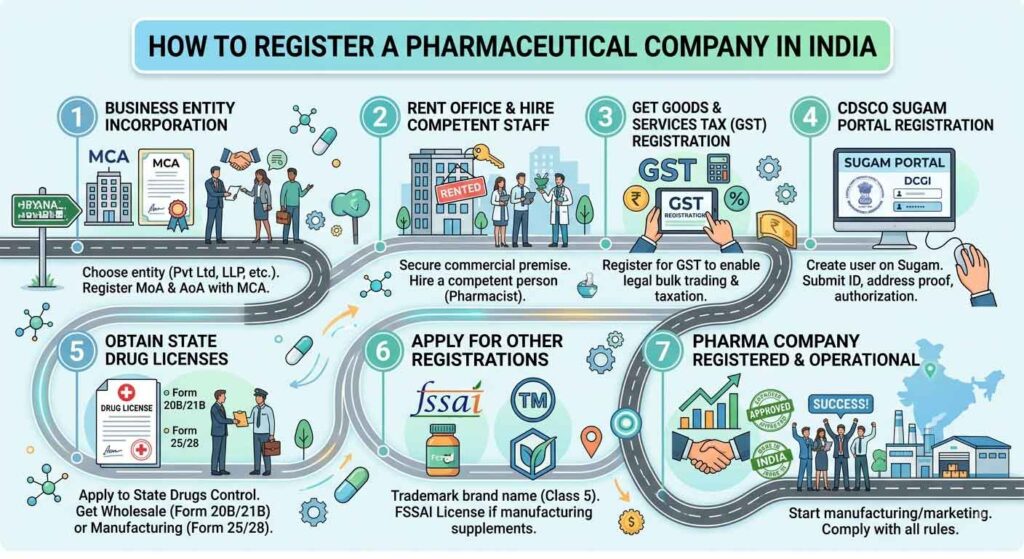
Starting a pharmaceutical company in India involves more than simply registering a company name.
A pharma entrepreneur may need separate registrations for:
Business constitution
Drug licence
GST
Trademark
Manufacturing
FSSAI, where applicable
AYUSH products
Cosmetics
Medical devices
Import-export activities
These registrations serve different purposes.
For example:
Company registration creates the legal entity.
Drug licence permits regulated activities involving medicines.
GST registration deals with taxation.
Trademark registration protects the brand name or logo.
Therefore, company incorporation should not be confused with pharmaceutical licensing.
Quick Answer
A pharmaceutical business in India may be started as:
Proprietorship
Partnership Firm
Limited Liability Partnership (LLP)
One Person Company (OPC)
Private Limited Company
Public Limited Company
For most small and medium pharmaceutical marketing businesses, the commonly considered structures are:
Proprietorship
LLP
OPC
Private Limited Company
A Private Limited Company currently requires at least two members, while an OPC can be incorporated with one member. The Companies Act permits a private company to have up to 200 members, excluding specified categories.
Company incorporation is currently completed through the Ministry of Corporate Affairs using the SPICe+ system. Every company incorporated from February 23, 2020 onwards uses SPICe+ for name reservation and incorporation.
Documents and procedure for Drug department and GST department, we have discussed in our post:
Registrations Commonly Required for a Pharma Business
Depending on the business model, you may need:
Registration/Licence
Purpose
Business registration
Creates legal business entity
Drug licence
Sale, distribution or manufacturing of medicines
GST registration
Tax registration where applicable
Trademark
Brand-name protection
Udyam
MSME registration
IEC
Import/export
FSSAI
Nutraceuticals and food supplements
AYUSH manufacturing licence
Ayurvedic/Siddha/Unani manufacturing
Cosmetic licence
Cosmetic manufacturing
Medical-device licence
Regulated medical devices
Not every pharma company needs every licence.
First define the business activity.
Step 1: Decide Your Pharma Business Model
Before choosing OPC, LLP or Private Limited Company, decide what the company will actually do.
Possible pharmaceutical business models include:
Pharma marketing company
PCD pharma franchise company
Pharmaceutical wholesaler
Retail pharmacy
Pharmaceutical manufacturer
Third-party manufacturing company
Pharmaceutical exporter
Ayurvedic marketing company
Nutraceutical company
Cosmetic company
Medical-device company
The regulatory requirements differ substantially.
Is a Drug Licence Compulsory for Every Pharma Company?
No.
The statement that every pharmaceutical company must obtain a drug licence simply because it is a “pharma company” is too broad.
A drug licence becomes relevant when the entity performs activities regulated under the Drugs and Cosmetics framework, such as:
Manufacturing drugs
Selling drugs
Stocking drugs for sale
Offering drugs for sale
Distributing drugs
The Drugs Rules provide separate licences for wholesale sale/distribution and other pharmaceutical activities.
For example:
Pharma Marketing Company Holding and Selling Stock
If the company purchases, stocks, invoices and distributes pharmaceutical medicines, it will generally need the applicable wholesale drug licence.
Pharmaceutical Manufacturer
It requires the applicable drug manufacturing licence and GMP-compliant manufacturing premises.
Retail Pharmacy
It requires a retail drug licence and registered pharmacist.
Pure Brand Owner or Marketing Arrangement
Where an entity only owns a brand or provides marketing services while manufacturing, invoicing, stocking and distribution are handled through appropriately licensed entities, the licensing position depends on the actual commercial arrangement.
Therefore, determine the drug-licence requirement based on the real activity—not merely the company name.
Types of Business Structures
1. Proprietorship Firm
A proprietorship is the simplest form of business.
There is no separate legal company distinct from its proprietor.
The owner and business are legally closely connected.
Advantages
Easy to start
Low compliance cost
Full control
Suitable for small businesses
Disadvantages
Unlimited personal liability
Limited fundraising ability
Business continuity depends heavily on proprietor
Less suitable for multiple investors
Best Suited For
Small PCD franchise business
Small distributor
Local wholesale business
Small marketing company
A proprietorship is not incorporated as a company under the Companies Act.
2. Partnership Firm
Two or more persons may start a traditional partnership.
Important matters should be recorded in the partnership deed, including:
Capital contribution
Profit-sharing ratio
Duties
Authority
Bank operation
Admission of partners
Retirement
Dispute settlement
Dissolution
Registration of the partnership firm under applicable law should be considered.
Advantage
It is relatively simple.
Main Disadvantage
Partners may have personal liability for partnership obligations.
For entrepreneurs wanting limited liability, an LLP may be preferable.
3. Limited Liability Partnership
The correct Indian term is Limited Liability Partnership or LLP.
“LLC” is commonly used in countries such as the United States but is not the standard Indian MCA entity used for this purpose.
An LLP combines characteristics of:
Partnership
Separate legal entity
Limited liability
At least two designated partners are required, and at least one designated partner must satisfy the applicable Indian-residency requirement.
MCA’s current FiLLiP form integrates:
Name reservation
LLP incorporation
DPIN/DIN allotment
LLPIN
PAN
TAN
Advantages of LLP
Limited liability
Separate legal entity
Flexible internal management
Lower corporate-compliance burden than many companies
Suitable for two or more promoters
Possible Disadvantages
Equity investment structure is less flexible than Private Limited Company
Venture/institutional investors often prefer companies
Ownership is structured through partnership contribution rather than shares
Suitable For
Two or more pharma promoters
Pharma consultancy
Distribution
Marketing
Smaller closely held businesses
4. One Person Company
An OPC is a company that can be formed by one person.
Under Section 3 of the Companies Act, one person may form an OPC, which is treated as a private company. A nominee must also be identified in accordance with the incorporation provisions.
An OPC generally has:
One shareholder
At least one director
One nominee
The same person may normally act as shareholder and director, subject to the Companies Act and rules.
Advantages
Separate legal entity
Limited liability
Single ownership
Better formal structure than proprietorship
Suitable for a sole entrepreneur
Disadvantages
More compliance than proprietorship
Less suitable where several investors will join soon
Company-law filings remain applicable
Suitable For
A sole entrepreneur starting:
Pharma marketing company
PCD company
Distribution company
Consultancy or service business
5. Private Limited Company
A Private Limited Company is one of the most commonly selected structures for a growing pharmaceutical business.
Under the Companies Act:
Minimum members: 2
Minimum directors: 2
Maximum members: 200, subject to statutory exclusions
At least one director must satisfy the applicable Indian-residency requirement under the Companies Act.
Advantages
Separate legal entity
Limited liability
Share-based ownership
Easier addition of shareholders
More suitable for outside investment
Stronger structure for expansion
Suitable for larger manufacturing and marketing operations
Disadvantages
More annual compliance
Statutory filings
Audit and corporate governance costs
More formal decision-making
Suitable For
Pharma marketing company
PCD franchise company
Pharmaceutical manufacturing
Export company
Third-party manufacturing company
Businesses planning future investors
6. Public Limited Company
A public company requires at least seven members.
The Companies Act also requires a minimum of three directors.
This structure is normally suitable for significantly larger businesses.
It is usually unnecessary for a new small pharmaceutical startup.
OPC vs LLP vs Private Limited Company
Point
OPC
LLP
Private Limited
Minimum owners
1
2 partners
2 members
Minimum directors/designated partners
1 director
2 designated partners
2 directors
Liability
Limited
Limited
Limited
Separate legal entity
Yes
Yes
Yes
Ownership
Shares
Partnership contribution
Shares
Best for
Single promoter
2+ closely held promoters
Growth-oriented company
Investor-friendly
Moderate
Lower
High
Compliance
Moderate
Moderate
Higher
Share transfer
Possible subject to rules
Partnership structure
Relatively structured
Which Structure Is Best for a Pharma Marketing Company?
For a single promoter:
OPC or proprietorship may be considered.
For two or more promoters with a relatively simple business:
LLP may be considered.
For promoters planning:
Large-scale PCD franchise
Manufacturing
Export
Investors
Multiple shareholders
Long-term expansion
a Private Limited Company is commonly the more suitable structure.
There is no universal best structure.
The choice should depend on:
Number of promoters
Investment
Liability
Tax planning
Future investors
Annual compliance
Ownership-transfer plans
Current Company Registration Procedure
Company incorporation is now carried out through SPICe+ — Simplified Proforma for Incorporating Company Electronically Plus.
MCA states that SPICe+ provides integrated incorporation and related services.
Subscribers and directors who are required to electronically sign incorporation forms must have a valid DSC according to the MCA process.
Documents typically used for DSC include:
PAN
Aadhaar or other identification
Address proof
Photograph
Mobile/email verification
Requirements depend on the DSC provider and applicant status.
Step 3: Check the Proposed Company Name
The proposed company name should be checked against:
Existing MCA company/LLP names
Existing trademarks
Similar pharmaceutical brands
Restricted or undesirable names
For example:
ABC Lifesciences Private Limited
may be proposed only after checking name availability.
Do not select a name merely because its domain name is available.
Step 4: Check Trademark Availability Before Incorporation
This is particularly important for pharma businesses.
A company name approved by MCA does not automatically give trademark rights.
Suppose MCA approves:
Medstar Pharmaceuticals Private Limited
but another party already owns a similar trademark for pharmaceutical products.
The company could still face a trademark dispute.
Therefore, check IP India’s trademark database before finalising the business name.
Pharmaceutical and medicinal preparations are generally covered within Trademark Class 5.
Step 5: Reserve Company Name Through SPICe+ Part A
SPICe+ Part A is used for reservation of the proposed company name.
MCA states that:
Part A may be submitted separately for name reservation, or
Part A and Part B may be completed together.
When Part A is submitted separately, two proposed names may be entered. When name reservation and incorporation are submitted together, one name is proposed through the integrated application.
Step 6: Prepare the Main Objects of the Company
The Memorandum of Association should properly describe the intended pharmaceutical activities.
Depending on the business, objects may cover:
Pharmaceutical marketing
Trading
Distribution
Wholesale
Manufacturing
Export
Import
Third-party manufacturing
Healthcare products
Ayurvedic products
Nutraceuticals
Cosmetics
Medical devices
Do not copy unnecessarily broad objects without considering the company’s actual activities and regulatory approvals.
Step 7: Complete SPICe+ Part B
SPICe+ Part B handles incorporation and integrated services such as:
Company registration
CIN allotment
DIN application
PAN
TAN
GST application, if selected
SPICe+ can currently allot DIN to up to three proposed directors during normal company incorporation; for a Producer Company, the limit under the integrated form is higher.
Step 8: Prepare MOA
MOA means:
Memorandum of Association
It principally defines:
Company name
Registered state
Main objects
Liability
Capital
Subscriber details
For many incorporations, electronic MOA is filed through the linked incorporation process.
Step 9: Prepare AOA
AOA means:
Articles of Association
It contains the company’s internal governance rules covering matters such as:
Shares
Directors
Meetings
Voting
Transfer of shares
Dividends
Company administration
Step 10: File Linked Forms
The SPICe+ process includes linked forms such as:
e-MOA
e-AOA
INC-9, where applicable
AGILE-PRO-S
MCA’s SPICe+ system links these incorporation forms together.
What Is AGILE-PRO-S?
AGILE-PRO-S is a linked incorporation form.
It integrates services relating to areas such as:
GSTIN application
EPFO
ESIC
Professional Tax in applicable states
Bank account opening
Shops and Establishments registration in supported jurisdictions
MCA’s current instruction kit confirms that AGILE-PRO-S accompanies incorporation under the Companies Incorporation Rules.
PAN and TAN
PAN and TAN are integrated into the company incorporation process.
Therefore, a newly incorporated company normally receives:
CIN
PAN
TAN
through the incorporation process.
Separate standalone PAN/TAN applications are generally unnecessary for the new company when incorporated through SPICe+.
Documents Required for Directors and Subscribers
Commonly required documents include:
PAN
Aadhaar or other identity proof
Passport, where applicable
Address proof
Photograph
Email
Mobile number
Digital signature
Consent to act as director
Subscriber details
Foreign subscribers/directors may require notarisation, apostille or consular authentication depending on the country. MCA specifically provides different authentication procedures for overseas subscribers and directors.
Registered Office Documents
Common documents include:
Rent agreement, where rented
Ownership proof, where owned
Utility bill
NOC from owner
Registered-office address proof
MCA guidance commonly requires a recent utility bill and NOC or rental documentation to support the registered-office address.
Can Your Home Be the Registered Office?
A company may use an appropriate residential property as its registered office where the legal documentation and owner consent support its use.
However:
Registered office and drug-licensed premises are two different concepts.
Your company registered office might be:
House No. 10, Delhi
while your wholesale drug licence may cover:
Shop No. 25, Industrial Area, Delhi
provided all applicable regulatory requirements are satisfied.
The drug licence applies to the approved licensed premises.
Company Name and Drug Licence Name
The legal entity named on the drug licence should correspond to the entity conducting the licensed pharmaceutical activity.
For example:
ABC Pharma Private Limited
should ordinarily apply for the relevant drug licence in the legal entity’s name where ABC Pharma Private Limited is the seller, stockist or distributor.
Do not casually obtain:
Company registration: ABC Pharma Private Limited
but
Drug licence: XYZ Enterprises
and then operate both as if they are the same legal entity.
They are not.
Can Product Brand Names Be Different From Company Name?
Yes.
For example:
Company:
ABC Healthcare Private Limited
Product brands:
Cefabc
Painabc
Livabc
Vitabc
The product brands do not need to be identical to the company name.
For suppliers exclusively dealing in goods, Notification 10/2019 provides an exemption from registration up to ₹40 lakh in qualifying states, with lower limits applicable in specified states/UTs and subject to conditions.
However, many pharmaceutical businesses register for GST from the beginning because they:
Purchase from GST-registered manufacturers
Sell through distributors
Conduct interstate trade
Need input tax credit
Deal with institutional customers
Check the current GST applicability for the specific business rather than using one universal turnover statement.
Drug Licence for Pharma Marketing Company
A typical pharma marketing company that purchases, stores and sells medicines usually requires the applicable wholesale drug licence.
Depending on the product categories, the licensing framework may involve forms such as:
Form 20B
Form 21B
and other forms where applicable.
Licence requirements depend on:
Product category
Premises
Storage
Competent person
State Licensing Authority requirements
Drug Licence for Manufacturing Company
A pharmaceutical manufacturer requires an applicable drug manufacturing licence.
Depending on the dosage forms and drug categories, licensing may involve:
Form 25
Form 28
Form 25A
Form 28A
Form 28D
Other applicable licences
Manufacturing also requires compliance with current Schedule M/GMP requirements.
FSSAI for Nutraceutical Products
If the company deals in:
Health supplements
Nutraceuticals
Protein powders
Certain vitamin/mineral food products
the product may come under FSSAI rather than pharmaceutical drug licensing.
Do not assume every capsule or syrup is legally a medicine.
AYUSH Licence
Ayurvedic medicines follow a separate regulatory pathway.
An Ayurvedic marketing company getting products manufactured through a licensed manufacturer should ensure proper:
Product approvals
Manufacturer–marketer arrangement
Label compliance
IEC for Export
A company planning pharmaceutical exports normally needs an:
Importer Exporter Code — IEC
in addition to pharmaceutical and destination-country regulatory requirements.
Udyam Registration
Eligible MSMEs may obtain Udyam registration.
It can assist with:
MSME recognition
Certain schemes
Financing
Procurement benefits where applicable
Udyam registration does not replace:
Drug licence
FSSAI licence
GST
Company incorporation
Manufacturing licence
Current Company Incorporation Cost
Actual cost depends on:
Authorized capital
State stamp duty
Name-reservation filing
DSC
Professional fees
Number of subscribers
MOA/AOA stamp duty
Other registrations
MCA states that companies incorporated through SPICe+ with authorised capital up to ₹15 lakh continue to receive a zero filing-fee concession for incorporation, but applicable stamp duty and other charges remain payable. A separate SPICe+ Part A name-reservation application carries a ₹1,000 fee.
Therefore, obtain an actual cost estimate according to:
State
Entity type
Authorized capital
Professional service charges
How Much Capital Is Required?
A company can determine an appropriate:
Authorized share capital
Subscribed capital
Paid-up capital
according to its business requirements, subject to the Companies Act and applicable filings.
Do not confuse:
Authorized capital
with
money required to actually operate a pharma company.
A pharma business may need substantially more working capital for:
Stock
Manufacturer payments
Marketing
Salaries
Freight
Credit to distributors
Product development
How Much Time Does Company Registration Take?
Time depends on:
Name approval
Document accuracy
MCA resubmission
DSC availability
Foreign subscriber documents
Registered-office documents
Registrar workload
A straightforward incorporation with correct documents may be completed relatively quickly, while objections or resubmissions may delay it.
Receive Certificate of Incorporation, CIN, PAN and TAN.
Open company bank account.
Arrange appropriate commercial premises.
Apply for wholesale drug licence where the company will stock/sell/distribute medicines.
Obtain GST registration where applicable.
File trademark applications.
Finalize third-party manufacturers.
Execute manufacturer–marketer agreements.
Launch products only after regulatory requirements are completed.
OPC vs Private Limited for a Single Pharma Entrepreneur
If only one person is starting the business, OPC can be a useful structure.
However, Private Limited may be better where:
Another shareholder will join soon.
Investment is expected.
Family or business partners will participate.
The company intends substantial expansion.
An entrepreneur should not add a nominal second shareholder merely to form a Pvt Ltd company without understanding the legal ownership implications.
LLP vs OPC
This is another common question.
Choose OPC When
There is one true owner.
Share-based company structure is preferred.
Separate corporate identity is important.
Choose LLP When
There are at least two genuine promoters.
Flexible profit sharing is preferred.
A partnership-style business structure is suitable.
An LLP cannot be formed by a single person because at least two designated partners are required.
Private Limited vs LLP for Pharma Company
Private Limited may be preferable where:
Investors may join.
Ownership will change.
Shares are important.
Larger institutional business is planned.
Long-term corporate expansion is expected.
LLP may be preferable where:
Promoters want a closely held business.
Outside investment is unlikely.
Flexible profit sharing is important.
Simpler corporate structure is preferred.
Both structures can apply for pharma licences, provided they satisfy the applicable licence conditions.
Does Drug Licence Have to Be on the Same Registered Office Address?
Not necessarily.
The drug licence applies to the premises from which the regulated pharmaceutical activity is conducted.
For example:
Registered office: Chandigarh
Licensed wholesale warehouse: Panchkula
may potentially be structured that way subject to the concerned State Licensing Authority, GST registration and other legal requirements.
Do not assume that the MCA registered office must always be the medicine warehouse.
Can the Company Name and Brand Name Be Different?
Yes.
Example:
Company: ABC Healthcare Private Limited
Brand: Livabc
This is normal.
But the legal company name shown under:
Marketed by
Manufactured by
Invoice
Drug licence
Agreement
must accurately reflect the relevant legal entity.
Important Documents Checklist
For a typical Private Limited pharma company, prepare:
Promoters/Directors
PAN
Identity proof
Address proof
Photograph
Email
Mobile
DSC
Director consent
Registered Office
Ownership proof or rent agreement
NOC
Utility bill
Address details
Incorporation
Proposed company name
Business objects
Capital structure
Shareholding
MOA
AOA
SPICe+ forms
Linked forms
After Incorporation
Certificate of Incorporation
CIN
PAN
TAN
Bank account
GST, where applicable
Drug licence
Trademark
Udyam
IEC, where applicable
Common Mistakes to Avoid
Avoid these mistakes:
Using old Form 1A procedures
Obtaining DIN separately when SPICe+ can allot it
Calling an LLP an LLC
Believing company incorporation itself allows sale of medicines
Assuming drug licence is required merely because “Pharma” appears in the name
Obtaining drug licence in a different legal entity without proper structure
Selecting company name without trademark search
Assuming MCA name approval protects a trademark
Assuming ₹1 lakh minimum paid-up capital is compulsory
Choosing Pvt Ltd when there is only one real owner
Choosing OPC despite immediate plans for multiple shareholders
Forgetting pharmaceutical business objects in MOA
Starting medicine sale before drug licensing
Starting nutraceutical business under drug licence instead of checking FSSAI classification
Final Answer
Registering a pharmaceutical company in India involves two separate decisions:
First: How should the business be legally constituted?
Possible structures include:
Proprietorship
Partnership
LLP
OPC
Private Limited Company
Public Limited Company
Second: Which pharmaceutical licences does that business activity require?
A company planning to sell and distribute pharmaceutical drugs will normally need the applicable drug-sale licence.
A pharmaceutical manufacturer requires a manufacturing licence.
A nutraceutical business may require FSSAI.
An Ayurvedic manufacturer requires the applicable AYUSH manufacturing licence.
Therefore:
Company registration does not equal pharmaceutical licence.
For a single owner, OPC may be suitable.
For two or more closely held promoters, LLP may be suitable.
For a growing pharma marketing, PCD, manufacturing or export business, a Private Limited Company is often considered because of its share-based ownership and expansion flexibility.
Current company incorporation is carried out through SPICe+, not the old Form 1A procedure. SPICe+ integrates incorporation, DIN applications, PAN, TAN and several linked registrations.
Frequently Asked Questions
1. How can I register a pharma company in India?
First choose the legal structure—proprietorship, LLP, OPC or Private Limited Company—then complete the relevant incorporation/registration and obtain pharmaceutical licences required for your actual business activity.
2. Is a Private Limited Company compulsory for pharma business?
No. A pharmaceutical business may operate through several legal structures, subject to licensing requirements.
3. Can one person register a pharma company?
Yes. A single promoter may consider an OPC or proprietorship.
4. Can one person form an LLP?
No. An LLP requires at least two designated partners.
5. How many persons are required for a Private Limited Company?
At least two members are required, together with the applicable minimum director requirements.
6. What is the maximum number of members in a Private Limited Company?
The Companies Act generally limits a private company to 200 members, subject to statutory exclusions.
7. Is DIN required before company registration?
Not necessarily. DIN for up to three proposed directors can generally be applied for through SPICe+ during incorporation.
8. Is PAN separately required after incorporation?
PAN and TAN are integrated into the SPICe+ incorporation process.
9. Is drug licence compulsory for a pharma marketing company?
It depends on actual activity. A company that sells, stocks or distributes medicines generally needs the applicable drug licence.
10. Can the drug licence address differ from the registered office?
Yes, the drug-licensed premises may differ from the company’s MCA registered office, subject to licensing, GST and other regulatory requirements.
11. Can the product brand differ from company name?
Yes. A company may own many different pharmaceutical brand names.
12. Does company-name approval protect my pharma brand?
No. Trademark protection is separate.
13. Which trademark class is commonly used for pharmaceuticals?
Pharmaceutical and medicinal products are commonly covered under Trademark Class 5.
14. What is the trademark filing fee?
The current electronic TM-A government fee is ₹4,500 per class/mark for Individual, Startup or Small Enterprise applicants and ₹9,000 for other applicants.
15. Is ₹1 lakh compulsory as minimum capital for a Private Limited Company?
No. The old fixed minimum paid-up-capital requirement is no longer applicable in that form.
Looking for Ayurvedic Franchise or Distribution Opportunities?
Elzac Herbal India offers opportunities for entrepreneurs interested in Ayurvedic and herbal product distribution, franchise marketing and third-party manufacturing.
Elzac Herbal India offers:
Ayurvedic & Herbal Product Range
Franchise & Distribution Opportunities
Third-Party Manufacturing
Product Development Support
Marketing Guidance
PAN India Business Opportunities
Whether you are an entrepreneur, retailer, distributor, or healthcare professional, our team can help you explore the right business opportunity in the growing Ayurvedic sector.
Ajay Kamboj is an entrepreneur and business owners associated with many Ayurvedic and Pharmaceutical start-ups. With years of experience in Ayurvedic product marketing, pharmaceutical distribution, franchise development, and client relationship management, he regularly shares practical business insights based on real-world experiences. His articles focus on business growth, entrepreneurship, customer management, and lessons learned from the healthcare and wellness industry.
10 responses to “How to Register a Pharmaceutical Company in India?”
I think there is a difference between trade mark vs trade name. Trademark is like as a logo. But trade is the name of your company.
Hey sir i have got my drug wholesale licence .. im a sole proprietor.. after geeting my license do i have to register company again.i mean im not starting a pvt ltd. And also where to get logo registered.
If you don’t want to register your company as pvt ltd or OPC then you can work without company registration as a proprietorship firm. For logo registration you have to apply for TRADE MARK registration process
Should I register my pharmaceutical company before getting drug license ? Or I after getting license I should register my company with same name of my drug license name




I think there is a difference between trade mark vs trade name. Trademark is like as a logo. But trade is the name of your company.
Fantastic ideas . I was fascinated by the facts – Does someone know if my business could get ahold of a template a form version to use ?
Sir please contact me
Hey sir i have got my drug wholesale licence .. im a sole proprietor.. after geeting my license do i have to register company again.i mean im not starting a pvt ltd. And also where to get logo registered.
If you don’t want to register your company as pvt ltd or OPC then you can work without company registration as a proprietorship firm. For logo registration you have to apply for TRADE MARK registration process
You can check Complete procedure to start marketing company at clicking at following link: https://pharmafranchisehelp.com/how-to-start-pharmaceutical-marketing-trading-company-in-india/
pharma marketing company registration you will also require wholesale drug license along with company registration
hello sir,
what type of help you want from us.. please specify
Dear sir I would like to start my own ayurvedic marketing company
.how to register brand name in Karnataka
Should I register my pharmaceutical company before getting drug license ? Or I after getting license I should register my company with same name of my drug license name