In India, most surgical dressings (cotton wool, gauze, bandages, etc.) are regulated under the Medical Devices Rules, 2017 as Class A (low‑risk) medical devices. For example, CDSCO explicitly notes that “absorbent cotton will be regulated as part of surgical dressings as a Medical Device under Risk Class A”. Thus, a medical‑device manufacturing license (Form MD‑5) from the State Drug Controller (through the CDSCO portal) is required to make Class A devices. In practice, manufacturers often also take a State FDA drug license, since absorbent cotton and medicated dressings are listed under the Drugs & Cosmetics Act. In fact, cotton wool is in Schedule C (1) of the D&C Act, so a State drug manufacturing license is needed to sell it legally. (In contrast, non‑medicated cotton cloth not marketed for wound care is not regulated.)
Key registrations: Company formation (e.g. LLP/Pvt Ltd, or proprietorship), GST registration, and (if exporting) IEC. For device manufacture, apply on CDSCO’s SUGAM portal (Form MD‑3) for a Class A device license. If treating products as drugs, apply for Form 28/25 manufacturing license from the State FDA (with supporting GMP compliance documents). Other approvals may include ISO 13485/QMS certification (voluntary), and BIS standards (e.g. IS 7912 for absorbent cotton). Environmental clearances (PCB consent) are usually required if effluents (e.g. bleaching liquor) are generated.
Factory Premises (Schedule M‑III)
The Drug Rules’ Schedule M-III lays out detailed facility requirements for medical device manufacturers. In summary:
Location & building: The factory must be in a sanitary, non‑residential area (no open drains, sewage, etc.). Buildings should be constructed for hygienic production (e.g. no entry for pests). Walls in production rooms must be smooth, impervious and washable up to 6 feet height; floors must be smooth, even, wash‑able and dust‑free. Controlled temperature and humidity are required to prevent product deterioration.
Water & waste: Only potable water is used in manufacturing. Adequate plumbing and drainage must dispose of process wastewater safely.
Personnel: All workers must be healthy (no infectious disease) and trained in hygiene. Provide clean uniforms, masks, gloves, and washbasins. First‑aid facilities are mandatory.
Equipment & layout: Fixed workbenches with smooth impervious tops are required for operations like moulding, cutting, labeling and packing. Provide areas (with utilities) for cleaning, washing and drying containers and components. Production must be logically divided into separate sections (to avoid cross‑contamination): e.g. Raw Material Storage, Moulding/Processing, Assembly (cutting/packing/labeling), Washing/Drying/Sealing, Sterilization, and QC/Testing.
Sources: Official Schedule M‑III (Drugs & Cosmetics Rules) text.
Equipment & Infrastructure
The specific equipment depends on product type. Some examples:
Absorbent Cotton (non‑sterile): Machinery for cleaning and preparing cotton fibres – e.g. carding machines, scouring vessels, bleaching tanks, drying units, and winding/cutting machines. Packaging equipment (e.g. sealers) is also needed. (A small unit might process ~50–100 kg per shift.) Providing an autoclave or boiler for steam processing may be needed if sterilization is planned.
Surgical Bandages/Gauze: Typical equipment includes a rolling machine (for weaving or forming cotton rolls), cutting/trimming machines (to size), and folding/pressing tables for gauze. If making medicated dressings (e.g. ointment‑impregnated gauze), mixers/processing tanks and drying ovens are needed. Work tables, clamp presses and a steam or hot‑air sterilizer are also recommended.
Disposable Medical Devices (e.g. syringes, IV sets): Injection moulding machines (for plastics), extruders for tubing, filter or drip‑chamber assembly presses, sealing machines, blister‑pack machines, etc.. (E.g. 30 m² for a small syringe moulding area and 15 m² for assembly, with HEPA‑filtered air in assembly).
Sterilization: If you produce sterile products in‑house, equip with ethylene‑oxide sterilizer (with gas control/monitoring) or arrange gamma irradiation. Schedule M-III recommends ~10 m² for an EtO chamber. Many small manufacturers instead outsource sterilization to approved third parties.
Quality Control: A basic lab must be provided for raw‐material and product testing – for example, checks on fibre quality, sterility, pyrogenicity, and chemical residuals. Schedule M-III allows new licensees to outsource some sterility/toxicity tests initially, but long‑term they must have these facilities. All raw materials are logged and labeled (“Under Test/Approved/Rejected”) per Schedule U procedures.
Floor Area: As a rule of thumb, Schedule M suggests 30 m² of floor space for basic operations (e.g. rolling/processing) and another 30 m² if making medicated or sterile products. Separate quarantine and sterilized storage areas (~10 m² each) should be provided.
Citations: Schedule M (Drugs Act) equipment list; industry sources on cotton machinery; Schedule M‑III (premises).
Compliance & Documentation
You must document and track every batch: Schedule U (Drugs Rules) requires records of each manufacturing step, from raw‐material lot to finished-product batch. Maintain a Plant Master File (site details, processes) and Device Master Files (product specs). Label all inputs and outputs clearly. Follow Good Manufacturing Practices – keep production area clean, calibrated, and subject to internal audits. If exporting, obtain a Free Sale Certificate from the State FDA after the license is granted.
Quality standards: Test products against relevant standards (e.g. IS 7912 for absorbent cotton). Implement an internal QA system (many firms adopt ISO 13485) to ensure consistent product quality.
Step-by-Step Startup Checklist
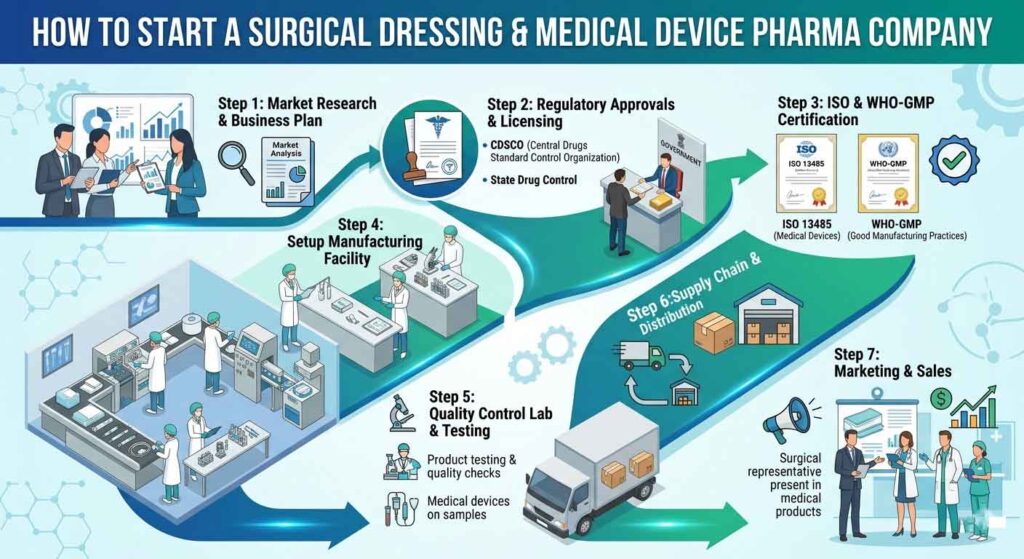
Plan your product range. Decide which surgical dressings/devices to make (cotton wool, cotton balls, bandages, IV sets, etc.), based on market need and your capabilities.
Form the company. Register your business entity (proprietorship/LLP/Pvt Ltd) and get GST registration.
Select site and build facility. Choose a location zoned for industry/healthcare. Build or renovate per Schedule M‑III hygiene rules (e.g. pest-proof walls, washable floors, controlled environment).
Purchase equipment. Acquire the machinery listed above according to your product line (see “Equipment & Infrastructure”). Maintain calibration logs and maintenance schedules.
Hire staff. Employ qualified personnel (a pharmacist or equivalent is typically required on site for drug licenses; a diploma/ITI staff for non‑sterile operations). Train all workers in hygiene and SOPs.
Register and apply for licenses.
If considered a device maker: Apply on the CDSCO SUGAM portal (MD‑3 form) for a Class A device license. Prepare supporting documents (plant layout, SOPs, quality manual, proof of QMS). A Notified Body will inspect your facility for GMP compliance.
If considered a drug manufacturer: Apply for a State FDA manufacturing license (Form 28 for Schedule C1, Form 25 for Schedule M products). Submit plans, MOA, stationery, equipment list, etc., as required.
Obtain any other permits (pollution NOC, electricity, construction, etc.).
Inspection & certification. A licensing inspector will visit to check GMP compliance against Schedule M‑III. On approval, you will receive the manufacturing license (device license in Form MD‑5 or drug license). BIS certification (e.g. IS 7912 for cotton wool) can be sought for marketing advantage.
Trial production and QC. Run trial batches to finalize processes. Perform all required tests (purity, weight, sterility, etc.).
Launch & maintain compliance. Once licensed, you may begin commercial production. Keep impeccable records (per Schedule U) of batches, QC results, maintenance, etc. Renew licenses periodically and prepare for random inspections.
Summary
Starting a surgical dressing/medical device company in India requires careful compliance with both the Drugs & Cosmetics Act and Medical Device Rules. You must set up a hygienic, controlled manufacturing facility (Schedule M‑III), install appropriate machinery (e.g. cotton processing line or medical device assembly equipment), and obtain the necessary licenses. Cotton wool and dressings are ultimately regulated as medical devices (Class A) – but they are also listed as Schedule C(1) under the Drugs Act, so most manufacturers hold both a medical-device license and a drug manufacturing license. Diligent quality control, documentation (Schedule U record-keeping), and adherence to good manufacturing practices are essential for regulatory approval and long-term success.
Sources: Official CDSCO/Drugs rules (Schedule M-III requirements; MDR 2017 FAQ on surgical dressings); industry guides on cotton & bandage manufacturing. These provide the basis for licensing, premises, and equipment standards in India’s surgical dressing industry.
Partner with Elzac Herbal India
Looking to start an Ayurvedic franchise, become a distributor, or launch your own herbal product range?
Elzac Herbal India offers:
Ayurvedic & Herbal Product Range
Franchise & Distribution Opportunities
Third-Party Manufacturing Services
Product Development Support
Marketing Guidance
PAN India Business Opportunities
Whether you are an entrepreneur, retailer, distributor, or healthcare professional, our team can help you explore the right business opportunity in the growing Ayurvedic sector.
Ajay Kamboj is an entrepreneur and business owners associated with many Ayurvedic and Pharmaceutical start-ups. With years of experience in Ayurvedic product marketing, pharmaceutical distribution, franchise development, and client relationship management, he regularly shares practical business insights based on real-world experiences. His articles focus on business growth, entrepreneurship, customer management, and lessons learned from the healthcare and wellness industry.
12 responses to “How to start surgical dressing and medical device pharma company?”
for manufacturing(cutting, rolling and packing) of surgical bandages, is there any kind of drug license required. if it is req then how many chemists would be required for this process. What will be the qualifications of both analytical and manufacturing chemist. how much time license procedure takes to complete. pls help
It is an important part for the medical, Your article is helpful for us to know the full procedure and requirement for this. Get the offer a great range of high standard Disposable Gloves Nitrile in UK.
Sir
Good morning
I am technical person of manufacturing surgical dressing products .
I am 30 years experience of surgical dressing products manufacturing and project planning with machinery
We r alsoanufactirong elastic adhesive bandage machinery.
sir ground floor of my house is 1000 square foot can i use this space as surgical bandage manufacturing unit? 1st floor I am using as residence purpose but 1st and ground floor have difference entrance. I want just surgical bandage making unit (no medicated bandage)
from
Durgapur
west Bengal



for manufacturing(cutting, rolling and packing) of surgical bandages, is there any kind of drug license required.
if it is req then how many chemists would be required for this process.
What will be the qualifications of both analytical and manufacturing chemist. how much time license procedure takes to complete.
pls help
It is an important part for the medical, Your article is helpful for us to know the full procedure and requirement for this. Get the offer a great range of high standard Disposable Gloves Nitrile in UK.
Is it economical to use gamma radiation sterilization of surgical cotton or other products than using steam sterilization?
What kind of licence need for manufacturing cotton crepe bandage? What are the criteria need for that?
You need Manufacturing License for surgical dressings for this
Dear Sir,
We want to apply for Manufacturing license for Surgical Adhesive tape. Will you be able to help us ??
Sir
Good morning
I am technical person of manufacturing surgical dressing products .
I am 30 years experience of surgical dressing products manufacturing and project planning with machinery
We r alsoanufactirong elastic adhesive bandage machinery.
sir ground floor of my house is 1000 square foot can i use this space as surgical bandage manufacturing unit? 1st floor I am using as residence purpose but 1st and ground floor have difference entrance. I want just surgical bandage making unit (no medicated bandage)
from
Durgapur
west Bengal
For Surgical Manufacturing unit, you need premises at industrial area…
medical disposable is going up
What are the requirements for manufacturing cotton crepe bandage since it is not listed in medical devices act 2017.
I want apply for manufacturing cotton bandage licence…any help