Parenteral preparations are among the most technically demanding pharmaceutical dosage forms to manufacture.
Unlike tablets, capsules or syrups, parenteral products are introduced directly into the body through injection, infusion or implantation. They bypass many of the body’s natural protective barriers. Therefore, contamination, particulate matter, incorrect strength, bacterial endotoxins or loss of sterility may create serious risk for patients.
A parenteral manufacturing facility must have:
Sterile manufacturing areas
A strong pharmaceutical quality system
Qualified technical personnel
Controlled HVAC systems
Pharmaceutical water systems
Validated sterilisation processes
Environmental monitoring
Aseptic-process simulation
Quality-control laboratories
Container-closure integrity controls
Detailed batch documentation
Quick Answer
Parenteral preparations include sterile injections, infusions, dry powders for injection, suspensions, emulsions and implantable preparations.
They may be classified as:
Small-Volume Parenterals
Large-Volume Parenterals
Single-dose injections
Multi-dose injections
Liquid injections
Dry-powder injections
Lyophilised injections
Terminally sterilised products
Aseptically manufactured products
Whenever the formulation and container allow it, terminal sterilisation is generally preferred because it provides greater sterility assurance than relying only on aseptic processing.
Aseptic processing should be used when the product cannot withstand terminal sterilisation.
What Are Parenteral Preparations?
Parenteral preparations are sterile preparations intended for administration by:
Intravenous injection
Intramuscular injection
Subcutaneous injection
Intradermal injection
Intra-articular injection
Intrathecal injection
Intraocular injection
Intraperitoneal administration
Intravenous infusion
Implantation
They may be presented as:
Solutions
Suspensions
Emulsions
Dry sterile powders
Lyophilised powders
Concentrates for dilution
Prefilled syringes
Infusion solutions
Implants
The route of administration, formulation, container and product stability determine the appropriate manufacturing process.
What Is an Injection?
An injection is a sterile parenteral preparation supplied in a container such as:
Ampoule
Vial
Prefilled syringe
Cartridge
Infusion bottle
Infusion bag
Some injections are ready to administer, while others must be diluted or reconstituted before use.
Examples include:
Diclofenac injection
Ceftriaxone dry-powder injection
Insulin injection
Iron-sucrose injection
Dextrose infusion
Sodium-chloride infusion
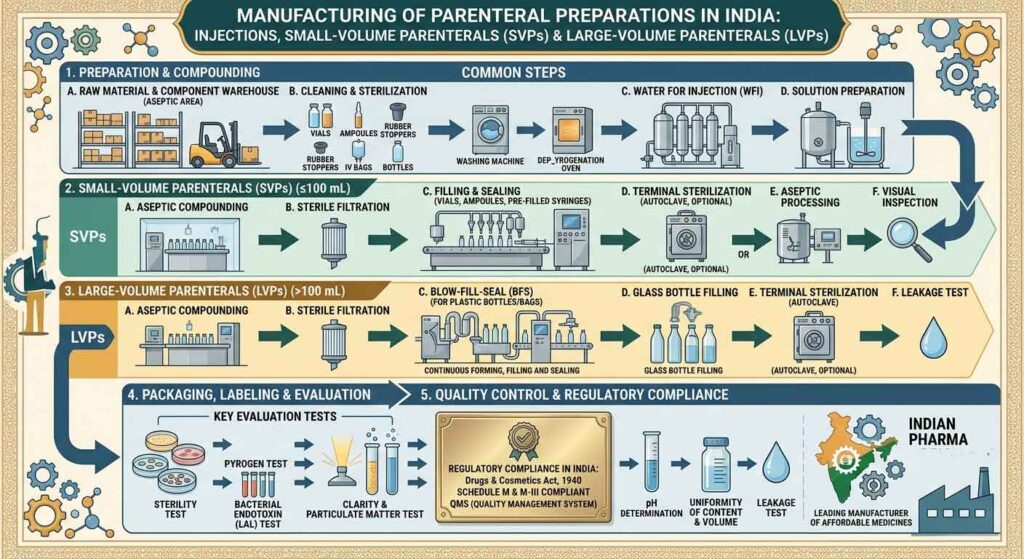
Small-Volume Parenterals
Small-Volume Parenterals, commonly called SVPs, are generally sterile parenteral preparations supplied in containers of 100 ml or less.
Examples include:
1 ml ampoules
2 ml ampoules
5 ml ampoules
10 ml vials
20 ml vials
50 ml infusion containers
100 ml infusion containers
Prefilled syringes
SVPs may be:
Single-dose
Multi-dose
Liquid
Dry powder
Lyophilised
Solutions
Suspensions
Emulsions
Large-Volume Parenterals
Large-Volume Parenterals, commonly called LVPs, are sterile liquid preparations generally supplied in containers of more than 100 ml.
Examples include:
200 ml intravenous infusion
500 ml normal saline
500 ml dextrose infusion
500 ml Ringer’s lactate
1-litre irrigation or infusion solution
LVPs are usually single-dose preparations and normally do not contain antimicrobial preservatives unless specifically permitted and justified.
Common LVP containers include:
Glass bottles
Plastic bottles
Flexible plastic bags
Blow-Fill-Seal containers
Form-Fill-Seal containers
Difference Between SVP and LVP
Point
Small-Volume Parenteral
Large-Volume Parenteral
Common volume
Up to 100 ml
More than 100 ml
Common containers
Ampoules, vials, syringes
Bottles and flexible bags
Dosage
Small injection volume
Large infusion volume
Single or multi-dose
May be either
Generally single-dose
Preservative
May be used in some multi-dose products
Normally avoided
Filling system
Ampoule/vial/syringe filling
Bottle, bag, BFS or FFS line
Common use
Injection or concentrate
Intravenous infusion or irrigation
Particulate control
Critical
Especially critical because of large volume
Liquid and Dry-Powder Parenterals
Liquid Parenteral Preparations
Liquid preparations may be:
Aqueous solutions
Non-aqueous solutions
Suspensions
Emulsions
Concentrates for dilution
Ready-to-infuse solutions
They may be terminally sterilised after filling or aseptically filled after sterilising filtration.
Dry-Powder Parenteral Preparations
Dry-powder injections are used when the active ingredient is unstable in solution.
Examples include:
Antibiotic powders
Certain biological products
Lyophilised injections
Hormonal products
Enzyme preparations
The powder is reconstituted with an approved diluent before administration.
Single-Dose and Multi-Dose Parenterals
Single-Dose Container
A single-dose container is intended for use on one occasion for one patient.
Examples include:
Sealed ampoule
Single-dose vial
Single-use prefilled syringe
LVP infusion bottle
Multi-Dose Container
A multi-dose container permits withdrawal of more than one dose.
Such products may require an appropriate antimicrobial preservative, unless the formulation or route prohibits its use.
The manufacturer should establish:
Preservative effectiveness
In-use stability
Maximum withdrawal period
Closure integrity
Suitable storage instructions
Main Sterility-Assurance Principle
Sterility cannot be assured only by testing a small number of finished containers.
It must be built into the complete manufacturing process through:
Facility design
Personnel practices
Cleaning
Disinfection
Material controls
Air filtration
Water quality
Equipment sterilisation
Process validation
Environmental monitoring
Container-closure integrity
Batch documentation
Terminal Sterilisation
In terminal sterilisation, the product is filled and sealed in its final container and then sterilised.
Examples include:
Steam sterilisation in an autoclave
Validated dry-heat treatment for suitable products
Other validated methods where technically justified
Terminal sterilisation is preferred where the product and container can withstand the process.
Aseptic Processing
Aseptic processing is used when the product cannot tolerate terminal sterilisation.
In this process:
Product-contact equipment is sterilised.
Containers and closures are sterilised or depyrogenated.
Product is sterilised separately, commonly by filtration where suitable.
Product is filled under Grade A conditions.
Containers are closed while maintaining aseptic protection.
Aseptic processing requires stricter control of personnel, environment, interventions and equipment.
Regulatory Requirements in India
Manufacturing of sterile pharmaceutical products in India is governed by:
Drugs and Cosmetics Act, 1940
Drugs Rules, 1945
Revised Schedule M
Applicable pharmacopoeial standards
Product-specific licences and permissions
State Licensing Authority requirements
Central Licensing Authority involvement for specified categories
CDSCO notified the revised Schedule M through G.S.R. 922(E) dated December 28, 2023. CDSCO subsequently issued notifications concerning its implementation timeline.
For Large-Volume Parenterals, CDSCO has also issued a public notice concerning manufacturing-licence applications in Forms 28D and 28DA through the ONDLS portal.
The exact licence route should be confirmed according to:
Product category
New-drug status
Biological status
LVP or SVP classification
Loan-licence arrangement
State and Central authority responsibilities
Contamination-Control Strategy
A modern sterile manufacturing facility should prepare a documented Contamination-Control Strategy.
The strategy should consider:
Facility design
Process flow
Personnel movement
Material movement
Cleanroom classification
HVAC
Utilities
Water systems
Cleaning and disinfection
Sterilisation
Depyrogenation
Aseptic interventions
Environmental monitoring
Personnel monitoring
Raw-material bioburden
Container-closure integrity
Vendor qualification
Maintenance
Investigation of contamination
Corrective and preventive actions
The strategy should connect all contamination-control measures rather than treating them as separate, unrelated procedures. WHO’s sterile-products GMP guideline places contamination-control strategy at the centre of sterile manufacturing.
Manufacturing Sections Required
The actual layout depends on the product and process, but a sterile facility may require the following areas.
General Areas
Raw-material warehouse
Packing-material warehouse
Quarantine area
Approved-material area
Rejected-material area
Sampling area
Dispensing area
Personnel change rooms
Equipment washing area
Component washing area
Sterilisation area
Production area
Filling and sealing area
Visual-inspection area
Labelling and packing area
Finished-goods quarantine
Released finished-goods warehouse
Returned and recalled-goods areas
Quality-control laboratory
Microbiology laboratory
Stability section
Utility area
Important Correction About Warehouses
A raw-material warehouse is not normally an aseptic area.
Materials are stored under controlled and documented conditions according to their status and storage requirements.
Only materials entering the sterile process are transferred through validated:
Cleaning
Disinfection
Sterilisation
Depyrogenation
Airlock
Pass-box procedures
Cleanroom Grades
Sterile production uses classified clean areas according to the risk of the operation.
Grade A
Grade A is the critical zone for high-risk operations such as:
Aseptic filling
Open sterile containers
Aseptic connections
Exposed sterile product
Stopper bowls and filling needles
Loading or unloading exposed sterile components
Grade A protection may be provided through:
Unidirectional airflow
Restricted Access Barrier System
Isolator technology
Appropriate HEPA filtration
Grade B
Grade B commonly provides the background environment for Grade A aseptic operations conducted in conventional cleanrooms.
Grade C and Grade D
These grades may be used for less critical preparation stages, depending on:
Whether the product will be terminally sterilised
Whether sterilising filtration will follow
Product bioburden risk
Process design
The applicable approved manufacturing method
Cleanroom classification should be supported by qualification, risk assessment and the applicable GMP requirements.
HVAC System
A sterile facility requires a carefully designed HVAC system.
It may control:
Air cleanliness
Particle levels
Microbial contamination
Temperature
Relative humidity
Air changes
Airflow direction
Pressure differentials
Recovery time
Separate air-handling systems may be needed for:
Aseptic filling
Component preparation
Sterile change rooms
Potent products
Sensitising products
Microbiology areas
Non-sterile support areas
Air should not flow from a less clean area into a more critical area.
Airlocks and Pass Boxes
Airlocks help maintain separation between areas of different cleanliness.
Types may include:
Personnel airlocks
Material airlocks
Equipment airlocks
Pass boxes
Doors should be interlocked where necessary to prevent both doors from opening simultaneously.
Material transfer procedures should specify:
Cleaning
Disinfection
Wrapping
Sterilisation status
Maximum holding time
Transfer sequence
Personnel and Garments
People are one of the main contamination sources in aseptic production.
Only trained and qualified personnel should enter sterile areas.
Training should include:
Microbiology
Aseptic behaviour
Gowning
Cleanroom movement
Intervention control
Hygiene
Disinfection
Contamination risks
Reporting of illness
Documentation
Sterile-area clothing may include:
Sterile coverall
Hood
Mask
Goggles, where required
Sterile gloves
Sterile footwear
The complete gown should cover exposed skin and minimise release of particles and microorganisms.
Personnel should undergo periodic gowning qualification and microbiological monitoring.
Technical Staff Required
A parenteral manufacturing facility may require:
Production head
Manufacturing chemist
Quality-control head
Analytical chemist
Microbiologist
Quality-assurance manager
Validation personnel
Engineering personnel
Production supervisors
Trained sterile operators
Visual inspectors
Warehouse staff
Production and quality-control responsibilities should remain appropriately independent.
The Quality Unit should have authority to:
Approve or reject materials
Review batch records
Approve or reject batches
Investigate deviations
Review sterility failures
Manage complaints
Initiate recalls
Approve changes
Review validation
Water for Parenteral Manufacturing
Water is a critical raw material in parenteral manufacturing.
Depending on the process, the facility may need:
Potable water
Purified water
Water for Injection
Clean steam
Water for Injection is commonly used for preparing aqueous parenteral products and for final rinsing of product-contact equipment where required.
The water system should be:
Properly designed
Qualified
Sanitised
Continuously circulated where applicable
Chemically monitored
Microbiologically monitored
Protected against stagnation
Maintained under change control
WHO maintains separate GMP guidance for pharmaceutical water systems in addition to sterile-product guidance.
Containers and Closures
Parenteral containers may include:
Glass ampoules
Tubular glass vials
Moulded glass vials
Plastic vials
Prefilled syringes
Cartridges
Glass infusion bottles
Plastic infusion bottles
Flexible infusion bags
Closures may include:
Rubber stoppers
Elastomeric plungers
Aluminium seals
Flip-off caps
Port closures
The container-closure system should be compatible with the formulation and provide protection throughout shelf life.
It should be evaluated for:
Chemical compatibility
Extractables and leachables
Light protection
Moisture protection
Oxygen protection
Breakage
Closure integrity
Sterilisation suitability
Particulate generation
Manufacturing Process for Terminally Sterilised Liquid Parenterals
A typical process may include:
Receipt and quarantine of materials
Sampling and quality-control approval
Dispensing of ingredients
Preparation of Water for Injection
Preparation of bulk solution
Adjustment of pH or volume
Pre-filtration, where required
Bioburden sampling
Washing of containers
Sterilisation or depyrogenation of components
Filling
Stoppering or sealing
Terminal sterilisation
Leak or integrity testing
Visual inspection
Finished-product testing
Labelling and packing
Batch review and release
The time between bulk preparation, filling and sterilisation should be controlled and validated.
Manufacturing Process for Aseptically Filled Liquid Injections
A typical aseptic process may include:
Material receipt and approval
Dispensing
Bulk-solution preparation
Bioburden control
Pre-filtration
Sterilising-grade filtration
Filter-integrity testing
Transfer through a sterile closed system
Aseptic filling under Grade A protection
Stoppering or sealing
Capping
Container-closure integrity evaluation
Visual inspection
Sterility and endotoxin testing
Batch review and release
Sterilising-grade filters are commonly around 0.22 micrometre nominal pore size, but filter selection must be validated for the product, microorganism retention, compatibility and processing conditions.
Filtration should not remove the need for:
Low starting bioburden
Clean equipment
Sterile components
Controlled holding times
Aseptic filling
Filter-integrity testing
Environmental control
Manufacturing Process for Dry-Powder Injections
Dry-powder injections may be prepared from a sterile active pharmaceutical ingredient or sterile formulation blend.
A typical process includes:
Receipt of sterile API or sterile bulk
Verification of sterility assurance and supplier controls
Receipt and preparation of containers and closures
Vial washing
Vial depyrogenation
Stopper washing and sterilisation
Transfer of sterile powder into the aseptic area
Aseptic powder filling
Stoppering
Crimp sealing
Weight verification
Container-closure integrity testing
Visual inspection
Labelling and packing
Finished-product testing
Batch release
Sterile powder cannot automatically be produced by autoclaving every raw material. Many APIs may be damaged by heat or moisture.
The sterilisation method must be scientifically suitable and validated.
Lyophilised Injection Manufacturing
Lyophilisation, or freeze-drying, is used for products that are unstable as liquids.
The typical process includes:
Bulk-solution preparation
Sterilising filtration
Aseptic filling
Partial stoppering
Transfer to lyophiliser
Freezing
Primary drying
Secondary drying
Stoppering inside the chamber
Removal from lyophiliser
Crimp sealing
Visual inspection
Container-closure integrity testing
Moisture testing
Reconstitution testing
The lyophilisation cycle should be validated for:
Freezing rate
Product temperature
Shelf temperature
Chamber pressure
Primary-drying endpoint
Secondary drying
Residual moisture
Product appearance
Reconstitution time
Large-Volume Parenteral Manufacturing
LVP production usually requires highly automated systems because of:
Large batch size
High filling volume
High particulate-risk exposure
Large water requirement
Large steriliser loads
Container-integrity concerns
A typical LVP line may use:
Glass bottles
Polypropylene bottles
Polyethylene containers
Flexible bags
Blow-Fill-Seal technology
Form-Fill-Seal technology
Blow-Fill-Seal Technology
In Blow-Fill-Seal technology:
Plastic container is formed.
Product is filled.
Container is sealed.
These operations occur in one continuous automated cycle.
BFS can reduce manual interventions, but the process still requires:
Machine qualification
Environmental control
Critical-zone protection
Container-closure validation
Sterilisation validation
Media fills
Maintenance controls
Form-Fill-Seal Technology
In Form-Fill-Seal systems, packaging film is formed into a container, filled and sealed in a continuous or highly integrated process.
It is commonly used for flexible infusion containers.
Sterilisation Methods
Moist-Heat Sterilisation
Steam sterilisation is commonly used for:
Suitable finished products
Rubber closures
Equipment parts
Garments
Product-contact components
Aqueous preparations
The cycle should be validated for:
Time
Temperature
Pressure
Heat penetration
Load pattern
Air removal
Biological effectiveness
Drying, where applicable
Dry-Heat Sterilisation and Depyrogenation
Dry heat may be used for:
Glass containers
Metal components
Heat-stable materials
Depyrogenation
The actual cycle should be validated according to:
Equipment design
Container type
Line speed
Temperature distribution
Heat penetration
Endotoxin reduction target
Sterilising Filtration
Sterilising filtration may be used for heat-sensitive solutions.
Validation should consider:
Microbial retention
Filter compatibility
Adsorption
Extractables
Pressure
Flow rate
Filtration time
Product temperature
Maximum batch size
Filter integrity
Gas and Radiation Sterilisation
Ethylene oxide, gamma radiation or electron-beam sterilisation may be suitable for certain components or devices.
Their use for pharmaceutical products requires scientific justification and validation because of:
Residues
Product degradation
Packaging compatibility
Dose distribution
Material changes
Depyrogenation and Endotoxin Control
Sterility and absence of bacterial endotoxins are different quality requirements.
A sterile product can still contain endotoxins if contamination occurred before sterilisation.
Endotoxin control includes:
High-quality water
Low raw-material bioburden
Clean equipment
Short holding times
Validated cleaning
Depyrogenation of suitable components
Microbial monitoring
Endotoxin testing
Endotoxin cannot be reliably controlled only through final-product testing.
Machinery and Equipment
Component Preparation
Ampoule washing machine
Vial washing machine
Rubber-stopper washing machine
Ultrasonic washer
Tunnel steriliser
Dry-heat oven
Autoclave
Component preparation vessels
Solution Preparation
Stainless-steel manufacturing vessel
Pressure vessel
Holding vessel
Magnetic stirrer
Homogeniser
Transfer pump
Load cells
pH meter
Temperature-control system
Clean-in-place system
Steam-in-place system
Filtration
Pre-filter housing
Sterilising-filter housing
Membrane-filter assemblies
Filter-integrity tester
Sterile transfer lines
Filling and Sealing
Ampoule filling and sealing machine
Vial filling machine
Powder filling machine
Stoppering machine
Crimping machine
Prefilled-syringe filling line
BFS machine
FFS machine
LVP bottle filling line
Bag filling and sealing machine
Lyophilisation
Pharmaceutical lyophiliser
Refrigeration system
Vacuum system
Automatic loading and unloading, where applicable
Chamber-cleaning system
Stoppering arrangement
Inspection and Packing
Visual-inspection machine
Leak-testing machine
High-voltage leak detector
Vacuum leak tester
Label application machine
Cartoning machine
Coding and serialization equipment
Quality-Control Tests
Depending on the product, finished-product testing may include:
Description
Identification
Assay
Related substances
pH
Osmolality or osmolarity
Sterility
Bacterial endotoxins
Pyrogen testing, where applicable
Visible particles
Sub-visible particulate matter
Extractable volume
Fill volume
Uniformity
Preservative content
Preservative effectiveness
Reconstitution time
Residual moisture
Container-closure integrity
Leak testing
Potency
Toxicity or biological tests, where applicable
The exact specification should follow the approved product dossier and applicable pharmacopoeial monograph.
Visual Inspection
Every parenteral container should undergo appropriate inspection for defects such as:
Visible particles
Fibres
Glass fragments
Black particles
Improper fill volume
Cracks
Cosmetic defects
Incomplete sealing
Damaged stopper
Incorrect crimping
Discolouration
Precipitation
Container leakage
Manual inspectors should be trained and periodically qualified.
Automatic inspection machines should be qualified and challenged with representative defect sets.
Environmental Monitoring
A sterile facility should monitor:
Non-viable particles
Viable airborne microorganisms
Settle plates
Surface microorganisms
Personnel gloves
Personnel garments
Temperature
Relative humidity
Pressure differentials
Airflow
Monitoring locations and frequency should be based on risk and process knowledge.
Grade A areas require continuous or appropriately frequent monitoring during critical operations according to applicable GMP requirements.
Environmental-monitoring results should be:
Reviewed promptly
Trended
Compared with alert and action limits
Investigated when abnormal
Included in batch review where relevant
Media Fill or Aseptic-Process Simulation
A media fill simulates the aseptic manufacturing process using a suitable microbiological growth medium.
It should represent:
Normal production duration
Maximum permitted interventions
Routine interventions
Worst-case line speed
Shift changes
Container sizes
Holding times
Operator involvement
Lyophilisation steps, where applicable
Media fills are required initially and periodically for each aseptic process and qualified operator group according to the approved programme.
A failed media fill requires investigation and assessment of affected aseptic operations.
Filter-Integrity Testing
Sterilising filters should undergo integrity testing according to the validated process.
Tests may include:
Bubble-point test
Diffusion-flow test
Pressure-hold test
Water-intrusion test
Testing should demonstrate that the filter remained integral throughout processing.
Pre-use post-sterilisation integrity testing may be required or expected according to the applicable process and risk assessment, along with post-use testing.
Container-Closure Integrity
Container-closure integrity demonstrates that the sealed container protects the sterile product from contamination throughout shelf life.
Methods may include:
Vacuum decay
Pressure decay
High-voltage leak detection
Helium leak testing
Dye ingress
Microbial ingress
Laser-based headspace analysis
The chosen method should be appropriate for:
Container
Closure
Product
Defect size
Shelf-life requirement
Validation and Qualification
A parenteral facility requires extensive qualification and validation.
Qualification
Design Qualification
Installation Qualification
Operational Qualification
Performance Qualification
Validation
Process validation
Cleaning validation
Sterilisation validation
Depyrogenation validation
Aseptic-process simulation
Filter validation
Holding-time validation
HVAC qualification
Water-system validation
Container-closure integrity validation
Computerised-system validation
Transport validation
Visual-inspection validation
Documentation Required
Records may include:
Master Formula Record
Batch Manufacturing Record
Batch Packing Record
Equipment logbook
Cleaning records
Sterilisation records
Autoclave cycle records
Tunnel-depyrogenation records
Filter-integrity records
Environmental-monitoring records
Personnel-monitoring records
Water-test records
Differential-pressure records
Temperature and humidity records
Visual-inspection records
Leak-test records
Yield reconciliation
Rejected-container records
Label reconciliation
Deviation reports
CAPA records
Change-control records
Stability records
Analytical reports
Batch-release records
Important Batch Record Details
The batch record should normally identify:
Product name
Batch number
Batch size
Manufacturing dates
Expiry date
Raw-material quantities
Control numbers
Equipment used
Mixing time
Solution pH
Filtration data
Filling volume
Environmental conditions
Sterilisation cycle
Number of containers filled
Number rejected
Actual yield
Reconciliation
Operators and supervisors
Quality-control reports
Quality-assurance release
Product Release
A batch should be released only after authorised Quality Assurance review.
Release review should include:
Complete batch records
Sterilisation records
Environmental monitoring
Filter-integrity results
Finished-product testing
Sterility results
Bacterial-endotoxin results
Deviations
Yield reconciliation
Packaging reconciliation
Container-closure information
Sterility-test results alone are not sufficient to release a batch if the manufacturing process or environmental records show loss of control.
Common Manufacturing Mistakes
Avoid these mistakes:
Treating final sterility testing as the main sterility assurance
Assuming filtration alone makes a product sterile
Using one fixed depyrogenation temperature for every container
Keeping raw-material warehouses as poorly defined “aseptic” areas
Ignoring personnel interventions
Weak environmental monitoring
No contamination-control strategy
Inadequate media fills
Poor water-system maintenance
Missing filter-integrity tests
Using unqualified visual inspectors
Inadequate container-closure integrity testing
Excessive bulk-solution holding time
Poor endotoxin control
Mixing sterile and non-sterile material flows
Installing equipment before finalising product and process
Copying another factory’s SOPs
Releasing batches despite unexplained deviations
Investment Required
Parenteral manufacturing requires substantially higher investment than ordinary tablet, capsule or liquid manufacturing.
Major cost areas include:
Industrial premises
Sterile-facility construction
Cleanroom panels
HVAC
Water for Injection system
Clean-steam generator
Autoclaves
Depyrogenation tunnel
Filling lines
Lyophiliser, where required
Quality-control laboratory
Microbiology laboratory
Stability chambers
Environmental-monitoring instruments
Validation
Technical staff
Backup utilities
Product development
Regulatory approvals
Working capital
LVP, lyophilised, biological and aseptic prefilled-syringe facilities normally require much higher investment than a basic terminally sterilised SVP line.
Best Startup Strategy
A first-time manufacturer should not start every parenteral category together.
A practical strategy is:
Select one product category.
Decide whether it can be terminally sterilised.
Prepare a detailed feasibility report.
Engage sterile-manufacturing experts.
Finalise product and container systems.
Design the facility according to the process.
Obtain regulatory guidance before construction.
Install scalable equipment.
Establish quality systems early.
Conduct qualification and validation before commercial manufacture.
Whenever possible, a new company may first use a licensed third-party sterile manufacturer rather than immediately constructing its own parenteral plant.
Final Answer
Parenteral preparations are sterile medicines administered by injection, infusion or implantation.
They include:
Small-Volume Parenterals
Large-Volume Parenterals
Liquid injections
Dry-powder injections
Lyophilised injections
Prefilled syringes
Infusion solutions
Their manufacture requires a much higher level of control than ordinary oral products.
The key requirements are:
Properly designed sterile premises
Qualified HVAC and water systems
Trained personnel
Validated sterilisation
Validated aseptic processing
Environmental monitoring
Media-fill studies
Endotoxin control
Container-closure integrity
Strong Quality Assurance review
Terminal sterilisation should be used whenever the product and container can tolerate it. Aseptic processing should be selected only when necessary and supported by a comprehensive contamination-control strategy.
In India, the facility should comply with the revised Schedule M, applicable product licences, pharmacopoeial requirements and State or Central Licensing Authority procedures.
Frequently Asked Questions
1. What are parenteral preparations?
Parenteral preparations are sterile medicines administered through injection, infusion or implantation.
2. What is an SVP?
An SVP is generally a Small-Volume Parenteral supplied in a container of 100 ml or less.
3. What is an LVP?
An LVP is generally a Large-Volume Parenteral supplied in a container containing more than 100 ml.
4. What is the difference between terminal sterilisation and aseptic filling?
Terminal sterilisation sterilises the sealed final container. Aseptic processing separately sterilises the product, components and equipment before filling under controlled conditions.
5. Which method is preferred?
Terminal sterilisation is preferred whenever scientifically and technically possible.
6. Is a 0.22-micron filter enough to ensure sterility?
No. Sterilising filtration must be validated and followed by protected aseptic filling, filter-integrity testing and environmental control.
7. Must vials always be depyrogenated above 300°C?
No. A validated time-and-temperature cycle should be established for the specific tunnel, vial and line speed.
8. Is Water for Injection required?
Water for Injection is generally required for aqueous parenteral preparations and applicable final rinsing operations.
9. What is a media fill?
A media fill is an aseptic-process simulation using a microbiological growth medium to evaluate the capability of the aseptic process.
10. What is container-closure integrity?
It is the ability of the sealed container to prevent entry of microorganisms and other contaminants throughout shelf life.
11. Are LVPs normally multi-dose?
No. Large-Volume Parenterals are generally single-dose preparations.
12. Can preservatives be used in LVPs?
LVPs normally do not contain antimicrobial preservatives unless specifically justified and permitted.
13. Is environmental monitoring compulsory?
Yes. Viable, non-viable, surface and personnel monitoring are fundamental controls in sterile manufacturing.
14. Can dry-powder APIs simply be autoclaved?
No. The sterilisation method must be compatible with the API. Many sterile powders are produced through specialised sterile processes or obtained from qualified sterile sources.
15. Which licence applies to LVP manufacturing in India?
The applicable route includes Forms 28D/28DA for LVP licensing under the relevant Central and State regulatory process. The current procedure should be confirmed through CDSCO and the concerned State Licensing Authority.
Looking for Ayurvedic Franchise or Distribution Opportunities?
Looking to start an Ayurvedic franchise, become a distributor, or launch your own herbal product range?
Elzac Herbal India offers:
Ayurvedic & Herbal Product Range
Franchise & Distribution Opportunities
Third-Party Manufacturing
Product Development Support
Marketing Guidance
PAN India Business Opportunities
Whether you are an entrepreneur, retailer, distributor, or healthcare professional, our team can help you explore the right business opportunity in the growing Ayurvedic sector.
Ajay Kamboj is an entrepreneur and business owners associated with many Ayurvedic and Pharmaceutical start-ups. With years of experience in Ayurvedic product marketing, pharmaceutical distribution, franchise development, and client relationship management, he regularly shares practical business insights based on real-world experiences. His articles focus on business growth, entrepreneurship, customer management, and lessons learned from the healthcare and wellness industry.

Leave a Reply
You must be logged in to post a comment.