Sales is the lifeline of every business. If a company is compared with a human body, then sales can be compared with blood. Without blood, the human body cannot function. Similarly, without sales, a company cannot survive for long.
In the pharmaceutical sector, sales is equally important, but the method of selling is different from many other industries. Pharma sales depends on product knowledge, doctor promotion, prescription generation, retailer availability, distributor support, ethical marketing, and regular follow-up.
A pharmaceutical company may manufacture excellent quality products, but if its sales team is weak, the products may not reach doctors, chemists, hospitals, distributors, and patients effectively.
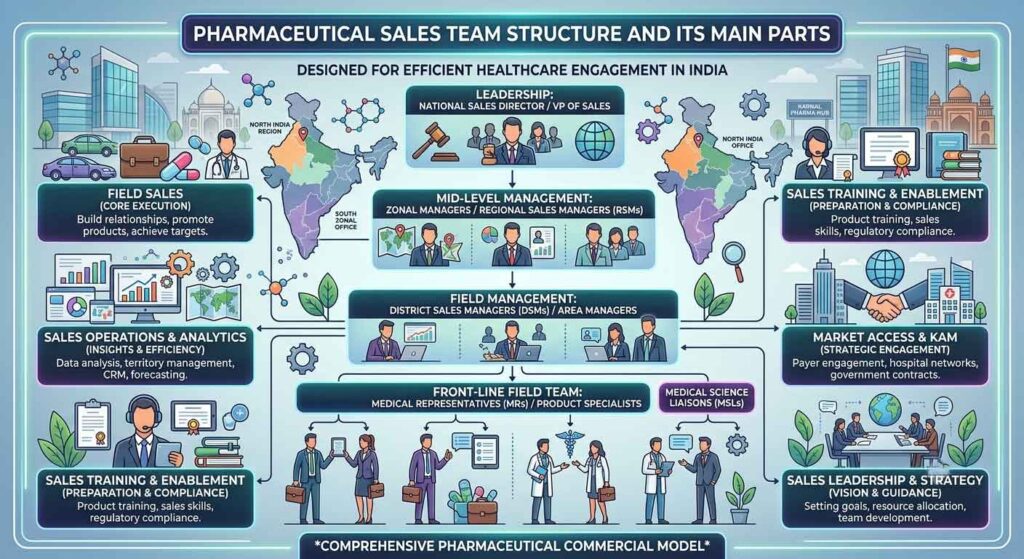
This article explains the basic structure of a pharmaceutical sales team and the role of each position.
Why Sales Team Is Important in Pharma Business
Pharmaceutical products are not sold like ordinary consumer products. In most prescription-based segments, doctors play a major role in product recommendation.
A pharma sales team helps the company by:
Promoting products to doctors
Generating prescriptions
Building relationships with healthcare professionals
Coordinating with stockists and retailers
Ensuring product availability
Collecting market feedback
Monitoring competitors
Increasing secondary and primary sales
Expanding company presence in new territories
Supporting product launches
In pharma, sales is not only about taking orders. It is about creating trust, product awareness, scientific communication, market coverage, and regular follow-up.
Common Levels in Pharmaceutical Sales
A pharmaceutical sales organization is generally divided geographically.
Common divisions include:
Country
Zone
Region
Area
Territory
For example, India may be divided into North Zone, South Zone, East Zone, West Zone, Central Zone, and North-East Zone. Each zone may have multiple regions. Each region may have multiple areas. Each area may have multiple territories.
The structure depends on company size, product range, sales potential, doctor coverage, population, and market opportunity.
Small companies may have only Medical Representatives and Area Managers. Large companies may have a complete hierarchy from field staff to national leadership.
1. Medical Representative
Medical Representative, commonly called MR, is the frontline sales person in the pharmaceutical industry.
An MR directly meets doctors, chemists, stockists, hospitals, and sometimes nursing homes or clinics, depending on company policy.
The main responsibility of a Medical Representative is to promote company products and generate prescriptions.
Role of Medical Representative
A Medical Representative is responsible for:
Meeting doctors regularly
Explaining product benefits and composition
Promoting new products
Providing scientific product information
Collecting prescription feedback
Checking retailer availability
Coordinating with stockists
Taking market feedback
Reporting daily work
Achieving sales targets
Monitoring competitor activity
Territory of Medical Representative
The area assigned to a Medical Representative is called a territory.
A territory may include:
One city
Part of a city
One district
Multiple small towns
Rural and urban market mix
Territory size depends on:
Number of doctors
Population
Prescription potential
Company turnover
Product category
Travel distance
Chemist coverage
Competition level
A Medical Representative is the foundation of pharma sales. If MR coverage is strong, the company can build better doctor relationships and prescription flow.
2. Area Sales Manager
Area Sales Manager, commonly called ASM, is the first-level manager in the pharma sales hierarchy.
Most Area Sales Managers are promoted from Medical Representative level after gaining field experience and achieving sales performance.
An ASM manages a team of Medical Representatives.
Role of Area Sales Manager
An Area Sales Manager is responsible for:
Handling MR team
Guiding field staff
Achieving area sales target
Conducting joint fieldwork with MRs
Meeting important doctors
Motivating team members
Reviewing daily and monthly reports
Planning doctor coverage
Monitoring stockist sales
Solving field-level problems
Supporting product launches
Training new Medical Representatives
An ASM works both as a team leader and field performer.
Area Covered by ASM
An ASM usually handles a larger area than an MR.
For example, one ASM may handle:
3 to 5 Medical Representatives
Multiple districts
One small region
Several important towns
The exact team size depends on company policy and market size.
3. Regional Sales Manager
Regional Sales Manager, commonly called RSM, manages multiple Area Sales Managers.
A region is bigger than an area and may include several districts, cities, or states, depending on the company structure.
An RSM is responsible for overall sales performance of the assigned region.
Role of Regional Sales Manager
A Regional Sales Manager is responsible for:
Managing Area Sales Managers
Monitoring regional sales
Planning monthly and quarterly targets
Reviewing primary and secondary sales
Handling important doctors and institutions
Managing key stockists and distributors
Implementing company strategy
Training ASMs and MRs
Controlling expenses
Reviewing market performance
Reporting to Zonal Sales Manager
Identifying growth opportunities
At RSM level, the person starts handling more managerial and strategic responsibilities along with field work.
4. Zonal Sales Manager
Zonal Sales Manager, commonly called ZSM, manages a complete zone.
A country like India may be divided into different zones such as:
North Zone
South Zone
East Zone
West Zone
Central Zone
North-East Zone
A ZSM manages multiple Regional Sales Managers and is responsible for sales growth in the assigned zone.
Role of Zonal Sales Manager
A Zonal Sales Manager is responsible for:
Managing regional teams
Achieving zonal sales targets
Reviewing zone-wise performance
Planning expansion strategy
Identifying weak markets
Monitoring competitors
Controlling field expenses
Supporting important product launches
Building major institutional or corporate contacts
Improving team productivity
Reporting to national sales leadership
ZSMs play an important role in converting company strategy into field execution.
5. General Sales Manager
General Sales Manager, also called GSM or GM Sales, is a senior sales leader.
A General Sales Manager may handle national sales, multiple zones, or a large business division, depending on company size.
Role of General Sales Manager
A General Sales Manager is responsible for:
Overall sales planning
National or division-level target achievement
Sales policy implementation
Field-force productivity
Budget planning
Product-wise sales analysis
Zone-wise review
Strategy development
Recruitment planning
Training coordination
Market expansion
Coordination with marketing, production, and management
A GM Sales usually does not work daily in the field like MR or ASM, but may visit the field for major reviews, important doctor meetings, product launches, or low-performing markets.
6. Vice President Sales
Vice President Sales is a senior leadership position in large pharmaceutical companies.
The VP Sales is responsible for high-level sales growth, business strategy, national performance, and leadership of the sales department.
Role of VP Sales
The VP Sales may handle:
National sales strategy
Business growth planning
Sales-force structure
Budget and profitability
New division launch
Large institutional business
Performance review of senior managers
Coordination with marketing and management
Policy-level decision making
Expansion into new markets
This position is usually found in medium and large pharma companies.
7. Country Manager
Country Manager is usually responsible for the overall business of a company in a particular country.
In multinational companies or large organizations, the Country Manager may handle sales, marketing, regulatory, finance, distribution, and business development functions at country level.
Role of Country Manager
A Country Manager may be responsible for:
Overall country business
Sales and marketing strategy
Profit and loss responsibility
Regulatory and compliance coordination
Business expansion
Senior leadership management
Distributor and institutional strategy
New launches
Long-term growth planning
This is a top-level leadership position.
Example of Pharma Sales Hierarchy
A simple pharma sales hierarchy may look like this:
Medical Representative → Area Sales Manager → Regional Sales Manager → Zonal Sales Manager → General Sales Manager → VP Sales → Country Manager
However, every company does not follow the same structure.
A small pharma company may have:
MR → ASM → Sales Head
A medium company may have:
MR → ASM → RSM → ZSM
A large company may have:
MR → ASM → RSM → ZSM → GM Sales → VP Sales → Country Head
The structure depends on company size, product range, turnover, and market expansion plan.
Difference Between Primary Sales and Secondary Sales
A pharma sales team must understand both primary and secondary sales.
Primary Sales
Primary sales means sale from company to stockist, super stockist, C&F agent, or distributor.
Example:
Company sells products worth ₹5 lakh to a stockist.
This is primary sale.
Secondary Sales
Secondary sales means sale from stockist or distributor to retailers, hospitals, or other customers.
Example:
Stockist sells products worth ₹3 lakh to retailers.
This is secondary sale.
For long-term success, secondary sales is more important because it shows actual market movement.
Doctor Promotion and Prescription Generation
In prescription-based pharma marketing, Medical Representatives promote products to doctors.
They may explain:
Product composition
Indications
Dosage
Benefits
Safety profile
Clinical references
Brand availability
Patient suitability
However, promotion should always be ethical, factual, and compliant. Companies should avoid misleading claims, gifts, inducements, or unethical practices.
Role of Chemist and Stockist in Pharma Sales
Doctor prescription alone is not enough if the product is not available in the market.
The sales team must ensure:
Product availability at stockist level
Product availability at retailer level
Fast replacement of shortage
Proper stock rotation
Expiry control
Scheme communication
Timely supply
A good Medical Representative maintains relationships not only with doctors but also with chemists and stockists.
Factors Affecting Sales Team Structure
A company cannot appoint the same number of sales persons in every area.
Sales team structure depends on:
Population
Number of doctors
Number of hospitals
Medicine consumption
Product category
Competition
Existing sales
Potential sales
Distance between towns
Distributor network
Company budget
Promotional strategy
For example, one territory in North India may generate ₹15 lakh monthly sales, while another territory in a different zone may generate ₹5 lakh. Both territories may not require the same sales team strength.
Product Category and Sales Team Requirement
Different product categories need different sales strategies.
General Pharma Products
Require wide doctor coverage and strong chemist availability.
Specialty Products
Require focused doctor coverage, scientific promotion, and trained representatives.
A pharma sales team usually follows a reporting system.
Common reports include:
Daily call report
Doctor visit report
Chemist visit report
Stockist visit report
Tour programme
Monthly sales report
Primary sales report
Secondary sales report
Expense report
Sample distribution report
Competitor activity report
New doctor conversion report
Today, many companies use CRM software or mobile reporting apps for field-force management.
Marketing Support Required for Sales Team
A sales team performs better when company provides proper marketing support.
Marketing support may include:
Product visual aid
Literature
Doctor reminder cards
Product samples, where legally permitted
Product monographs
Clinical references
Promotional inputs
Digital presentations
Product training
Brand strategy
Launch campaigns
Distributor support
Without proper marketing support, it becomes difficult for the sales team to compete.
Ethical Compliance in Pharma Sales
Pharma sales should be done responsibly.
Important ethical points include:
Do not make false claims.
Do not promote unapproved uses.
Do not offer unethical gifts or inducements.
Do not mislead doctors, chemists, or patients.
Use scientific and approved promotional material.
Maintain proper sample records, where applicable.
Follow company policy and applicable marketing code.
Keep interactions professional and transparent.
Long-term pharma business is built on trust, not shortcuts.
Common Challenges in Pharma Sales Team Management
Pharma companies often face challenges such as:
High field-staff turnover
Poor reporting discipline
Low doctor conversion
Weak secondary sales
Stockist payment issues
Competition pressure
Product shortage
Lack of training
Poor territory planning
Excessive dependence on schemes
Unrealistic targets
Weak manager follow-up
A company must solve these issues through training, planning, support, and realistic market strategy.
How to Build a Strong Pharma Sales Team
To build a strong sales team, a company should:
Hire suitable candidates
Provide product training
Give clear territory allocation
Set realistic targets
Monitor primary and secondary sales
Support field staff with promotional material
Conduct regular review meetings
Reward performance
Maintain ethical standards
Keep product availability strong
Train managers in leadership
Use data for decision making
A strong sales team is built slowly through systems, training, and consistent leadership.
Final Thoughts
Pharmaceutical sales is one of the most important functions of a pharma company. A good sales team connects the company with doctors, chemists, stockists, hospitals, distributors, and the market.
The Medical Representative creates the foundation at field level. Area Sales Manager manages territories. Regional and Zonal Sales Managers expand and monitor bigger markets. General Sales Manager, VP Sales, and Country Manager handle strategy and national growth.
But hierarchy alone does not create success.
A successful pharma sales team needs:
Product knowledge
Ethical promotion
Regular fieldwork
Strong distribution
Good reporting
Managerial support
Market understanding
Consistent follow-up
In pharmaceutical business, sales is not only about pushing products. It is about building trust, ensuring availability, and creating long-term relationships through ethical and professional work.
Frequently Asked Questions
1. What is a pharmaceutical sales team?
A pharmaceutical sales team is a group of professionals responsible for promoting products, generating prescriptions, managing distributors, ensuring market availability, and achieving company sales targets.
2. Who is a Medical Representative?
A Medical Representative is a frontline pharma sales person who meets doctors, chemists, and stockists to promote company products and generate sales.
3. What is the role of an Area Sales Manager?
An Area Sales Manager manages a team of Medical Representatives, reviews sales, conducts joint fieldwork, motivates the team, and handles important doctors and stockists.
4. What is the role of a Regional Sales Manager?
A Regional Sales Manager manages multiple Area Sales Managers and is responsible for regional sales growth, strategy implementation, and performance review.
5. What is the role of a Zonal Sales Manager?
A Zonal Sales Manager manages the sales performance of a complete zone and handles multiple regions under that zone.
6. What is primary sale in pharma?
Primary sale means sale from company to stockist, distributor, or C&F agent.
7. What is secondary sale in pharma?
Secondary sale means sale from stockist or distributor to retailers, hospitals, or other customers.
8. Is doctor promotion important in pharma sales?
Yes, in prescription-based pharma marketing, doctor promotion is important, but it should be ethical, scientific, and compliant.
9. Can every company have the same sales team structure?
No. Sales team structure depends on company size, product category, geography, turnover, and market potential.
10. What makes a pharma sales team successful?
Product knowledge, ethical promotion, regular fieldwork, strong distribution, good reporting, realistic targets, and managerial support make a pharma sales team successful.
Looking for Ayurvedic Franchise or Distribution Opportunities?
Looking to start an Ayurvedic franchise, become a distributor, or launch your own herbal product range?
Elzac Herbal India offers:
Ayurvedic & Herbal Product Range
Franchise & Distribution Opportunities
Third-Party Manufacturing
Product Development Support
Marketing Guidance
PAN India Business Opportunities
Whether you are an entrepreneur, retailer, distributor, or healthcare professional, our team can help you explore the right business opportunity in the growing Ayurvedic sector.
Ajay Kamboj is an entrepreneur and business owners associated with many Ayurvedic and Pharmaceutical start-ups. With years of experience in Ayurvedic product marketing, pharmaceutical distribution, franchise development, and client relationship management, he regularly shares practical business insights based on real-world experiences. His articles focus on business growth, entrepreneurship, customer management, and lessons learned from the healthcare and wellness industry.




Leave a Reply
You must be logged in to post a comment.