The pharmaceutical industry relies heavily on one key professional who directly connects pharmaceutical companies with doctors and healthcare professionals—the Medical Representative (MR).
Whether it is a multinational pharmaceutical company or a growing Ayurvedic business, Medical Representatives play a crucial role in product promotion, prescription generation, and business growth.
In many ways, the Medical Representative is the backbone of pharmaceutical sales and marketing.
Who Is a Medical Representative (MR)?
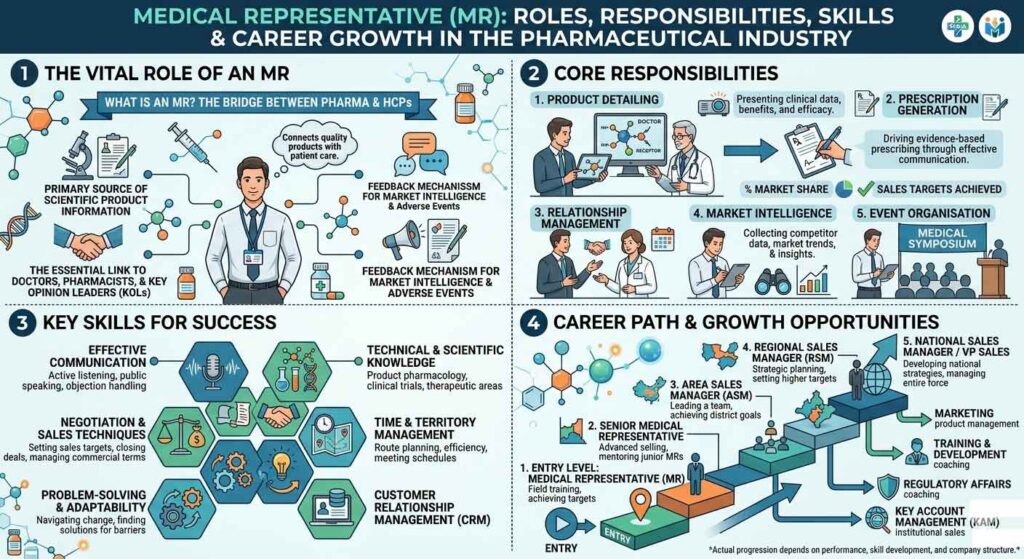
A Medical Representative is a pharmaceutical sales professional responsible for promoting medicines and healthcare products to doctors, hospitals, clinics, chemists, and healthcare professionals.
The primary objective of an MR is to:
Create awareness about company products
Provide scientific product information
Generate prescriptions through ethical promotion
Build professional relationships
Increase company sales
Medical Representatives act as a bridge between pharmaceutical companies and healthcare professionals.
Where Does an MR Fit in the Pharma Sales Structure?
A typical pharmaceutical sales hierarchy includes:
General Sales Manager (GSM)
Responsible for national or large-scale sales operations.
Zonal Sales Manager (ZSM)
Manages a specific geographical zone.
Regional Sales Manager (RSM)
Handles a region consisting of multiple territories.
Area Sales Manager (ASM)
Directly supervises Medical Representatives within assigned territories.
Medical Representative (MR)
Responsible for field-level product promotion and sales generation.
Key Responsibilities of a Medical Representative
1. Product Promotion
An MR educates doctors and healthcare professionals about:
Product benefits
Composition
Indications
Dosage information
Product updates
2. Doctor Visits
Regular meetings with doctors are a core part of the job.
The objective is to:
Present products
Discuss clinical benefits
Build trust
Encourage product prescriptions
3. Market Research
Successful MRs continuously study:
Prescription trends
Competitor products
Market demand
New molecules
Emerging therapies
4. Product Sampling
Providing product samples allows doctors to evaluate and understand the product.
5. Organizing Medical Activities
Medical Representatives may support:
CMEs (Continuing Medical Education programs)
Product launches
Doctor meetings
Healthcare conferences
Scientific discussions
6. Customer Relationship Management
Strong relationships with:
Doctors
Chemists
Hospitals
Healthcare professionals
are essential for long-term success.
7. Reporting and Documentation
MRs regularly submit:
Daily Call Reports (DCR)
Tour reports
Expense reports
Sales reports
Market feedback
8. Achieving Sales Targets
Most pharmaceutical companies assign:
Monthly targets
Quarterly targets
Annual targets
Meeting these goals is a key performance indicator.
Essential Skills Required for a Medical Representative
Communication Skills
The ability to explain products clearly and confidently.
Product Knowledge
Understanding molecules, indications, and therapeutic benefits.
Relationship Building
Professional relationships often drive long-term success.
Confidence
Confidence in yourself, your company, and your products is essential.
Listening Skills
Understanding doctor requirements and concerns is as important as speaking.
Time Management
Managing daily calls, travel schedules, and reporting activities effectively.
Adaptability
Healthcare markets change constantly, and successful MRs adapt quickly.
Personal Qualities of Successful Medical Representatives
The best MRs often share these characteristics:
✔ Positive attitude
✔ Professional appearance
✔ Enthusiasm
✔ Self-motivation
✔ Patience
✔ Consistency
✔ Strong work ethic
✔ Problem-solving ability
✔ Professional conduct
Educational Qualifications for an MR
Many pharmaceutical companies prefer candidates with:
B.Pharm
D.Pharm
B.Sc. (Life Sciences)
Biotechnology
Microbiology
Chemistry
However, many companies also hire graduates from other fields if they demonstrate strong communication and sales skills.
Why Is a Personal Vehicle Important?
Field sales require frequent travel.
Medical Representatives often visit:
Clinics
Hospitals
Medical stores
Distributor locations
Having a personal vehicle can improve:
Territory coverage
Productivity
Time management
However, requirements vary between companies and territories.
How Much Area Does an MR Cover?
Coverage depends on:
Company strategy
Product category
Territory potential
Number of doctors
Market size
Some MRs may handle a single city, while others may cover multiple districts.
What Is a DCR (Daily Call Report)?
A DCR records:
Doctor visits
Product discussions
Sample distribution
Market feedback
It helps managers monitor field activity and evaluate performance.
How Are Reports Submitted?
Today, most pharmaceutical companies use:
Mobile applications
CRM systems
Web-based reporting platforms
MRs typically receive login credentials to submit reports electronically.
Many successful pharmaceutical entrepreneurs began their careers as Medical Representatives.
How to Find a Medical Representative Job?
Popular recruitment channels include:
Job portals
Recruitment consultants
Company websites
Employee referrals
LinkedIn networking
Fresh graduates often start as trainee MRs before moving into independent territories.
Final Thoughts
Medical Representatives are among the most important professionals in the pharmaceutical industry. They not only promote products but also help healthcare professionals stay informed about treatment options and product innovations.
The role requires dedication, communication skills, scientific understanding, and perseverance. For individuals interested in healthcare sales and business development, a career as an MR can offer excellent growth opportunities and valuable industry experience.
Many successful pharma managers, distributors, franchise partners, and company owners started their journey as Medical Representatives.
Frequently Asked Questions (FAQs)
What is the main role of a Medical Representative?
The primary role of an MR is to promote pharmaceutical products, provide scientific information, build relationships with healthcare professionals, and generate sales.
Is a science background mandatory for becoming an MR?
Many companies prefer science graduates, but candidates from other educational backgrounds may also find opportunities depending on the company’s requirements.
What is a DCR in pharma sales?
DCR stands for Daily Call Report, which records doctor visits, product discussions, samples provided, and other field activities.
Can an MR become a Pharma Franchise owner?
Yes. Many successful Pharma Franchise owners and entrepreneurs started their careers as Medical Representatives.
What skills are most important for an MR?
Communication skills, product knowledge, relationship building, confidence, listening ability, and time management are among the most important skills.
Is field travel compulsory in an MR job?
Yes. Medical Representatives typically spend a significant portion of their working hours visiting doctors, chemists, hospitals, and distributors.
Looking for a Career or Business Opportunity in the Healthcare Industry?
At Elzac Herbal India, we value passionate sales professionals, healthcare entrepreneurs, and franchise partners who want to grow in the Ayurvedic sector.
Whether you’re a Medical Representative looking to grow your career or an entrepreneur planning your own healthcare business, we would be happy to connect with you.
Ajay Kamboj is an entrepreneur and business owners associated with many Ayurvedic and Pharmaceutical start-ups. With years of experience in Ayurvedic product marketing, pharmaceutical distribution, franchise development, and client relationship management, he regularly shares practical business insights based on real-world experiences. His articles focus on business growth, entrepreneurship, customer management, and lessons learned from the healthcare and wellness industry.




Leave a Reply
You must be logged in to post a comment.