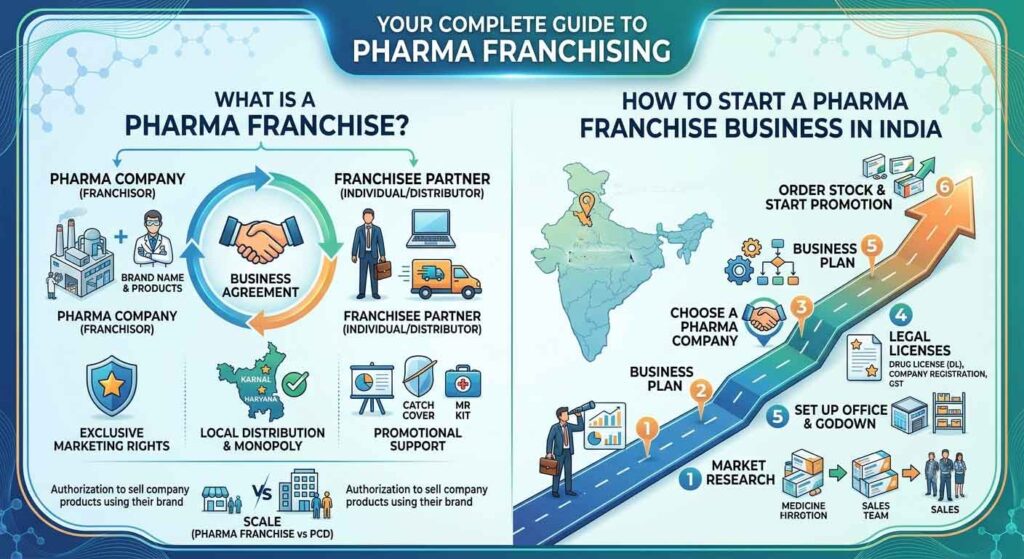
A pharma franchise is a business arrangement in which a pharmaceutical company authorises an individual, distributor or marketing firm to promote and distribute its products in a specified territory.
The franchise partner purchases medicines from the company and markets them through doctors, hospitals, pharmacies, wholesalers, retailers or other permitted channels.
In many cases, the pharmaceutical company also provides:
Product catalogues
Promotional literature
Visual aids
Medical samples
Product images
Franchise guidance
Territory or monopoly rights
Product and marketing support
The franchise partner is mainly responsible for building the local market, generating orders, maintaining distribution and collecting payments.
Quick Answer
To start a pharma franchise business:
Select a product category and territory.
Prepare a business and investment plan.
Register the business.
Obtain the applicable drug licence and GST registration.
Shortlist reliable pharmaceutical companies.
Verify the company, products and manufacturing licences.
Compare rates, margins, MOQ and promotional support.
Finalise territory and monopoly conditions.
Sign a written franchise or distribution agreement.
Purchase a focused opening stock.
Develop doctor, retailer and distributor coverage.
Track secondary sales, payments, expiry and repeat orders.
A pharma franchise is a business model; it is not a substitute for the drug licence or other registrations required for storing and selling medicines.
What Is a Franchise?
A franchise is an authorisation given by a company or organisation to another person or business to carry out specified commercial activities.
Depending on the arrangement, the franchisee may be permitted to:
Use the company’s brand or business identity
Market its products
Distribute products
Operate in an allotted territory
Use approved promotional materials
Represent the company before selected customers
The rights and responsibilities of both parties should be clearly stated in a written agreement.
What Is a Pharma Franchise?
A pharma franchise can be defined as:
A commercial arrangement under which a pharmaceutical company grants an individual or business the right to market and distribute its products in an agreed geographical territory, subject to specified terms and conditions.
The pharmaceutical company is generally known as the:
Franchisor
Pharma franchise company
Product supplier
Marketing or manufacturing company
The business partner is generally known as the:
Franchisee
PCD partner
Monopoly distributor
Franchise distributor
Marketing associate
What Does PCD Mean?
PCD commonly stands for:
Propaganda Cum Distribution
In this model:
“Propaganda” refers to promotion and marketing.
“Distribution” refers to supplying the company’s products in the allotted market.
The PCD partner promotes the products and develops their distribution in a particular town, district, region or state.
Pharma Franchise vs PCD Pharma
The words PCD and pharma franchise are frequently used interchangeably, but companies may use them for different business sizes.
Factor
PCD Pharma
Pharma Franchise
Typical territory
Small town, district or limited area
District, region, state or larger area
Opening order
Usually smaller
May be higher
Team size
Individual or small team
May involve distributors and sales team
Product range
Limited or focused
Broader product range
Promotional support
Basic to moderate
May be more extensive
Business commitment
Relatively smaller
Generally larger
There is no universal legal definition separating PCD from pharma franchise. Each company may use the terms according to its own marketing structure.
How Does the Pharma Franchise Business Work?
The basic process is:
The pharmaceutical company develops, manufactures or sources products.
The franchisee selects a territory and product range.
The company supplies products at an agreed net rate.
The franchisee promotes the brands locally.
Products are supplied through distributors, stockists or retailers.
The franchisee earns the difference between purchase cost and selling value after expenses.
Territory rights continue according to the agreement and performance conditions.
Responsibilities of the Pharma Company
The company may be responsible for:
Supplying approved products
Maintaining product quality
Providing invoices
Providing manufacturing and product documents
Supplying promotional material
Informing the franchisee about product changes
Replacing defective products according to policy
Maintaining agreed territory conditions
Providing commercial and technical support
Responsibilities of the Franchisee
The franchisee is generally responsible for:
Generating local demand
Promoting products responsibly
Maintaining required licences
Purchasing agreed quantities
Developing doctors and retailers
Maintaining adequate stock
Making timely payments
Following company policies
Avoiding misleading claims
Preventing expiry and excessive stock
Reporting complaints or adverse events
Protecting the company’s brand reputation
Types of Pharma Franchise Businesses
1. Monopoly Pharma Franchise
The company grants one franchise partner marketing or distribution rights for an agreed territory.
The territory may be:
Town
Tehsil
District
Group of districts
State
Monopoly rights should always be defined in writing.
2. Non-Monopoly Franchise
The company may appoint several partners in the same territory.
This model may involve:
Lower opening investment
Fewer territory restrictions
Greater competition
Limited exclusivity
3. Ethical or Prescription-Based Franchise
Products are promoted primarily through doctors and other qualified healthcare professionals.
This model commonly requires:
Medical representatives
Visual aids
Product knowledge
Medical literature
Approved samples
Regular doctor coverage
4. Generic Medicine Franchise
The franchisee markets medicines mainly through:
Retail pharmacies
Hospitals
Wholesalers
Institutional buyers
Generic medicine outlets
Price, availability and distribution efficiency are important in this segment.
5. OTC Franchise
OTC and consumer healthcare products may be promoted through:
Retail pharmacies
General stores, where permitted
Digital marketing
Retail displays
Consumer advertising
Distributors
Promotion must remain consistent with the product category and applicable advertising rules.
Ayurvedic medicines, foods, health supplements and cosmetics are different regulatory categories. The correct category should be verified before marketing.
7. Specialty Pharma Franchise
A company may offer a franchise for a specific therapy segment, such as:
Cardiology
Diabetology
Gynaecology
Paediatrics
Orthopaedics
Dermatology
Neurology
Psychiatry
Critical care
Ophthalmology
Veterinary medicines
A focused specialty division may require stronger product knowledge and access to the relevant doctors.
A pharmacy qualification may be useful, but the proprietor does not necessarily have to be a pharmacist.
The business must still fulfil the applicable licensing requirements and appoint an approved pharmacist or competent person wherever required.
Is Previous Experience Necessary?
Previous pharmaceutical experience is not compulsory in every commercial arrangement, but it is highly beneficial.
Experience helps with:
Product selection
Doctor communication
Distributor appointments
Medicine storage
Credit control
Market potential
Pricing
Claims and compliance
Expiry management
Competitor analysis
A beginner without experience should consider working with:
An experienced sales professional
A pharmacist
A licensed wholesaler
A reliable distributor
A regulatory consultant
Registrations and Licences Required
Requirements depend on whether the franchisee will purchase, stock, invoice, distribute or retail the products.
1. Business Registration
The business may operate as:
Proprietorship
Partnership
Limited Liability Partnership
Private Limited Company
A proprietorship is often selected for a small individual business, while LLP or company structures may be suitable for multiple owners or larger expansion plans.
2. PAN and Bank Account
The firm should have:
PAN
Business bank account
Address proof
Business constitution documents
Maintain business and personal transactions separately.
3. GST Registration
GST registration may be required depending on:
Turnover
Nature of supplies
Interstate transactions
Product category
Applicable GST provisions
Many pharmaceutical companies prefer or require a valid GSTIN before appointing a franchise partner.
4. Wholesale Drug Licence
A wholesale drug licence is generally required when the franchisee purchases, stocks, invoices and wholesales pharmaceutical medicines.
Common wholesale licence categories include:
Form 20B for drugs other than Schedule C, C(1) and Schedule X
Form 21B for Schedule C and C(1) drugs, excluding Schedule X
The exact licences depend on the intended product range.
5. Retail Drug Licence
A retail drug licence may be required when medicines are sold directly to patients or consumers through a retail medical shop.
Retail operations generally require the services of a registered pharmacist where prescribed by law.
6. Competent Person
A wholesale premises must be supervised by a competent person who meets the applicable qualification or experience requirements.
Confirm the current eligibility conditions with the State Drugs Control Department.
7. Shop and Establishment or Local Registration
Local registrations may be required according to:
State
Municipal area
Premises
Employee strength
Nature of business
8. Udyam Registration
An eligible micro, small or medium business may obtain Udyam registration.
It can be useful for:
MSME recognition
Certain financing facilities
Delayed-payment protections
Participation in selected schemes
9. Trademark
A franchisee normally sells the company’s existing brands and does not own those trademarks.
However, trademark registration should be considered when the franchisee launches:
Its own company name
Its own product brands
Its own third-party manufactured range
When May a Drug Licence Not Be Required?
The answer depends on the actual business activity.
A person who only introduces customers or works as a commission-based marketing agent without purchasing, stocking, invoicing or physically distributing medicines may have a different licensing position.
However, when the franchisee:
Purchases medicines
Keeps stock
Issues invoices
Supplies pharmacies
Operates as a distributor
Sells medicines
an appropriate drug licence is generally required.
Obtain written clarification from the relevant State Licensing Authority rather than relying only on the franchise company’s verbal statement.
Documents Commonly Required by a Pharma Franchise Company
A company may request:
PAN
Aadhaar or identity proof
Address proof
Business registration document
GST certificate
Wholesale drug licence
Pharmacist or competent-person details
Passport-size photographs
Cancelled cheque
Territory information
Previous experience
Expected opening order
Customer network details
Signed application form
Franchise or distribution agreement
The exact requirements vary between companies.
Step-by-Step Procedure to Start a Pharma Franchise
Step 1: Assess Your Experience and Market
Evaluate:
Your pharmaceutical experience
Doctor contacts
Retailer network
Distributor contacts
Available capital
Product knowledge
Territory knowledge
Time available for fieldwork
Do not select a large territory merely because the company offers it.
Step 2: Select the Marketing Model
Decide whether you want to work through:
Ethical prescription marketing
Generic distribution
OTC marketing
Ayurvedic marketing
Specialty products
Institutional sales
PCD monopoly franchise
Your product range and promotional strategy will depend on this decision.
Step 3: Select a Territory
A practical territory should have:
Sufficient population
Doctors and hospitals
Pharmacies
Distributor access
Transport facilities
Reasonable competition
Purchasing capacity
Scope for repeat business
Begin with an area that can be covered regularly.
Step 4: Conduct a Market Survey
Study:
Existing companies
Popular molecules
Doctor specialties
Retail demand
Current MR activity
Competitor prices
Available distributors
Frequently unavailable products
Customer payment habits
The aim is to understand what can actually be sold, not merely what is available in the catalogue.
Step 5: Choose Product Categories
Start with a focused range.
For example:
General medicine
Gynaecology
Paediatrics
Orthopaedics
Gastroenterology
Ayurvedic products
A focused opening range is usually easier to promote than several hundred products.
Step 6: Prepare an Investment Plan
There is no fixed investment for a pharma franchise.
Include:
Business registration
Drug licence
GST and professional expenses
Premises deposit
Refrigerator or storage equipment
Opening inventory
Promotional material
Samples
Field travel
Sales staff
Distributor margin
Freight
Credit to customers
Working-capital reserve
Do not invest the entire budget in opening stock.
Step 7: Register the Business and Obtain Licences
Complete the applicable:
Business registration
GST registration
Drug licence
Bank account
Local registrations
Udyam registration
Avoid accepting commercial stock before the required licences are ready.
Step 8: Shortlist Pharma Franchise Companies
Shortlist companies according to:
Product range
Product quality
Market reputation
Availability
Rates
Promotional support
Territory policy
Delivery service
Experience
Communication
Compare at least three suitable companies.
Step 9: Verify the Company
Ask for copies of:
Company registration documents
GST certificate
Drug licences
Manufacturing licences
GMP certificate
Product permissions
Product list
Sample invoices
Manufacturing details
Quality certificates
Where products are manufactured by third parties, identify the actual manufacturer.
Step 10: Check the Product Range
Examine:
Composition
Dosage form
Strength
Pack size
MRP
Net rate
Manufacturer
Product permission
Market demand
Competition
Shelf life
Availability
Avoid selecting products only because they offer a high apparent discount from MRP.
Step 11: Request Product Samples
Review:
Packaging
Printing
Label details
Batch coding
Product appearance
Manufacturer information
MRP
Expiry
Storage conditions
Samples can also help assess the quality of promotional presentation.
Step 12: Compare Commercial Terms
Request a written quotation covering:
Net rates
GST
Freight
Minimum order
Payment terms
Credit terms
Promotional support
Sample policy
Expiry policy
Breakage policy
Return policy
Monopoly conditions
Dispatch time
Step 13: Finalise the Territory
Clearly define the territory by:
Town
PIN code
Tehsil
District
State
Product division
Avoid vague descriptions such as “surrounding area.”
Step 14: Negotiate Monopoly Rights
Ask:
Is monopoly product-wise or company-wise?
Is the territory exclusive?
Are existing customers excluded?
Can the company supply hospitals directly?
Can the company appoint another franchisee?
What minimum purchase is required?
How often will performance be reviewed?
Under what conditions can monopoly be withdrawn?
Monopoly should not depend only on verbal assurances.
Step 15: Sign a Written Agreement
The agreement should define:
Parties
Territory
Product range
Duration
Minimum purchase
Payment terms
Promotional support
Brand usage
Confidentiality
Product complaints
Expiry and return policy
Territory conflicts
Termination
Dispute resolution
Applicable jurisdiction
Have the agreement reviewed professionally before signing where the investment is significant.
Step 16: Place the Opening Order
Select products based on actual market potential.
Avoid:
Buying every product
Ordering excessive quantity
Selecting only high-MRP products
Ignoring expiry
Ordering slow-moving specialty products without demand
The opening order should support market testing and repeat sales.
Step 17: Arrange Storage and Inventory Control
Maintain products according to their labelled storage conditions.
Your stock system should record:
Product
Batch number
Expiry
Quantity
Purchase rate
MRP
Customer
Return
Damage
Near-expiry stock
Use first-expiry-first-out inventory management.
Step 18: Develop the Market
Depending on the model, approach:
Doctors
Pharmacies
Hospitals
Distributors
Stockists
Nursing homes
Ayurvedic practitioners
Institutional customers
Prepare a regular coverage plan rather than depending on occasional visits.
Step 19: Maintain Product Availability
Prescription generation without product availability leads to loss of confidence.
Monopoly rights mean that the company agrees not to appoint another franchise partner for the same agreed product range and territory, subject to the agreement.
Monopoly rights may be:
Product-wise
Division-wise
Territory-wise
Time-limited
Performance-based
Conditional on minimum purchase
Monopoly Does Not Always Mean Complete Exclusivity
The agreement should clarify whether the company may still supply:
Existing customers
Hospitals
Government institutions
Online customers
National accounts
Company-owned branches
Other product divisions
Can Monopoly Rights Be Withdrawn?
Rights may be withdrawn if the franchisee:
Fails to achieve agreed sales
Does not purchase regularly
Delays payment
Violates company policy
Misuses the brand
Makes misleading claims
Supplies outside the territory
Fails to maintain licences
The conditions and notice period should be stated in writing.
Prescription-drug promotion to the public requires particular caution.
Key Records to Maintain
Maintain:
Purchase invoices
Sales invoices
Drug licences
GST records
Batch and expiry records
Customer licences
Payment records
Product-return records
Complaint records
Sample distribution records
Franchise agreement
Territory correspondence
Promotional approvals
Advantages of a Pharma Franchise Business
Lower investment than manufacturing
No need to build a manufacturing facility
Ready product range
Established formulations
Marketing support
Territory opportunity
Potential for gradual expansion
Suitable for experienced sales professionals
Possibility of starting with a focused range
Risks and Challenges
High competition
Delayed payments
Product shortages
Expiry losses
Territory disputes
Dependence on one supplier
Poor-quality products
Frequent price changes
Unrealistic sales targets
Weak promotional support
Manufacturer or brand discontinuation
Credit and collection problems
These risks should be considered before placing a large opening order.
Common Mistakes to Avoid
Selecting a company only by low rates
Accepting verbal monopoly rights
Not verifying manufacturing licences
Starting without the required drug licence
Ordering too many products
Giving excessive credit
Ignoring expiry dates
Focusing only on primary purchase
Making unapproved medical claims
Depending on one distributor
Not calculating net profit
Failing to maintain written records
Selecting a territory that cannot be covered regularly
Practical 90-Day Startup Plan
First 30 Days
Select the business model.
Conduct market research.
Select the territory.
Prepare the budget.
Begin registration and licensing.
Shortlist companies.
Days 31–60
Verify companies and products.
Compare rates and agreements.
Finalise product range.
Confirm the territory.
Appoint a distributor where required.
Prepare the marketing plan.
Days 61–90
Place a focused opening order.
Receive promotional material.
Start doctor and retailer coverage.
Monitor stock availability.
Collect market feedback.
Review repeat-order potential.
Final Thoughts
A pharma franchise can provide a practical entry into the pharmaceutical business without establishing a manufacturing unit.
However, success does not depend merely on obtaining monopoly rights or purchasing products at a low rate.
A sustainable franchise requires:
Reliable products
Appropriate licences
A carefully selected territory
Written commercial terms
Consistent market coverage
Strong distribution
Credit control
Product availability
Ethical promotion
Regular business review
Start with a focused product range, protect working capital and expand only after achieving repeat sales.
Frequently Asked Questions
1. What is a pharma franchise?
It is a business arrangement in which a pharmaceutical company authorises a partner to market and distribute its products in an agreed territory.
2. What is the full form of PCD?
PCD commonly means Propaganda Cum Distribution.
3. Is PCD the same as pharma franchise?
The terms are often used interchangeably. Some companies use PCD for smaller territories and pharma franchise for larger business arrangements.
4. Is a separate pharma franchise licence required?
There is no document ordinarily called a “pharma franchise licence.” The business must obtain the drug licence, GST registration and other registrations applicable to its actual activities.
5. Is a wholesale drug licence required?
It is generally required when the franchisee purchases, stocks, invoices and wholesales pharmaceutical medicines.
6. Does the proprietor need to be a pharmacist?
Not necessarily. However, the business must appoint an eligible registered pharmacist or competent person wherever required by the applicable licence.
7. How much investment is required?
There is no fixed amount. It depends on opening stock, product range, premises, promotion, staff, credit and territory size.
8. What are monopoly rights?
They are agreed exclusive marketing or distribution rights for a specified territory and product range, usually subject to performance and payment conditions.
9. Can one company appoint two franchisees in the same area?
Yes, unless a written agreement provides exclusive rights to one franchisee.
10. How is profit earned?
Profit is earned from the difference between purchase and selling value after deducting freight, discounts, salaries, promotional expenses, returns and other business costs.
11. Can a beginner start a pharma franchise?
Yes, but pharmaceutical sales or distribution experience is strongly beneficial. A beginner should start with a limited range and experienced support.
12. What should be checked before selecting a company?
A properly drafted written agreement is strongly recommended, particularly for monopoly rights, commercial terms and significant investments.
14. Can pharma products be promoted online?
Digital promotion is possible, but product claims, audience and prescription-drug restrictions must be considered carefully.
15. What is the biggest reason for franchise failure?
Common reasons include poor market research, weak distribution, excessive credit, product unavailability, overstocking and selecting an unreliable company.
Looking for Ayurvedic Franchise or Distribution Opportunities?
Elzac Herbal India offers opportunities for entrepreneurs interested in Ayurvedic and herbal product distribution, franchise marketing and third-party manufacturing.
Elzac Herbal India offers:
Ayurvedic & Herbal Product Range
Franchise & Distribution Opportunities
Third-Party Manufacturing
Product Development Support
Marketing Guidance
PAN India Business Opportunities
Whether you are an entrepreneur, retailer, distributor, or healthcare professional, our team can help you explore the right business opportunity in the growing Ayurvedic sector.
Ajay Kamboj is an entrepreneur and business owners associated with many Ayurvedic and Pharmaceutical start-ups. With years of experience in Ayurvedic product marketing, pharmaceutical distribution, franchise development, and client relationship management, he regularly shares practical business insights based on real-world experiences. His articles focus on business growth, entrepreneurship, customer management, and lessons learned from the healthcare and wellness industry.
7 responses to “What Is a Pharma Franchise? How to Start a Pharma Franchise Business in India”
Starting pharma pcd or franchise is just like launching new pharmaceutical company in your territory. Its your fresh start, so start with less than 10000/- amount. We are providing few hints to start:
Prepare list of Doctors, nursing home in area, you want to do work Do some market research what doctors prefer to prescribe there Prepare list of molecules those have strong hold in locality Choose molecules which can be easily sold by you Send quotation to more than 4 pcd/franchise companies Check for molecules, you have selected in their price list. Check for molecules, you want to market and also for molecules, you could promote in future Compare all companies list i.e. rates, offer, number of products, required products etc Prepare list of promotion input, gift article etc. Companies will support but promotional material that is provided by them will not be enough for you to do work effectively. Prepare or purchase some good promotional input, you consider good for promoting your products Fixed schedule to call doctors daily, as medical representative do Prepare daily reporting card. Try to fix appointments with doctors in working time and in non-working hours. Appointment in Non working hours could provide best results Do regular visit to doctors
Is PCD franchisee /marketing can be taken by only professionals who did B.pharma or D.pharma ? Or professionals from any background can avail this opportunity. ?
We are leading Pharma manufacturing company in HIMACHAL PRADESH .We are looking for distributors of Pharma products in all India basis.If you are interested to do business then please free to contact us. Manish Kumar ..Company Name:—— LABS LTD, KALA-AMB.HIMACHAL. Contact No: …Email id :a





Starting pharma pcd or franchise is just like launching new pharmaceutical company in your territory. Its your fresh start, so start with less than 10000/- amount. We are providing few hints to start:
Prepare list of Doctors, nursing home in area, you want to do work
Do some market research what doctors prefer to prescribe there
Prepare list of molecules those have strong hold in locality
Choose molecules which can be easily sold by you
Send quotation to more than 4 pcd/franchise companies
Check for molecules, you have selected in their price list. Check for molecules, you want to market and also for molecules, you could promote in future
Compare all companies list i.e. rates, offer, number of products, required products etc
Prepare list of promotion input, gift article etc. Companies will support but promotional material that is provided by them will not be enough for you to do work effectively. Prepare or purchase some good promotional input, you consider good for promoting your products
Fixed schedule to call doctors daily, as medical representative do
Prepare daily reporting card. Try to fix appointments with doctors in working time and in non-working hours. Appointment in Non working hours could provide best results
Do regular visit to doctors
Is PCD franchisee /marketing can be taken by only professionals who did B.pharma or D.pharma ? Or professionals from any background can avail this opportunity. ?
We are leading Pharma manufacturing company in HIMACHAL PRADESH .We are looking for distributors of Pharma products in all India basis.If you are interested to do business then please free to contact us. Manish Kumar ..Company Name:—— LABS LTD, KALA-AMB.HIMACHAL. Contact No: …Email id :a
How long I can continue franchises company and otherside company can withdraw us from franchises after business set.
Anybody looking for PCD pharma franchise on monoply basis in India can contact us:
200+ products
150+ Associates
A—- Pharmaceuticals
can a doctor purchase medicines from PCD Franchise with his lisence
Bonjour. Cet article est très informatif. je cherchais tout juste des informations sur le sujet.
Bon courage!