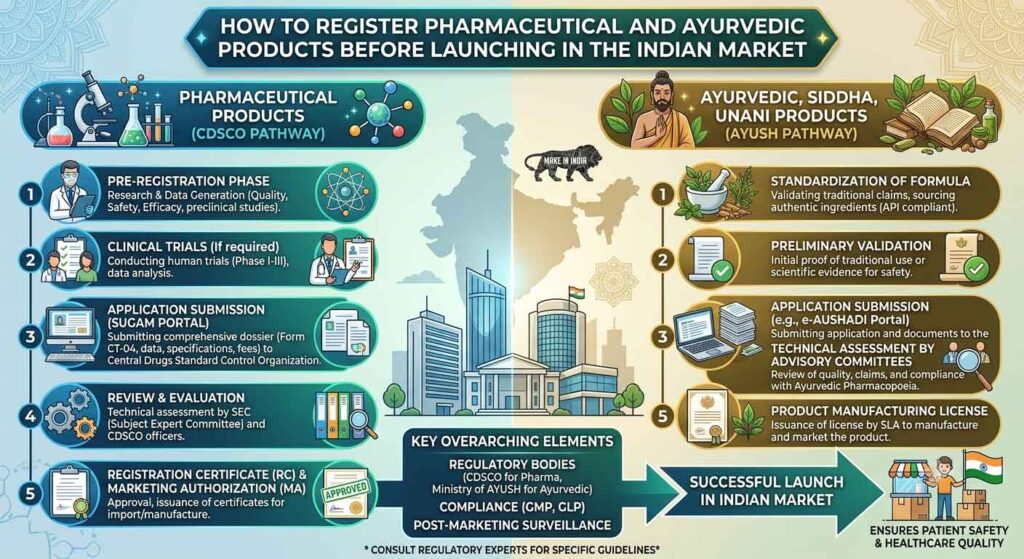
Before launching a pharmaceutical or Ayurvedic product in India, a company should understand that there are usually two separate regulatory questions:
Is the formulation legally permitted to be manufactured and marketed?
Who owns or protects the brand name under which the product will be sold?
These are not the same process.
For example:
A drug-manufacturing authority may permit a manufacturer to manufacture a particular formulation.
The Trade Marks Registry deals separately with ownership and registration of the brand name.
Therefore, obtaining manufacturing approval does not automatically provide trademark rights over the product name.
Quick Answer
If your products are being manufactured in India by a third-party manufacturer:
For Pharmaceutical Products
The manufacturer must hold:
A valid manufacturing licence
Permission or endorsement for the relevant formulation
Additional Central approval where the product falls under the definition of a new drug
The marketing company normally does not separately “register” every already-approved pharmaceutical formulation merely because its brand name will appear on the pack.
For Ayurvedic Products
The Ayurvedic manufacturer must hold an appropriate Ayurvedic manufacturing licence and the required product permissions under the applicable Drugs Rules.
For a patent or proprietary Ayurvedic product, the formulation and ingredients must satisfy the applicable Ayurvedic licensing requirements.
For Brand Name
Trademark registration is a separate process.
The person or company that intends to own the brand should normally:
Conduct a trademark search
File the trademark application
Maintain ownership of the mark
Handle objections or opposition, if any
Two Different Registrations You Should Understand
1. Regulatory Product Approval or Manufacturing Permission
This relates to:
Composition
Strength
Dosage form
Product category
Manufacturing licence
Safety and efficacy requirements
Manufacturing site
The application is handled through the applicable drug regulatory authority.
2. Trademark or Brand-Name Registration
This relates to ownership and protection of names such as:
ABC Tablets
XYZ Syrup
ABC Pharma
XYZ Ayurveda
Trademark registration is handled by the Office of the Controller General of Patents, Designs and Trade Marks.
A drug licence does not give exclusive trademark ownership.
Pharmaceutical Product Registration in India
For an ordinary pharmaceutical formulation manufactured in India, the regulatory responsibility lies primarily with the licensed manufacturer.
The manufacturer must hold the applicable manufacturing licence for:
Tablets
Capsules
Syrups
Injections
Ointments
Creams
Other dosage forms
The approved manufacturing site must also comply with applicable GMP requirements.
Is Every Pharmaceutical Brand Registered Separately With CDSCO?
Not necessarily.
There is an important difference between:
Approval of the drug/formulation, and
Commercial use of a brand name.
Manufacturing licences for ordinary formulations are primarily linked to the proper or generic name, composition and strength of the drug.
However, where a manufacturer intends to market a product under a brand or trade name, the licensing process may require declarations or undertakings regarding that proposed brand.
This regulatory declaration should not be confused with trademark registration.
What Happens If the Formulation Is Already Approved?
Suppose a third-party manufacturer already has permission to manufacture:
Paracetamol Tablets IP 500 mg
If your marketing company wants the same approved formulation under its own brand, it may not require a completely new central drug approval simply because the brand is different.
However, the manufacturer must ensure that:
Its licence covers the formulation.
The approved strength and dosage form are correct.
The label complies with the Drugs Rules.
Brand-name requirements of the licensing authority are fulfilled.
The marketing-company details are correctly included.
The product does not fall under a special regulatory category requiring additional approval.
The manufacturer’s regulatory or QA team should confirm this before commercial production.
What If It Is a New Drug or New Combination?
This is different.
If the proposed pharmaceutical product qualifies as a new drug under the New Drugs and Clinical Trials Rules, 2019, prior permission from the Central Licensing Authority may be required.
Examples can include:
New chemical entities
Certain new fixed-dose combinations
New indications
New routes of administration
New dosage forms in circumstances covered by the rules
Certain new strengths or combinations
The application may require data relating to:
Pharmaceutical development
Quality
Stability
Safety
Efficacy
Bioavailability or bioequivalence
Clinical trials, where applicable
Therefore, a manufacturer cannot simply manufacture every new combination after paying a small “product approval fee.”
Who Applies for Pharmaceutical Product Approval?
Existing Approved Formulation
The licensed manufacturer normally handles manufacturing-related permissions.
If you are only the marketing company using third-party manufacturing, you generally coordinate with the manufacturer.
New Drug
The applicant seeking permission for the new drug must proceed under the New Drugs and Clinical Trials Rules and obtain the necessary Central Licensing Authority permission before commercial manufacture.
The exact applicant may depend on the commercial and licensing structure.
Loan Licence
Where the marketing company itself operates under a loan-licence structure, its regulatory responsibilities may be different from a simple “marketed by” arrangement.
Do not treat third-party manufacturing and loan licensing as automatically identical.
Can a Marketing Company Launch a Product Without Checking Manufacturer Approval?
No.
Before placing an order, request:
Manufacturing licence
Product permission or endorsement
GMP certificate
Manufacturer details
Approved composition
Product specification
COA or testing arrangements
Approved artwork confirmation
A quotation from the manufacturer is not proof that the product is legally authorised.
Ayurvedic Product Registration in India
Ayurvedic, Siddha and Unani medicines are governed under separate provisions of the Drugs and Cosmetics Act and Drugs Rules.
The State Government appoints the licensing authority for the manufacture of Ayurvedic, Siddha and Unani medicines.
Manufacturing applications are processed under the applicable Ayurvedic drug-licensing provisions.
Main Categories of Ayurvedic Medicines
It is important to distinguish between:
1. Classical Ayurvedic Medicines
These are formulations manufactured according to formulae described in the authoritative books recognised under the Drugs and Cosmetics Act.
Examples may include traditional formulations such as:
The formulation should correspond with the authoritative reference.
The manufacturer cannot arbitrarily modify the classical composition while continuing to present it as the same classical medicine.
2. Patent or Proprietary Ayurvedic Medicines
These are formulations composed of permitted ingredients from authoritative Ayurvedic texts but formulated as proprietary combinations according to the applicable rules.
The manufacturer must provide the necessary details and supporting information required by the licensing authority.
The manufacturing licence is issued in Form 25D, subject to applicable requirements.
A manufacturer without its own facilities may also operate under an approved loan-licence arrangement using the facilities of an eligible licensed manufacturer.
Who Applies for Ayurvedic Product Permission?
In a normal third-party manufacturing arrangement, the licensed Ayurvedic manufacturer generally deals with the product licensing and manufacturing permission.
However, the situation may differ if the marketing company:
Holds a loan licence
Is itself the licence applicant
Owns the formulation dossier
Uses a special contractual manufacturing structure
The regulatory structure should therefore be decided before manufacturing begins.
Does a Marketing Company Need Its Own Ayurvedic Manufacturing Licence?
Not merely because its name is printed as:
“Marketed by”
on a product manufactured by another properly licensed manufacturer.
However, the marketing company may require other registrations depending on:
Its business model
Storage activity
Wholesale activity
Product category
State
Online selling
Export activity
If the marketing company wants to act as a loan-licensee or manufacture in its own name under the relevant licensing arrangement, separate licensing requirements apply.
Classical Ayurvedic Product Approval
Even though a classical medicine follows an authoritative formulation, the manufacturer still needs appropriate licensing documentation and must identify the authoritative reference.
The product should match:
Classical name
Ingredients
Preparation method
Dosage form
Applicable authoritative text
Where changes are made to dosage form, indication or other important aspects, additional regulatory requirements may apply.
Patent and Proprietary Ayurvedic Product Approval
For a patent or proprietary Ayurvedic medicine, the regulatory authority may review:
Formula
Ingredients
Authoritative-book references
Safety requirements
Evidence of effectiveness
Product category
Indications
The requirements differ depending on whether the formulation uses:
Known classical ingredients
Changed dosage form
New indication
New combination
Other permitted proprietary approaches
Do not assume that any combination of herbal ingredients can automatically receive an Ayurvedic drug licence.
Ayurvedic Product Approval Fees
Under the current Drugs Rules, an application for an Ayurvedic, Siddha or Unani manufacturing licence has prescribed fees.
Broadly:
Classical medicines under Section 3(a)
The prescribed application fee is: Vary state to state
Patent or Proprietary medicines under the relevant Section 3(h) category
The prescribed fee is: vary state to state
These are regulatory fees prescribed for the licensing application.
They should not be confused with the amount that a third-party manufacturer may charge its customer.
A manufacturer may separately charge for:
Documentation
Regulatory consultancy
Product development
Samples
Testing
Stability work
Artwork
Administrative expenses
Therefore, the manufacturer’s commercial “product approval charge” may differ from the government fee.
How Much Time Does Ayurvedic Approval Take?
The Drugs Rules provide for issuance of the Form 25D manufacturing licence within two months from receipt of the application or from the date on which any shortcomings identified by the licensing authority have been complied with.
In practice, the actual total project time can be longer if:
Documents are incomplete.
The authority raises queries.
Formulation clarification is required.
Testing is pending.
Manufacturing facilities require correction.
Product-category questions arise.
Therefore, do not fix a commercial product-launch date until the manufacturer confirms approval in writing.
Brand Name Registration Is a Separate Process
A product licence does not mean that you own the brand.
For example, a manufacturer may be authorised to manufacture:
Brahmi Capsules
but this does not automatically give you exclusive rights to use:
BRAHMITEC
or any other proposed brand.
Trademark protection is dealt with separately under the Trade Marks Act and Rules.
Who Should Register the Brand Name?
Normally, the company that wants to own the brand should file the trademark application.
For a third-party marketed product, this is commonly the:
Marketing company
rather than the contract manufacturer.
This is important because the brand is a valuable business asset.
The manufacturing agreement should clearly confirm that:
The marketing company owns the trademark.
The manufacturer is only authorised to use it for manufacturing.
The manufacturer does not acquire ownership rights.
Packaging containing the trademark is controlled appropriately.
Is Trademark Registration Compulsory Before Launch?
Trademark registration is generally not the same as regulatory permission to sell the medicine.
However, filing for trademark protection before investing heavily in:
Packaging
Advertising
Product launch
Distributor appointments
Website development
is strongly advisable.
Before selecting a brand name, conduct a proper trademark search.
Pharmaceutical Trademark Class
Pharmaceutical, medicinal and many veterinary preparations generally fall under Class 5 of the trademark classification system.
However, your business may require additional classes depending on what you want to protect.
For example:
Medicine brand
Company trading services
Retail services
Cosmetics
Food supplements
A trademark professional should determine the appropriate class or classes.
Current Trademark Filing Fee
For a standard TM-A application filed electronically, the official fee is currently:
Individual / Startup / Small Enterprise
₹4,500 per mark per class
Other applicants
₹9,000 per mark per class
Professional fees of a trademark attorney or agent are additional.
If you file the same brand in multiple classes, separate class fees apply.
How Long Does Trademark Registration Take?
There is no fixed period that guarantees registration.
The process normally involves:
Filing
Formality check
Examination
Response to objections, if any
Hearing, where necessary
Acceptance
Publication in the Trade Marks Journal
Opposition period
Registration
After publication, there is a four-month opposition period.
If there is:
No objection
No opposition
No hearing delay
registration can move considerably faster than a contested application.
If objections or opposition arise, the process may take much longer.
The manufacturer must be legally authorised to manufacture the composition.
Brand Side
You should check whether “CARDIOZAC” or a confusingly similar trademark already exists and consider filing your own trademark application.
These two procedures are independent.
The drug authority does not guarantee trademark ownership.
The Trade Marks Registry does not approve the medicine’s formulation.
Important Form 51 Brand-Name Requirement for Pharmaceutical Manufacturers
Current CDSCO manufacturing-licence guidance provides that where a manufacturer proposes to market a drug under a brand or trade name, an undertaking in Form 51 is furnished to the licensing authority.
The manufacturer declares, to the best of its knowledge, that:
The proposed or similar drug brand does not already exist.
The proposed name will not create confusion or deception.
This is a regulatory undertaking.
It is not a substitute for a trademark search or trademark registration.
Step-by-Step Procedure Before Launching a Pharmaceutical Product
Step 1: Finalise the Product
Confirm:
Composition
Strength
Dosage form
Pack
Intended market
Proposed brand
Step 2: Select the Manufacturer
Verify:
Manufacturing licence
GMP status
Dosage-form capability
Product approval
Testing facilities
Step 3: Determine Whether the Formulation Is Already Approved
Ask the manufacturer for documentary evidence.
Step 4: Determine Whether It Is a New Drug
If applicable, obtain advice on requirements under the New Drugs and Clinical Trials Rules.
Step 5: Search the Proposed Trademark
Search:
Exact name
Similar spelling
Similar pronunciation
Similar pharmaceutical marks
Step 6: File the Trademark
File the application in the appropriate class or classes.
Step 7: Prepare Artwork
Include:
Approved composition
Manufacturer details
Manufacturing licence number
Marketed-by details
Batch and expiry fields
MRP
Storage
Schedule warnings
Other mandatory declarations
Step 8: Obtain Manufacturer Approval of Artwork
Do not print packaging before the manufacturer’s QA/regulatory approval.
Step 9: Manufacture the Batch
Commercial manufacture should start only when the applicable regulatory requirements are complete.
Step 10: Maintain Documentation
Keep:
Manufacturing licence
Product permission
GMP certificate
Purchase order
Manufacturing agreement
Approved artwork
Trademark application
COA
Batch documents
Invoice
Step-by-Step Procedure Before Launching an Ayurvedic Product
Step 1: Decide the Product Category
Determine whether it is:
Classical Ayurvedic medicine
Patent/proprietary Ayurvedic medicine
Food supplement
Cosmetic
Do not assume every herbal product is an Ayurvedic medicine.
Step 2: Finalise the Formula
Mention:
Ingredient
Botanical name
Part used
Quantity
Extract strength
Authoritative reference
Dosage form
Step 3: Select a Licensed Ayurvedic Manufacturer
Verify:
Form 25D licence
GMP certificate
Approved product categories
Manufacturing capability
Step 4: Confirm Product Licensing Status
Ask whether:
The formulation already appears under the manufacturer’s approved scope.
A new product application is required.
Additional safety or evidence documents are required.
Step 5: Select and Search the Brand
Do a trademark search before packaging investment.
Step 6: File the Trademark
File the application in the appropriate class or classes.
Step 7: Submit the Required Product Application
The manufacturer or loan-license applicant should complete the applicable regulatory process.
Step 8: Finalise Artwork
Check:
Product category
Ingredients
Classical reference where applicable
Manufacturer
Licence number
Dosage
Indication
Warnings
Batch details
Marketed-by details
Step 9: Start Manufacturing Only After Approval
Do not launch the product while approval is still “under process.”
Documents a Marketing Company Should Obtain From the Manufacturer
Before launching a third-party manufactured product, maintain copies of:
Manufacturing licence
GMP certificate
Product permission
Product composition
Manufacturer GST details
Manufacturing agreement
COA
Test reports
Approved artwork
Invoice
Batch number
Expiry details
For Ayurvedic products, also request:
Relevant Form 25D details
Product approval/listing
Classical reference where applicable
Authoritative ingredient references for proprietary products
Approximate Responsibility Matrix
Activity
Manufacturer
Marketing Company
Manufacturing licence
Yes
No, unless own/loan licence
Product manufacturing permission
Primarily yes
Coordinate
New drug approval
Applicant/manufacturer as applicable
May be involved
Manufacturing quality
Yes
Must verify
Product testing
Yes
May independently verify
Brand selection
Joint review
Primarily
Trademark search
Should check
Yes
Trademark application
Not necessarily
Normally brand owner
Artwork technical approval
Yes
Yes
Marketing claims
Shared responsibility
Yes
Product promotion
Support
Primarily
Brand infringement risk
Both should check
Brand owner bears major commercial risk
Common Mistakes to Avoid
Assuming manufacturer quotation means product approval
Confusing drug approval with trademark registration
Printing packaging before trademark search
Believing a drug authority owns or protects the brand
Assuming all Ayurvedic products follow one approval route
Calling a health supplement an Ayurvedic medicine
Launching a new pharmaceutical combination without checking NDCTR requirements
Relying only on verbal approval from the manufacturer
Using another company’s similar brand name
Paying a “product approval fee” without asking what it covers
Manufacturing before written approval
Filing trademark only after the product becomes successful
Answer to the Original Questions
1. Is registration required before launching pharmaceutical or Ayurvedic products?
Yes, the formulation must be legally authorised for manufacture under the applicable regulatory framework.
However, this does not necessarily mean that the marketing company has to independently register every existing formulation.
The manufacturer must have the appropriate licence and product permission.
Trademark registration is a separate and strongly recommended process.
2. Who applies: manufacturer or marketing company?
Regulatory Manufacturing Approval
Usually the licensed manufacturer or applicable licence holder.
Trademark
Normally the person or company that intends to own the brand.
3. What are the approximate time and fees?
There is no single fee or timeline for every pharmaceutical and ayurvedic product.
Trademark e-filing currently costs:
₹4,500 per class per mark for individual/startup/small enterprise applicants
₹9,000 per class per mark for other applicants
Trademark completion time varies according to examination, objections and opposition.
Frequently Asked Questions
1. Does every pharmaceutical brand require a separate CDSCO registration?
Not simply because the brand name changes. The manufacturer must hold the appropriate licence and product authorisation for the formulation. New drugs require additional Central permission.
2. Does drug approval protect my brand name?
No. Trademark protection is separate.
3. Can I start manufacturing immediately after filing a trademark?
Trademark filing does not grant permission to manufacture a medicine. Drug regulatory requirements must be completed separately.
4. Who owns the brand in third-party manufacturing?
Normally the person or company that owns or applies for the trademark, subject to contractual arrangements.
5. Can a manufacturer use my brand for another customer?
Your manufacturing agreement and trademark rights should prohibit unauthorised use.
6. Does a classical Ayurvedic medicine require approval?
The manufacturer still requires the appropriate Ayurvedic manufacturing licence and the product must comply with the authorised classical formulation and reference.
7. Can I change the ingredients of a classical medicine?
Not arbitrarily while continuing to represent it as the same classical formulation.
8. Who grants Ayurvedic manufacturing licences?
The applicable State Licensing Authority grants Ayurvedic, Siddha and Unani manufacturing licences.
9. What is Form 25D?
Form 25D is the manufacturing licence for sale of Ayurvedic, Siddha or Unani drugs under the applicable Drugs Rules.
10. What is a loan licence?
A loan licence allows an eligible applicant without its own manufacturing facilities to use the manufacturing facilities of an approved licensed manufacturer under the applicable regulatory framework.
11. Should I register the trademark before ordering packaging?
Preferably conduct the trademark search and file the application before making substantial investment in printed packaging.
12. Can two pharmaceutical products have similar brand names?
Similar marks can create regulatory, commercial and trademark disputes. A comprehensive search should be conducted before adoption.
Final Thoughts
Before launching a pharmaceutical or Ayurvedic product, remember the following formula:
Never treat product approval and brand registration as the same thing.
The manufacturer is primarily responsible for ensuring that the product is legally permitted to be manufactured.
The brand owner should protect the commercial identity of the product through proper trademark due diligence and registration.
Looking for Ayurvedic Franchise or Distribution Opportunities?
Elzac Herbal India offers opportunities for entrepreneurs interested in Ayurvedic and herbal product distribution, franchise marketing and third-party manufacturing.
Elzac Herbal India offers:
Ayurvedic & Herbal Product Range
Franchise & Distribution Opportunities
Third-Party Manufacturing
Product Development Support
Marketing Guidance
PAN India Business Opportunities
Whether you are an entrepreneur, retailer, distributor, or healthcare professional, our team can help you explore the right business opportunity in the growing Ayurvedic sector.
Ajay Kamboj is an entrepreneur and business owners associated with many Ayurvedic and Pharmaceutical start-ups. With years of experience in Ayurvedic product marketing, pharmaceutical distribution, franchise development, and client relationship management, he regularly shares practical business insights based on real-world experiences. His articles focus on business growth, entrepreneurship, customer management, and lessons learned from the healthcare and wellness industry.
5 responses to “How to Register Pharmaceutical and Ayurvedic Products Before Launching in the Indian Market”
I am an ayurvedic doctor, i want to start ayurvedic medicine manufacturing , does it take any licence? or trademark registration or i can give medicine to all as usual as i am giving to my patient
Ayurvedic Doctor can give self made medicine only to own patient. But if you want to start ayurvedic manufacturing unit then you need ayurvedic manufacturing license…
I want to aproval for my herbal tea ( kwath )as a aayurveda …. now i have FSSAI and NABL certificate of nutrition…. now i want to go for medical aproval .. please help or suggest me.
Sir i want to register a new ayurvedic product and market. I am not a aayurvedic doctor. What i have to do for the registration formalities and how much i have to spend registration fees etc. Pls give me a reply early as possible





I am an ayurvedic doctor, i want to start ayurvedic medicine manufacturing , does it take any licence? or trademark registration or i can give medicine to all as usual as i am giving to my patient
Ayurvedic Doctor can give self made medicine only to own patient. But if you want to start ayurvedic manufacturing unit then you need ayurvedic manufacturing license…
Thanks sir
I want to aproval for my herbal tea ( kwath )as a aayurveda …. now i have FSSAI and NABL certificate of nutrition…. now i want to go for medical aproval .. please help or suggest me.
Sir i want to register a new ayurvedic product and market. I am not a aayurvedic doctor. What i have to do for the registration formalities and how much i have to spend registration fees etc. Pls give me a reply early as possible