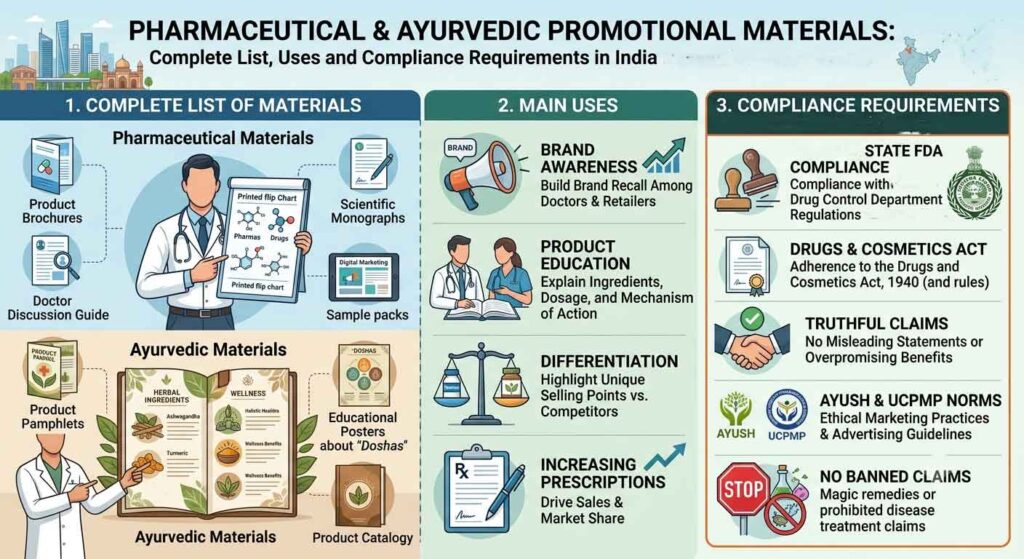
Promotion is an important part of every business, but pharmaceutical and Ayurvedic marketing is different from the promotion of ordinary consumer products.
Medicines and healthcare products can influence treatment decisions and patient safety. Therefore, promotional material should not only be attractive—it must also be accurate, balanced, supportable and appropriate for the intended audience.
The type of promotional material required depends on the company’s marketing model.
A company may operate through:
- Ethical or prescription marketing
- Generic medicine marketing
- PCD or pharma-franchise marketing
- OTC marketing
- Ayurvedic product marketing
- Institutional and hospital marketing
- Online and direct-to-consumer marketing
- Third-party manufacturing
Each model requires a different promotional strategy.
Quick Answer
The most useful promotional materials for pharmaceutical and Ayurvedic companies include:
- Printed or electronic visual aids
- Product monographs and scientific literature
- Leave-behind cards
- Product cards and catalogues
- Approved medical samples
- Patient-education material
- Product-detailing presentations
- Franchise brochures and price lists
- Digital product images and videos
- Retail display material
- Exhibition banners and standees
- Order books and sales-order forms
- Daily call reports and CRM tools
- Stock and availability lists
- Company profile and manufacturing presentation
Promotional materials should be selected according to the product category, target audience and marketing model.
What Is Pharmaceutical Promotional Material?
Pharmaceutical promotional material means any printed, digital, audio, visual or physical communication intended to encourage the:
- Prescription of a medicine
- Supply of a medicine
- Purchase of a product
- Recommendation of a brand
- Use of a healthcare product
- Appointment of a distributor
- Selection of a manufacturing or franchise partner
Promotion includes more than advertisements.
It may include:
- Medical-representative presentations
- Product brochures
- Samples
- Emails
- WhatsApp messages
- Websites
- Social-media posts
- Journal advertisements
- Conference material
- Franchise catalogues
- Retail displays
- Promotional videos
If a communication is intended to influence the use, sale or recommendation of a product, it should be treated as promotional material.
Promotion Material vs Sales Material
Although the terms are sometimes used interchangeably, they are not exactly the same.
Promotional Material
Promotional material creates awareness and communicates product benefits.
Examples:
- Visual aid
- Product literature
- Scientific presentation
- Patient leaflet
- Product video
- Reminder card
Sales Material
Sales material helps complete or manage a commercial transaction.
Examples:
- Price list
- Order book
- Stock list
- Scheme circular
- Franchise proposal
- Payment terms
- Distributor agreement
- Product-availability sheet
A pharmaceutical company usually requires both.
Promotional Materials for Ethical or Prescription Marketing
Ethical pharmaceutical marketing primarily involves communication with doctors and other qualified healthcare professionals.
The main purpose is to provide sufficient, accurate information to support a rational prescribing decision.
1. Printed Visual Aid
A visual aid is a printed detailing book used by a medical representative during a doctor visit.
It may contain:
- Brand name
- Generic composition
- Therapeutic category
- Approved indication
- Product benefits
- Dosage
- Mode of administration
- Clinical evidence
- Safety information
- Warnings and precautions
- Pack information
A good visual aid should have one clear communication objective per page.
It should not contain:
- Unsupported superlative claims
- False comparisons
- Excessive text
- Hidden safety information
- Guarantees of cure
- Unqualified “completely safe” claims
2. Electronic Visual Aid or E-Detailer
An electronic visual aid is displayed through:
- Tablet
- Laptop
- Mobile device
- Online meeting
- Web-based detailing platform
Advantages include:
- Easier updates
- Video and animation
- Interactive product information
- Usage tracking
- Reduced printing
- Consistent presentation
The scientific and legal standards applicable to a printed visual aid also apply to electronic promotion.
3. Product Monograph
A product monograph is a detailed scientific document about one medicine.
It may contain:
- Generic name
- Pharmacological class
- Mechanism of action
- Indications
- Dosage
- Pharmacokinetics
- Clinical evidence
- Contraindications
- Drug interactions
- Adverse effects
- Warnings
- References
It is particularly useful for:
- New products
- Specialist products
- Hospital medicines
- Complex combinations
- Scientific discussions
4. Product Literature
Product literature is shorter than a full monograph but more detailed than a reminder card.
It may focus on:
- One clinical problem
- One key product benefit
- One patient type
- One study
- One formulation advantage
Scientific references should be relevant, current and accurately represented.
5. Leave-Behind Card
A leave-behind card is given after product detailing so the healthcare professional can review the important information later.
It may include:
- Product name
- Composition
- Main indication
- Dosage
- Key clinical message
- Safety information
- Company details
The card should not omit important warnings merely because of its smaller size.
6. Reminder Card
A reminder card is a short promotional piece designed mainly to reinforce:
- Brand name
- Composition
- Pack
- One approved product message
Reminder cards are useful for established products that have already been explained in detail.
7. Comparison Chart
A comparison chart may explain differences between:
- Dosage forms
- Strengths
- Dosing schedules
- Formulation technologies
- Pharmacological properties
Comparisons must be factual, fair and capable of verification.
A company should avoid:
- Misleading omissions
- Selective data
- Disparaging competitors
- Unapproved superiority claims
- Using another company’s brand without proper consideration of applicable requirements
8. Clinical Reprint or Study Summary
A company may provide:
- Published clinical-paper reprints
- Study summaries
- Guideline extracts
- Evidence-review documents
The material should clearly distinguish:
- Published findings
- Company interpretation
- Approved product information
- Limitations of the evidence
A study should not be presented as proving more than it actually supports.
Medical Samples and Sample-Related Material
Medical samples remain an important promotional tool, but they require strict control.
1. Free Medical Sample
An approved sample can help a qualified prescriber become familiar with a product.
Sample packs should:
- Be supplied only to persons qualified to prescribe the product
- Be properly recorded
- Carry “Free Medical Sample—Not for Sale” or equivalent wording
- Not be larger than the smallest marketed pack
- Be used for legitimate product familiarisation
- Comply with applicable sample limits
Samples should not be casually distributed to:
- General consumers
- Retail customers
- Unauthorised persons
- Unqualified prescribers
2. Sample Catch Cover
A sample catch cover is an outer presentation folder used to hold one or more sample packs.
It may display:
- Brand name
- Composition
- Product image
- Key approved message
- Dosage
- Company details
It should not hide the mandatory declarations printed on the actual sample pack.
3. Sample Accountability Register
Companies should maintain records such as:
- Product name
- Batch number
- Quantity issued
- Medical representative
- Recipient’s name
- Recipient’s address
- Date
- Balance quantity
- Value of samples
An electronic sample-tracking system is preferable when a company has a large field force.
Informational and Educational Brand Reminders
Current ethical marketing rules permit limited informational and educational items intended for professional use in healthcare settings.
Examples may include:
- Medical books
- Clinical guidelines
- Scientific journals
- E-journal access
- Educational calendars
- Professional diaries
- Dummy device models
- Treatment-reference material
These items should:
- Be useful in a healthcare setting
- Remain within the applicable value limit
- Not provide an independent personal commercial benefit
- Not be offered as an inducement for prescribing
Companies should maintain an internal approval and distribution record.
Materials That Should Not Be Treated as Routine Doctor Gifts
Older marketing practices often used items such as:
- Expensive pens
- Keychains
- Personal bags
- T-shirts
- Coats
- Umbrellas
- Electronic gadgets
- Household products
- Travel benefits
- Cash benefits
These should not be recommended as routine gifts to healthcare professionals.
The fact that a company’s logo is printed on an item does not automatically make it an acceptable promotional input.
Before distributing any item, ask:
- Is it genuinely educational or informational?
- Is it meant for professional use?
- Does it have independent personal value?
- Could it influence prescribing?
- Does it comply with the current marketing code?
- Has the compliance team approved it?
Product Catalogue and Product Glossary
A product catalogue contains the company’s complete or selected product range.
It may be prepared for:
- Doctors
- Distributors
- Franchise partners
- Hospitals
- Retailers
- Third-party manufacturing customers
Doctor-Focused Catalogue
It may include:
- Brand
- Composition
- Therapeutic category
- Dosage form
- Pack
- Brief scientific description
Distributor-Focused Catalogue
It may include:
- Product image
- Packing
- MRP
- Product category
- Availability
- Order code
Third-Party Manufacturing Catalogue
It may include:
- Available formulations
- Dosage forms
- Pack options
- Minimum order quantity
- Packaging options
- Manufacturing capabilities
The same catalogue should not automatically be used for every audience.
Product Cards
A product card provides a compact description of one or several products.
It is useful for:
- Medical representatives
- Franchise enquiries
- Trade exhibitions
- Distributor meetings
- WhatsApp sharing
- New-product launches
Product cards should be updated whenever there is a change in:
- Composition
- MRP
- Pack
- Label
- Indication
- Product status
Patient-Education Materials
Patient-education material should educate rather than indirectly promote prescription medicines to the public.
Examples include:
- Disease-awareness leaflets
- Medicine-adherence cards
- Dosage calendars
- Injection-use guides
- Diet and lifestyle booklets
- Inhaler-technique guides
- Blood-pressure records
- Blood-glucose diaries
Patient material should:
- Use simple language
- Encourage professional medical advice
- Avoid diagnosis or self-prescription
- Avoid guarantees
- Clearly separate education from product promotion
- Include important safety information
Promotional Materials for PCD and Pharma-Franchise Marketing
PCD and franchise marketing target distributors, entrepreneurs and regional marketing partners.
The material should focus on commercial opportunity, product range and company support.
1. Franchise Brochure
A franchise brochure may include:
- Company introduction
- Product range
- Manufacturing standards
- Available territories
- Monopoly arrangements
- Marketing support
- Order process
- Contact information
Avoid presenting projected earnings as guaranteed income.
2. Product and Price List
A price list should contain:
- Product code
- Brand
- Composition
- Packing
- MRP
- Net rate
- GST
- Minimum order
- Scheme, if applicable
- Availability status
Mention the date from which the price list is effective.
3. Franchise Proposal
A formal proposal may include:
- Proposed territory
- Opening order
- Payment terms
- Promotional support
- Sales expectations
- Exclusivity conditions
- Renewal or review conditions
4. Monopoly or Territory Document
This should clearly define:
- District or territory
- Product range
- Duration
- Minimum purchase
- Performance conditions
- Company’s reserved rights
- Termination conditions
Avoid promising permanent monopoly rights without written conditions.
5. Promotional Input Menu
The company may provide a list of available inputs, such as:
- Product cards
- Visual aids
- Approved samples
- Literature
- Order book
- Prescription pads, where legally and ethically appropriate
- Retail posters
- Product images
- Digital creatives
6. Stock-Availability List
A regularly updated stock list helps franchise partners know:
- Available products
- Out-of-stock items
- New launches
- Expected restocking date
- Near-discontinuation products
7. Digital Franchise Kit
A digital kit may contain:
- Company profile PDF
- Product catalogue
- Price list
- Certificates
- Product images
- Videos
- Terms and conditions
- Enquiry form
- Franchise agreement draft
Promotional Materials for OTC Products
OTC products are commonly promoted to consumers, pharmacies and retailers.
Promotion may include:
- Retail posters
- Shelf strips
- Counter displays
- Standees
- Danglers
- Product demonstration videos
- Consumer leaflets
- Social-media creatives
- Website landing pages
- Marketplace images
- Product explainer videos
- Point-of-sale displays
Consumer advertising should still be truthful and should not encourage unsafe self-medication.
Promotional Materials for Ayurvedic Companies
Ayurvedic companies may promote products to:
- Ayurvedic practitioners
- General consumers
- Distributors
- Retailers
- Wellness centres
- Online customers
- Franchise partners
The material selected depends on whether the product is:
- Classical Ayurvedic medicine
- Ayurvedic proprietary medicine
- Food or health supplement
- Cosmetic
- Personal-care product
Useful Ayurvedic Promotional Materials
- Ingredient education cards
- Classical-reference summaries
- Practitioner visual aids
- Product monographs
- Herb-origin information
- Manufacturing-quality presentation
- Product catalogues
- Consumer brochures
- Product videos
- Website articles
- Packaging QR codes
- Social-media educational content
- Distributor catalogues
- Franchise brochures
- Retail displays
Ayurvedic Claims Require Special Care
Avoid expressions such as:
- Guaranteed cure
- Permanent cure
- No side effects
- 100% safe for everyone
- Cures diabetes
- Cures cancer
- Reverses infertility
- Works instantly
- Scientifically proven, without adequate evidence
“Natural” does not automatically mean risk-free.
Every product claim should match:
- Product licence
- Approved indication
- Ingredients
- Product category
- Label
- Available evidence
- Applicable advertising laws
Digital Promotional Materials
Modern pharmaceutical and Ayurvedic companies should maintain an approved digital-material library.
1. Website
A professional website may include:
- Company profile
- Product pages
- Practitioner information
- Consumer information
- Franchise page
- Third-party manufacturing page
- Contact details
- Privacy policy
- Terms
- Medical disclaimer
- Complaint contact
2. Social-Media Creatives
Useful formats include:
- Ingredient education
- Health-awareness posts
- Product-use videos
- Frequently asked questions
- Manufacturing-quality posts
- Distributor opportunities
- Company updates
All posts should pass the same claim-review process as printed advertising.
3. WhatsApp Creatives
WhatsApp materials may include:
- Product launch
- Stock availability
- Scheme update
- Franchise opportunity
- Product education
- Order reminder
Do not make uncontrolled treatment claims simply because the message is shared privately.
4. Product Videos
A product video may explain:
- Ingredients
- Dosage form
- Pack
- Intended use
- Product features
- Quality processes
The voice-over, text, visuals and subtitles should all be reviewed.
5. Email Campaigns
Email material may be used for:
- Product updates
- Scientific newsletters
- Distributor communication
- Franchise follow-up
- Conference invitations
- Stock updates
The promotional nature of paid or company-issued communication should not be disguised as independent editorial content.
6. QR Codes
A QR code may lead to:
- Approved product information
- Patient instructions
- Authentication page
- Batch information
- Product video
- Customer-support page
- Scientific references
The linked page should be controlled and regularly reviewed.
Retail and Point-of-Sale Materials
Retail materials can improve product visibility, particularly for OTC, Ayurvedic, cosmetic and wellness products.
Examples include:
- Counter display
- Shelf strip
- Poster
- Window sticker
- Product stand
- Display carton
- Danglers
- Price cards
- Product leaflets
- Product demonstration screen
Check that retailer-facing materials do not promote prescription medicines directly to the public in an inappropriate manner.
Exhibition and Conference Materials
For trade fairs, conferences and distributor meetings, companies may use:
- Stall backdrop
- Standees
- Product panels
- Company presentation
- Digital display
- Product catalogue
- Enquiry form
- Visiting cards
- QR-based lead form
- Sample display
- Manufacturing-certification display
The stall should separate:
- Scientific information
- Consumer promotion
- Distributor opportunity
- Manufacturing services
Internal Sales and Field-Force Materials
Some essential materials are not given to customers. They help the company manage promotion and sales.
1. Order Book
Used to record orders from:
- Retailers
- Stockists
- Distributors
- Hospitals
- Franchise partners
2. Daily Call Report
A DCR records:
- Doctors visited
- Retailers visited
- Stockists visited
- Products discussed
- Samples issued
- Orders received
- Follow-up required
3. Tour Programme
A tour plan helps schedule:
- Towns
- Doctors
- Hospitals
- Retailers
- Stockists
- Monthly coverage
4. Sample Issue Record
This provides accountability for medical samples.
5. Expense Statement
Used to record approved field expenses.
6. CRM or Sales Application
A digital system may record:
- Customer profiles
- Visit history
- Product detailing
- Orders
- Follow-ups
- Samples
- Sales targets
- Territory performance
7. MR Training Manual
The manual may cover:
- Product knowledge
- Competitor knowledge
- Approved claims
- Objection handling
- Ethical conduct
- Sample policy
- Adverse-event reporting
- Complaint reporting
Company Profile and Corporate Promotional Material
A company profile helps promote the organisation rather than an individual product.
It may contain:
- Company history
- Leadership
- Manufacturing facilities
- Quality systems
- Certifications
- Product categories
- Distribution network
- Export markets
- Research capabilities
- Contact details
Corporate material should not exaggerate:
- Certifications
- Manufacturing capacity
- Market leadership
- Export presence
- Product approvals
- Awards
Only valid and current certificates should be displayed.
How to Prepare Promotional Material
Step 1: Identify the Audience
The audience may be:
- Doctor
- Ayurvedic practitioner
- Pharmacist
- Distributor
- Retailer
- Franchise applicant
- Patient
- General consumer
- Institutional buyer
Step 2: Define One Objective
Examples:
- Explain a new formulation
- Generate a franchise enquiry
- Remind doctors about a brand
- Educate patients
- Increase retail visibility
- Announce a product launch
Step 3: Prepare the Content
Collect:
- Approved product information
- Scientific references
- Dosage
- Safety details
- Pack information
- Product images
- Company details
Step 4: Conduct Medical and Regulatory Review
Review:
- Claims
- Comparisons
- References
- Warnings
- Images
- Audience
- Product category
- Legal requirements
Step 5: Design the Material
The design should be:
- Readable
- Professional
- Consistent
- Uncluttered
- Suitable for the audience
- Consistent with the approved content
Step 6: Approve a Final Proof
Maintain evidence of approval by:
- Medical department
- Regulatory department
- Legal or compliance department
- Marketing department
- Authorised company officer
Step 7: Assign a Material Code and Review Date
Every item should ideally contain:
- Material identification code
- Version number
- Approval date
- Review date
- Expiry or withdrawal date
Step 8: Control Distribution
Record:
- Quantity printed
- Quantity issued
- Person receiving material
- Territory
- Date
- Remaining stock
Step 9: Withdraw Obsolete Material
Old material should be withdrawn when there is a change in:
- Composition
- Approval
- Dosage
- Safety information
- MRP
- Product status
- Company address
- Regulatory requirement
Minimum Promotional Kit for a New Pharma Company
A small ethical-marketing company may begin with:
- Company profile
- Product list
- Printed or electronic visual aid
- Product cards
- Approved scientific literature
- Controlled medical samples
- Sample-accountability register
- Order book
- DCR or CRM system
- Digital product-image library
Minimum Promotional Kit for a PCD Company
A new PCD or franchise company may begin with:
- Company profile
- Franchise brochure
- Product catalogue
- Current price list
- Monopoly or territory terms
- Product cards
- Approved samples
- Order form
- Stock-availability list
- Digital franchise kit
Minimum Promotional Kit for an Ayurvedic Consumer Brand
A new Ayurvedic consumer brand may begin with:
- Compliant product packaging
- Product brochure
- Ingredient information cards
- Website product pages
- Marketplace images
- Product videos
- Consumer FAQs
- Retail display material
- Social-media creative library
- Customer-support and complaint system
Which Promotional Materials Give the Best Return?
The answer depends on the business model.
| Marketing Model | Most Useful Materials |
| Ethical prescription | Visual aid, literature, monograph, approved samples |
| PCD/franchise | Catalogue, price list, franchise brochure, digital kit |
| Generic | Rate list, stock list, order form, distributor communication |
| OTC | Retail display, packaging, consumer video, digital advertising |
| Ayurvedic practitioner | Product monograph, ingredient literature, visual aid |
| Ayurvedic consumer | Website, packaging, education content, product video |
| Third-party manufacturing | Manufacturing catalogue, company profile, quotation format |
| Institutional | Technical dossier, tender documents, company credentials |
Common Promotional Mistakes
Avoid:
- Printing material before product approval
- Making unsupported claims
- Hiding contraindications
- Calling a medicine completely safe
- Claiming no side effects
- Using fake scientific references
- Copying another company’s design
- Using doctors’ photographs without proper basis
- Promising guaranteed business income
- Giving personal gifts to influence prescribing
- Distributing uncontrolled medical samples
- Publishing consumer ads for inappropriate prescription products
- Using outdated product information
- Promoting Ayurveda as risk-free merely because it is natural
- Allowing franchise partners to create unapproved advertisements
Final Thoughts
The best promotional material is not necessarily the most expensive item.
Effective pharmaceutical and Ayurvedic promotion depends on:
- Correct audience
- Accurate information
- Clear communication
- Professional design
- Ethical conduct
- Regulatory approval
- Consistent follow-up
- Product availability
- Reliable service
A good visual aid cannot compensate for poor product quality. Similarly, gifts cannot build a sustainable brand.
Long-term growth comes from useful information, trustworthy products and professional relationships.
Frequently Asked Questions
1. What is the most important promotional material for an ethical pharma company?
A scientifically accurate visual aid, supported by product literature and approved medical samples, is generally the core promotional kit.
2. Can pharma companies give pens and keychains to doctors?
Personal-use gifts should not be treated as routine promotional material. Any item provided to a healthcare professional must comply with the current pharmaceutical marketing code.
3. Are medical samples still allowed?
Yes, but they may be supplied only under defined conditions to qualified prescribers, with appropriate records and sample labelling.
4. What should be printed on a free sample?
The pack should carry “Free Medical Sample—Not for Sale” or equivalent wording and comply with applicable labelling requirements.
5. Can a company promote prescription medicines on social media?
Public promotion of prescription products requires great caution. Social media does not remove the restrictions that apply to medicine advertising.
6. What promotion material is required for a PCD franchise company?
The essential material includes a franchise brochure, product catalogue, price list, product cards, samples, order form, stock list and digital franchise kit.
7. What is the difference between a visual aid and product literature?
A visual aid is used by a representative during detailing. Product literature is normally left with the recipient for later review.
8. Can an Ayurvedic company claim that its product has no side effects?
Such an absolute claim should be avoided. Natural products can also have contraindications, interactions or adverse effects.
9. Can a doctor’s photograph be used in promotional material?
Healthcare professionals’ names or photographs should not be used in pharmaceutical promotional material in a manner prohibited by the applicable code or as an unauthorised endorsement.
10. Should promotional material include references?
Scientific claims should be supported by relevant and verifiable evidence. References should accurately support the statements made.
11. Who should approve promotional material?
It should be reviewed by appropriate medical, regulatory, legal or compliance personnel before release.
12. How often should promotional material be updated?
It should be reviewed periodically and immediately updated when product approval, composition, dosage, safety information or regulatory requirements change.
Looking for Ayurvedic Franchise or Distribution Opportunities?
Looking to start an Ayurvedic franchise, become a distributor, or launch your own herbal product range?
Elzac Herbal India offers:
- Ayurvedic & Herbal Product Range
- Franchise & Distribution Opportunities
- Third-Party Manufacturing
- Product Development Support
- Marketing Guidance
- PAN India Business Opportunities
Whether you are an entrepreneur, retailer, distributor, or healthcare professional, our team can help you explore the right business opportunity in the growing Ayurvedic sector.
Contact us today to discuss ayurvedic franchise, distribution, or third-party manufacturing opportunities.
Related Posts:


Leave a Reply
You must be logged in to post a comment.