Prescription generation is one of the most important—and most difficult—activities in ethical pharmaceutical marketing.
A pharmaceutical company may have:
Good products
Attractive packaging
Competitive pricing
A large sales team
Strong distribution
But prescription-based products will not grow sustainably unless doctors understand the product, trust its quality and consider it appropriate for suitable patients.
Prescription generation should therefore not mean “getting a doctor to write a brand at any cost.”
A better definition is:
Prescription generation is the process of building sufficient scientific, professional and product confidence so that a qualified healthcare professional chooses a brand for an appropriate patient on its clinical merits.
This distinction is extremely important.
Modern pharmaceutical marketing must combine:
Scientific communication
Product quality
Ethical promotion
Consistent doctor coverage
Availability
Patient affordability
Professional follow-up
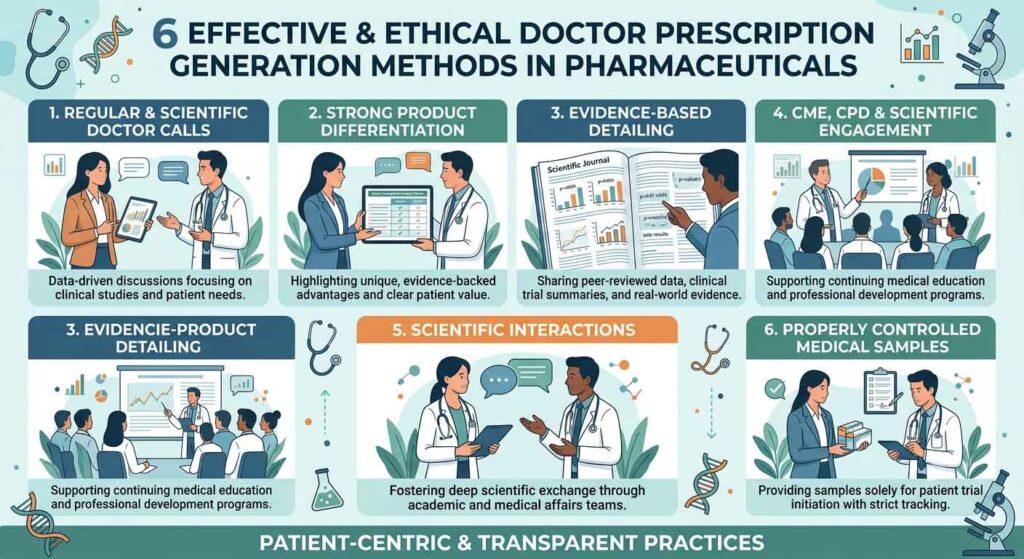
Quick Answer: Six Effective Prescription Generation Methods
The six most useful methods are:
Regular and Scientific Doctor Calls
Strong Product Differentiation and Evidence-Based Detailing
CME, CPD and Scientific Engagement
Properly Controlled Medical Samples
Strong Product Availability, Distribution and Affordability
Consistent Follow-Up, Feedback and Relationship Management
These methods work together.
A good product without regular follow-up may be forgotten.
Regular calls without scientific content may irritate doctors.
Good detailing without product availability may generate prescriptions that cannot be fulfilled.
Successful prescription marketing therefore requires a complete system.
1. Regular and Scientific Doctor Calls
Doctor calls remain the foundation of pharmaceutical prescription marketing.
A doctor call occurs when a Medical Representative, Business Executive or sales professional meets a healthcare professional to provide approved information about the company’s products.
The purpose should be to:
Explain the product
Communicate approved indications
Discuss dosage and administration
Explain important precautions
Provide scientific information
Answer legitimate questions
Introduce new formulations
Provide approved literature
Obtain market feedback
Why Regular Doctor Calls Work
Doctors deal with hundreds or thousands of medicines.
A pharmaceutical company needs consistent professional communication so that its brand remains familiar.
However, “regular” does not mean excessive visits.
Repeatedly visiting a doctor’s clinic without useful information may:
Waste the doctor’s time
Irritate clinic staff
Reduce brand credibility
Damage the representative’s relationship
The objective should be quality of communication, not merely the number of calls.
How Often Should a Doctor Be Visited?
There is no single frequency suitable for every doctor.
Call frequency should depend on:
Doctor potential
Specialty
Product relevance
Territory
Previous response
Product launch stage
Company’s call plan
A high-priority doctor may require more frequent professional follow-up than a low-potential doctor.
What Makes a Good Doctor Call?
A good representative should know:
Brand name
Generic composition
Strength
Approved indication
Dosage
Mechanism of action
Contraindications
Important adverse effects
Drug interactions
Product positioning
Clinical evidence
Relevant competing therapies
A representative should never invent an answer.
If the doctor asks something the representative cannot answer confidently, the better response is to obtain accurate information from the medical or regulatory department and follow up later.
2. Strong Product Differentiation and Evidence-Based Detailing
Doctors already have numerous treatment choices.
Simply saying:
“Doctor, please prescribe my brand.”
provides no clinical reason to change behaviour.
The representative should be able to explain:
“Why should this product be considered for an appropriate patient?”
Product Differentiation May Come From
Formulation
Strength
Dosage convenience
Release technology
Dosage form
Stability
Palatability
Packaging
Patient convenience
Quality standards
Evidence
Cost of therapy
Availability
The claimed advantage must be genuine and supportable.
New Molecules Can Help—but “New” Is Not Enough
A newer molecule may receive attention when it offers a meaningful clinical advantage.
However, a product should not be promoted simply because it is new.
Doctors may ask:
Is it more effective?
Is it safer?
For which patients?
What evidence supports it?
What are the contraindications?
How does it compare with existing therapy?
What is the cost?
Is it readily available?
A representative must be prepared for these questions.
Mature Molecules Can Also Build Strong Brands
A company does not necessarily need a newly patented molecule.
Even an established molecule can grow when the company provides:
Reliable quality
Consistent supply
Appropriate pricing
Strong scientific communication
Convenient dosage form
Patient-friendly packaging
The objective should be meaningful differentiation rather than artificial novelty.
Prepare a Product Dossier Before Entering the Market
Before launching any prescription product, prepare a detailed internal product report.
It should cover:
Product Information
Brand name
Generic name
Composition
Strength
Dosage form
Pack size
Approved indication
Clinical Information
Pharmacological class
Mechanism of action
Dosage
Administration
Contraindications
Precautions
Adverse effects
Drug interactions
Special populations
Market Information
Market size
Market growth
Major competitors
Leading brands
Price comparison
Therapy trends
Prescribing specialties
Positioning
Define:
Target doctor
Target patient
Main product benefit
Supporting evidence
Key objection
Approved response
Core detailing message
This document becomes useful for:
MR training
Visual-aid development
Product launches
Sales meetings
Objection handling
Scientific communication
3. CME, CPD and Scientific Engagement
Doctors need continuous professional education because medical knowledge evolves continuously.
Scientific engagement may include:
Continuing Medical Education
Continuing Professional Development
Seminars
Workshops
Scientific conferences
Webinars
Clinical discussions
Expert panels
Research presentations
These activities can help pharmaceutical companies build scientific credibility when organised transparently and compliantly.
Why Scientific Meetings Are Effective
They allow healthcare professionals to:
Understand new evidence
Review treatment guidelines
Discuss difficult clinical cases
Learn from specialists
Compare therapeutic approaches
Stay updated with medical science
A pharmaceutical company’s role should be to support legitimate scientific education—not purchase prescriptions.
Conferences Should Never Become Prescription Deals
The wrong approach is:
“We sponsored your conference, so you should prescribe our product.”
Scientific support should never be conditional on:
Number of prescriptions
Brand commitment
Sales generated
Switching from a competitor
Minimum monthly business
That converts scientific education into an inducement.
Foreign Leisure Tours Are Not a Marketing Method
Older pharmaceutical marketing practices sometimes included:
Foreign holidays
Family tours
Resort stays
Cruise tickets
Luxury travel
These should not be treated as acceptable prescription-generation strategies.
Scientific engagement must follow current pharmaceutical marketing rules and internal compliance procedures.
4. Properly Controlled Medical Samples
Medical samples can be useful when provided appropriately.
The objective of a free medical sample is to allow a qualified healthcare professional to become familiar with a product and its use.
Samples should not function as gifts.
How Samples Can Support Prescription Generation
A doctor may use a sample to:
Become familiar with a new dosage form
Assess patient acceptability
Understand packaging
Start appropriate treatment in a selected situation
Become familiar with administration
If the doctor’s experience is satisfactory and the product is clinically appropriate, the doctor may subsequently consider the brand.
Sample Distribution Should Be Controlled
The company should maintain records covering:
Product name
Doctor
Quantity
Date
Representative
Batch information where required
Value of samples
Sample packs should carry the appropriate:
“Free Medical Sample – Not for Sale”
declaration.
Samples Should Not Be Used As
Personal gifts
Retail stock
Cash substitutes
Rewards for prescribing
Incentives for increasing prescription volume
The purpose must remain legitimate product familiarisation.
5. Strong Availability, Distribution and Patient Affordability
Generating a prescription is not enough.
Imagine a doctor prescribes your product and the patient visits three pharmacies but cannot find it.
The result may be:
Pharmacist substitutes another brand.
Patient returns to the doctor.
Doctor loses confidence in your availability.
Future prescriptions decline.
That is why prescription generation and distribution must work together.
Ensure Availability Around Important Doctors
Identify:
Nearby pharmacies
Main stockists
Distributors
Hospital pharmacies
High-volume retailers
Ensure appropriate stock is available without forcing excessive inventory on retailers or distributors.
Track Prescription-to-Supply Conversion
The sales team should investigate:
Is the product available?
Are retailers ordering it?
Is the distributor maintaining inventory?
Is there frequent stockout?
Is a competitor being substituted?
Is the patient’s price objection high?
Patient Affordability Matters
Price can influence whether a patient:
Starts therapy
Completes therapy
Buys the prescribed brand
Asks for an alternative
Companies should evaluate the cost of therapy, not merely MRP.
For example:
Cost per day = Price paid by patient ÷ number of treatment days
Two products with similar MRPs may have very different daily treatment costs.
Legitimate Commercial Pricing Is Different from Paying for Prescriptions
Hospitals, distributors and pharmacies may negotiate legitimate commercial rates, discounts or institutional supply terms.
But pricing should be:
Transparent
Properly invoiced
Commercially justified
Consistent with applicable law
It should never be converted into a personal cash payment or commission to an individual doctor in exchange for prescriptions.
6. Consistent Follow-Up, Feedback and Professional Relationship Management
The first doctor call rarely creates a successful brand.
Prescription development usually occurs gradually.
A representative may need to:
Introduce the product.
Explain the evidence.
Leave approved literature.
Answer questions.
Follow up.
Confirm availability.
Receive feedback.
Address objections.
Reinforce the appropriate product positioning.
Ask for Feedback, Not Prescription Guarantees
Useful questions include:
“Doctor, have you had an opportunity to use this formulation?”
“What has been your experience?”
“Are there any concerns about the dosage?”
“Do you need further information on the evidence?”
“Are patients facing any availability issue?”
This creates a professional discussion.
Keep Proper Doctor Profiles
A CRM or doctor profile may contain:
Specialty
Clinic location
Relevant therapy interests
Preferred call timing
Products detailed
Scientific questions
Follow-up required
Product availability around the clinic
Do not record inappropriate personal information unrelated to legitimate professional interaction.
Relationship Does Not Mean Inducement
A strong doctor relationship should be based on:
Reliability
Knowledge
Respect
Professional communication
Accurate information
Timely follow-up
Product quality
Service
It should not be based on:
Cash
Commissions
Expensive gifts
Personal benefits
Family travel
Prescription targets assigned to a doctor
Methods That Should NOT Be Used for Prescription Generation
Older pharmaceutical marketing discussions frequently described certain practices as a normal part of business.
They should no longer be recommended.
1. Cash Against Prescription
Giving a doctor:
Cash
Percentage commission
Monthly payment
Prescription-linked incentive
Monetary grant
in exchange for prescribing a product is not an acceptable pharmaceutical marketing method.
2. Luxury Gifts
Do not use items such as:
Expensive electronics
Luxury watches
Vehicles
Personal household goods
Premium personal accessories
as prescription inducements.
3. Leisure and Family Tours
Paid vacations or travel for a healthcare professional or family members should not be used as a prescription-generation strategy.
4. Prescription-Linked Conference Sponsorship
Scientific participation should not depend on:
“Write X prescriptions and we will sponsor your conference.”
5. Fake Clinical Evidence
Never:
Invent trials
Manipulate statistics
Misquote research
Hide material safety information
Present promotional material as independent research
6. Off-Label Promotion
A drug should not be promoted for an indication that is outside its approved marketing authorisation.
Prescription Generation vs Prescription Buying
These concepts should never be confused.
Prescription Generation
Built through:
Product merit
Scientific information
Quality
Evidence
Availability
Professional follow-up
Prescription Buying
Attempts to obtain prescriptions through:
Cash
Commission
Personal gifts
Trips
Personal financial benefits
The first creates a sustainable pharmaceutical brand.
The second creates regulatory, ethical and reputational risk.
Business and Marketing Plan for Prescription Products
Suppose a company plans to launch 20 products.
Do not send representatives into the market with only:
Brand names
MRPs
Visual aids
Prepare a strategy for every important product.
Step 1: Understand the Molecule
Study:
Drug class
Generation
Mechanism
Indications
Dosage
Contraindications
Side effects
Interactions
Important precautions
Step 2: Understand the Market
Analyse:
Market size
Growth
Top brands
Competitors
Price
Prescription trends
Step 3: Identify the Target Specialty
Determine who is most likely to prescribe the product.
Examples:
General physicians
Paediatricians
Gynaecologists
Orthopaedic surgeons
Cardiologists
Diabetologists
Dermatologists
Neurologists
Do not promote every product to every doctor.
Step 4: Define the Product Positioning
Answer in one sentence:
“For which appropriate patient should the doctor consider this brand, and why?”
If the sales team cannot answer this clearly, the marketing strategy is incomplete.
Step 5: Prepare Approved Communication
Develop:
Visual aid
Product monograph
Literature
Leave-behind card
FAQ sheet
Objection-handling guide
Step 6: Train the Field Force
Medical Representatives should be trained on:
Product
Disease
Competition
Evidence
Safety
Compliance
Doctor communication
Step 7: Ensure Distribution Before Promotion
Make sure the product is available before large-scale prescription activity begins.
Step 8: Measure the Right Indicators
Do not measure success only through primary dispatch.
Track:
Secondary sales
Repeat orders
Retail availability
Product-wise growth
Doctor coverage
Call quality
Stockouts
Returns
Expiry
Feedback
Prescription Generation for a New Pharma Company
A new company should not try to compete simultaneously with large established companies across hundreds of products.
A better strategy is to select:
A focused therapy area
A limited product range
Selected doctors
A manageable territory
For example, instead of marketing 50 unrelated products, a startup may select 8–15 products focused on:
Orthopaedics
Gynaecology
Paediatrics
Gastroenterology
General medicine
This allows:
Better product knowledge
Better doctor targeting
Lower inventory
More focused promotion
Easier availability management
How Long Does Prescription Generation Take?
There is no fixed period.
Results depend on:
Product
Doctor
Competition
Brand familiarity
Representative quality
Price
Availability
Clinical need
Frequency of calls
Some products may receive early trials.
Others require repeated scientific interaction.
Prescription marketing should therefore be evaluated over a reasonable period rather than expecting immediate results after one doctor visit.
Role of the Medical Representative
A Medical Representative should act as a professional communication link between the pharmaceutical company and healthcare professionals.
The role includes:
Product detailing
Scientific communication
Providing approved literature
Providing authorised samples
Answering questions
Reporting feedback
Ensuring product availability
Reporting complaints
Reporting adverse-event information according to company procedure
An MR should not be trained merely to “extract prescriptions.”
Frequently Asked Questions
1. What is prescription generation in pharma?
It is the process of creating awareness and professional confidence among healthcare professionals so that an appropriate pharmaceutical product may be prescribed to suitable patients.
2. What is the most effective prescription-generation method?
Regular, well-planned doctor calls supported by accurate scientific information and consistent product availability remain among the most important methods.
3. Can pharma companies give cash to doctors for prescriptions?
No. Cash or monetary benefits should not be used as an inducement for prescribing pharmaceutical products.
4. Can pharma companies sponsor foreign tours for doctors?
Foreign leisure travel or paid vacations should not be used as prescription incentives. Current pharmaceutical marketing rules place significant restrictions on travel and hospitality.
5. Can pharmaceutical companies organise CME programs?
Yes, scientific CME and CPD engagement is possible when conducted through transparent and compliant arrangements under applicable rules.
6. Are free medicine samples allowed?
Free medical samples may be provided subject to applicable restrictions, proper labelling and accountability.
7. Does a new molecule automatically generate prescriptions?
No. Newness alone is not sufficient. The product must have a clinically meaningful and supportable position.
8. Why is product availability important?
A doctor’s prescription may be lost if the patient cannot obtain the product from nearby pharmacies.
9. Should doctors be visited every day?
No. Call frequency should be appropriate to the doctor, product and territory. Excessive visits may become counterproductive.
10. Should a Medical Representative promise that a drug has no side effects?
No. Pharmaceutical communication must provide accurate and balanced information.
11. Can a doctor be paid commission on MRP or PTR?
A personal prescription-linked commission is not a legitimate substitute for normal trade pricing and should not be used to induce prescriptions.
12. What should a startup focus on first?
Start with a focused product range, strong product knowledge, selected doctors, reliable distribution and regular professional follow-up.
Final Thoughts
Prescription generation should never be reduced to:
Money → Doctor → Prescription → Sale
A sustainable pharmaceutical business works differently:
Quality product → Scientific communication → Doctor confidence → Patient suitability → Availability → Repeat use
Successful brands are built when:
Representatives are knowledgeable
Claims are credible
Doctors are respected
Products are available
Prices are reasonable
Follow-up is consistent
Marketing remains ethical
There is no shortcut that replaces these fundamentals.
Looking for Ayurvedic Franchise or Distribution Opportunities?
Elzac Herbal India offers opportunities for entrepreneurs interested in Ayurvedic and herbal product distribution, franchise marketing and third-party manufacturing.
Elzac Herbal India offers:
Ayurvedic & Herbal Product Range
Franchise & Distribution Opportunities
Third-Party Manufacturing
Product Development Support
Marketing Guidance
PAN India Business Opportunities
Whether you are an entrepreneur, retailer, distributor, or healthcare professional, our team can help you explore the right business opportunity in the growing Ayurvedic sector.
Ajay Kamboj is an entrepreneur and business owners associated with many Ayurvedic and Pharmaceutical start-ups. With years of experience in Ayurvedic product marketing, pharmaceutical distribution, franchise development, and client relationship management, he regularly shares practical business insights based on real-world experiences. His articles focus on business growth, entrepreneurship, customer management, and lessons learned from the healthcare and wellness industry.



Leave a Reply
You must be logged in to post a comment.