The pharmaceutical industry depends on many supporting businesses, including:
Packaging-material manufacturers
Printing presses
Label manufacturers
Bottle and cap manufacturers
Aluminium-foil converters
Promotional-material printers
Machinery suppliers
Artwork-design agencies
Logistics and warehousing companies
Most pharmaceutical, Ayurvedic, cosmetic and nutraceutical companies outsource at least some of their packaging and promotional materials to specialist suppliers.
This creates opportunities for entrepreneurs who have knowledge of printing, packaging, graphic design, quality control or industrial production.
However, pharmaceutical packaging is not ordinary commercial printing. A small error in composition, strength, batch details, licence number, schedule warning or dosage can lead to:
Batch rejection
Product recall
Regulatory action
Financial loss
Patient-safety risk
Therefore, a pharmaceutical packaging unit must combine printing capability with strong artwork control, inspection, traceability and documentation.
Quick Answer
A pharmaceutical packaging and promotional-material business may manufacture:
Printed cartons
Labels
Package inserts
Aluminium foils
Blister materials
Bottles and containers
Caps and closures
Tubes
Sachets
Shippers
Visual aids
Reminder cards
Product cards
Doctor folders
Prescription pads
Product catalogues
To start this business, you generally need:
Select the packaging segment.
Conduct a market and investment study.
Register the business.
Select suitable industrial premises.
Obtain applicable local registrations.
Purchase printing and finishing machinery.
Install artwork and colour-management systems.
Recruit designers, machine operators and quality staff.
Develop approved-vendor and raw-material systems.
Establish artwork approval and line-clearance procedures.
Approach pharmaceutical and healthcare companies.
Produce commercial material only against signed artwork approval.
A unit printing secondary packaging such as cartons, labels and leaflets is easier to establish than a unit manufacturing primary drug-contact packaging such as blister foil, bottles, ampoules or rubber closures.
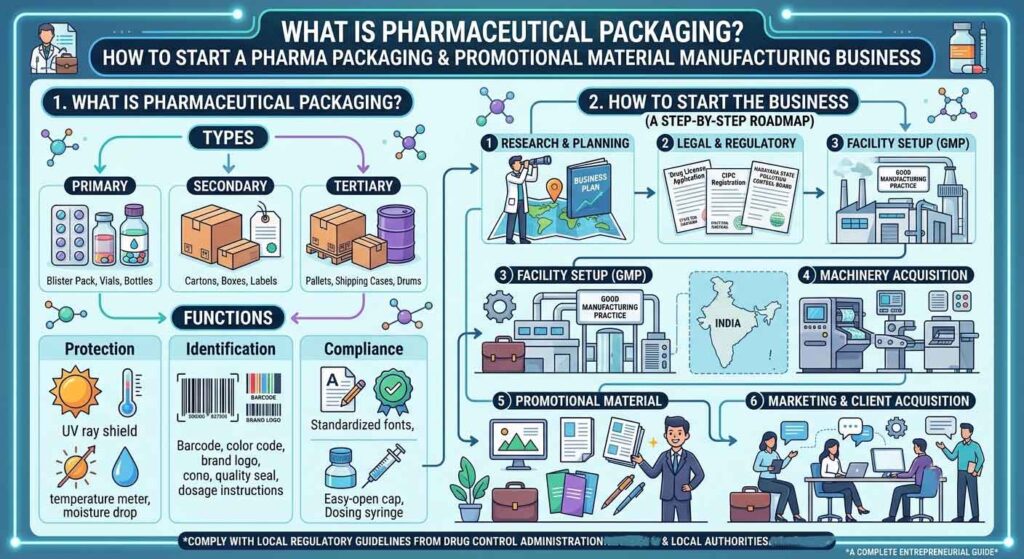
What Is Pharmaceutical Packaging?
Pharmaceutical packaging is the complete system used to contain, protect, identify, transport, store and present a medicine or healthcare product.
Its main purposes are:
Protecting the product
Preventing contamination
Preserving stability
Providing product information
Preventing mix-ups
Supporting correct use
Providing tamper evidence
Improving transport and storage
Identifying the brand
Supporting regulatory compliance
Packaging is not used only to make a product attractive. Its first responsibility is to protect the medicine and patient.
Main Functions of Pharmaceutical Packaging
1. Product Protection
Packaging protects medicines from:
Moisture
Oxygen
Light
Dust
Microorganisms
Temperature
Physical damage
Leakage
Breakage
Chemical contamination
2. Product Identification
Packaging tells the user:
Product name
Generic name
Composition
Strength
Dosage form
Batch number
Manufacturing date
Expiry date
MRP
Manufacturer
Marketer
Licence number
Storage condition
3. Patient Information
The pack may provide:
Dosage instructions
Route of administration
Warnings
Contraindications
Storage instructions
Schedule warning
Prescription status
Customer-care details
4. Tamper Evidence
Packaging may help indicate whether a product has been opened or altered.
Examples include:
Shrink sleeves
Tamper-evident seals
Breakable caps
Induction seals
Security labels
Serialized codes
5. Brand Presentation
Colours, typography, layout and finishing help customers and healthcare professionals identify a product.
However, appearance should never reduce the readability of mandatory information.
Types of Pharmaceutical Packaging
Pharmaceutical packaging is generally divided into three levels.
1. Primary Packaging
Primary packaging directly contacts the pharmaceutical product.
Examples include:
Blister foil
PVC/PVDC film
Alu-alu foil
Glass bottles
Plastic bottles
Ampoules
Vials
Rubber stoppers
Tubes
Sachets
Strip packs
Prefilled syringes
Eye-drop bottles
Infusion bags
Primary packaging must be compatible with the product.
It should not:
React with the medicine
Release harmful substances
Absorb active ingredients
Permit contamination
Affect product stability
Allow unacceptable moisture or oxygen entry
Primary packaging manufacturing requires much stronger technical, quality and testing capability than ordinary carton printing.
2. Secondary Packaging
Secondary packaging surrounds the primary container.
Examples include:
Printed cartons
Labels
Package inserts
Patient-information leaflets
Printed sleeves
Mono cartons
Inner boxes
Display boxes
Secondary packaging provides identification, protection and regulatory information.
This is the most practical entry segment for a new pharmaceutical printing business.
3. Tertiary Packaging
Tertiary packaging is used for storage, handling and transportation.
Examples include:
Corrugated shippers
Master cartons
Pallets
Stretch wrapping
Transport labels
Insulated boxes
Cold-chain containers
Tertiary packaging should protect products during transport and warehouse handling.
Pharmaceutical Packaging vs Promotional Material
Packaging material and promotional material serve different purposes.
Point
Pharmaceutical packaging
Promotional material
Main purpose
Protect and identify product
Promote product or company
Used with product
Yes
Usually separate
Regulatory text
Mandatory
Depends on material
Examples
Carton, foil, label, leaflet
Visual aid, reminder card, catalogue
Batch details
Often required
Normally not required
Patient use
May be used by patient
Mostly used by sales team or doctors
Artwork control
Extremely critical
Also important, especially for claims
Quantity
Based on batch size
Based on marketing campaign
What Are Pharmaceutical Promotional Inputs?
Promotional inputs are printed or digital materials used by pharmaceutical and Ayurvedic companies to communicate product information and support sales.
Common promotional materials include:
Visual aids
Product cards
Reminder cards
Doctor folders
Product monographs
Literature
Leaflets
Prescription pads
Writing pads
Order books
Product lists
Price lists
Company profiles
Product catalogues
Promotional calendars
Desk reminders
Notebooks
Patient-awareness material
Exhibition material
Posters
Banners
Standee graphics
Promotional materials should not contain false, exaggerated or misleading therapeutic claims.
The Drugs and Magic Remedies (Objectionable Advertisements) Act prohibits certain drug advertisements and misleading advertisements relating to drugs.
The Uniform Code for Pharmaceutical Marketing Practices 2024 also provides that pharmaceutical promotional material should be accurate, balanced, current and capable of substantiation.
Does a Pharma Packaging Printer Need a Drug Licence?
A company that only manufactures or prints:
Cartons
Labels
Leaflets
Promotional material
Shippers
Paper packaging
does not ordinarily require a drug-manufacturing licence merely because its customers are pharmaceutical companies.
However, it may need normal business and industrial approvals such as:
Business registration
GST registration, where applicable
Udyam registration
Factory licence, where applicable
Pollution Control Board consent, depending on operations
Fire-safety approval
Shops and Establishments registration
Municipal trade licence
Labour registrations
Electricity-load approval
Boiler approval, where applicable
If the unit also performs activities such as:
Filling medicines
Repacking medicines
Relabelling medicines
Over-labelling finished medicines
Opening bulk drug containers
Packing products into retail packs
the activity should be reviewed separately because pharmaceutical repacking and labelling may require an applicable drug licence.
Product-Specific Packaging Regulations
The artwork requirements depend on the product category.
Allopathic Medicines
Allopathic medicine packaging should comply with applicable Drugs Rules relating to:
Labelling
Packing
Schedule warnings
Manufacturer details
Batch details
Expiry
Licence numbers
Prescription status
CDSCO maintains the current consolidated Drugs Rules and subsequent amendments.
The exact requirements depend on the product category and approved formula.
Nutraceuticals and Food Supplements
Nutraceutical packaging must follow applicable FSSAI requirements, including:
Food-category declarations
Ingredient list
Nutrition information
Allergen declarations
Veg/non-veg symbol
FSSAI logo and licence number
Net quantity
Batch details
Date marking
Usage instructions
Mandatory warnings
Claims compliance
FSSAI maintains separate Packaging Regulations, Advertising and Claims Regulations, and Labelling and Display Regulations.
The Labelling and Display Regulations have continued to receive amendments, including amendments notified in 2025 and 2026.
Cosmetics
Cosmetic packaging must comply with the Cosmetics Rules, 2020, including applicable labelling provisions.
Medical Devices
Medical-device packages may be subject to:
Medical Devices Rules
Product-specific labelling
Import or manufacturing details
Sterility declarations
Lot or serial number
Expiry date
Legal Metrology requirements
The Department of Consumer Affairs has also issued specific guidance concerning packaged-commodity provisions for medical devices.
Legal Metrology
Pre-packaged commodities may require declarations such as:
Name and address of manufacturer or packer
Generic name of commodity
Net quantity
Month and year details, where applicable
MRP
Consumer-care details
The Legal Metrology (Packaged Commodities) Rules and amendments should be checked along with product-specific drug, food, cosmetic or device rules.
Which Packaging Business Should You Start?
You do not need to manufacture every type of packaging.
Choose one focused segment.
Option 1: Printed Pharmaceutical Cartons
Products include:
Tablet cartons
Capsule cartons
Syrup cartons
Ointment cartons
Injection cartons
Cosmetic cartons
Ayurvedic product cartons
This business requires:
Offset or digital press
Cutting
Die cutting
Creasing
Folding
Gluing
Inspection
Option 2: Pharmaceutical Labels
Products include:
Bottle labels
Vial labels
Ampoule labels
Cosmetic labels
Nutraceutical labels
Security labels
Tamper-evident labels
Label production may use:
Flexographic printing
Digital label printing
Offset printing
Screen printing
Variable-data printing
Option 3: Package Inserts and Leaflets
This segment produces:
Patient-information leaflets
Prescribing information
Product inserts
Instruction sheets
Multi-fold leaflets
It needs high-quality small-text printing and accurate folding.
Option 4: Pharmaceutical Foil Printing
Products may include:
Strip foil
Blister lidding foil
Aluminium foil
Child-resistant foil
Cold-form foil laminates
This segment requires specialized:
Printing
Coating
Slitting
Inspection
Material testing
It is more technically demanding than carton printing.
Option 5: Plastic Bottles and Containers
Products may include:
HDPE tablet bottles
PET syrup bottles
Eye-drop bottles
Nasal bottles
Lotion bottles
Cosmetic jars
Measuring cups
This unit may require:
Injection-moulding machines
Blow-moulding machines
Injection-blow moulding
Clean manufacturing areas
Moulds
Leak testing
Dimensional testing
Option 6: Tubes
Products may include:
Aluminium tubes
Laminated tubes
Plastic tubes
Used for:
Ointments
Creams
Gels
Toothpaste
Cosmetics
Option 7: Corrugated Shippers
Corrugated-box manufacturing supplies:
Master cartons
Transport shippers
Partition boxes
Display cartons
This is a wider business that can serve pharma and non-pharma customers.
Option 8: Promotional Material
This includes:
Visual aids
Product cards
Brochures
Catalogues
Reminder cards
Doctor folders
Prescription pads
Posters
Exhibition material
This segment can be started with lower investment than an integrated packaging factory.
Printing Technologies Used
1. Offset Printing
Offset printing is commonly used for:
Mono cartons
Leaflets
Brochures
Visual aids
Large-volume paper printing
Advantages include:
High print quality
Economical large runs
Good colour consistency
Wide paper compatibility
2. Digital Printing
Digital printing is suitable for:
Short runs
Samples
Promotional materials
Prototype cartons
Variable data
Personalized printing
Small quantities
It does not normally require printing plates.
3. Flexographic Printing
Flexographic printing is widely used for:
Roll labels
Flexible packaging
Foils
Films
Sachets
Self-adhesive labels
4. Rotogravure Printing
Rotogravure is suitable for high-volume flexible-packaging applications.
It offers:
High consistency
Long production runs
Detailed print
Film and foil compatibility
However, cylinders and setup costs make it less suitable for very small orders.
5. Screen Printing
Screen printing may be used for:
Bottles
Containers
Tubes
Special effects
Selected labels
Modern Prepress Process
The old method of creating film negatives and exposing aluminium plates is now mainly a legacy workflow.
Many modern offset plants use Computer-to-Plate technology.
A modern workflow may include:
Receiving approved artwork
Checking dimensions and dieline
Font and image checking
Barcode verification
Colour separation
Trapping and overprint checking
Imposition
PDF preflight
Proof generation
Customer approval
Direct plate imaging through CTP
Printing
Design and Prepress Software
Common software includes:
Adobe Illustrator
CorelDRAW
Adobe InDesign
Adobe Photoshop
Adobe Acrobat Professional
Preflight software
Imposition software
RIP software
Barcode-verification software
Colour-management software
PageMaker is now obsolete for most professional packaging workflows.
The designer should understand more than attractive design. He or she should understand:
Dielines
Bleed
Safe area
Overprint
Trapping
Barcode quiet zones
Minimum font size
Colour separation
Spot colours
Varnish layers
Braille, where applicable
Regulatory text hierarchy
Standard Pharmaceutical Artwork Workflow
A strong artwork workflow may be:
Client sends approved text.
Packaging specification is created.
Dieline is approved.
Designer prepares artwork.
Internal prepress checks are completed.
Regulatory and technical text is checked by the client.
Barcode is generated and verified.
Colour proof is prepared.
Client signs the final artwork.
Artwork receives a unique version number.
Plate or cylinder is prepared.
Line clearance is conducted.
Printing starts.
First-off sample is approved.
In-process inspection continues.
Finished material is inspected.
Quantity is reconciled.
Approved material is dispatched.
The printer should not make independent changes to:
Composition
Strength
Licence number
Dosage
Warnings
MRP
Manufacturer address
Marketed-by address
Batch coding area
Every alteration should be approved by the client in writing.
Machinery for a Pharmaceutical Carton Unit
A carton-printing unit may require:
Multicolour offset printing machine
Computer-to-plate system
Plate processor
Paper-cutting machine
Die-cutting and creasing machine
Folder-gluer
Lamination machine
UV coating machine
Drip-off coating facility
Foil-stamping machine
Embossing machine
Window-patching machine
Sheet inspection system
Waste-stripping system
Air compressor
Material-handling equipment
Generator or power backup
Machinery for Label Manufacturing
A label unit may require:
Flexographic label press
Digital label press
Slitting machine
Die-cutting unit
Matrix-removal unit
Lamination unit
Varnishing unit
Foil-stamping facility
Rewinding machine
Roll-inspection machine
Barcode verifier
Label-counting machine
Machinery for Leaflets and Promotional Materials
Digital printing machine
Offset printing machine
Paper cutter
Folding machine
Creasing machine
Lamination machine
Binding machine
Stapling machine
Perfect-binding machine
Spiral-binding machine
UV coating machine
Foil-stamping machine
Embossing machine
Machinery for Aluminium Foil Printing
Depending on the product, the unit may need:
Foil printing machine
Flexographic or gravure press
Coating machine
Lacquering machine
Drying system
Slitting and rewinding machine
Inspection machine
Pin-hole tester
Thickness tester
Heat-seal testing equipment
Colour-measurement equipment
Primary pharmaceutical foil manufacturing requires material and performance testing against the customer’s approved specification.
Raw Materials Required
For Cartons and Promotional Material
Duplex board
Folding-box board
Art paper
Maplitho paper
Kraft paper
Corrugated sheets
Printing ink
Varnish
Lamination film
Adhesive
UV coating
Foil-stamping rolls
Printing plates
Cutting dies
Packing material
For Labels
Self-adhesive paper
BOPP film
PET film
Release liner
Adhesive
Ink
Varnish
Foil
Lamination film
For Primary Packaging
Pharmaceutical-grade aluminium foil
PVC film
PVDC-coated film
Polyethylene
Polypropylene
PET
HDPE
LDPE
Glass
Elastomeric materials
Approved inks and coatings
Raw materials should be purchased against clear specifications.
Technical Staff Required
Graphic Designer
The designer should know:
Packaging artwork
CorelDRAW or Illustrator
Photoshop
Dielines
Colour management
Barcode placement
Print production
Pharma artwork controls
Prepress Operator
Responsible for:
File checking
Colour separation
Trapping
Imposition
Plate preparation
Proof control
Version control
Printing Machine Operator
The operator should control:
Registration
Ink density
Colour consistency
Print defects
Sheet feeding
Machine speed
Wastage
Line clearance
Post-Press Operator
Responsible for:
Lamination
Die cutting
Embossing
Foil stamping
Folding
Gluing
Binding
Finishing
Quality-Control Staff
Quality staff should check:
Text
Colour
Dimensions
Barcode
GSM
Board thickness
Adhesion
Rub resistance
Scuff resistance
Die-cut accuracy
Folding
Gluing
Quantity
Contamination
Mixed artwork
Marketing Staff
Marketing staff should understand:
Pharma-company requirements
Minimum order quantities
Product categories
Delivery commitments
Artwork timelines
Quality agreements
Credit management
Quality-Control Tests
Tests depend on the packaging type.
Printed Cartons
Possible checks include:
Artwork verification
Text and spelling
Colour shade
Dimensions
GSM
Board thickness
Grain direction
Print registration
Rub resistance
Scuff resistance
Die-cut dimensions
Creasing quality
Glue strength
Barcode verification
Labels
Possible checks include:
Adhesion
Release performance
Curling
Print resistance
Barcode readability
Label dimensions
Die-cut accuracy
Roll direction
Roll count
Core size
Foil and Flexible Packaging
Possible checks include:
Thickness
Pinholes
Seal strength
Bond strength
Coating weight
Print adhesion
Solvent residue
Barrier properties
Surface treatment
Slip
Dimensions
Plastic Containers
Possible checks include:
Weight
Dimensions
Neck finish
Leakage
Drop test
Closure fit
Wall thickness
Transparency
Colour
Capacity
Compatibility
Good Documentation Practices
A packaging supplier should maintain:
Approved artwork
Artwork version history
Customer purchase order
Packaging specification
Master sample
Shade card
Plate or cylinder record
Printing-job card
Line-clearance record
In-process inspection
Finished-goods inspection
Quantity reconciliation
Rejection record
Destruction record
Dispatch record
Complaint record
Change-control record
Supplier qualification
Training records
Line Clearance
Line clearance is essential before starting a packaging job.
It should confirm that:
Previous artwork has been removed.
Previous printed sheets are removed.
Old labels are removed.
Incorrect plates are removed.
Work area is clean.
Correct raw material is issued.
Correct artwork is available.
Correct plate or cylinder is installed.
Rejected material is identified.
Waste containers are empty.
This helps prevent mixing cartons or labels of different products, strengths or companies.
Reconciliation of Printed Material
Printed pharmaceutical packaging is sensitive and should be reconciled.
For example:
Sheets issued
Sheets printed
Good sheets
Rejected sheets
Samples taken
Sheets destroyed
Quantity transferred for die cutting
Finished cartons produced
Balance material
Excess printed material should not be sold as ordinary scrap without control because it may carry:
Brand names
Licence details
Batch spaces
Medicine names
Manufacturer information
Rejected printed material should be defaced or destroyed securely.
Barcode and QR-Code Control
The packaging unit should verify:
Barcode number
Barcode type
Magnification
Quiet zone
Contrast
Orientation
Readability
Product mapping
QR-code destination
Variable-data accuracy
A barcode that looks correct may still fail during scanning.
Use a calibrated barcode verifier rather than only a mobile-phone scanner.
Colour Management
Colour consistency is important because customers use colour to identify brands and strengths.
The plant should establish:
Approved colour proof
Pantone or spot-colour reference
Ink formulation
Spectrophotometer controls
Density limits
Shade cards
Lighting conditions
Batch-to-batch comparison
Visual judgement alone may not be enough for high-quality pharmaceutical packaging.
Supplier Qualification by Pharma Companies
A pharmaceutical company may audit the packaging supplier before approval.
The audit may review:
Premises
Pest control
Material segregation
Artwork security
Line clearance
Printed-material control
Inspection
Reconciliation
Computer access
Data backup
Change control
Complaint handling
Training
Calibration
Documentation
Destruction of rejected material
Large manufacturers may require a written Quality Agreement.
Promotional Material Approval
A printing press should not independently create therapeutic claims merely to make a visual aid more attractive.
The client should provide or approve:
Product indication
Clinical claims
References
Dosage
Safety statements
Comparative statements
Product classification
Intended audience
UCPMP 2024 requires promotional information issued under the authority of a pharmaceutical company to be consistent with approved information, accurate, balanced and not misleading.
The printer should retain signed or digitally approved artwork as proof that the content was authorized by the client.
Premises Requirements
The plant layout may include:
Raw-material warehouse
Quarantine area
Approved-material area
Rejected-material area
Design studio
Prepress area
Plate-making area
Printing hall
Ink room
Lamination area
Die-cutting area
Folding and gluing area
Inspection area
Finished-goods warehouse
Rejected-material area
Scrap-destruction area
Quality-control laboratory
Administrative office
Raw materials and printed materials belonging to different customers should be segregated.
Registrations and Approvals
Depending on location and business scale, registrations may include:
Proprietorship, partnership, LLP or company registration
PAN
GST registration
Udyam registration
Factory licence
State Pollution Control Board consent
Fire NOC
Municipal trade licence
Shops and Establishments registration
Labour registrations
Professional tax, where applicable
Electricity-load sanction
Boiler registration, where applicable
Import Export Code, if importing or exporting
Legal Metrology registration, where applicable to the activity
Udyam registration is free, online and paperless through the official government portal.
Requirements vary by state, printing process, solvents, inks, machinery power and number of workers.
Environmental and Worker-Safety Requirements
Printing operations may involve:
Ink
Solvents
Cleaning chemicals
Adhesives
Coatings
Paper dust
Noise
Moving machinery
Fire risk
The plant should provide:
Ventilation
Fire extinguishers
Solvent storage
Chemical labels
Safety Data Sheets
Personal protective equipment
Machine guards
Emergency exits
Spill-control procedures
Waste segregation
Authorized waste disposal
Worker training
Solvent-based printing and lamination may require stronger environmental controls than water-based or low-solvent processes.
Investment Required
Investment depends on the selected business model.
Low-to-Medium Investment
Suitable for:
Artwork design
Digital promotional printing
Small leaflet production
Short-run labels
Outsourced finishing
Main costs include:
Computers
Design software
Digital printer
Cutting
Lamination
Binding
Rent
Working capital
Medium-to-High Investment
Suitable for:
Offset carton manufacturing
Pharmaceutical labels
Integrated promotional printing
Main costs include:
Multicolour press
CTP
Die cutting
Folder-gluer
Lamination
Inspection equipment
Quality laboratory
Power supply
Working capital
High Investment
Suitable for:
Printed pharmaceutical foils
Flexible packaging
Plastic containers
Tubes
Primary packaging
Rotogravure
Integrated packaging plants
This may require several production lines, specialized testing and significantly higher working capital.
Fixed Capital
Fixed capital may include:
Land or building
Security deposit
Printing machines
Finishing machines
CTP system
Quality instruments
Computers and software
Electrical installation
Air compressor
Generator
Fire-safety system
Furniture
Material-handling equipment
Working Capital
Working capital may include:
Paper
Board
Foil
Film
Ink
Adhesive
Coating
Wages
Electricity
Rent
Transport
Printing plates
Cutting dies
Customer credit
Rejected material
Machine maintenance
Pharmaceutical companies may demand credit, while paper and ink suppliers may require faster payment. Working-capital planning is therefore critical.
Expand only after achieving consistent quality and delivery.
Profitability
Pharmaceutical packaging can be profitable, but it is not automatically more profitable than pharmaceutical business.
Profit depends on:
Machine utilization
Order quantity
Raw-material price
Wastage
Rejection
Credit period
Delivery performance
Competition
Printing quality
Customer concentration
Machinery finance
Maintenance
A unit may have good gross margins but still lose money because of:
Idle machinery
High wastage
Delayed customer payments
Artwork errors
Product rejection
Excessive credit
Frequent small orders
Major Risks
Important risks include:
Wrong artwork
Mixed cartons
Incorrect strength
Barcode error
Colour variation
Delayed delivery
Paper-price increase
Customer payment delay
Machine breakdown
High wastage
Regulatory artwork change
Obsolete printed stock
Theft or misuse of printed material
Data leakage
Counterfeit-packaging risk
Common Mistakes to Avoid
Avoid these mistakes:
Treating pharma packaging as ordinary printing
Starting every packaging segment together
Purchasing machinery without confirmed demand
Using outdated software and processes
Printing without signed artwork approval
Changing text independently
Weak line clearance
No reconciliation
Selling rejected packs as scrap without destruction
Mixing customer materials
Ignoring barcode verification
Depending on visual colour checking only
Promising impossible delivery dates
Giving excessive credit
Ignoring pollution and fire requirements
Claiming guaranteed profitability
Printing misleading promotional claims
Manufacturing primary packaging without technical testing
Best Opportunity for Beginners
A beginner should consider starting with:
Pharmaceutical artwork design
Digital promotional materials
Leaflets
Visual aids
Short-run labels
Carton trading with outsourced production
After building customers and understanding specifications, the business may invest in:
Offset printing
Die cutting
Folder gluing
Flexographic labels
Foil printing
Plastic packaging
This staged model reduces capital and market risk.
Practical Checklist
Before starting, confirm:
Packaging segment selected
Market survey completed
Project report prepared
Business registered
Industrial premises selected
GST checked
Udyam registration completed
Factory and pollution requirements checked
Fire safety completed
Machinery installed
Design software installed
Skilled operators appointed
Quality staff appointed
Artwork SOP prepared
Line-clearance SOP prepared
Reconciliation system prepared
Raw-material suppliers qualified
Barcode verifier available
Inspection equipment available
Rejected-material destruction system available
Sample portfolio prepared
Pharma vendor-approval package prepared
Final Answer
Pharmaceutical packaging includes all materials used to contain, protect, identify, store and transport pharmaceutical products.
It is divided into:
Primary packaging
Secondary packaging
Tertiary packaging
Promotional materials, such as visual aids, reminder cards and product catalogues, support product promotion but are not the same as packaging.
For a beginner, printed cartons, labels, leaflets and promotional inputs are the most practical entry segments. Primary packaging such as foils, bottles, tubes and closures requires significantly greater technical capability, investment and testing.
The key success factors are:
Correct artwork
Strong line clearance
Printed-material reconciliation
Colour consistency
Barcode verification
On-time delivery
Secure destruction of rejected material
Good documentation
Compliance with customer specifications
A pharmaceutical packaging supplier does not merely print attractive material. It forms part of the pharmaceutical company’s quality and patient-safety system.
Frequently Asked Questions
1. What is pharmaceutical packaging?
Pharmaceutical packaging is the system used to contain, protect, identify, store and transport medicines.
2. What are the three levels of packaging?
They are primary, secondary and tertiary packaging.
3. What is primary packaging?
Primary packaging directly contacts the medicine, such as a blister, bottle, vial, tube or sachet.
4. What is secondary packaging?
Secondary packaging surrounds the primary container, such as a printed carton, label or package insert.
5. Is promotional material packaging?
No. Promotional material supports marketing, while packaging protects and identifies the product.
6. Is a drug licence required for carton printing?
A printing unit manufacturing only empty cartons, labels or leaflets does not ordinarily need a drug-manufacturing licence. Actual drug packing or repacking is a separate regulated activity.
7. Which printing process is best for pharma cartons?
Offset printing is commonly used for medium and large carton runs. Digital printing is useful for short runs and samples.
8. Which process is suitable for roll labels?
Flexographic and digital label-printing systems are commonly used.
9. Is the film-negative process still used?
It may still be used by some older plants, but modern offset printers commonly use Computer-to-Plate technology.
10. Is CorelDRAW sufficient for pharmaceutical artwork?
It can be used, but the workflow should also include PDF preflight, barcode verification, version control, proof approval and secure file management.
11. Who is responsible for product claims in promotional material?
The pharmaceutical or healthcare company issuing and approving the material is responsible for its content. The printer should obtain written artwork approval and avoid unauthorized changes.
12. Can rejected cartons be sold as waste paper?
Printed rejected material should first be securely defaced or destroyed to prevent misuse and counterfeiting.
13. What is line clearance?
Line clearance confirms that all materials from the previous printing job have been removed before a new product is printed.
14. Is pharmaceutical packaging manufacturing expensive?
Investment ranges from relatively low for digital promotional printing to very high for integrated primary-packaging, foil, bottle or flexible-packaging plants.
15. Which business is best for a beginner?
Artwork design, promotional materials, package inserts, short-run labels and outsourced-carton trading are usually more manageable starting points.
Looking for Ayurvedic Franchise or Distribution Opportunities?
Looking to start an Ayurvedic franchise, become a distributor, or launch your own herbal product range?
Elzac Herbal India offers:
Ayurvedic & Herbal Product Range
Franchise & Distribution Opportunities
Third-Party Manufacturing
Product Development Support
Marketing Guidance
PAN India Business Opportunities
Whether you are an entrepreneur, retailer, distributor, or healthcare professional, our team can help you explore the right business opportunity in the growing Ayurvedic sector.
Ajay Kamboj is an entrepreneur and business owners associated with many Ayurvedic and Pharmaceutical start-ups. With years of experience in Ayurvedic product marketing, pharmaceutical distribution, franchise development, and client relationship management, he regularly shares practical business insights based on real-world experiences. His articles focus on business growth, entrepreneurship, customer management, and lessons learned from the healthcare and wellness industry.
5 responses to “What Is Pharmaceutical Packaging? How to Start a Pharma Packaging and Promotional Material Manufacturing Business”
The growth of the pharmaceutical packaging market is driven by the increasing demand for drug delivery devices, technological advancements, and reduction in the packaging cost with the advancement in the technology.



The growth of the pharmaceutical packaging market is driven by the increasing demand for drug delivery devices, technological advancements, and reduction in the packaging cost with the advancement in the technology.
Want to start this business
Yes, You can start pharma business
I want a franchise of pharmaceutical franchise help please 0826797099
Hello Sir I want to start this business. Can you help me .