Finding the exact list of top-selling pharmaceutical brands or molecules in India is not easy.
Unlike some international markets where detailed public sales databases are more accessible, Indian pharmaceutical retail-sales data is usually tracked by private market-research agencies. These reports are often paid and not freely available to the public.
Therefore, any free list of “top 10 pharma brands in India” or “most-selling molecules in India” should be treated carefully.
Such lists may be useful for idea generation, but they should not be considered fully accurate unless they are based on reliable market-audit data.
Why Top-Selling Medicine Data Is Difficult to Find
Indian pharma market data is difficult to interpret because of several reasons:
Large number of brands
Multiple companies selling the same molecule
Branded-generic nature of the market
Regional prescription differences
Doctor-specialty differences
Seasonal demand
Hospital vs retail sales variation
Rural vs urban demand difference
OTC, prescription and institutional channels
Price-control impact
Frequent new launches
Local generic competition
A brand may be top-selling by value but not by volume. Another product may sell in very high quantity but generate lower value because of lower price.
Brand Sales vs Molecule Sales
Before studying top-selling products, understand the difference between brand and molecule.
What Is a Pharma Brand?
A brand is the trade name given by a company to a medicine.
Example:
Augmentin
Calpol
Telma
Mounjaro
Shelcal
These are brand names.
What Is a Molecule?
A molecule is the active pharmaceutical ingredient or drug substance.
Example:
Amoxicillin + Clavulanic Acid
Paracetamol
Telmisartan
Tirzepatide
Calcium + Vitamin D3
Many companies may sell the same molecule under different brand names.
Top-Selling by Value vs Top-Selling by Volume
This is very important.
A high-priced product may become top-selling by value even with lower unit sales.
A low-priced product may sell in huge quantity but may not rank high by value.
For example:
A premium injectable may sell fewer units but generate high revenue.
A common tablet may sell millions of strips but generate lower revenue per unit.
Therefore, while preparing a product list for a new pharma company, both value and volume should be considered.
Sources Used for Pharma Market Tracking
Pharma companies generally use market data from:
PharmaTrac
AIOCD-AWACS
IQVIA
Pharmarack
Internal sales data
Stockist feedback
Retailer movement
Doctor prescription audit
Distributor reports
Hospital purchase data
Free internet articles may not provide complete or updated information.
Why Free Lists May Be Misleading
Many online lists are copied from old sources or written without updated market data.
Problems include:
Old rankings
Global data mixed with Indian data
Brand list without sales value
Molecule list without source
No MAT or monthly period mentioned
No retail vs hospital separation
No indication whether ranking is by value or volume
No distinction between prescription and OTC products
Always check the source, date and data type before relying on any list.
Therapy Areas That Commonly Show Strong Demand in India
Although exact rankings change, certain therapy segments generally remain important in the Indian market.
These include:
Cardiac medicines
Anti-diabetic medicines
Anti-infectives
Gastrointestinal medicines
Respiratory medicines
Pain and inflammation products
Vitamins and minerals
Dermatology products
Gynecology products
Neuro and CNS products
Pediatric products
Nutraceuticals
Lifestyle and obesity-related therapies
Demand changes according to disease burden, prescription trends, pricing and product innovation.
Important High-Demand Molecule Categories in India
Below are commonly demanded molecule categories in Indian pharma practice. This list is not a ranking. It is only a practical reference for product-selection research.
1. Cardiac Medicines
Cardiac therapy is one of the strongest segments in India due to hypertension, cholesterol disorders and cardiovascular-risk management.
Common molecule categories include:
Telmisartan
Amlodipine
Rosuvastatin
Atorvastatin
Metoprolol
Cilnidipine
Olmesartan
Aspirin combinations
Clopidogrel combinations
Diuretics
Antihypertensive combinations
Cardiac products usually provide repeat prescriptions because many patients use them long term.
2. Anti-Diabetic Medicines
Diabetes is a major chronic-disease segment in India.
Common categories include:
Metformin
Glimepiride combinations
Gliclazide
Voglibose
Teneligliptin
Sitagliptin
Dapagliflozin
Empagliflozin
Insulin products
GLP-1 and GIP/GLP-1 therapies, where applicable
This segment is growing because of lifestyle changes, obesity and increased diagnosis.
3. Anti-Infective Medicines
Anti-infectives have large usage, but they are highly competitive and must be promoted responsibly.
Common categories include:
Amoxicillin + Clavulanic Acid
Cefixime
Cefpodoxime
Azithromycin
Cefuroxime
Ofloxacin combinations, where approved
Ceftriaxone injections
Piperacillin + Tazobactam
Meropenem
Antifungal products
Antibiotics should be selected carefully because of prescription restrictions, antimicrobial-resistance concerns and high competition.
4. Gastrointestinal Medicines
Gastrointestinal products are commonly prescribed with many treatments.
Pediatric promotion should be responsible and evidence-based.
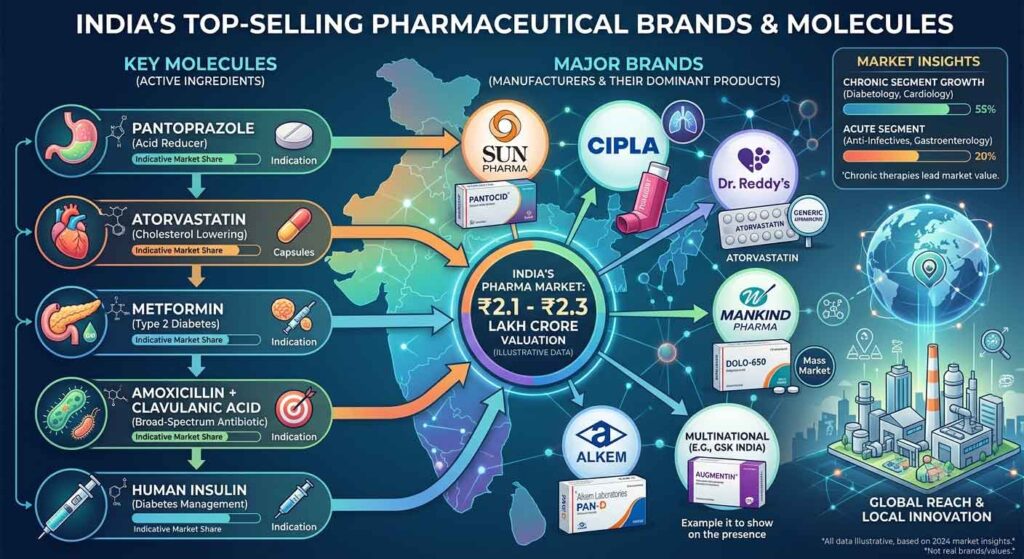
Examples of Popular Indian Pharma Brands
The following are examples of well-known brands often discussed in Indian pharma trade and public reports. This is not a current official ranking.
Examples include:
Augmentin
Calpol
Ceftum
Telma
Shelcal
Mixtard
Pan
Rantac
Glycomet
Janumet
Dolo
Mounjaro
Rybelsus
Market position changes with time, prescription patterns, competition, pricing and new launches.
Examples of Commonly Used Molecules
Again, this is not a ranking. It is a practical reference for market research.
Commonly used molecules and combinations include:
Paracetamol
Pantoprazole
Rabeprazole
Amoxicillin + Clavulanic Acid
Azithromycin
Cefixime
Cefpodoxime
Telmisartan
Amlodipine
Rosuvastatin
Atorvastatin
Metformin
Glimepiride
Teneligliptin
Dapagliflozin
Montelukast + Levocetirizine
Aceclofenac + Paracetamol
Etoricoxib
Methylcobalamin combinations
Calcium + Vitamin D3
A new company should not select products only because they are popular nationally. Local prescription demand matters more.
Global Top-Selling Medicines vs Indian Top-Selling Medicines
Global top-selling medicines are often patented, specialty or biologic products such as oncology, diabetes, autoimmune and obesity medicines.
Indian retail-market leaders may be different because India has:
Large branded-generic market
Strong acute therapy sales
High chronic disease burden
Price-sensitive patients
Strong local brands
Multiple companies selling the same molecule
Large retail pharmacy network
Therefore, global sales lists should not be directly copied for Indian product selection.
Should a New Pharma Company Launch Top-Selling Molecules?
Yes, but with caution.
Top-selling molecules have demand, but they also have strong competition.
For example, if you launch common products like Pantoprazole, Rabeprazole, Cefixime, Azithromycin, Calcium or Multivitamins, you will face many competitors.
To succeed, you need:
Good brand name
Attractive packaging
Competitive pricing
Regular availability
Strong doctor coverage
Product knowledge
Reliable distributor network
Ethical promotion
Quality assurance
A product sells not only because of the molecule but because of brand trust, prescription support and availability.
Do Not Choose Products Only by National Ranking
A product may be top-selling at national level but weak in your territory.
Before launching, check:
Which doctors you will target
Which products they prescribe
Which brands are already strong
Which products have shortage
Which products offer workable margin
Which products match your manufacturer’s strength
Which products are under price control
Which products need prescription control
Which products are seasonal
Which products have repeat demand
Local research is more useful than a copied national list.
How to Research Top-Selling Products in Your Area
1. Visit Retail Chemists
Ask them:
Which products move daily?
Which brands are repeatedly demanded?
Which prescriptions are common?
Which products face shortage?
Which products give better margin?
Which products frequently expire?
2. Study Doctor Prescriptions
Observe prescription trends ethically and without collecting patient-identifiable information.
Check:
Molecules
Brand names
Dosage forms
Strengths
Frequency
Seasonal variation
Specialty-wise prescribing
3. Talk to Stockists
Stockists know product movement across multiple retailers.
Ask about:
Fast-moving brands
Slow-moving products
Market shortage
Credit trends
Distributor margins
Replacement issues
Seasonal demand
4. Analyze Competitor Price Lists
Collect competitor lists and compare:
Product range
MRP
Pack size
Scheme
Composition
Packaging
Product positioning
Do not copy blindly. Use the information for planning.
5. Check Public Market Reports
Use public reports only as a direction.
They can help you identify trends such as:
Growth of cardiac therapy
Growth of anti-diabetic medicines
Demand for obesity therapies
Strong gastrointestinal segment
Continued importance of anti-infectives
Growth in nutraceuticals and wellness
6. Track Search Demand
Digital search trends can help identify consumer and distributor interest.
For example:
PCD franchise queries
Product-category searches
Medicine information searches
Disease-awareness searches
Nutraceutical demand
Ayurvedic product demand
Search demand should be combined with field research.
Best Product Strategy for a New Pharma Company
A new pharma company should build a balanced product list.
A practical product mix may include:
1. Fast-Moving Products
These help generate regular sales.
Examples:
PPIs
Pain products
Antibiotics, where approved
Anti-allergic products
Calcium
Multivitamins
2. Chronic Therapy Products
These can create repeat sales.
Examples:
Cardiac products
Diabetes products
Lipid-lowering medicines
Neuro-support products
3. Supportive Nutraceuticals
These may provide better margins.
Examples:
Protein powders
Multivitamins
Calcium
Vitamin D3
Antioxidants
Probiotics
4. Seasonal Products
These help during specific seasons.
Examples:
Cough syrups
Cold tablets
Antiallergics
ORS
Skin infection products
5. Differentiated Products
These help your company stand out.
Examples:
Specialty combinations
Premium packaging products
Unique nutraceutical formulations
Ayurvedic support products
Better patient-friendly dosage forms
Product Selection Mistakes to Avoid
Avoid these mistakes:
Copying top brand lists blindly
Launching 100 products at once
Selecting only high-competition molecules
Ignoring local prescription trends
Ignoring DPCO or price control
Ignoring banned or restricted FDCs
Selecting products without product permission
Choosing products with poor shelf life
Ignoring packaging quality
Selecting only high-margin products
Ignoring prescription rules
Promoting antibiotics irresponsibly
Making unsupported claims
Compliance Points Before Launch
Before selecting any molecule, check:
Whether it is approved
Whether the FDC is permitted
Whether it is under DPCO or price control
Whether it is Schedule H, H1 or X
Whether manufacturer has product permission
Whether label warnings are correct
Whether promotional claims are substantiated
Whether MR material is compliant
Whether the product can be promoted to the intended doctor segment
Do not launch a product only because it is selling well in the market.
How to Use Top-Selling Data Correctly
Top-selling data should be used for:
Understanding demand trends
Selecting product categories
Identifying therapy growth
Studying competition
Planning product pipeline
Preparing PCD product range
Estimating doctor potential
Improving sales strategy
Top-selling data should not be used for:
Copying brand names
Copying label claims
Making unapproved combinations
Overpricing products
Ignoring regulations
Launching products without market survey
Practical Starter Product Categories
A new pharma marketing company can consider these categories after market research:
This list should be customized according to territory, doctor segment and business model.
Final Thoughts
Finding the exact top-selling pharmaceutical brands and molecules in India is difficult without paid market-audit data.
Free online lists may provide ideas, but they should not be treated as final business data.
For a new pharma company, the best approach is:
Study national trends
Understand therapy growth
Research local prescriptions
Talk to chemists and stockists
Check competitor products
Verify regulatory status
Select products according to your target doctors
Maintain quality and availability
A top-selling molecule can help you enter the market, but long-term success depends on brand building, product quality, regular supply, ethical promotion and territory-level execution.
Frequently Asked Questions
1. Which is the top-selling medicine brand in India?
The ranking changes by month, year, value and volume. Exact ranking usually comes from paid market-audit sources, so free lists should be treated as indicative only.
2. Which pharma therapy is currently strong in India?
Cardiac, anti-diabetic, respiratory, gastrointestinal, anti-infective and nutraceutical segments are important therapy areas in India.
3. Should I launch only top-selling molecules?
No. Top-selling molecules have demand but also high competition. Balance them with differentiated and margin-supporting products.
4. What is the difference between top-selling brand and top-selling molecule?
A brand is a company’s trade name, while a molecule is the active ingredient. Many brands can contain the same molecule.
5. Where can I find accurate pharma sales data?
Paid market-research sources are commonly used by companies. Public sources are limited.
6. Are global top-selling medicines useful for Indian market planning?
They are useful for trend understanding, but they cannot be directly applied to Indian retail-market planning.
7. Which products are best for a new pharma company?
A new company should choose products based on local doctor demand, chemist movement, pricing, margin, regulatory approval and product availability.
8. Are antibiotics good for a new pharma company?
Antibiotics have demand but high competition and strict prescription responsibility. They should be selected and promoted carefully.
9. Are nutraceuticals good for pharma companies?
Yes, nutraceuticals can be useful as supportive and margin-friendly products, but they must comply with FSSAI and claim regulations.
10. What is the biggest mistake in product selection?
The biggest mistake is copying a list from the internet without local market research and regulatory verification.
Looking for Ayurvedic Franchise or Distribution Opportunities?
Looking to start an Ayurvedic franchise, become a distributor, or launch your own herbal product range?
Elzac Herbal India offers:
Ayurvedic & Herbal Product Range
Franchise & Distribution Opportunities
Third-Party Manufacturing Services
Product Development Support
Marketing Guidance
PAN India Business Opportunities
Whether you are an entrepreneur, retailer, distributor, or healthcare professional, our team can help you explore the right business opportunity in the growing Ayurvedic sector.
Ajay Kamboj is an entrepreneur and business owners associated with many Ayurvedic and Pharmaceutical start-ups. With years of experience in Ayurvedic product marketing, pharmaceutical distribution, franchise development, and client relationship management, he regularly shares practical business insights based on real-world experiences. His articles focus on business growth, entrepreneurship, customer management, and lessons learned from the healthcare and wellness industry.




Leave a Reply
You must be logged in to post a comment.