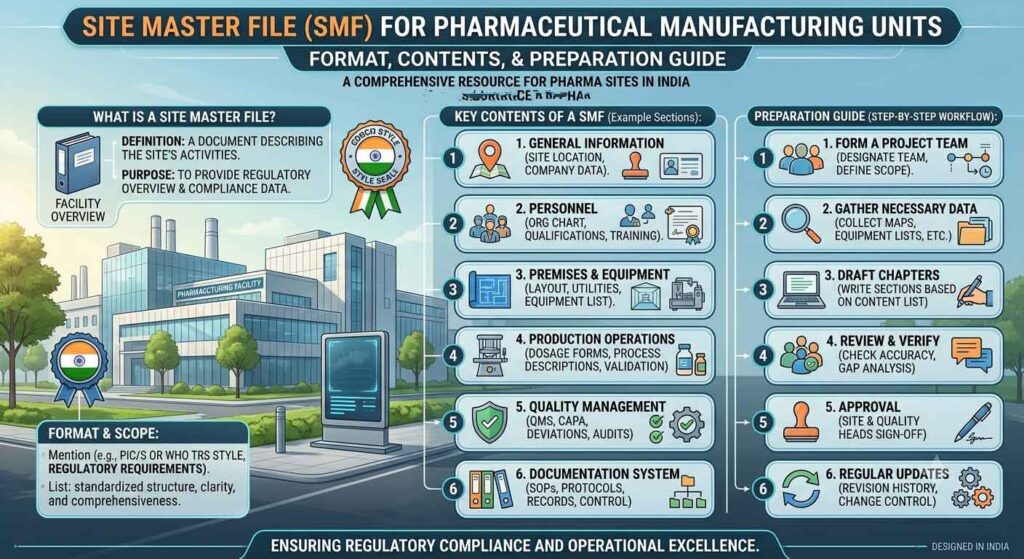
A Site Master File, commonly abbreviated as SMF, is one of the most important documents maintained by a pharmaceutical manufacturing facility.
It presents a concise, factual and organized description of:
The manufacturing site
Products and dosage forms
Pharmaceutical quality system
Personnel and responsibilities
Premises and utilities
Major equipment
Production operations
Quality assurance
Quality control
Validation
Documentation
Warehousing and distribution
Complaints and recalls
Self-inspection
Contract and loan-licence activities
The document allows a licensing authority, auditor, customer or technical reviewer to understand how the manufacturing site is organized and how it maintains Good Manufacturing Practices.
Under the revised Schedule M, manufacturers must prepare and maintain an updated Site Master File according to Appendix I.
What Is a Site Master File?
A Site Master File is a controlled document containing specific and factual information about the Good Manufacturing Practices followed at a named manufacturing site.
It provides an overview of:
The products manufactured
The operations performed
The quality systems implemented
The people responsible for critical activities
The manufacturing and testing facilities
The control of materials and products
The systems for handling quality failures
The document should describe what actually happens at the site.
It should not contain:
Promotional language
Unsupported statements
Future plans presented as current systems
Copied procedures that are not followed
Machinery not installed at the premises
Employees who do not actually work at the site
Products not endorsed on the manufacturing licence
Purpose of a Site Master File
The Site Master File is used for several purposes.
Regulatory Inspection Planning
The licensing authority can review the file before inspection to understand:
Site size
Dosage forms
Critical manufacturing processes
Sterile or non-sterile operations
High-risk products
Utilities
Contracted activities
Quality-control arrangements
WHO guidance identifies the Site Master File as an important tool for planning and conducting GMP inspections.
Manufacturing-Licence Applications
Depending on the state and product category, an SMF may be requested with:
New manufacturing-licence application
Licence amendment
Addition of a dosage form
Addition of a manufacturing section
Change of constitution
Change of technical staff
Expansion of premises
GMP certification
Export certification
Customer and Contract-Manufacturer Audits
Marketing companies and contract-givers may review the SMF before approving a manufacturer.
Export and International Audits
Foreign regulators and importers may request an SMF when assessing:
Manufacturing capability
GMP status
Product registration
Contract manufacturing
Export authorization
Internal Management
A properly prepared SMF also helps management understand whether:
Responsibilities are clearly defined.
All areas appear in the approved layout.
Equipment and utilities are qualified.
Outsourced activities are controlled.
Complaint and recall systems are documented.
Regulatory information is current.
Site Master File Is Not a Site Plan
These terms should not be used interchangeably.
Document
Main purpose
Site Master File
Overview of the entire manufacturing site and its GMP systems
Site plan
Shows factory location, boundaries, surrounding areas and access
Plant layout
Shows manufacturing rooms, warehouses, laboratory and utilities
Personnel-flow diagram
Shows employee entry and movement
Material-flow diagram
Shows movement of raw materials, packing materials, products and waste
HVAC schematic
Shows air-handling units, filtration, pressure zones and air distribution
Water-system diagram
Shows generation, storage, circulation and sampling points
Site Master Plan
May refer to a site-development or facility plan; it is not necessarily the same as an SMF
Validation Master Plan
Describes the site’s overall qualification and validation programme
Quality Manual
Describes the organization’s quality-management principles
Product dossier
Contains product-specific formula, process, specifications, stability and regulatory data
Device Master File
Contains information relating to a particular medical device
The site plan and plant layout are normally included as annexures or referenced drawings within the Site Master File.
Who Should Prepare the Site Master File?
The SMF should be prepared through cooperation between departments such as:
Quality assurance
Quality control
Production
Engineering
Warehouse
Regulatory affairs
Human resources
Information technology
Safety and environment
Quality assurance should ordinarily coordinate the preparation, review, document control and updating of the file.
Approval of the Site Master File
The approval structure may include:
Prepared by: Quality Assurance
Reviewed by: Production, Quality Control and Engineering
Approved by: Head of Quality or authorized senior management
Authorized by: Site Head or Technical Director
The approval system should be defined in the company’s document-control procedure.
Document-Control Details
The cover page should include:
Company name
Manufacturing-site name
Complete address
Document title
Document number
Version or revision number
Effective date
Review date
Superseded version
Copy number
Controlled-copy status
Confidentiality classification
Preparation, review and approval signatures
Revision History
Maintain a table such as:
Revision
Effective date
Reason for change
Sections affected
00
01 January 2026
Initial issue
All
01
15 April 2026
New liquid section added
Premises, equipment and production
02
01 August 2026
Water system upgraded
Premises and utilities
Do not replace the document without maintaining a traceable revision history.
Recommended Length
WHO guidance recommends that an SMF should generally remain concise—normally not more than approximately 25–30 pages plus annexures, although the actual length depends on the complexity of the site. It should remain current and carry edition, effective and review dates.
A very large file is not necessarily better.
Detailed SOPs, protocols, reports and specifications should normally be referenced rather than reproduced completely.
Recommended Writing Style
The SMF should be:
Concise
Factual
Site-specific
Easy to navigate
Technically accurate
Consistent with licences and layouts
Supported by annexures
Regularly updated
Use:
Short paragraphs
Tables
Flow diagrams
Organization charts
Schematics
Controlled annexures
Avoid vague statements such as:
“All activities are performed according to GMP.”
“Best-quality raw materials are used.”
“Highly qualified employees are appointed.”
“World-class machines are installed.”
Instead, provide factual information.
For example:
Weak statement: “The company has a modern purified-water system.”
Better statement: “Purified water is generated through pretreatment, reverse osmosis and electrodeionization, stored in a 2,000-litre stainless-steel tank and circulated through a continuously recirculating loop.”
Complete Site Master File Structure
Appendix I of revised Schedule M organizes the SMF around the following major sections:
General information
Personnel
Premises
Equipment
Sanitation
Documentation
Production
Quality assurance and control
Manufacture under loan licence
Distribution, complaints and product recall
Self-inspection
Export of drugs
1. General Information
1.1 Company and Site Information
Provide:
Legal name of the manufacturer
Registered-office address
Manufacturing-site address
Telephone and email
Website, where applicable
Contact person
Emergency contact
Geographic coordinates, where useful
Brief history of the site
Ownership and constitution
Relationship with parent or group companies
1.2 Manufacturing Licences
Mention:
Manufacturing-licence numbers
Licence forms
Date of grant
Retention status
Dosage forms approved
Product categories
GMP certificate details
WHO-GMP or CoPP status, where formally granted
Other regulatory approvals
Copies may be placed in annexures.
Do not describe an application under process as an approval already granted.
1.3 Authorized Manufacturing Activities
Describe the manufacturing operations permitted at the site, such as:
Tablets
Hard-gelatin capsules
Oral liquids
Dry syrups
External preparations
Powders
Sterile products
Biological products
APIs
Medical devices
1.4 Other Activities at the Site
Identify any other operations, such as:
Cosmetics
Nutraceuticals
Medical devices
Research and development
Warehousing
Secondary packaging
Contract testing
Export packing
Clearly explain how separate product categories and operations are segregated.
The revised Schedule M SMF framework specifically includes the pharmaceutical quality system and quality-risk-management approach.
1.10 Quality-Risk Management
Describe:
Risk-management policy
Risk-assessment tools
Responsible committee
Risk-review procedure
Risk register
Application to changes, deviations and validation
Possible tools include:
Failure Mode and Effects Analysis
Risk ranking
Hazard analysis
Fishbone analysis
Preliminary hazard assessment
2. Personnel
2.1 Organization Chart
Attach an organization chart showing:
Site Head
Production Head
Quality Assurance Head
Quality Control Head
Engineering Head
Warehouse Head
Regulatory Affairs
Human Resources
The chart should demonstrate independence between production and quality functions.
2.2 Key Personnel
Provide a table containing:
Position
Qualification
Experience
Main responsibility
Head–Production
B.Pharm
12 years
Production operations
Head–Quality Assurance
M.Pharm
14 years
Quality system and release
Head–Quality Control
M.Sc. Chemistry
10 years
Laboratory controls
Engineering Manager
B.Tech
11 years
Utilities and maintenance
2.3 Responsibilities
Briefly state the responsibilities of:
Production Head
Quality Assurance Head
Quality Control Head
Authorized batch-release person
Engineering Head
Warehouse Head
Detailed job descriptions should be controlled separately.
2.4 Training
Describe:
Induction training
GMP training
Job-specific training
SOP training
Safety training
Data-integrity training
Refresher training
Training effectiveness
Training records
2.5 Employee Health
Describe:
Pre-employment medical examination
Periodic medical examination
Communicable-disease reporting
Injury reporting
Restrictions for ill employees
Occupational-health monitoring
2.6 Personnel Hygiene
Include:
Gowning
Handwashing
Protective clothing
Jewellery restrictions
Food and drink prohibition
Entry restrictions
Visitor controls
Garment washing
Male and female changing arrangements
3. Premises
3.1 Site Plan
Attach a site plan showing:
Property boundary
Buildings
Entry and exit
Roads
Security
Utility areas
Waste-storage area
Effluent-treatment plant
Warehouse
Manufacturing building
Quality-control laboratory
Administrative block
Future expansion area
3.2 Manufacturing Layout
Provide floor-wise layouts drawn to an identified scale.
Show:
Room names
Room numbers
Dimensions
Doors
Airlocks
Change rooms
Manufacturing equipment
Pass boxes
Warehouses
Wash areas
Utility areas
Emergency exits
3.3 Personnel Flow
Show:
Entry
Change sequence
Movement into production
Movement between cleanliness zones
Exit
Visitor movement
3.4 Material Flow
Show separate movement of:
Raw materials
Packing materials
In-process materials
Finished products
Rejected materials
Waste
Returned products
3.5 Construction Details
Describe:
Floors
Walls
Ceilings
Doors
Windows
Drains
Lighting
Surface finishes
Coving
Cleaning suitability
3.6 HVAC System
Provide a concise description of:
Air-handling units
Areas served
Filtration
HEPA filters
Air changes
Temperature
Relative humidity
Pressure differentials
Return-air percentage
Fresh-air percentage
Dust extraction
Monitoring and alarms
For sterile facilities, identify:
Clean-room classifications
Terminal HEPA filtration
Unidirectional airflow
Environmental monitoring
Pressure cascade
Attach HVAC schematics as annexures.
3.7 Dedicated and Segregated Areas
Identify dedicated arrangements for products such as:
Beta-lactams
Sex hormones
Cytotoxic products
Highly sensitizing substances
Biological products
Highly potent materials
Hazardous chemicals
Do not merely state that products are “handled separately.” Explain the physical and procedural controls.
3.8 Water System
Describe:
Source water
Pretreatment
Reverse osmosis
Purified-water generation
Water-for-injection generation, where applicable
Storage tank
Distribution loop
Material of construction
Sanitization
Sampling points
Monitoring
Alert and action limits
Attach:
Water-flow schematic
Sampling-point diagram
User-point list
3.9 Other Utilities
Describe critical utilities such as:
Compressed air
Nitrogen
Clean steam
Pure steam
Vacuum
Chilled water
Boiler
Power backup
Dust extraction
Effluent treatment
3.10 Preventive Maintenance
Explain the system for:
Building maintenance
HVAC maintenance
Utility maintenance
Work orders
Breakdown maintenance
Preventive-maintenance schedules
Maintenance records
Post-maintenance cleaning and release
4. Equipment
4.1 Major Production Equipment
List major equipment department-wise.
Equipment
Identification number
Capacity
Location
Rapid mixer granulator
TAB-RMG-01
250 litres
Granulation room
Fluid-bed dryer
TAB-FBD-01
120 kg
Drying room
Tablet press
TAB-CMP-02
45 station
Compression room
Coating machine
TAB-CTG-01
48-inch pan
Coating room
Detailed equipment lists may be attached as annexures.
4.2 Laboratory Equipment
List major instruments such as:
HPLC
Gas chromatograph
UV-visible spectrophotometer
Dissolution apparatus
Stability chambers
Microbiology equipment
TOC analyser
Particle counter
4.3 Preventive Maintenance
Describe:
Maintenance scheduling
Responsible department
Status labels
Breakdown handling
Spare-parts controls
Maintenance records
QA release after critical maintenance
4.4 Calibration
Explain:
Calibration programme
Internal and external calibration
Calibration frequency
Traceability
Calibration labels
Out-of-calibration investigation
Impact assessment
Record retention
4.5 Equipment Qualification
Describe the site’s policy for:
User-requirement specification
Design qualification
Installation qualification
Operational qualification
Performance qualification
Requalification
4.6 Computerized Systems
Briefly describe:
ERP
Laboratory systems
Building-management system
Environmental-monitoring system
Electronic batch records
Access control
Audit trails
Backup
Disaster recovery
Computerized-system validation
5. Sanitation
Describe written systems for:
Cleaning manufacturing rooms
Cleaning equipment
Cleaning utensils
Cleaning warehouses
Cleaning laboratories
Disinfectant preparation
Disinfectant rotation
Cleaning verification
Pest control
Waste removal
Laundry
Drain cleaning
Provide references to principal SOPs without reproducing every procedure.
Cleaning Status
Explain the status-identification system, such as:
Cleaned
To be cleaned
Under maintenance
In use
Under qualification
Not for use
Cleaning Validation
Provide a concise statement covering:
Product selection
Worst-case approach
Residue limits
Sampling method
Analytical method
Acceptance criteria
Revalidation
6. Documentation
Describe the document-management system covering:
SOPs
Specifications
Master formula records
Batch manufacturing records
Batch packing records
Test methods
Protocols
Reports
Logbooks
Forms
Electronic records
Document Lifecycle
Explain:
Preparation
Review
Approval
Issuance
Distribution
Revision
Withdrawal
Archiving
Destruction
Data Integrity
Briefly describe controls for ensuring records are:
Attributable
Legible
Contemporaneous
Original
Accurate
Complete
Consistent
Enduring
Available
Record Retention
Identify the general retention policy for:
Batch records
Testing records
Training records
Validation documents
Complaints
Recalls
Distribution records
Electronic data
7. Production
7.1 Production Operations
Provide concise process descriptions and flow charts for each dosage form.
Identify critical stages such as:
Dispensing
Granulation
Drying
Blending
Compression
Coating
Filling
Sterilization
Packaging
7.2 Material Management
Describe the systems for:
Receipt
Quarantine
Sampling
Testing
Approval
Rejection
Dispensing
Storage
Issuance
Reconciliation
7.3 Packaging Materials
Explain controls for:
Printed materials
Labels
Foils
Cartons
Coding components
Issuance
Reconciliation
Destruction
7.4 In-Process Materials
Describe:
Identification
Status control
Hold-time limits
Storage
Sampling
In-process testing
7.5 Finished Products
Explain:
Quarantine
Sampling
Testing
Batch review
QA release
Storage
Dispatch
7.6 Rejected Materials
Describe:
Identification
Segregation
Investigation
Reprocessing or destruction
Authorization
Records
7.7 Process Validation
Briefly state the policy covering:
Prospective validation
Concurrent validation where justified
Continued process verification
Revalidation
Validation batches
Acceptance criteria
7.8 Cross-Contamination Control
Explain:
Facility segregation
Pressure differentials
Dust extraction
Closed processing
Cleaning
Gowning
Campaign manufacture
Material and personnel flow
Risk assessment
8. Quality Assurance and Control
The revised Schedule M heading is broader than only “Quality Control.” It should describe both quality assurance and laboratory-control systems.
8.1 Quality Assurance
Describe:
Batch-document review
Batch release
Deviation management
CAPA
Change control
Risk management
Product-quality review
Validation oversight
Supplier qualification
Self-inspection
Market complaints
Recalls
8.2 Change Control
Explain:
Change initiation
Classification
Risk assessment
Departmental review
Regulatory impact
Validation requirement
Approval
Implementation
Effectiveness review
Closure
8.3 Deviations
Describe the process for:
Recording deviations
Immediate correction
Investigation
Root-cause analysis
Product-impact assessment
CAPA
Quality approval
8.4 Out-of-Specification Results
Explain the general approach to:
Laboratory investigation
Manufacturing investigation
Retesting
Resampling
Root cause
Batch decision
Trending
8.5 Product-Quality Review
Describe:
Review frequency
Products covered
Trends assessed
Deviations
OOS results
Complaints
Recalls
Stability
Process capability
CAPA
Recommendations
8.6 Quality-Control Department
Describe:
Laboratory organization
Sampling
Specifications
Analytical methods
Reference standards
Reagents
Instrument calibration
Microbiology
Stability studies
Retention samples
8.7 Batch Release
Explain:
Production-record review
Packing-record review
Laboratory-result review
Deviation assessment
Yield and reconciliation
Label verification
Final authorization
9. Manufacture Under Loan Licence and Contracted Activities
Where the site manufactures products for loan licensees or contract-givers, describe:
Approval of the customer
Technical or quality agreement
Product transfer
Formula control
Material responsibility
Manufacturing responsibility
Testing responsibility
Batch release
Complaints
Recalls
Regulatory communication
Assessment of the Loan Licensee
Explain how compliance is assessed through:
Document review
Technical agreement
Audit
Product review
Complaint history
Change notification
Periodic performance evaluation
Where no loan-licence activity exists, write:
“Not applicable to the present manufacturing site.”
Do not leave the section blank.
10. Distribution, Complaints and Product Recall
10.1 Distribution System
Describe:
Approved customers
Warehouses
Dispatch procedures
Transporters
Temperature-sensitive products
Batch traceability
Proof of delivery
Distribution records
10.2 Product Complaints
Explain:
Complaint receipt
Registration
Classification
Sample collection
Investigation
Batch-record review
Trend review
Regulatory reporting
Customer response
CAPA
10.3 Product Recall
Describe:
Recall committee
Recall classification
Decision authority
Customer communication
Stock blocking
Retrieval
Quantity reconciliation
Effectiveness checks
Regulatory notification
Final report
10.4 Mock Recall
State:
Frequency
Scope
Traceability target
Reconciliation target
Report and CAPA
11. Self-Inspection
Describe the internal-audit programme covering:
Audit frequency
Audit team
Auditor independence
Audit checklist
Observation classification
CAPA
Follow-up
Management review
Record retention
State whether external experts are used for:
GMP gap assessment
Data-integrity audits
Sterile-facility assessment
Engineering assessment
Regulatory readiness
12. Export of Drugs
Provide:
List of export countries
Exported products
Foreign registrations
Foreign inspections
Export certificates
Export complaints
Product recalls
Regulatory actions
Where the facility does not export, state that the section is not presently applicable.
Recommended Annexures
WHO guidance identifies annexures such as licences, dosage-form lists, organization charts, site layouts, personnel and material flows, water schematics, contract laboratories and major-equipment lists.
A practical annexure list is:
Manufacturing licence
GMP certificate
WHO-GMP certificate, where granted
Dosage-form and product list
Organization chart
Site location map
Site plan
Building layout
Personnel-flow diagram
Material-flow diagram
Waste-flow diagram
HVAC zoning diagram
Pressure-differential diagram
Water-system schematic
Utility schematic
Major production-equipment list
Major laboratory-equipment list
Contract-manufacturer list
Contract-laboratory list
Warehouse layout
Dosage-form process flow charts
Export-country and product list
Suggested Table of Contents
A practical SMF index may be:
Cover page
Approval page
Revision history
Distribution list
Table of contents
Abbreviations
General information
Personnel
Premises
Equipment
Sanitation
Documentation
Production
Quality assurance and control
Loan-licence and contract activities
Distribution, complaints and recall
Self-inspection
Export activities
Annexure list
Sample General-Information Opening
Company and Site
ABC Pharmaceuticals Private Limited operates a pharmaceutical formulation manufacturing facility at [complete address]. The site manufactures non-sterile tablets, hard-gelatin capsules and oral liquids under manufacturing licences [licence numbers] granted by [State Licensing Authority].
The facility consists of a production block, raw- and packing-material warehouse, finished-goods warehouse, quality-control laboratory, utility area, engineering workshop and administrative block.
The site operates under an established pharmaceutical quality system covering material control, production, quality control, batch release, deviation management, change control, CAPA, validation, complaints, recalls and self-inspection.
This sample must be adapted to the actual licensed site.
How to Prepare a Site Master File
Step 1: Collect Regulatory Documents
Collect:
Current manufacturing licences
Product permissions
GMP certificates
Export certificates
Approved layouts
Technical-person approvals
Step 2: Verify the Actual Site
Walk through the facility and verify:
Room names
Room numbers
Installed equipment
Utilities
Material flow
Personnel flow
Warehouses
Laboratories
Step 3: Collect Departmental Information
Request controlled information from:
Production
QA
QC
Engineering
Warehouse
HR
Regulatory affairs
Distribution
Step 4: Prepare Current Layouts
Ensure drawings match:
Actual walls
Doors
airlocks
Equipment
Utilities
Approved regulatory layout
Step 5: Draft Concise Sections
Describe the system and refer to:
SOP numbers
Master plans
Qualification documents
Annexures
Step 6: Conduct Cross-Functional Review
Verify that statements match:
SOPs
Licences
Layouts
Employee records
Equipment lists
Actual practices
Step 7: Approve Through Document Control
Assign:
Document number
Version
Effective date
Review date
Controlled-copy status
Step 8: Train Relevant Personnel
Key employees should understand the information stated in the SMF.
Updating the Site Master File
Update the document whenever there is a significant change involving:
Manufacturing licence
Company constitution
Site address
New dosage form
New production section
Major equipment
HVAC
Water system
Warehouse
Laboratory
Organization chart
Key technical personnel
Outsourced testing
Contract manufacturer
Loan licensee
Distribution system
Recall procedure
Export countries
Minor annexure changes may be controlled separately where the document-control procedure permits.
Periodic Review
The company should define a periodic review interval even where no major change has occurred.
A practical review may confirm:
Licence validity
Current personnel
Current products
Current equipment
Updated layouts
Current service providers
Export status
Accuracy of contact information
WHO guidance requires the file to remain current and to carry effective and review dates.
Common Site Master File Mistakes
Avoid:
Treating the SMF as only a factory layout
Copying another company’s SMF
Showing uninstalled machinery
Using an outdated organization chart
Mentioning resigned technical staff
Omitting outsourced testing
Showing proposed systems as operational
Using old licence numbers
Omitting rejected and returned-goods areas
Providing unreadable drawings
Describing QA and QC as one uncontrolled function
Omitting validation and change control
Leaving non-applicable sections blank
Using promotional claims
Failing to update annexures
Maintaining conflicting information in different sections
Inspection Red Flags
Inspectors may question the SMF where:
Layouts do not match the facility.
Equipment numbers differ from logbooks.
Employee details differ from licensing records.
Water-system diagrams are incomplete.
Contract laboratories are not approved.
Flow diagrams show cross-contamination risks.
The document claims systems that have no SOP or record.
The revision date is old despite major changes.
The batch-release authority is unclear.
Complaints and recalls have no responsible committee.
Computerized systems are mentioned without validation controls.
Applicability to Different Industries
Pharmaceutical Formulations
For pharmaceutical manufacturing units, revised Schedule M requires the SMF to be prepared and maintained according to Appendix I.
Medical-Device Manufacturing
The Medical Devices Rules use a Site or Plant Master File and a separate Device Master File.
The Site or Plant Master File describes the manufacturing site and quality system, while the Device Master File contains information about the individual device, design, manufacturing, risk management, verification and validation.
The two documents should not be combined indiscriminately.
Ayurvedic, Siddha and Unani Units
These facilities operate under the applicable ASU licensing provisions and Schedule T GMP requirements.
Some State Licensing Authorities specifically request a Site Master File or Site Master Plan with the manufacturing application. The exact structure should follow:
Schedule T
State checklist
Approved product categories
Actual manufacturing operations
A pharmaceutical Schedule M template should not be copied without adapting it to ASU manufacturing.
Homoeopathic Manufacturing Units
Homoeopathic manufacturing premises are governed by Schedule M-I and applicable state licensing requirements.
A state authority may ask for an SMF or detailed site documentation, but it should reflect:
Homoeopathic manufacturing operations
Schedule M-I requirements
Mother tinctures
Potentisation
Alcohol storage
Homoeopathic quality control
Cosmetic Manufacturing Units
Cosmetic manufacturers apply under the Cosmetics Rules, 2020 and provide a GMP self-certificate in Form COS-7 with the applicable manufacturing or loan-licence application.
The premises must comply with the Seventh Schedule. A State Licensing Authority may request an SMF as supporting documentation, but the pharmaceutical Schedule M Appendix I should not automatically be treated as the statutory cosmetic format.
Nutraceutical and Food-Supplement Units
Food and nutraceutical manufacturing is regulated through FSSAI and FoSCoS.
Licensing documentation commonly includes:
Form B
Plant blueprint and layout
Equipment list
Food-category list
Water-analysis report
Food Safety Management System plan
Supporting business and premises documents
A pharmaceutical SMF is not automatically a statutory FSSAI licensing document. A food manufacturer may prepare a similar plant overview for management or customer audits, but it should be aligned with FSSAI’s FSMS and hygiene requirements.
Frequently Asked Questions
1. Is a Site Master File compulsory for pharmaceutical manufacturers?
Yes. Revised Schedule M requires a pharmaceutical manufacturing site to prepare and maintain an updated SMF according to Appendix I.
2. Is the Site Master File the same as the plant layout?
No. The plant layout is an important annexure or component of the SMF.
3. Who should prepare the Site Master File?
Quality assurance should ordinarily coordinate it with input from production, QC, engineering, warehouse, HR and regulatory affairs.
4. How many pages should an SMF contain?
WHO recommends a concise document, generally not exceeding approximately 25–30 pages plus annexures. A more complex site may require additional information.
5. Does every product need a separate SMF?
No. The SMF is site-specific. Product-specific information belongs in product dossiers or master files.
6. Should every machine be described in detail?
Major equipment should be listed. Detailed operating principles, SOPs and qualification records should normally be referenced rather than copied into the SMF.
7. Should SOPs be attached?
Usually not in full. Relevant SOP numbers and titles may be referenced.
8. How often should the SMF be updated?
It should be updated whenever significant site, licence, product, equipment, utility, personnel or quality-system changes occur and reviewed periodically.
9. Is a separate SMF required for every manufacturing address?
Generally, one SMF should cover one named manufacturing site. Separately licensed locations ordinarily require separate site documentation.
10. What should be written where a section does not apply?
Write “Not applicable” and briefly explain why.
11. Is the Validation Master Plan part of the SMF?
The validation policy should be summarized in the SMF, while the complete Validation Master Plan remains a separate controlled document.
12. Is a Device Master File the same as an SMF?
No. The Device Master File is device-specific, while the Site or Plant Master File is facility-specific.
Final Conclusion
A Site Master File should enable a technically qualified reader to understand:
What the site is authorized to manufacture
How the factory is organized
Who controls production and quality
How materials and personnel move
Which utilities and machines are used
How processes are validated
How batches are tested and released
How complaints and recalls are handled
How compliance is internally assessed
The correct preparation sequence is:
Verify licences → Verify the actual premises → Collect current departmental information → Prepare layouts and flow diagrams → Draft according to Appendix I → Conduct cross-functional review → Approve through document control → Maintain it under change control
The Site Master File should never be treated as a one-time consultant document prepared only for obtaining a licence.
It should remain a current and accurate representation of the manufacturing site throughout its operational life.
Looking for Ayurvedic Franchise or Distribution Opportunities?
Looking to start an Ayurvedic franchise, become a distributor, or launch your own herbal product range?
Elzac Herbal India offers:
Ayurvedic & Herbal Product Range
Franchise & Distribution Opportunities
Third-Party Manufacturing Services
Product Development Support
Marketing Guidance
PAN India Business Opportunities
Whether you are an entrepreneur, retailer, distributor, or healthcare professional, our team can help you explore the right business opportunity in the growing Ayurvedic sector.
Ajay Kamboj is an entrepreneur and business owners associated with many Ayurvedic and Pharmaceutical start-ups. With years of experience in Ayurvedic product marketing, pharmaceutical distribution, franchise development, and client relationship management, he regularly shares practical business insights based on real-world experiences. His articles focus on business growth, entrepreneurship, customer management, and lessons learned from the healthcare and wellness industry.






Leave a Reply
You must be logged in to post a comment.