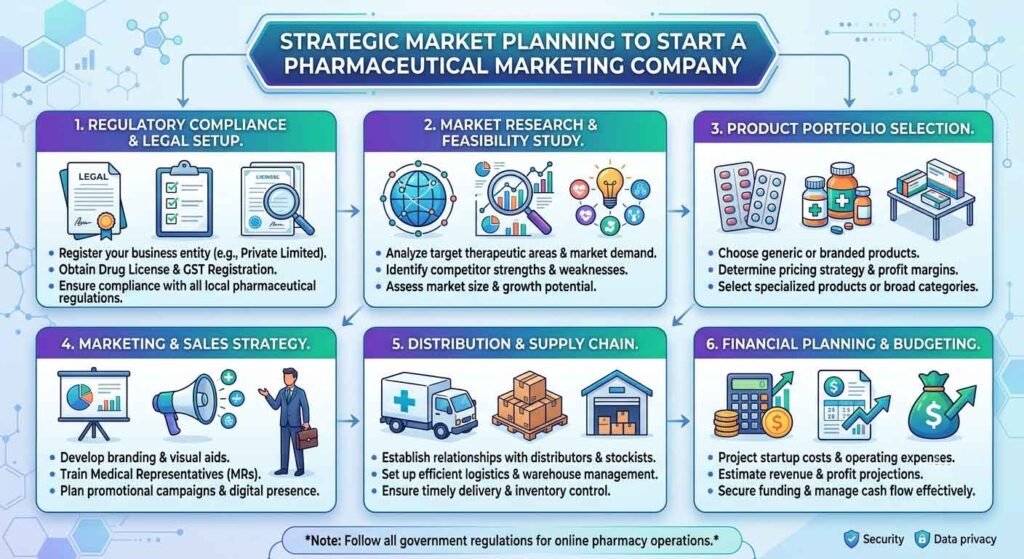
Starting a pharmaceutical marketing company is possible even without previous sales experience, particularly for pharmacy graduates who already understand formulations, pharmacology, quality and regulatory concepts.
However, technical qualifications alone do not guarantee commercial success.
A new pharmaceutical marketing company must understand:
Market demand
Product selection
Doctor segmentation
Distribution
Pricing
Medical-representative management
Cash flow
Inventory
Ethical promotion
Competitive positioning
A common query is:
“We are pharmacy postgraduates and want to start a small pharmaceutical marketing firm. We have no practical marketing experience and are confused about product selection, margins, schemes, MR appointment and competition from large and small companies. How should we start?”
The best approach is not to launch a large product range immediately.
Start with a small, focused territory, a clearly defined doctor segment, a limited product list and a measurable 90-day market plan.
Is the Pharmaceutical Market Too Competitive for a New Company?
The pharmaceutical market is competitive, but it is not closed to new companies.
New companies continue to enter because demand is spread across:
Different therapeutic segments
Different specialties
Different cities and rural areas
Different price levels
Hospital and retail channels
Branded, generic and franchise models
Pharma, nutraceutical and Ayurvedic categories
A small company does not need to compete with every large pharmaceutical company.
It needs to build a strong position in:
One defined territory
One or two doctor segments
A focused product range
A reliable distribution network
A clear brand promise
Competition becomes difficult when a company tries to launch everywhere, promote everything and compete only through discounts.
How Do Large Pharma Companies Survive with Normal Retail Margins?
Large pharmaceutical companies do not depend only on retailer margin.
Their strengths may include:
Strong prescription generation
Established brands
Large field force
Doctor confidence
Product quality consistency
Wide distribution
Regular product availability
Scientific promotional material
Multiple therapeutic divisions
Institutional sales
OTC and consumer-health portfolios
Higher production volumes
Better working-capital systems
When a product has strong demand, retailers usually stock it even if the margin is not unusually high.
A small company should learn an important lesson from this:
Demand generation and product availability are more sustainable than excessive margin.
Should a New Company Offer Very High Margins?
High margin may attract some retailers and distributors, but margin alone does not create long-term demand.
A high-margin product can still fail if:
Doctors do not prescribe it
Patients do not ask for it
The product is unavailable
Packaging is poor
Quality is inconsistent
The price appears unrealistic
There is no repeat demand
The company gives excessive credit
Unusually high margins may also make doctors, retailers or distributors question the product’s price structure or credibility.
Your pricing should be:
Competitive
Commercially sustainable
Consistent with product quality
Suitable for the market segment
Compliant with price-control requirements
Capable of supporting distributor and retailer margins
Capable of covering your field and administrative costs
What Should a New Pharma Company Compete On?
A new company can compete through one or more of these strategies:
1. Focused Product Selection
Choose products according to local demand rather than copying a national company’s complete list.
2. Better Availability
A regularly available average-selling product is more valuable than an excellent product that remains out of stock.
3. Strong Service
Provide:
Fast delivery
Quick complaint response
Clear billing
Replacement support
Accurate information
Regular follow-up
4. Differentiated Products
A differentiated product may have:
Better dosage convenience
Better packaging
A relevant formulation
Suitable pack size
Improved patient acceptability
A clearly defined therapeutic position
Differentiation should be real and supportable, not based on exaggerated claims.
5. Territory Focus
Covering 100 suitable doctors in one territory is often better than claiming presence across an entire state without consistent follow-up.
6. Scientific Promotion
Pharmacy-qualified promoters can use their technical knowledge to explain compositions responsibly and answer legitimate product questions.
7. Consistency
Doctors and retailers value companies that remain active for years, not those that disappear after a few months.
Step-by-Step Market Planning
Step 1: Decide Your Marketing Model
Before selecting products, decide how you will sell.
The main models include:
Ethical or Prescription Marketing
Your company appoints MRs who visit healthcare professionals and generate prescriptions.
PCD or Franchise Marketing
You appoint territory-wise franchise partners who handle local promotion and distribution.
Generic Marketing
Products are marketed mainly through distributors, wholesalers, hospitals or institutions, often with stronger price competition.
Institutional Marketing
Products are supplied to:
Hospitals
Nursing homes
Clinics
Government institutions
Corporate healthcare buyers
Hybrid Model
You may operate:
Ethical marketing in your home territory
PCD franchise in distant territories
Institutional supply for selected products
For beginners, one primary model should be selected first.
Step 2: Select a Small Launch Territory
Do not begin with an entire state.
Select:
One city
One district
One headquarters with nearby towns
One manageable doctor network
Your territory should allow you to personally monitor:
Doctor visits
Chemist availability
Stockist service
MR activity
Sales conversion
Payments
You can expand after proving the model.
Step 3: Map the Market
Prepare a complete list of:
Doctors
Clinics
Hospitals
Nursing homes
Pharmacies
Wholesalers
Stockists
Diagnostic centres
Competitor companies
Existing MRs
For each doctor, record:
Name
Qualification
Specialty
Location
Visiting hours
Approximate patient flow
Relevant product categories
Nearby chemists
Existing company coverage
Target only healthcare professionals whose lawful scope of practice matches the category of products being promoted. State-specific professional and prescribing rules should be checked.
Step 4: Conduct Prescription and Retail Research
Study the market for at least two to four weeks.
Observe:
Frequently prescribed molecules
Leading brands
Common strengths
Pack sizes
MRP
Retail availability
Competitor schemes
Prescription frequency
Seasonal demand
Shortage products
Patient affordability
Do not obtain or use confidential patient information.
The purpose of research is to understand general market trends.
Step 5: Select the Doctor Segment
A new company should preferably start with one or two segments.
Possible choices include:
General physician
Orthopedic
Gynecology
Pediatric
ENT
Dermatology
Dental
Gastro
Neuro-support
General nutraceutical range
For example, an orthopedic-focused division may contain:
Pain-management products
Muscle-relaxant products
Calcium
Vitamin D3
Neuropathy-support products
Joint-support nutraceuticals
Topical pain products
A focused range makes MR training and doctor communication easier.
Step 6: Choose the Initial Products
A new ethical-marketing company usually does not need 100 products.
A practical initial range may contain:
15 to 25 core products for a narrow segment
25 to 40 products for a broader general division
Additional products only after demand becomes visible
Use three categories:
A. Fast-Moving Products
These provide regular turnover.
B. Margin-Supporting Products
These help cover field and promotional costs.
C. Differentiated Products
These give the company a reason to be noticed.
A possible portfolio mix is:
50% established demand products
30% value-added or supportive products
20% differentiated or specialty products
This is a planning model, not a compulsory formula.
Step 7: Verify Every Product Before Finalization
Check:
Whether the molecule or combination is permitted
Whether the manufacturer has product permission
Schedule status
Prescription requirements
Label warnings
Price-control applicability
Shelf life
Stability
Packaging
Market demand
Manufacturing MOQ
Testing documentation
Do not launch a product only because a third-party manufacturer offers it at a low rate.
Step 8: Select a Reliable Manufacturer
Your marketing plan will fail if the manufacturer cannot provide regular stock.
Evaluate:
Manufacturing licence
GMP compliance
Product permissions
Quality-control system
COA availability
Delivery timeline
Minimum batch
Packaging quality
Stability support
Defective-batch policy
Complaint response
Market reputation
Begin with smaller quantities wherever commercially possible.
Step 9: Develop a Realistic Pricing Structure
Calculate product economics from the bottom upward.
A product with high MRP may still provide poor contribution if discounts and expenses are excessive.
Step 10: Fix a Monthly Break-Even Target
Before hiring anyone, calculate:
Total monthly fixed expenses
Average product contribution
Required monthly sales
Example:
If monthly fixed expenses are ₹1,20,000 and the average contribution after product and channel cost is 25%, then approximate sales required to cover fixed expenses would be:
₹1,20,000 ÷ 25% = ₹4,80,000
This is a simplified planning calculation. Actual taxation, credit, returns, expiry and collection timing should also be considered.
Step 11: Decide Whether to Appoint an MR
The founders should initially spend time in the market even if they intend to appoint MRs.
This helps them understand:
Doctor behaviour
Call timing
Product objections
Chemist expectations
Competitor activity
Stock movement
Conversion time
Real territory potential
Start Without MR When:
Budget is limited
Territory is small
Founders are available full-time
Product range is still being tested
Market knowledge is low
Appoint MR When:
Territory has been mapped
Products and promotional messages are ready
Stockist availability is confirmed
Salary can be funded for at least six months
Founders can train and supervise the MR
A realistic sales target has been calculated
Hiring an MR without a system usually increases expense without creating sustainable sales.
Step 12: Create an MR Compensation Plan
The package may include:
Fixed salary
Travel allowance
Daily allowance
Mobile or reporting support
Performance incentive
Statutory benefits where applicable
Targets should be based on:
Territory potential
Doctor coverage
Number of working days
Product availability
Expected conversion cycle
Collection quality
Do not set unrealistic targets merely to reduce salary liability.
Step 13: Train the MR Properly
MR training should cover:
Company profile
Product composition
Approved indication
Dosage and administration
Contraindications
Precautions
Adverse reactions
Product positioning
Competitor understanding
Ethical promotion
Call planning
Chemist follow-up
Daily reporting
Promotional material for prescribers should include adequate product and safety information.
Step 14: Build a Stockist and Retail Network
Before generating prescriptions, ensure products are available.
Your supply structure may include:
Company → Distributor/Stockist → Retailer → Patient
Select a stockist who has:
Valid licence
Good retailer network
Reliable delivery
Proper storage
Billing discipline
Reasonable credit terms
Product reporting capability
Provide stock only according to realistic movement.
Step 15: Ensure Chemist Availability Near Target Doctors
For each target doctor, identify two or three nearby chemists.
Before sustained doctor promotion:
Introduce the products
Explain availability
Confirm supply route
Share stockist details
Monitor stock
Replace damaged products according to policy
A prescription that cannot be filled may not be repeated.
Step 16: Prepare Promotional Material
Useful materials include:
Visual aid
Product card
Scientific literature
Product monograph
MR detailing guide
Digital catalogue
Sample-accountability records
Approved presentation
Corporate profile
All product information should be:
Accurate
Balanced
Current
Verifiable
Consistent with approval
Free from misleading comparisons
Do not use healthcare-professional names or photographs in promotional material without ensuring legal and ethical compliance.
Step 17: Build Ethical Promotion into the Business Model
Do not budget for:
Cash payments to doctors
Personal gifts
Family benefits
Holiday travel
Paid vacations
Expensive hospitality
Unrelated personal expenses
Payment for access to doctors
Instead, invest in:
Product quality
MR training
Scientific literature
Availability
Professional education within permitted frameworks
Pharmacovigilance
Complaint handling
Patient-support information
Reliable service
Ethical promotion may appear slower, but it creates a safer and more durable business.
Step 18: Launch Only After Supply Is Ready
Before the first field call, confirm:
Finished stock is available
COA has been received
Invoices and billing systems are ready
Stockist is appointed
Retail supply route is active
Promotional material is approved
MR is trained
Price list is final
Complaint contact is active
Reorder timeline is known
Do not create demand for products that cannot be supplied.
A 90-Day Pharma Market Launch Plan
Days 1–30: Research and Preparation
Complete:
Territory mapping
Doctor classification
Chemist survey
Competitor analysis
Product selection
Manufacturer verification
Costing
Brand-name checking
Stockist discussion
Promotional-material preparation
Do not focus on sales during this phase. Focus on readiness.
Days 31–60: Controlled Launch
Start with:
20 to 30 priority doctors
20 to 40 relevant chemists
One reliable stockist
Five to ten priority products
Founder-led fieldwork or one trained MR
Track every call and response.
Days 61–90: Review and Expansion
Review:
Doctor response
Product enquiries
Chemist movement
Stockist orders
Prescription conversion
Product availability
MR productivity
Expense against sales
Collection cycle
Then decide:
Which products to continue
Which products to stop
Which doctors need more follow-up
Whether to hire another MR
Whether to add products
Whether to expand territory
Suggested Doctor Classification
A-Class Doctors
Strong potential
Relevant specialty
Regular patient flow
Good conversion possibility
Visit according to a planned, reasonable frequency.
B-Class Doctors
Moderate potential
Developing relationship
Limited initial response
Follow up consistently without excessive calls.
C-Class Doctors
Low immediate potential
New practice
Distant location
Mismatch with current range
Cover less frequently and reassess later.
Classification should be based on business relevance, not on unethical benefit expectations.
Key Performance Indicators
Track more than total sales.
Useful monthly indicators include:
Doctor calls completed
Product-wise doctor response
New prescribers
Repeat prescribers
Chemist availability
Stockist orders
Product-wise sales
Collection period
Expiry risk
Promotional cost
MR cost
Sales per MR
Contribution per product
Out-of-stock days
Customer complaints
What gets measured can be improved.
Cash-Flow Planning
A profitable company can still fail because of poor cash flow.
Plan for:
Manufacturing advance
Packing-material payment
Credit to stockists
Retail schemes
MR salary
Travel
Office expenses
Taxes
Product returns
Expiry
Reorders
Maintain a minimum working-capital reserve for several months.
Avoid using all available funds for the first inventory order.
Product Selection Mistakes
Avoid:
Launching 100 products initially
Copying a competitor’s complete list
Selecting only high-margin products
Selecting only antibiotics
Launching unverified combinations
Ignoring DPCO or ceiling prices
Choosing excessive MOQ
Using unrealistic MRP
Ignoring shelf life
Promoting products without stock
Selecting products unrelated to target doctors
Marketing Mistakes
Avoid:
Hiring too many MRs before testing the territory
Giving uncontrolled credit
Competing only through price
Ignoring retailer availability
Making unsupported superiority claims
Using gifts or inducements
Changing products frequently
Expanding too quickly
Failing to train MRs
Not maintaining records
Depending entirely on one doctor
Expecting immediate prescriptions
How Can a Small Company Compete with a Large Company?
A small company has some advantages:
Faster decision-making
Closer customer relationships
Flexible product selection
Better local service
Direct founder involvement
Quick complaint response
Territory specialization
Use these advantages.
Do not imitate the cost structure of a multinational company.
A small company can win a local market through:
Ten reliable products
Fifty well-covered doctors
Strong availability
Professional detailing
Consistent service
Controlled expenses
Should You First Gain Experience?
Practical experience is valuable, but it does not always require postponing the business for years.
Possible approaches include:
Work with an established company for six to twelve months
Hire an experienced sales manager
Start in one small territory under founder supervision
Work with an experienced consultant
Take a PCD franchise before launching a full company
Conduct a pilot launch with limited products
For pharmacy postgraduates, a controlled pilot can combine learning with business development.
Recommended Beginner Strategy
For a small company with limited marketing experience:
Select one city or district.
Target one or two doctor specialties.
Launch 15 to 25 products.
Personally work in the market for the first few months.
Appoint one MR only after preparing a proper system.
Use one reliable stockist.
Monitor chemist availability.
Avoid excessive credit.
Follow ethical promotion.
Expand only after achieving repeat orders.
Frequently Asked Questions
How many products should a new pharma marketing company launch?
A focused range of approximately 15 to 25 products may be suitable for a narrow therapeutic segment. A general division may begin with around 25 to 40 products, depending on budget and market research.
Should we appoint an MR from the first day?
Not necessarily. Founders should first understand the territory. Appoint an MR when the product range, stockist, training material, supervision system and six-month salary budget are ready.
How can a new company compete with large pharma companies?
Compete through focused products, regular availability, local service, scientific promotion, faster response and stronger territory management rather than only through discounts.
Should retailers be given very high margins?
Retailer margin should be competitive and commercially sustainable. Excessive margin without prescription demand does not guarantee repeat sales.
Can we offer commissions to doctors?
The business should not be built on cash commissions, gifts, travel, hospitality or personal benefits. Follow current ethical pharmaceutical-marketing requirements.
Which doctors should a new company target?
Select doctors according to product category, specialty, territory and lawful scope of practice. Do not promote every product to every practitioner.
How long does a pharma brand take to establish?
It varies by territory and product. Consistent prescriptions and repeat sales often require several months or longer. A company should maintain enough working capital for the development period.
Is it better to launch common or innovative products?
Use a balance. Common products support turnover, while differentiated products create identity. Every product should have real demand and proper permission.
Should we start through PCD or prescription marketing?
PCD requires less direct field-force management, while prescription marketing gives more control but needs MR investment and supervision. Choose according to your budget and capabilities.
What is the most important factor in a pharma launch?
There is no single factor, but product-market fit, regular availability, ethical promotion, distribution and cash-flow control are essential.
Final Thoughts
Starting a pharmaceutical marketing company requires more than selecting products and appointing MRs.
You need a complete system covering:
Market research
Product selection
Pricing
Distribution
Availability
MR management
Ethical promotion
Cash flow
Performance review
Do not try to compete with the largest company on its own scale.
Build one territory successfully first.
A small company with focused products, disciplined market work, good quality and regular supply can gradually build a strong pharmaceutical brand.
Looking for Ayurvedic Franchise or Distribution Opportunities?
Looking to start an Ayurvedic franchise, become a distributor, or launch your own herbal product range?
Elzac Herbal India offers:
Ayurvedic & Herbal Product Range
Franchise & Distribution Opportunities
Third-Party Manufacturing Services
Product Development Support
Marketing Guidance
PAN India Business Opportunities
Whether you are an entrepreneur, retailer, distributor, or healthcare professional, our team can help you explore the right business opportunity in the growing Ayurvedic sector.
Ajay Kamboj is an entrepreneur and business owners associated with many Ayurvedic and Pharmaceutical start-ups. With years of experience in Ayurvedic product marketing, pharmaceutical distribution, franchise development, and client relationship management, he regularly shares practical business insights based on real-world experiences. His articles focus on business growth, entrepreneurship, customer management, and lessons learned from the healthcare and wellness industry.





Leave a Reply
You must be logged in to post a comment.