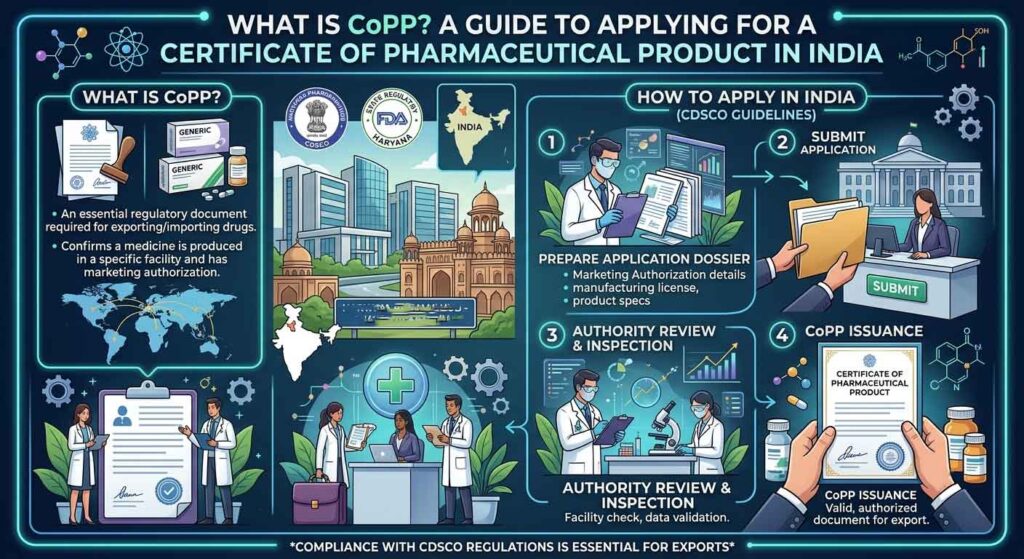
A Certificate of Pharmaceutical Product, commonly called a CPP or CoPP, is an important regulatory document used for the international registration and export of pharmaceutical products.
Foreign drug regulatory authorities may ask an Indian manufacturer or marketing-authorisation holder to submit a CoPP while:
Registering a medicine
Renewing a product registration
Participating in an international tender
Adding a manufacturing site
Changing product information
Applying for an import authorisation
Demonstrating the regulatory and GMP status of a product
The certificate is issued by the competent regulatory authority of the exporting country in the format recommended by the World Health Organization.
WHO created the Certification Scheme to help participating countries obtain reliable information about pharmaceutical products moving in international commerce. The CPP is the principal document under this voluntary international scheme.
Quick Answer
In India, a licensed pharmaceutical manufacturer generally applies for WHO-GMP and CoPP through the ONDLS portal.
Before submitting the application, the manufacturer should ensure that:
The manufacturing site is registered on ONDLS.
Its manufacturing licence is uploaded and verified.
Approved technical staff are mapped to the licence.
Licensed product details are uploaded.
The State Drug Regulatory Authority has approved the licence and product data.
Product permissions are current.
The manufacturing facility complies with applicable GMP requirements.
Product-specific technical documents are available.
Stability, process-validation and quality-review documents are complete.
The application is examined by the concerned regulatory authorities. An inspection may be conducted or relied upon according to the current inspection status and regulatory assessment. Deficiencies must be resolved before the certificate is issued.
What Does CoPP Mean?
CoPP stands for Certificate of a Pharmaceutical Product.
The abbreviations used include:
CPP
CoPP
COPP
All generally refer to the same product certificate issued under the WHO Certification Scheme.
The WHO model uses the expression:
Certificate of a Pharmaceutical Product
It is not technically correct to expand CoPP as “Certificate of Pharmaceutical Products” because a CPP is normally prepared for one specific product.
What Information Does a CoPP Contain?
The WHO model CPP may contain information such as:
Certificate number
Exporting country
Importing or requesting country
Product name
Dosage form
Active ingredients
Strength
Complete composition or attached formula
Product-licence status
Marketing status in the exporting country
Product-licence number
Product-licence holder
Manufacturer’s name and address
Applicant’s name and address
GMP inspection status
Frequency of regulatory inspection
Confirmation regarding GMP compliance
Details of authorized product information
Certifying authority
Signature or secure electronic authentication
Issue date
The certificate establishes the regulatory status of the product and its manufacturing arrangements in the exporting country.
Does WHO Issue the CoPP?
No.
WHO recommends:
The certification scheme
The certificate format
Explanatory notes
Implementation principles
The actual certificate is issued by the competent national or regional regulatory authority of the exporting country.
In India, CDSCO and the concerned Central and State regulatory offices participate in the WHO-GMP and CoPP process.
A company should not claim that its certificate was “issued by WHO” merely because it follows a WHO-recommended format.
A more accurate statement is:
Certificate of Pharmaceutical Product issued by the competent Indian regulatory authority in the format recommended by WHO.
Purpose of a CoPP
The main purpose of a CoPP is to provide an importing-country regulator with reliable information about:
Whether the product is authorised in the exporting country
Whether it is actually marketed there
Who holds the product permission
Who manufactures the dosage form
Whether the manufacturing site is inspected
Whether the site complies with applicable GMP requirements
Whether the submitted product information agrees with the authorised information
WHO explains that the CPP may be used when a product is being considered for marketing authorisation and when an existing authorisation is being renewed, extended, modified or reviewed.
Is CoPP Compulsory for Every Pharmaceutical Export?
Not necessarily.
A CoPP is required when:
The importing-country authority asks for it.
It is listed in the destination-country registration dossier.
It is required for an international tender.
The overseas buyer requests it.
The foreign regulator requires proof of product and GMP status.
Some countries may instead or additionally request:
Free Sale Certificate
WHO-GMP certificate
Market Standing Certificate
Manufacturing licence
Product permission
Certificate of Analysis
Batch certificate
Certificate of Pharmaceutical Product
Legalised or apostilled documents
Certificate of Pharmaceutical Product issued directly to the authority
Written Confirmation for APIs exported to the European Union
The required documents should be confirmed before filing the export dossier.
CoPP vs WHO-GMP Certificate
CoPP and WHO-GMP certification are closely connected, but they are not identical.
Point
CoPP
WHO-GMP certificate
Main subject
A specific pharmaceutical product
Manufacturing site and approved operations
Main purpose
Product registration and international commerce
Confirmation of GMP compliance
Product details
Yes
May list dosage forms or sections
Market-authorisation status
Yes
Normally not its primary purpose
Manufacturing-site details
Yes
Yes
Importing country
Normally identified
May not be product-country specific
Scope
Product specific
Site or manufacturing-section specific
WHO format
Model CPP format
GMP certification format followed by authority
Issuing authority
Competent regulatory authority
Competent regulatory authority
A manufacturer may receive WHO-GMP certification for its approved facility and separate CoPPs for individual products.
CoPP vs Free Sale Certificate
CoPP
Free Sale Certificate
Provides detailed product and GMP information
Primarily confirms lawful sale or marketability
Based on WHO-recommended certification format
Format depends on issuing authority
Identifies manufacturing and product-licence status
Usually provides less detailed GMP information
Used in pharmaceutical registration
Used for export or market-status confirmation
Normally product specific
May cover one or more products depending on authority
A Free Sale Certificate does not automatically replace a CoPP.
CoPP vs Market Standing Certificate
A Market Standing Certificate generally confirms matters such as:
Product has been licensed.
Product has been marketed for a stated period.
Manufacturing licence remains valid.
Regulatory record or market history, as applicable.
A CoPP provides broader information about product authorisation, manufacturing and GMP status.
CoPP vs Batch Certificate
A CoPP relates to the regulatory and manufacturing status of a product.
A batch certificate relates to a particular manufactured batch or consignment and may include:
Batch number
Manufacturing date
Expiry date
Release specifications
Test results
Confirmation of batch compliance
WHO identifies the batch certificate as a separate document under the Certification Scheme. It is normally issued by the manufacturer and relates to an individual batch.
Who Can Apply for CoPP in India?
The application is generally made by:
Licensed pharmaceutical manufacturer
Marketing-authorisation or product-permission holder
Authorised applicant acting with the consent of the licence holder
Manufacturer producing an export-only licensed product
Loan-licensee, subject to its approved licensing arrangements
Product owner working through an authorised manufacturer, where accepted
The identity and roles of the following parties should be clear:
Applicant
Product-licence holder
Manufacturer
Primary packer
Secondary packer
Testing laboratory
Batch-release site
Marketing company
The WHO model specifically provides for an applicant that may be different from the product-licence holder, but the relationship and manufacturing arrangements must be disclosed.
Can a Pharma Marketing Company Apply?
A pharma marketing company cannot represent itself as the manufacturer merely because its name appears under “Marketed by.”
Where the marketer is different from the manufacturer:
The actual licensed manufacturer must be disclosed.
The product permission should support the product.
A valid manufacturer–marketer or contract arrangement should exist.
The manufacturer’s authorisation may be required.
The authority should be able to verify the complete manufacturing arrangement.
The CoPP may identify:
Product-licence holder
Applicant
Actual dosage-form manufacturer
Other sites involved in manufacturing or packaging
The exact applicant arrangement should be confirmed through ONDLS and the concerned authority before submission.
Can a Third-Party Manufactured Product Obtain CoPP?
Yes, it may be possible when the product and manufacturing arrangements are properly licensed and documented.
The application should clearly identify:
Product owner
Product-permission holder
Manufacturing site
Testing site
Packing site
Batch-release responsibility
Contract or technical agreement
Applicant for the certificate
A third-party manufacturing agreement alone is not sufficient if the product permission, licence or approved manufacturing arrangement does not support the product.
Can a Loan-Licence Product Obtain CoPP?
A loan-licensee may apply subject to:
Valid loan licence
Approved product permission
Valid manufacturing-site licence
Clear technical agreement
GMP status of the manufacturing site
Acceptance of the arrangement by the concerned authority
The certificate should accurately identify the loan-licensee and the physical manufacturing site.
Current Application System in India
CDSCO directed that WHO-GMP and CoPP applications be submitted online through ONDLS.
ONDLS is a single-window platform developed by CDAC with CDSCO and State/UT Drug Regulatory Authorities. It processes manufacturing and sale licences and certificates such as:
CoPP
GMP
WHO-GMP
Market Standing Certificate
Free Sale Certificate
Performance Certificate
Non-Conviction Certificate
The portal currently lists WHO-GMP and Certificate of Pharmaceutical Product as available certificate services.
Physical or Online Application?
Applications should now be submitted through ONDLS.
The initial CDSCO circular instructed manufacturing units to submit WHO-GMP and CoPP applications through ONDLS and stated that physical files would not be accepted after the prescribed transition date. After an extension, CDSCO reiterated that physical submissions would not be accepted after August 15, 2025.
Prerequisites Before Filing the CoPP Application
Before applying, confirm the following.
1. Valid Manufacturing Licence
The manufacturing site should have the applicable licence, such as:
Form 25
Form 28
Form 25A
Form 28A
Form 28D
Form 28DA
Other applicable manufacturing licence
The form depends on the product and manufacturing arrangement.
2. Product Permission
The product should have valid approval or permission from the competent authority.
The product details should match:
Product name
Generic name
Composition
Strength
Dosage form
Manufacturing site
Pack size
Approved label
Shelf life
Storage condition
3. Approved Technical Staff
Production and testing personnel approved on the manufacturing licence should be current and mapped in ONDLS.
4. ONDLS Site Registration
The manufacturing unit must be registered through the portal.
5. Verified Licence Data
Existing licence information should be uploaded and approved by the concerned State Drug Regulatory Authority.
6. Verified Product Data
All products requested for CoPP should be mapped to the approved licence and verified by the State authority.
7. GMP Readiness
The manufacturing unit should comply with:
Applicable Schedule M requirements
Product-specific GMP requirements
Applicable WHO GMP expectations
Licence conditions
Approved manufacturing and testing procedures
CDSCO notified the revised Schedule M through G.S.R. 922(E), dated December 28, 2023, followed by a corrigendum and implementation-related directions.
Preliminary ONDLS Registration Procedure
CDSCO’s annexed online procedure describes the following preliminary steps:
Register the manufacturing site.
Register the technical staff currently endorsed on the licence.
Add licensed products through the old-licence management function.
Add the basic licence data.
Submit the licence data to the concerned State Drug Regulatory Authority.
Obtain State approval of the uploaded licence data.
File the CoPP application after verification.
After State approval, the portal may generate an online number against the existing licence record.
Step-by-Step Procedure to Apply for CoPP
Step 1: Confirm the Importing-Country Requirement
Before filing, obtain a written requirement from:
Foreign regulatory authority
Importer
Overseas agent
Tendering authority
Registration consultant
Confirm:
Whether CoPP is required
Number of original certificates
Required certificate age
Whether a product marketed in India is compulsory
Whether an export-only product is acceptable
Whether legalisation or apostille is required
Whether the certificate must be sent directly by the authority
Whether WHO-GMP certificate is also required
Whether composition and product information should be attached
This prevents applying for the wrong certificate.
Step 2: Register the Corporate Entity on ONDLS
The authorised signatory should register the corporate entity with details such as:
Organisation name
Organisation type
CIN or PAN
Registered address
Authorised-person details
Identity proof
Address proof
Undertaking
ONDLS requires the corporate registration to be completed before the manufacturing unit is linked under it.
Step 3: Register the Manufacturing Site
Register the manufacturing unit and upload:
Unit name
Factory address
Licence number
Manufacturing-licence copy
Authorised-person details
Identity proof
Undertaking
Corporate passcode or linkage information
Uploaded documents should follow the portal’s file-format and size requirements.
Step 4: Add Technical Staff
Add the approved technical persons connected with:
Production
Quality Control
Testing
Section-wise manufacturing
Microbiology, where applicable
The details should agree with the current manufacturing licence.
Step 5: Upload Existing Licence Details
Use the old-licence management function to add:
Licence number
Licence form
Issue date
Retention or validity status
Approved dosage forms
Approved sections
Product list
Technical staff
Submit the information to the State authority for verification.
Step 6: Obtain State Approval
The State Drug Regulatory Authority verifies:
Licence
Site
Technical staff
Product permissions
Approved products
The applicant should resolve any mismatch before filing the certificate application.
Common mismatches include:
Different spelling of company name
Different manufacturing address
Old technical staff
Incorrect composition
Missing product permission
Changed pack size
Different strength
Unapproved brand name
Incomplete licence retention
Step 7: Select WHO-GMP or CoPP Service
After licence and product approval, select the required service from the certificate section.
The portal separately lists:
WHO-GMP
Certificate of Pharmaceutical Product
CoPP/WHO endorsement
Select the correct service according to the overseas requirement.
Step 8: Enter Product-Specific Information
Enter the required product information accurately.
It may include:
Brand name
Generic name
Dosage form
Strength
Complete composition
Product-permission number
Product-permission date
Manufacturing licence
Manufacturing site
Pack size
Shelf life
Storage condition
Importing country
Requesting authority
Marketing status in India
Applicant details
Every entry should match the approved regulatory documents.
Step 9: Upload Supporting Documents
Upload all documents required by:
ONDLS checklist
State Licensing Authority
CDSCO zonal or sub-zonal office
Product category
Importing-country requirement
Do not rely only on an old generic checklist because document requirements may change.
Step 10: Pay the Applicable Fee
Pay the fee generated or prescribed through the current portal and retain:
Payment receipt
Transaction reference
Application number
Submission acknowledgement
The fee may depend on the certificate service and regulatory requirements.
Step 11: Submit the Application
After final checking:
Digitally submit the application.
Download the acknowledgement.
Record the application number.
Monitor the dashboard.
Check regulatory queries regularly.
Respond within the permitted time.
Step 12: Regulatory Scrutiny
The concerned authorities may verify:
Licence status
Product approval
Formula
Manufacturing arrangements
Inspection status
GMP compliance
Stability data
Validation
Labelling
Export requirement
Previous certificate history
The authority may raise an online query where information is incomplete or inconsistent.
Step 13: Inspection
A GMP inspection may be conducted where:
The unit is applying for the first time.
Existing certification has expired.
A new dosage-form section is added.
Significant changes have occurred.
Previous compliance is not satisfactory.
Risk assessment requires inspection.
The latest inspection does not cover the requested scope.
Serious quality or regulatory concerns exist.
The inspection arrangement may involve officers from CDSCO and the State Licensing Authority according to the applicable jurisdiction and procedure.
Step 14: Submit CAPA
Where deficiencies are observed, submit a Corrective and Preventive Action response containing:
Inspection observation
Root-cause analysis
Immediate correction
Corrective action
Preventive action
Responsible person
Completion date
Supporting evidence
Effectiveness check
Avoid giving only statements such as “noted and will comply.”
Step 15: Certificate Issuance
After satisfactory review and compliance, the certificate may be issued electronically through the current regulatory system.
Check the issued certificate for:
Product name
Strength
Dosage form
Composition
Licence number
Licence holder
Manufacturer
Importing country
Manufacturing address
Certificate number
Issue date
Digital signature or authentication
Annexures
Report any discrepancy immediately.
Products Under Licence Consideration
CDSCO issued a circular in September 2025 regarding CoPP applications for products whose licence approval was still under consideration through ONDLS.
Under this updated approach, processing may begin while the product application is pending, but final CoPP or WHO-GMP approval should not be issued until the concerned State Licensing Authority confirms the product approval.
Applicants should not treat the submission of a product-permission application as equivalent to receiving the permission.
Documents Required for CoPP Application
The exact checklist can vary. A practical document package may contain the following.
A. Application and Legal Documents
Online application
Covering letter
ONDLS acknowledgement
Fee receipt
Manufacturing-licence copy
Licence-retention proof
Loan licence, where applicable
Product-permission copies
Constitution documents
Authorised-signatory letter
Manufacturer’s authorisation, where applicable
Contract manufacturing agreement
Technical or quality agreement
Previous WHO-GMP or CoPP certificates
Importing-country request, where available
B. Product-Specific Documents
List of products applied for
Product name
Dosage form
Strength
Complete composition
Approved formula
Product-permission number and date
Approved label
Carton artwork
Package insert
Prescribing information
Patient Information Leaflet, where applicable
Pack sizes
Shelf life
Storage conditions
Manufacturing process
Finished-product specification
Standard testing procedure
Certificate of Analysis
Product summary sheet
WHO recommends submitting information on the marketing authorisation, product name, dosage form, active ingredients, licence holder, manufacturing sites, complete composition, approved product information and packaging.
C. Site Master File
Submit a current Site Master File describing:
General company information
Licensed manufacturing activities
Pharmaceutical Quality System
Quality-risk management
Personnel
Premises
Equipment
Utilities
Documentation
Production
Quality Control
Contract activities
Storage
Distribution
Complaints
Recalls
Self-inspection
Product-quality review
The Site Master File should reflect the current facility and current GMP framework.
D. Technical-Staff Documents
Organisation chart
Production personnel list
Quality Control personnel list
Quality Assurance personnel list
Qualification certificates
Experience records
Regulatory approvals
Appointment letters
Job descriptions
Training records
E. Equipment and Instrument Documents
Section-wise machinery list
Laboratory instrument list
Equipment identification numbers
Qualification status
Calibration status
Preventive-maintenance status
Major equipment specifications
Computerised-system list
F. Water-System Documents
Water-system schematic
Material of construction
Pretreatment system
Purified Water or Water for Injection system
Storage and distribution loop
Sampling points
Qualification status
Sanitisation procedure
Trend data
Chemical and microbiological results
G. HVAC Documents
HVAC schematic
Air-handling unit details
Area classification
Pressure-differential plan
Terminal-filter configuration
Temperature and humidity limits
Qualification status
HEPA integrity testing, where applicable
Environmental-monitoring programme
H. SOP and Specification Lists
Master list of SOPs
Master list of specifications
Master list of testing procedures
Document-control procedure
Change-control procedure
Deviation procedure
CAPA procedure
OOS procedure
Complaint procedure
Recall procedure
Data-integrity procedure
Vendor-qualification procedure
Batch-release procedure
I. Validation Documents
Validation Master Plan
Process-validation reports
Cleaning-validation reports
Analytical-method validation
Analytical-method verification
Hold-time studies
Equipment qualification
HVAC qualification
Water-system qualification
Computerised-system validation
Transport validation, where applicable
Aseptic-process simulations, where applicable
Sterilisation validation, where applicable
J. Stability Documents
Stability protocol
Accelerated stability data
Long-term stability data
Intermediate-condition data, where applicable
Stability summary
Stability commitments
Ongoing stability programme
Stability-chamber qualification
Excursion records
Trend review
The stability data should support the approved:
Shelf life
Container
Pack size
Storage condition
Product formula
Manufacturing process
K. Product Quality Review Documents
Annual Product Quality Review or Product Quality Review
Number of batches manufactured
Number of batches rejected
Deviations
OOS results
Complaints
Recalls
Returns
Stability trends
Process capability
Change controls
CAPA effectiveness
Yield trends
Critical-quality trends
L. Revalidation or Renewal Documents
For renewal, revalidation or repeat certification, the authority may ask for:
Previous certificate
Export data
Countries supplied
Product-wise export quantities
Changes since previous inspection
Previous observations
CAPA status
Product Quality Reviews
Complaints and recalls
Regulatory actions
Updated stability data
Updated validation status
Updated Site Master File
Suggested Product Summary Sheet
A product summary sheet may include:
Field
Information
Product name
Brand and generic name
Composition
Complete active composition
Strength
Per tablet, capsule, ml or dose
Dosage form
Tablet, capsule, injection, syrup etc.
Product permission
Number and date
Manufacturing licence
Form and licence number
Batch history
Batches made during review period
Commercial scale
Batch sizes manufactured
Stability
Accelerated and long-term period completed
Process validation
Completed, ongoing or not applicable
Cleaning validation
Status
Analytical method
Validation or verification status
Reference standards
Availability and validity
Product quality review
Latest period completed
Complaints and recalls
Summary
Previous CoPP
Certificate number and issue date
Suggested Stability Summary Format
General Information
Product name
Strength
Dosage form
Batch number
Batch size
Manufacturing date
Stability initiation date
Pack style
Storage condition
Expiry or proposed shelf life
Test Results
Test
Specification
Initial
3 months
6 months
12 months
18 months
24 months
36 months
Description
Approved limit
Assay
Approved limit
Related substances
Approved limit
Dissolution
Approved limit
Microbial quality
Approved limit
The actual tests and time points should follow the approved stability protocol and product requirements.
What Inspectors Check During WHO-GMP Inspection
Pharmaceutical Quality System
Inspectors may review:
Quality policy
Management responsibilities
Quality-risk management
Change control
Deviations
CAPA
Product-quality review
Management review
Knowledge management
Continual improvement
Personnel
They may check:
Qualifications
Experience
Approved technical staff
Training
Hygiene
Medical examination
Duties and job descriptions
Independence of Quality Control
Premises
Inspection may cover:
Building condition
Material flow
Personnel flow
Cross-contamination control
Warehouses
Production rooms
Laboratories
Change rooms
Pest control
Waste handling
Maintenance
Equipment
Inspectors may assess:
Suitability
Qualification
Calibration
Preventive maintenance
Cleaning
Logbooks
Breakdown history
Computerised controls
Documentation
They may review:
Master formulae
Batch records
Packing records
SOPs
Specifications
Testing procedures
Raw data
Audit trails
Corrections
Document control
Record retention
Production
Production review may cover:
Dispensing
Line clearance
In-process controls
Reconciliation
Yield
Hold times
Process validation
Cleaning validation
Prevention of mix-ups
Prevention of contamination
Quality Control
Quality Control inspection may cover:
Sampling
Raw-material testing
Finished-product testing
Reference standards
Reagents
OOS investigations
Method validation
Stability
Data integrity
Retained samples
Complaints and Recalls
Inspectors may review:
Complaint investigations
Adverse-quality trends
Recall procedure
Mock recall
Distribution traceability
Returned products
Regulatory reporting
WHO GMP principles require licensed products to be manufactured by licensed manufacturers whose activities are regularly inspected by competent authorities.
Common Reasons for CoPP Delay
Applications may be delayed because of:
Licence data not mapped on ONDLS
State approval pending
Product missing from licence
Incorrect product composition
Different product name in documents
Expired manufacturing permission
Technical staff mismatch
Incomplete Site Master File
Missing stability data
Incomplete process validation
Unresolved inspection observations
Weak CAPA
Missing approved artwork
Different manufacturing addresses
Incorrect importing-country details
Unpaid fee
Delayed response to an online query
Common Reasons for Rejection
An application may be rejected or returned when:
The product is not approved.
The manufacturing licence does not cover the dosage form.
The applicant cannot establish authority over the product.
The certificate request does not match the actual manufacturing arrangement.
Required technical documents are absent.
The applicant fails to respond to regulatory queries.
Validity of CoPP
The WHO model CPP records the issue date and current regulatory status of the product. It does not establish one universal validity period for every country.
Check:
Validity shown on the issued certificate
WHO-GMP certificate validity
ONDLS record
Importing-country requirement
Tender requirement
Whether changes have occurred since issuance
Whether the product licence remains valid
Whether the manufacturing site remains GMP compliant
A foreign regulator may ask for a recently issued CoPP even when an older certificate has not been formally cancelled.
When Should a Fresh CoPP Be Obtained?
A fresh certificate may be needed when:
Importing country changes
Product name changes
Composition changes
Strength changes
Dosage form changes
Manufacturing site changes
Product-licence holder changes
Manufacturing arrangement changes
Major packaging information changes
Certificate becomes too old for the destination country
Existing certificate expires
Foreign authority asks for a newly issued certificate
How Much Time Does CoPP Approval Take?
There is no single guaranteed timeline.
The processing time depends on:
ONDLS data verification
Completeness of documents
Inspection requirement
Inspection scheduling
Number and seriousness of deficiencies
CAPA response
State and CDSCO coordination
Product-permission status
Regulatory workload
WHO recommends that certifying authorities aim to issue a certificate ideally within 30 working days after sufficient documents are submitted, but this is an international recommendation and not a guaranteed Indian processing period.
Does CoPP Guarantee Product Registration Abroad?
No.
A CoPP supports the overseas registration application, but the foreign authority may still review:
Product dossier
Formula
Specifications
Stability
Bioequivalence
Clinical information
Labels
GMP documents
Pharmacovigilance
Local agent
Samples
Registration fee
The importing country makes the final registration decision.
Can a Product Not Marketed in India Obtain CoPP?
The WHO model certificate provides for situations where:
A product is authorised and marketed.
A product is authorised but not actually marketed.
Marketing authorisation is absent for a stated reason.
The certificate may record whether authorisation was:
Not required
Not requested
Under consideration
Refused
However, Indian issuance depends on valid product permissions, export status and the concerned regulatory authority’s assessment. The destination country must also accept that status.
CoPP for Export-Only Products
Export-only products may require:
Valid manufacturing permission
Export NOC or approval, where applicable
Importing-country formula or specification
Justification where the product is not marketed domestically
Approved manufacturing site
Product testing
GMP compliance
Destination-country acceptance
Do not manufacture an unapproved export product merely on the basis of a foreign purchase order.
CoPP for Ayurvedic Products
CDSCO continues to publish details of Ayurvedic products granted CoPP under the WHO-GMP Certification Scheme, including an updated list dated April 15, 2026.
However, the documentation and inspection process for Ayurvedic, Siddha and Unani products may differ from conventional allopathic pharmaceuticals.
Applicants may need documents such as:
AYUSH manufacturing licence
Product approval
Formula
Classical reference or proprietary status
GMP certificate
Raw-material controls
Finished-product specifications
Stability or shelf-life support
Testing methods
Product labels
Site Master File
Export details
Use the latest applicable CDSCO and AYUSH checklist.
Is CoPP Available for Nutraceuticals?
Ordinary FSSAI-regulated nutraceuticals are food products rather than pharmaceutical products.
A pharmaceutical CoPP should not automatically be expected for:
Health supplements
Nutraceuticals
Food for special dietary use
Foods for special medical purpose
Functional foods
The exporter may instead need documents such as:
FSSAI licence
Free Sale Certificate
Health Certificate
Certificate of Analysis
Country-of-origin certificate
Manufacturer declaration
Product registration documents required by the destination country
Product classification should be confirmed before applying.
Is CoPP Available for Medical Devices?
Medical devices are regulated under a separate framework.
A device exporter may need:
Free Sale Certificate
Market Standing Certificate
Manufacturing licence
ISO 13485 certificate
Certificate to Foreign Government
Product registration documents
Do not use the pharmaceutical CoPP process automatically for a medical device.
Practical CoPP Application Checklist
Before submission, confirm:
Manufacturing site registered on ONDLS
Corporate registration completed
Valid manufacturing licence uploaded
Licence data approved by State authority
Technical staff mapped
Product permission uploaded
Product mapped to licence
Importing country confirmed
Product name checked
Composition checked
Strength checked
Dosage form checked
Pack details checked
Approved artwork available
Site Master File updated
Stability data updated
Process validation completed
Cleaning validation completed
Analytical methods validated or verified
Product Quality Review completed
Water and HVAC documents updated
Inspection CAPA closed
Fee paid
Covering letter prepared
Manufacturer authorisation available
Application reviewed before submission
Common Mistakes to Avoid
Avoid these mistakes:
Saying WHO directly issued the certificate
Calling it Certificate of Pharmaceutical Products
Assuming one certificate covers every product
Applying before ONDLS licence verification
Applying for an unapproved product
Using an outdated Site Master File
Submitting three-batch validation data copied from another product
Showing a marketer as the manufacturer
Ignoring third-party manufacturing arrangements
Using different compositions in different documents
Assuming universal three-year validity
Applying for the wrong importing country
Ignoring foreign regulator requirements
Submitting expired stability data
Giving incomplete CAPA
Continuing to send only physical files
Treating CoPP as guaranteed foreign registration
Final Answer
A CoPP is a Certificate of a Pharmaceutical Product issued by the competent regulatory authority of an exporting country in the format recommended by WHO.
It provides information about:
Product authorisation
Marketing status
Licence holder
Manufacturer
Manufacturing site
GMP inspection
Approved product information
In India, WHO-GMP and CoPP applications are now processed through the ONDLS portal.
The main steps are:
Register the corporate entity and manufacturing site.
Upload the manufacturing licence.
Register approved technical staff.
Upload licensed products.
Obtain State authority verification.
Select the CoPP or WHO-GMP service.
Upload product and GMP documents.
Pay the required fee.
Complete regulatory scrutiny and inspection.
Resolve observations through CAPA.
Download or receive the approved certificate.
A CoPP is product specific and should not be confused with a WHO-GMP certificate, Free Sale Certificate, Market Standing Certificate or batch certificate.
The validity or acceptance period should be taken from the issued certificate and the importing-country requirements rather than relying on a universal three-year statement.
Frequently Asked Questions
1. What is the full form of CoPP?
CoPP stands for Certificate of a Pharmaceutical Product.
2. Is CPP different from CoPP?
No. Both abbreviations are commonly used for the Certificate of a Pharmaceutical Product.
3. Does WHO issue CoPP?
No. The competent national regulatory authority issues it in the format recommended by WHO.
4. Who issues CoPP in India?
The certificate is processed through the Indian drug-regulatory system involving CDSCO and the concerned regulatory authorities.
5. Where is the application submitted?
Applications are currently submitted online through ONDLS.
6. Are physical applications accepted?
CDSCO stopped accepting physical WHO-GMP and CoPP applications after the transition to the ONDLS system.
7. Is CoPP issued for the entire factory?
No. CoPP is product specific. WHO-GMP certification mainly relates to the manufacturing site and approved activities.
8. Can one CoPP contain many products?
The WHO model CPP is intended for a single product. Multiple product requests may be processed administratively, but product-specific certificates or entries are required according to the authority’s process.
9. Is CoPP compulsory for exports?
Only when required by the importing authority, buyer, tender or destination-country registration process.
10. Is CoPP valid for three years?
Do not assume a universal three-year validity. Check the issued certificate and destination-country requirement.
11. Can a marketed-by company apply?
It may apply only under an accepted and documented arrangement. The actual licensed manufacturer and product-permission holder must be correctly identified.
12. Can third-party manufactured products obtain CoPP?
Yes, where the product permission, contract arrangement, manufacturing site and GMP status are properly documented and accepted.
13. Is WHO-GMP compulsory for CoPP?
The CPP records whether the manufacturing facilities comply with applicable GMP requirements. Therefore, satisfactory GMP status is fundamental to the certification process.
14. Can an export-only product receive CoPP?
It may be possible where the product has valid permission and the certificate accurately explains its domestic marketing status.
15. Does CoPP guarantee registration in another country?
No. The importing authority makes the final decision after reviewing the complete product dossier.
Looking for Ayurvedic Franchise or Distribution Opportunities?
Looking to start an Ayurvedic franchise, become a distributor, or launch your own herbal product range?
Elzac Herbal India offers:
Ayurvedic & Herbal Product Range
Franchise & Distribution Opportunities
Third-Party Manufacturing
Product Development Support
Marketing Guidance
PAN India Business Opportunities
Whether you are an entrepreneur, retailer, distributor, or healthcare professional, our team can help you explore the right business opportunity in the growing Ayurvedic sector.
Ajay Kamboj is an entrepreneur and business owners associated with many Ayurvedic and Pharmaceutical start-ups. With years of experience in Ayurvedic product marketing, pharmaceutical distribution, franchise development, and client relationship management, he regularly shares practical business insights based on real-world experiences. His articles focus on business growth, entrepreneurship, customer management, and lessons learned from the healthcare and wellness industry.



Leave a Reply
You must be logged in to post a comment.