Profit Margin in the Pharmaceutical Industry: From Manufacturer to Retailer
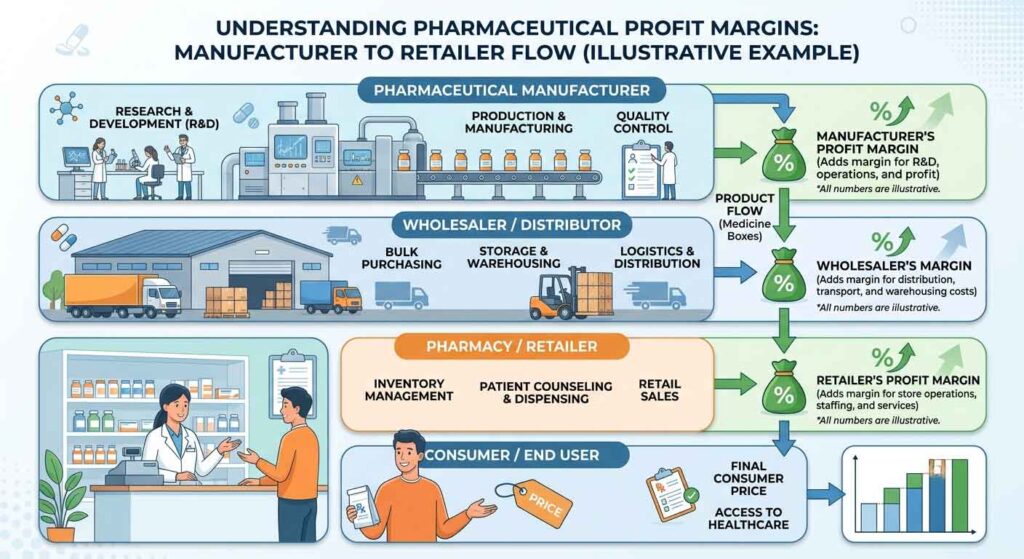
Profit margin in the pharmaceutical industry varies at every level of the distribution chain.
A manufacturer, marketing company, C&F agent, stockist, distributor and retail pharmacy do not earn profit in the same way.
A common query is:
“What is the profit margin in the complete pharmaceutical distribution cycle, from manufacturer to retailer?”
The practical answer is:
There is no single fixed pharmaceutical profit margin. Each participant earns a different gross margin, service fee or trading spread, and its final net profit depends on operating expenses, credit, expiry, returns, promotion and sales volume.
A large difference between MRP and purchase price should never automatically be described as profit.
Pharmaceutical Distribution Chain
A commonly used distribution channel is:
Manufacturer → Marketing company → C&F agent → Stockist or distributor → Retail pharmacy → Consumer
Every product does not pass through every level.
Alternative structures include:
Manufacturer → Distributor → Retailer
Manufacturer → Marketing company → Retailer
Manufacturer → Hospital
Manufacturer → C&F → Super stockist → Distributor → Retailer
The final commercial arrangement depends on:
Product category
Company business model
Territory
Sales volume
Order frequency
Credit structure
Distribution cost
Price-control status
Important Terms Before Calculating Profit
The terms margin, markup, discount and profit are frequently used interchangeably, but they have different meanings.
1. Gross Profit
Gross profit is the difference between the selling price and the direct cost of the goods.
Gross Profit
= Selling Price Excluding GST
− Cost of Goods Excluding GST
Example:
Purchase price excluding GST: ₹100
Selling price excluding GST: ₹120
Gross Profit
= ₹120 − ₹100
= ₹20
2. Markup on Cost
Markup measures profit as a percentage of the purchase cost.
Markup %
= Gross Profit ÷ Purchase Cost × 100
Using the above example:
Markup
= ₹20 ÷ ₹100 × 100
= 20%
3. Gross Margin on Sales
Gross margin measures gross profit as a percentage of the selling price.
Gross Margin %
= Gross Profit ÷ Selling Price × 100
Using the same figures:
Gross Margin
= ₹20 ÷ ₹120 × 100
= 16.67%
Therefore:
Markup on cost: 20%
Gross margin on sales: 16.67%
They are not the same.
4. Discount
Discount is a reduction from a listed selling price, such as MRP or PTR.
Discount %
= Listed Price − Actual Price
÷ Listed Price
× 100
For an MRP of ₹120 and a supply price of ₹96:
Discount
= ₹24 ÷ ₹120 × 100
= 20%
However, the markup from ₹96 to ₹120 is:
Markup
= ₹24 ÷ ₹96 × 100
= 25%
Thus, a 20% discount from MRP is equivalent to a 25% markup on the reduced purchase price.
5. Net Profit
Net profit is the amount remaining after all business expenses.
Net Profit
= Gross Profit – Salaries – Rent – Freight – Marketing – Interest − Expiry Loss − Bad Debts − Administrative Expenses − Other Operating Costs
A business may have a high gross margin but a low net profit.
6. Contribution Margin
Contribution is the amount available after direct or variable costs to cover fixed expenses and profit.
Contribution
= Net Sales − Product Cost − Variable Selling and Distribution Costs
This is particularly useful for pharmaceutical marketing companies.
Always Exclude GST From Profit Calculation
For ordinary medicines, GST is currently generally 5%, except specifically exempt medicines.
GST collected from the customer is payable through the GST system after input-tax adjustments. It is not the distributor’s or retailer’s profit.
Suppose:
Invoice value including GST: ₹105
GST: 5%
Price excluding GST:
₹105 ÷ 1.05
= ₹100
GST:
₹105 − ₹100
= ₹5
Profit calculations should generally use ₹100—not ₹105.
Current Regulatory Position on Retailer Margin
For scheduled formulations, NPPA calculates the ceiling price using:
Ceiling Price
= Average Price to Retailer
+ 16% Retailer Margin
This 16% is part of the statutory ceiling-price methodology.
It does not mean:
Every retailer receives exactly 16% on every medicine.
The retailer’s net profit is 16%.
The retailer will sell every pack at full MRP.
Expiry, discount and operating costs do not matter.
For non-scheduled formulations, companies generally determine commercial trade margins, subject to DPCO monitoring and any special trade-margin controls.
Industry-reported benchmarks for some non-scheduled branded formulations have traditionally been around:
Retailer: approximately 20%
Wholesaler: approximately 10%
These are not universal compulsory margins.
Manufacturer Profit Margin
The manufacturer’s profit cannot be calculated from MRP alone.
A manufacturer may operate under:
Own-brand manufacturing
Third-party manufacturing
Contract manufacturing
Loan licensing
Export manufacturing
Government tender supply
Each model has a different cost and profit structure.
Manufacturer’s Direct Cost
Manufacturing cost may include:
Active ingredients
Excipients
Herbal extracts
Packing material
Labour
Power
Quality control
Quality assurance
Production loss
Testing
Machinery usage
Factory overhead
Regulatory compliance
Batch documentation
Manufacturer Gross Contribution
Manufacturing Gross Contribution
= Ex-GST Invoice Price
− Direct Manufacturing and Packing Cost
Example:
Manufacturing cost: ₹50
Manufacturer invoice value excluding GST: ₹65
Gross Contribution
= ₹65 − ₹50
= ₹15
Markup on manufacturing cost:
₹15 ÷ ₹50 × 100
= 30%
Gross margin on invoice value:
₹15 ÷ ₹65 × 100
= 23.08%
This ₹15 is not necessarily net profit.
The manufacturer must still cover:
Factory administration
Machinery depreciation
Interest
Validation
Regulatory staff
Rejected batches
Maintenance
Unused production capacity
Corporate overhead
Income tax
Third-Party Manufacturing Margin
There is no compulsory third-party manufacturing margin.
The quotation depends on:
Formula
Raw-material price
Batch size
Dosage form
Packaging
Testing
Plant capacity utilization
Payment terms
Manufacturing complexity
Yield loss
Regulatory documentation
A larger batch may reduce cost per unit because fixed production and testing costs are spread over more units.
A small batch may carry a higher per-unit manufacturing charge.
Marketing Company Profit Margin
A pharmaceutical marketing company may purchase finished products from a manufacturer and sell them through:
C&F agents
Distributors
PCD franchise partners
Hospitals
Direct wholesale channels
Its basic gross contribution is:
Marketing Company Gross Contribution
= Company Selling Price Ex-GST
− Landed Product Cost Ex-GST
Landed product cost may include:
Manufacturer’s invoice
Freight
Packaging development
Testing
Artwork
Warehousing
Breakage
Non-creditable costs
Marketing Company Expenses
The marketing company may bear:
Medical-representative salaries
Travel expenses
Sales incentives
Product samples
Visual aids
Digital promotion
Distributor schemes
Office expenses
C&F charges
Expiry replacements
Product complaints
Credit losses
Interest on working capital
Therefore:
Marketing Company Net Profit
= Gross Contribution
− Sales and Marketing Expenses
− Administration
− Finance Cost
− Expiry and Bad-Debt Losses
A product showing a large gap between manufacturing cost and MRP may still generate a modest net profit after these expenses.
C&F Agent Earnings
A genuine C&F agent commonly earns a service charge rather than a conventional purchase-and-resale margin.
Its remuneration may be based on:
Percentage of dispatch value
Fixed monthly fee
Per-case charge
Per-invoice charge
Storage volume
Cold-chain handling
Combination of fixed and variable charges
A C&F agent may bear expenses such as:
Warehouse rent
Staff
Electricity
Software
Loading
Packing
Insurance
Security
Temperature control
Therefore, a C&F service rate should not be confused with net profit.
Stockist and Distributor Margin
Stockists and distributors generally purchase medicines and resell them to:
Retail chemists
Hospitals
Other wholesalers
Institutions
Their gross profit is:
Distributor Gross Profit
= PTR Ex-GST
− PTS Ex-GST
Distributor markup:
Distributor Markup %
= Gross Profit ÷ PTS × 100
Distributor gross margin:
Distributor Gross Margin %
= Gross Profit ÷ PTR × 100
Distributor Expenses
The gross trade margin must cover:
Warehouse rent
Billing employees
Delivery staff
Vehicles
Fuel
Software
Interest
Retailer credit
Expiry returns
Breakage
Bad debt
Collection cost
Insurance
A distributor receiving a nominal 10% markup may earn only a small net margin after expenses.
Retail Pharmacy Margin
A retail pharmacy earns the difference between:
Actual consumer selling price excluding GST
Retailer purchase price excluding GST
Retailer Gross Profit
= Consumer Selling Price Ex-GST
− PTR Ex-GST
Retail pharmacies may receive additional benefits such as:
Quantity schemes
Cash discounts
Turnover incentives
Credit
Promotional schemes
However, they may also suffer losses from:
Expiry
Discounts to customers
Low stock rotation
Rent
Pharmacist salary
Electricity
Software
Home delivery
Breakage
Working-capital interest
Actual Retailer Margin Depends on Selling Price
Suppose:
MRP excluding GST: ₹100
PTR excluding GST: ₹83.33
If the medicine is sold at full MRP:
Retailer Gross Profit
= ₹100 − ₹83.33
= ₹16.67
Markup on PTR:
₹16.67 ÷ ₹83.33 × 100
= 20%
Gross margin on selling price:
₹16.67 ÷ ₹100 × 100
= 16.67%
But if the retailer gives a 10% consumer discount:
Actual selling price: ₹90
Retailer Gross Profit
= ₹90 − ₹83.33
= ₹6.67
Gross margin:
₹6.67 ÷ ₹90 × 100
= 7.41%
The printed trade margin is therefore not necessarily the realized margin.
Complete Manufacturer-to-Retailer Example
Assume:
MRP including 5% GST: ₹120
Retailer markup: 20%
Stockist markup: 10%
Trading or C&F-level markup: 6%
Company landed product cost: ₹55
This is a simplified trading example. A genuine C&F service agreement may use a separate service fee.
Step 1: Remove GST From MRP
MRP Ex-GST
= ₹120 ÷ 1.05
= ₹114.29
Step 2: Calculate PTR
PTR Ex-GST
= ₹114.29 ÷ 1.20
= ₹95.24
Retailer gross earning:
₹114.29 − ₹95.24
= ₹19.05
Retailer:
Markup on cost: 20%
Gross margin on selling price: 16.67%
Step 3: Calculate PTS
PTS Ex-GST
= ₹95.24 ÷ 1.10
= ₹86.58
Stockist gross earning:
₹95.24 − ₹86.58
= ₹8.66
Stockist:
Markup on cost: 10%
Gross margin on selling price: 9.09%
Step 4: Calculate Company or Previous-Level Price
Previous-Level Price
= ₹86.58 ÷ 1.06
= ₹81.68
Gross spread at this level:
₹86.58 − ₹81.68
= ₹4.90
Step 5: Calculate Company Gross Contribution
Company realization excluding GST:
₹81.68
Landed product cost:
₹55
Company gross contribution:
₹81.68 − ₹55
= ₹26.68
Company markup on landed cost:
₹26.68 ÷ ₹55 × 100
= 48.51%
Company gross margin on realization:
₹26.68 ÷ ₹81.68 × 100
= 32.66%
The company has not necessarily earned a 32.66% net profit.
It must still deduct:
Promotion
Sales salaries
Samples
Warehousing
Administration
Credit losses
Expiry
Interest
Other expenses
Complete Price and Gross-Earning Table
Level
Purchase or Base Price Ex-GST
Selling Price Ex-GST
Gross Earning
Company
₹55.00 landed cost
₹81.68
₹26.68
Previous distribution level
₹81.68
₹86.58
₹4.90
Stockist
₹86.58
₹95.24
₹8.66
Retailer
₹95.24
₹114.29
₹19.05
Consumer
—
₹120 including GST
—
This table does not include:
Schemes
Customer discounts
Freight
Credit cost
Expiry
Promotion
Operating expenses
Effect of Free-Goods Schemes
Schemes reduce the buyer’s effective cost.
Suppose:
Invoice rate excluding GST: ₹100 per pack
Scheme: 10+1
The buyer pays for 10 packs:
10 × ₹100
= ₹1,000
Total packs received:
10 + 1
= 11 packs
Effective cost:
₹1,000 ÷ 11
= ₹90.91 per pack
Although the invoice rate is ₹100, the effective rate is ₹90.91.
Effective scheme benefit:
₹100 − ₹90.91
= ₹9.09 per pack
Scheme percentage on total quantity:
1 free ÷ 11 total × 100
= 9.09%
Effect of Cash Discount
Suppose:
Invoice value excluding GST: ₹1,00,000
Cash discount: 2%
Discount:
₹1,00,000 × 2%
= ₹2,000
Effective purchase value:
₹1,00,000 − ₹2,000
= ₹98,000
The GST treatment of discounts depends on invoice documentation and applicable GST conditions.
Effective Margin After Schemes
Use:
Effective Cost Per Unit
= Net Taxable Purchase Value
÷ Total Units Received
Then:
Effective Gross Profit
= Actual Selling Price Ex-GST
− Effective Cost Per Unit
This provides a more accurate result than comparing only PTR and PTS.
Branded Prescription-Medicine Model
In branded prescription marketing:
The pharmaceutical company creates demand through its sales team.
The distributor mainly ensures availability, delivery and collection.
The retailer supplies against market demand and prescriptions.
Trade margins are usually more structured, but exact terms vary by:
Company
Product
Schedule status
Territory
Sales volume
Distributor role
Generic and Trade-Generic Model
Generic and trade-generic products may show:
Larger discounts from MRP
Larger schemes
Greater price competition
Variable actual selling prices
A product purchased at a low percentage of MRP does not automatically provide that entire difference as profit.
The seller may have to bear:
Large customer discounts
Sales-team expenses
Credit
Schemes
Freight
Expiry
Slow movement
PCD and Pharma-Franchise Margin
PCD products are often offered at net rates substantially below MRP.
However, the franchise partner may be responsible for:
Doctor promotion
Sales staff
Travel
Product samples
Visual aids
Distributor margin
Retailer margin
Freight
Credit
Market returns
Therefore:
PCD Net Profit
= Actual Sales Realization
− Product Purchase Cost
− Trade Margins
− Promotion
− Field Expenses
− Expiry
− Credit Loss
A claim such as “70% or 80% margin from MRP” is usually describing an MRP discount—not net profit.
OTC Product Margin
OTC products may be supported through:
Advertising
Retail promotion
Consumer awareness
Point-of-sale display
E-commerce
The company may offer attractive trade terms, but advertising and retailer-promotion costs may be substantial.
Institutional-Supply Margin
Hospital and institutional supply is often price-sensitive.
Margins depend on:
Tender price
Purchase quantity
Payment period
Security deposit
Freight
Replacement conditions
Penalties
Product documentation
A lower gross percentage can still produce a reasonable profit where:
Volumes are high.
Payment is reliable.
Delivery cost is controlled.
Stock movement is fast.
Medical Store Monthly Profit
A pharmacy’s profit should not be estimated merely by applying 20% to total cash collections.
Use:
Monthly Gross Profit
= Net Sales Ex-GST
− Cost of Goods Sold Ex-GST
Then:
Monthly Operating Profit
= Gross Profit
− Rent
− Salaries
− Utilities
− Delivery
− Software
− Expiry
− Interest
− Other Expenses
Example
Suppose:
Monthly sales excluding GST: ₹10,00,000
Blended gross margin: 18%
Gross profit:
₹10,00,000 × 18%
= ₹1,80,000
Monthly expenses:
Expense
Amount
Rent
₹35,000
Pharmacist and staff
₹55,000
Electricity and software
₹10,000
Delivery and miscellaneous
₹10,000
Expiry and damage provision
₹10,000
Interest and finance cost
₹5,000
Total
₹1,25,000
Operating profit:
₹1,80,000 − ₹1,25,000
= ₹55,000
Operating margin:
₹55,000 ÷ ₹10,00,000 × 100
= 5.5%
This is only an illustration. Actual results depend on the business.
Distributor Monthly-Profit Example
Suppose:
Monthly sales excluding GST: ₹20,00,000
Average gross margin: 10%
Gross profit:
₹20,00,000 × 10%
= ₹2,00,000
Expenses:
Expense
Amount
Rent and utilities
₹35,000
Staff
₹70,000
Delivery and fuel
₹35,000
Software and administration
₹10,000
Interest
₹15,000
Expiry, damage and bad debts
₹20,000
Total
₹1,85,000
Operating profit:
₹2,00,000 − ₹1,85,000
= ₹15,000
Net operating margin:
₹15,000 ÷ ₹20,00,000 × 100
= 0.75%
This example shows why turnover, credit discipline and delivery efficiency are critical in pharmaceutical distribution.
Break-Even Sales Formula
Break-Even Sales
= Monthly Fixed and Operating Costs
÷ Gross Margin Percentage
Example:
Monthly expenses: ₹1,50,000
Average gross margin: 10%
Break-Even Sales
= ₹1,50,000 ÷ 10%
= ₹15,00,000 per month
The business must generate approximately ₹15 lakh in monthly ex-GST sales before earning operating profit.
Excel Formulas
Assume:
Cell
Information
B2
Purchase price excluding GST
C2
Selling price excluding GST
D2
Operating expenses allocated
E2
GST rate
Gross Profit
=C2-B2
Markup Percentage
=(C2-B2)/B2
Format as percentage.
Gross-Margin Percentage
=(C2-B2)/C2
Selling Price for Desired Markup
If B2 is cost and D2 is desired markup:
=B2*(1+D2)
Selling Price for Desired Gross Margin
If B2 is cost and D2 is desired gross margin:
=B2/(1-D2)
Net Profit
=C2-B2-D2
Use a separate expense total instead of D2 where several costs are listed.
Assuming the same margins apply to medicines, nutraceuticals, Ayurvedic products and cosmetics
Claiming manufacturers automatically earn 30–50% net profit
Profitability Factors at Every Level
Manufacturer
Batch size
Capacity utilization
Raw-material price
Yield
Packaging
Rejection rate
Regulatory expenses
Payment terms
Marketing Company
Product landed cost
Sales-team expense
Prescription generation
Advertising
Distributor structure
Expiry
Credit
Product turnover
C&F Agent
Warehouse rent
Number of invoices
Cases handled
Staff
Storage volume
Cold chain
Service fee
Distributor
Monthly turnover
Delivery density
Customer credit
Supplier credit
Expiry
Freight
Bad debt
Retail Pharmacy
Location
Product mix
Consumer discounts
Rent
Staff
Inventory turnover
Online competition
Expiry
How to Improve Pharmaceutical Profitability
1. Increase Stock Rotation
Fast-moving stock generates more annual profit than slow-moving inventory carrying the same nominal margin.
2. Control Credit
Sales without collection are not profit.
Track:
Outstanding
Overdue days
Customer limit
Bad-debt risk
3. Control Expiry
Generate reports for stock expiring within:
12 months
9 months
6 months
3 months
4. Measure Product-Wise Contribution
Do not evaluate products only by sales.
Calculate:
Product Contribution
= Product Sales
− Product Cost
− Direct Promotion
− Scheme
− Freight
− Expiry Provision
5. Measure Customer-Wise Profit
A customer with high sales may be unprofitable because of:
High discount
Frequent small deliveries
Late payment
High returns
Excessive claims
6. Separate Gross and Net Reporting
Management reports should show:
Sales excluding GST
Cost of goods
Gross profit
Gross-margin percentage
Operating expenses
Operating profit
Net profit
Frequently Asked Questions
1. What is the normal retailer margin on medicines?
For scheduled medicines, NPPA’s ceiling-price methodology includes a 16% retailer margin over average PTR. For some non-scheduled branded formulations, an approximately 20% retailer trade term is commonly reported, but it is not universally compulsory.
2. What is the normal distributor margin?
For some non-scheduled branded formulations, approximately 10% is commonly reported as a wholesaler benchmark. Actual terms vary by company, product and calculation method.
3. Is a 20% retailer margin the same as 20% markup?
Not necessarily. The agreement should state whether 20% means markup on PTR, margin on selling price or discount from MRP.
4. How is manufacturer profit calculated?
Deduct direct manufacturing cost and all factory and business expenses from the manufacturer’s ex-GST realization.
5. Does a C&F agent earn a trading margin?
A genuine C&F agent commonly earns a service charge. Its remuneration depends on the agreement.
6. Can a PCD franchise earn 70% profit?
A 70% difference from MRP generally represents an MRP discount or price spread. It is not necessarily net profit after retailer margin, distribution, promotion, freight, credit and expiry.
7. Should GST be included in profit?
No. Profit should generally be calculated on prices excluding GST.
8. What is the current GST on medicines?
Drugs and medicines generally attract 5% GST, except specifically nil-rated medicines.
9. Is the manufacturer’s net margin normally 30–50%?
There is no reliable universal manufacturer net-margin rate. Results vary substantially according to products, scale, capacity, marketing expenses and finance costs.
10. How much can a medical shop owner earn?
Income depends on sales, product mix, consumer discounts, rent, salaries, inventory rotation and expiry. It should be calculated from actual monthly financial records.
Final Thoughts
Pharmaceutical profit should be calculated in the following order:
Remove GST → Identify actual purchase cost → Include schemes and discounts → Calculate actual selling price → Calculate gross profit → Deduct operating expenses → Calculate net profit
The most important distinction is:
MRP difference is not profit.
True pharmaceutical profitability depends on:
Actual realization
Product cost
Sales volume
Inventory rotation
Credit collection
Expiry control
Operating efficiency
Regulatory price limits
Every participant—from manufacturer to retailer—should calculate both:
Gross margin
Net profit
before deciding whether a product or business model is genuinely profitable.
Looking for Ayurvedic Franchise or Distribution Opportunities?
Looking to start an Ayurvedic franchise, become a distributor, or launch your own herbal product range?
Elzac Herbal India offers:
Ayurvedic & Herbal Product Range
Franchise & Distribution Opportunities
Third-Party Manufacturing Services
Product Development Support
Marketing Guidance
PAN India Business Opportunities
Whether you are an entrepreneur, retailer, distributor, or healthcare professional, our team can help you explore the right business opportunity in the growing Ayurvedic sector.
Ajay Kamboj is an entrepreneur and business owners associated with many Ayurvedic and Pharmaceutical start-ups. With years of experience in Ayurvedic product marketing, pharmaceutical distribution, franchise development, and client relationship management, he regularly shares practical business insights based on real-world experiences. His articles focus on business growth, entrepreneurship, customer management, and lessons learned from the healthcare and wellness industry.
2 responses to “Profit margin in Pharmaceutical Industry (Manufacturer to Retailers)”
I want to start a distributor. How much I can earn investing minimum of 20 lacs ?



I want to start a distributor. How much I can earn investing minimum of 20 lacs ?
Investment is not a guarantee for earning. You first need to know about your customer type and how to make strong distribution channel.