Many new pharma entrepreneurs get confused between three common business terms:
Loan licence manufacturing
Third-party manufacturing
PCD or pharma franchise
These three models are different from each other. Loan licence and third-party manufacturing are related to manufacturing arrangements, while PCD/franchise is mainly related to marketing and distribution rights.
In simple words:
Loan licence means manufacturing your products by using another licensed manufacturer’s facilities under your own loan licence.
Third-party manufacturing means getting your brand products manufactured by an existing manufacturer.
PCD/franchise means taking marketing and distribution rights of another company’s products for a particular area.
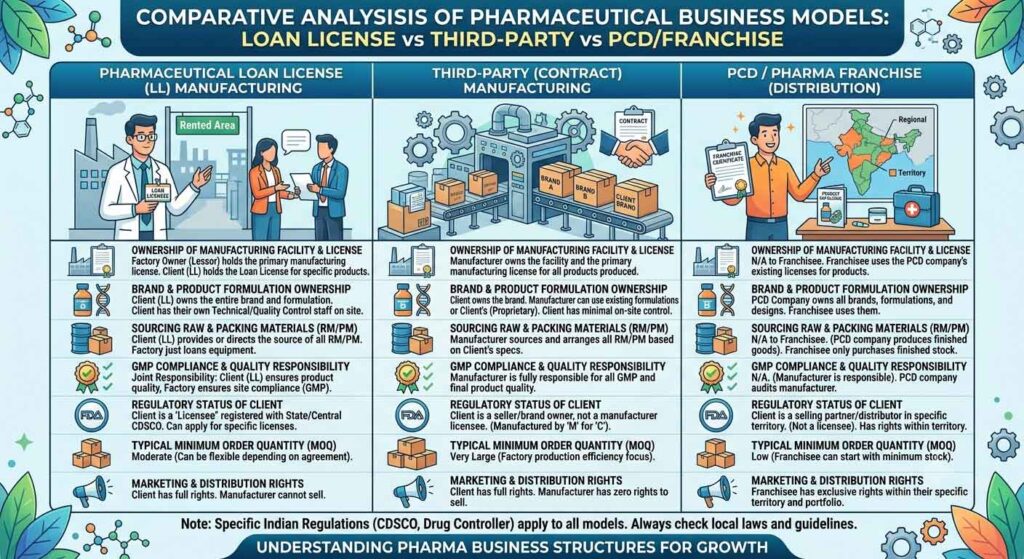
Quick Comparison
Point
Loan Licence
Third-Party Manufacturing
PCD/Franchise
Main purpose
Manufacturing through borrowed facility
Getting products manufactured by another company
Marketing and selling another company’s products
Business type
Manufacturing model
Contract manufacturing model
Marketing/distribution model
Licence control
Loan licensee gets manufacturing permission
Manufacturer manufactures under its licence
Franchise party usually needs wholesale drug licence
Brand ownership
Usually loan licensee/marketing company
Usually marketing company
Usually parent company
Manufactured by
Loan licensee details may appear as per licence/approval, with manufacturing site details
Actual manufacturer name and address appear
Parent company or its manufacturer
Marketed by
Loan licensee/brand owner
Marketing company/brand owner
Parent company or as per company policy
Raw material
Usually arranged by loan licensee or as agreed
Usually arranged by manufacturer
Not applicable for franchise party
Quality responsibility
Loan licensee and facility-related responsible parties
Manufacturer and marketer both have responsibilities
Parent company/manufacturer; distributor handles sale compliance
Investment
Higher than third-party manufacturing
Moderate
Lower to moderate
Best for
Established companies needing manufacturing control
Startups and marketing companies
Distributors and sales professionals
What Is Loan Licence in Pharmaceutical Industry?
Loan licence is a manufacturing arrangement where a company that does not own its own manufacturing unit uses the manufacturing facilities of an already licensed manufacturer after obtaining a loan licence from the licensing authority.
For example, suppose you have a pharma marketing company and want to manufacture your own medicines, but you do not want to set up your own manufacturing plant.
In that case, you may tie up with an existing licensed pharmaceutical manufacturer and apply for a loan licence to manufacture your products at that manufacturer’s premises.
The manufacturing unit belongs to another company, but you get permission to manufacture your products by using that unit’s approved premises, machinery, staff and facilities.
Simple Meaning of Loan Licence
Loan licence means:
Manufacturing your own products by using another licensed manufacturer’s manufacturing facility with permission from the drug authority.
It is like renting or using another manufacturer’s approved premises for manufacturing your products under a legal licence arrangement.
Example of Loan Licence
Suppose your company name is:
ABC Pharma
You do not have your own factory.
You tie up with:
XYZ Laboratories, Baddi, Himachal Pradesh
XYZ Laboratories already has a manufacturing licence.
You apply for a loan licence to manufacture your products at XYZ Laboratories.
After approval, your products may be manufactured under your loan licence using XYZ Laboratories’ facility.
The final label and manufacturing declaration must be printed as per approved licence, artwork and regulatory requirements.
Main Features of Loan Licence
Important features of loan licence include:
Applicant does not own its own manufacturing facility.
Applicant uses another licensed manufacturer’s facility.
Separate loan licence is issued by the licensing authority.
Manufacturing is done at the approved premises.
Loan licensee has stronger control than normal third-party manufacturing.
Product approval and documentation are required.
Technical staff, machinery, site plan and facility details are involved.
Regulatory inspection and approval are required.
Manufacturing address is the actual licensed manufacturing premises.
Documents Required for Loan Licence
Documents may vary by state and product category, but commonly required documents include:
Loan licence application form
Agreement between loan licensee and manufacturer
Manufacturing licence copy of parent manufacturer
Site plan
List of machinery and equipment
List of technical staff
Product list
Product formula
Product permission details
Testing facility details
Proof of premises approval
Constitution of firm or company
PAN and GST documents
Wholesale drug licence, where applicable for sale/distribution
Declaration and affidavits as required by authority
Government fee challan
The exact requirement should be checked from the concerned State Drug Control Department.
Raw Material in Loan Licence
In loan licence manufacturing, raw material procurement is usually the responsibility of the loan licensee, because the loan licensee is treated more closely to a manufacturer.
However, actual responsibility may depend on agreement between the loan licensee and the manufacturing unit.
Raw material, packing material, quality control and documentation should be properly recorded.
Companies that do not want to invest immediately in their own plant
Companies that want to be more involved in production and quality
Loan licence is generally not the simplest option for beginners.
What Is Third-Party Pharmaceutical Manufacturing?
Third-party manufacturing is a business model where a marketing company gets its products manufactured from an existing licensed pharmaceutical manufacturer.
The marketing company gives an order to the manufacturer. The manufacturer produces the product and supplies it in ready-to-sell form.
The marketing company then sells the product through its own distribution, franchise, stockist or sales network.
Simple Meaning of Third-Party Manufacturing
Third-party manufacturing means:
Getting your own brand products manufactured by another licensed manufacturer.
You own the brand, but another company manufactures the product.
Example of Third-Party Manufacturing
Suppose your company name is:
ABC Pharma
You want to launch a product called:
ABC-Cef Tablets
You place an order with:
XYZ Laboratories, Baddi
XYZ Laboratories manufactures the product and supplies it to you.
The label may show:
Manufactured by: XYZ Laboratories, Baddi Marketed by: ABC Pharma, your licensed business address
This is third-party manufacturing.
Main Features of Third-Party Manufacturing
Important features include:
Marketing company owns or markets the brand.
Licensed manufacturer manufactures the product.
Manufacturer’s name and address are printed on the label.
Marketer’s name and address are printed as “Marketed by.”
Manufacturing licence belongs to the manufacturer.
Product is supplied in ready-to-sell form.
Documentation is simpler than loan licence.
Minimum order quantity applies.
Packing material and product approval requirements apply.
Manufacturer–marketer agreement is important.
Documents Required for Third-Party Manufacturing
Common documents required from the marketing company may include:
Wholesale drug licence
GST registration
Firm or company registration
PAN card
Address proof
Trademark application or brand ownership proof
Agreement with manufacturer
Product list
Artwork approval
Marketing authorization details, where applicable
The manufacturer may also provide:
Manufacturing licence copy
Product permission copy
Certificate of Analysis
Batch manufacturing records, where required
Invoice
Test reports
Product samples
Raw Material in Third-Party Manufacturing
In third-party manufacturing, raw material is usually arranged by the manufacturer.
The manufacturer quotes a final rate that may include:
Raw material
Packing material
Manufacturing charges
Testing
Documentation
Packing
Labour
Profit margin
However, in some cases, the marketing company may provide special raw material, packing material or artwork as per agreement.
Who Should Choose Third-Party Manufacturing?
Third-party manufacturing is suitable for:
New pharma marketing companies
PCD companies
Franchise companies
Startups
Companies with low manufacturing knowledge
Brand owners
Traders entering pharma business
Ayurvedic or nutraceutical marketing companies
Businesses that want quick product launch
For most beginners, third-party manufacturing is easier than loan licence.
What Is PCD Pharma or Pharma Franchise?
PCD stands for Propaganda Cum Distribution.
PCD or pharma franchise is a marketing and distribution model where a pharma company gives marketing rights to a person, distributor or franchise partner for a particular area or territory.
The franchise partner promotes and sells the company’s products in that area.
Simple Meaning of PCD/Franchise
PCD/franchise means:
Taking marketing and distribution rights of a pharma company’s products in a selected area.
You do not own the brand. You get permission to sell and promote the company’s brands in your territory.
Example of PCD/Franchise
Suppose XYZ Pharma gives you franchise rights for your district.
You purchase products from XYZ Pharma at agreed net rates.
You promote those products to doctors, chemists and distributors in your area.
The product brand, company name and manufacturing arrangement belong to XYZ Pharma.
You earn profit by selling those products in your assigned territory.
Main Features of PCD/Franchise
Important features include:
Franchise party markets company products.
Company owns brand names.
Company controls product range and pricing policy.
Monopoly rights may be given for a territory.
Franchise party purchases products at net rate.
Franchise party promotes products locally.
Franchise party may appoint stockists or distributors as per company policy.
Investment is lower than manufacturing models.
Sales and marketing effort is the main work.
Documents Required for PCD/Franchise
Common documents may include:
Wholesale drug licence
GST registration
PAN card
Aadhaar card
Firm registration proof
Address proof
Bank details
Franchise agreement or appointment letter
Territory confirmation
Product order details
Requirement may vary depending on product category and company policy.
Difference Between Loan Licence and Third-Party Manufacturing
Point
Loan Licence
Third-Party Manufacturing
Meaning
You manufacture using another licensed facility under loan licence
Manufacturer manufactures products for your brand
Licence
Separate loan licence is required
Manufacturer’s licence is used
Control
More control over manufacturing
Less direct control
Documentation
More documentation
Comparatively simpler
Investment
Higher
Lower to moderate
Raw material
Usually loan licensee responsibility
Usually, manufacturer responsibility
Label
As per loan licence approval
Manufactured by actual manufacturer, marketed by brand owner
Suitable for
Established companies
Startups and marketing companies
Difference Between Third-Party Manufacturing and PCD/Franchise
Point
Third-Party Manufacturing
PCD/Franchise
Main role
You create your own brand
You sell another company’s brand
Brand ownership
Marketing company
Parent pharma company
Manufacturing
Done by third-party manufacturer
Already arranged by company
Investment
Moderate
Lower to moderate
Marketing control
High
Limited to company terms
Product selection
You can develop your own range
You choose from company range
Territory
You can sell as per your business model
Territory may be fixed
Best for
Building own pharma brand
Starting sales business with ready products
Difference Between Loan Licence and PCD/Franchise
Point
Loan Licence
PCD/Franchise
Business nature
Manufacturing model
Marketing/distribution model
Licence
Loan manufacturing licence
Wholesale drug licence usually required
Brand ownership
Loan licensee
Pharma company
Manufacturing control
High
No manufacturing control
Investment
Higher
Lower
Technical requirement
More technical and regulatory involvement
Sales and distribution focus
Suitable for
Established companies
Sales professionals and distributors
Which Model Is Best for Beginners?
For most beginners, the order of ease is:
PCD/Franchise
Third-party manufacturing
Loan licence manufacturing
PCD/Franchise for Beginners
PCD/franchise is easiest because you do not need to develop your own brand or manage manufacturing.
You can start with ready products and focus on sales.
Third-Party Manufacturing for Brand Building
Third-party manufacturing is best if you want to launch your own pharma brand without setting up your own factory.
This is suitable when you have some investment and marketing plan.
Loan Licence for Established Companies
Loan licence is better for companies that already have market demand and want more control over manufacturing.
It requires more documentation, technical involvement and regulatory work.
Which Model Gives More Control?
Control level is generally:
Loan licence – highest control
Third-party manufacturing – medium control
PCD/franchise – lower control
In loan licence, you are more directly involved in manufacturing.
In third-party manufacturing, you own the brand but depend on the manufacturer.
In PCD/franchise, you sell the parent company’s brands.
Which Model Requires More Investment?
Investment level is generally:
Loan licence – highest
Third-party manufacturing – moderate
PCD/franchise – lower
However, exact investment depends on product category, order quantity, company policy and business scale.
Which Model Is Better for Own Brand?
If you want to build your own brand, choose:
Third-party manufacturing, or
Loan licence
If you only want to sell products and earn margin in your area, choose:
PCD/franchise
Which Model Is Better for Pharma Marketing Company?
For a pharma marketing company, third-party manufacturing is usually the most practical option.
It allows you to:
Launch your own brands
Use your own marketed by name
Select your product range
Build your company identity
Avoid setting up a manufacturing plant
Start with manageable investment
Loan licence can be considered later when your sales volume increases.
Which Model Is Better for Sales Professionals?
For sales professionals, PCD/franchise may be better initially.
It allows them to use their doctor contacts, market knowledge and sales skills without investing heavily in manufacturing or brand development.
Once business grows, they can start their own marketed by company through third-party manufacturing.
Role of Brand Ownership
Brand ownership is a major difference between these models.
In Loan Licence
The loan licensee usually owns or controls the brand.
In Third-Party Manufacturing
The marketing company usually owns or markets the brand.
In PCD/Franchise
The parent pharma company owns the brand. The franchise partner only gets marketing rights for a territory.
Role of Quality Responsibility
Quality responsibility should be taken seriously in all three models.
In Loan Licence
The loan licensee is directly involved in manufacturing permission and responsibility.
In Third-Party Manufacturing
The manufacturer is responsible for manufacturing quality, but the marketer also has responsibility for quality and regulatory compliance when its name is printed as marketer.
In PCD/Franchise
The parent company and manufacturer are responsible for product quality, while the franchise party is responsible for proper sale, storage, promotion and distribution according to law and company terms.
Role of Wholesale Drug Licence
Wholesale drug licence is commonly required when a party sells, stocks or distributes medicines.
Loan licence is separate from wholesale drug licence. A company may still need wholesale drug licence if it sells, stocks or distributes products after manufacturing.
Role of GST
GST registration is generally required for business billing and tax compliance.
It is commonly needed in:
Loan licence business
Third-party manufacturing business
PCD/franchise business
Wholesale distribution
Stockist business
GST requirement depends on turnover, interstate supply, business model and current tax rules.
Advantages of Loan Licence
Loan licence offers:
Better manufacturing control
Own brand identity
Stronger manufacturing involvement
Better production planning
More control on raw material and packing
Suitable for large volume
Useful for companies without own factory
Disadvantages of Loan Licence
Challenges include:
More documentation
Higher regulatory involvement
Higher cost than third-party manufacturing
Need for technical knowledge
Dependence on another facility
Approval process required
More responsibility
Advantages of Third-Party Manufacturing
Third-party manufacturing offers:
Own brand launch
Lower investment than own plant
Faster product launch
Less technical burden
Manufacturer handles production
Suitable for startups
Scalable business model
Large product range possible
Disadvantages of Third-Party Manufacturing
Challenges include:
Minimum order quantity
Dependence on manufacturer
Packing material inventory
Delivery time issues
Quality depends on manufacturer selection
Less direct control than loan licence
Artwork and regulatory coordination required
Advantages of PCD/Franchise
PCD/franchise offers:
Low investment
Ready product range
Existing company support
Monopoly rights may be available
Promotional material support
Good for sales professionals
Faster business start
Less manufacturing complexity
Disadvantages of PCD/Franchise
Challenges include:
Brand ownership remains with company
Limited control on product range
Dependence on company supply
Monopoly terms may vary
Product rates may change
Same brands may be sold elsewhere if policy is weak
Company may discontinue products
Practical Example
Suppose you want to sell liver tonic tablets.
Under Loan Licence
You obtain loan licence and manufacture the product using another manufacturer’s facility.
You have stronger manufacturing control and responsibility.
Under Third-Party Manufacturing
You place order with a licensed manufacturer.
The manufacturer makes the product under your brand and supplies finished goods to you.
You sell it through your distribution network.
Under PCD/Franchise
You take franchise of a company that already has liver tonic tablets.
You purchase the company’s product and sell it in your territory.
The brand belongs to the company.
Which Model Should You Choose?
Choose according to your goal.
Choose Loan Licence If:
You have strong sales volume.
You want manufacturing control.
You can handle regulatory work.
You have technical knowledge.
You want to operate like a manufacturer without owning a plant.
Starting without wholesale drug licence where sale/stock is involved
Not executing manufacturer–marketer agreement
Not checking product permissions
Not checking label artwork carefully
Selecting manufacturer only by low rate
Launching too many products at once
Ignoring GST and documentation
Not confirming ownership of brand name
Not understanding quality responsibility
Final Thoughts
Loan licence, third-party manufacturing and PCD/franchise are three different models in the pharmaceutical business.
Loan licence is close to manufacturing because you use another licensed unit’s facility under your own loan licence.
Third-party manufacturing is a practical brand-building model where another manufacturer manufactures your products and you market them under your company name.
PCD/franchise is a sales and distribution model where you market another company’s products in a particular area.
For beginners, PCD/franchise is usually easiest. For entrepreneurs who want to build their own brand, third-party manufacturing is usually better. For established companies that want more production control, loan licence may be suitable.
Before choosing any model, check your investment, experience, licence requirement, product category, market plan and long-term goal.
Frequently Asked Questions
1. What is the difference between loan licence and third-party manufacturing?
In loan licence, you obtain manufacturing permission to use another licensed facility. In third-party manufacturing, another manufacturer manufactures products for your brand under its own manufacturing licence.
2. What is the difference between third-party manufacturing and PCD franchise?
Third-party manufacturing is for launching your own brand. PCD franchise is for selling another company’s products in your area.
3. Which is best for beginners?
PCD/franchise is easiest for beginners. Third-party manufacturing is better for building your own brand. Loan licence is better for established companies.
4. Does loan licence require approval from drug authority?
Yes. Loan licence requires approval from the licensing authority.
5. Is wholesale drug licence required for third-party manufacturing?
If you sell, stock or distribute medicines, wholesale drug licence is generally required.
6. Is GST required for PCD franchise?
GST is generally required for proper billing and business operations, especially for interstate supply and regular commercial activity.
7. Who owns the brand in third-party manufacturing?
Usually the marketing company owns or controls the brand, subject to trademark and agreement terms.
8. Who owns the brand in PCD franchise?
The parent pharma company owns the brand. The franchise party gets marketing rights only.
9. Who arranges raw material in third-party manufacturing?
Usually the manufacturer arranges raw material, but this depends on agreement.
10. Which model gives maximum control?
Loan licence gives maximum control, followed by third-party manufacturing and then PCD/franchise.
Looking for Ayurvedic Franchise or Distribution Opportunities?
Looking to start an Ayurvedic franchise, become a distributor, or launch your own herbal product range?
Elzac Herbal India offers:
Ayurvedic & Herbal Product Range
Franchise & Distribution Opportunities
Third-Party Manufacturing Services
Product Development Support
Marketing Guidance
PAN India Business Opportunities
Whether you are an entrepreneur, retailer, distributor, or healthcare professional, our team can help you explore the right business opportunity in the growing Ayurvedic sector.
Ajay Kamboj is an entrepreneur and business owners associated with many Ayurvedic and Pharmaceutical start-ups. With years of experience in Ayurvedic product marketing, pharmaceutical distribution, franchise development, and client relationship management, he regularly shares practical business insights based on real-world experiences. His articles focus on business growth, entrepreneurship, customer management, and lessons learned from the healthcare and wellness industry.
3 responses to “Difference Between Pharmaceutical Loan Licence, Third-Party Manufacturing and PCD/Franchise”
In Third Party Manufacturing, what if The marketeer buys Raw material ? Please help me describing the law that says Manufacturer has to buy RM in third party manufacturing and RM to be bought by Marketeer in Loan Licensing ?




In Third Party Manufacturing, what if The marketeer buys Raw material ? Please help me describing the law that says Manufacturer has to buy RM in third party manufacturing and RM to be bought by Marketeer in Loan Licensing ?
Nice Article.
Informative.
Nice