A strong distribution network is one of the most important requirements for a pharmaceutical business.
A company may have excellent products, competitive prices, strong medical representatives and good prescriptions, but sales will still suffer if medicines are not available at the required pharmacy, hospital or distributor when customers need them.
For pharmaceutical companies, distribution has an additional responsibility: the medicine must not only reach the customer quickly—it must reach the customer without losing its quality, identity, traceability or required storage conditions.
Therefore, a strong pharmaceutical distribution system should achieve four things:
Right product → Right quantity → Right place → Right condition → Right time
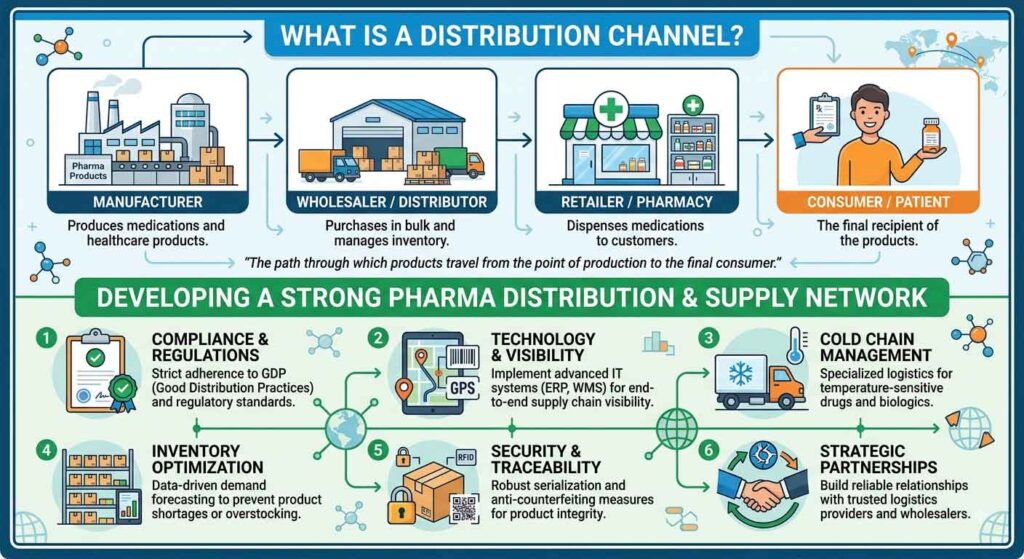
What is a Distribution Channel?
A distribution channel is the commercial and physical route through which a product moves from the manufacturer or marketing company to the final buyer or patient.
A conventional pharmaceutical channel may look like:
Manufacturer / Marketing Company → C&F / Super Stockist → Stockist / Distributor → Retail Pharmacy / Hospital → Patient
However, every company does not need all these levels.
The channel should be designed according to business volume, geography, product characteristics and customer density rather than copying another pharma company.
Distribution Channel vs Supply Chain
These terms are often used as if they mean the same thing, but there is an important difference.
Distribution Channel
Supply Chain
Focuses mainly on getting finished products to customers
Covers the complete flow from suppliers to final customer
Manufacturer to distributor to retailer
Raw material to manufacturing to warehouse to distributor to customer
Mainly downstream
Upstream + internal operations + downstream
Focuses on market coverage
Focuses on procurement, production, inventory and delivery
Includes channel partners
Includes suppliers, manufacturers, transporters, warehouses and customers
For example, purchasing paracetamol API is part of the supply chain, but not normally part of the finished-product distribution channel.
What Is a Delivery Network?
The delivery network is the physical system used to move orders between locations.
It includes matters such as:
Transporters and couriers
Local delivery vehicles
Warehouses
Regional depots
Cold-chain vehicles
Route planning
Delivery schedules
Proof of delivery
Return collection
A company may have many distributors but still have a poor delivery network if products take five days to reach retailers.
Main Participants in a Pharma Distribution Channel
Participant
Main Role
Manufacturer
Produces and releases medicines
Marketing company
Generates business and manages brands/channel
C&F agent
Stores and dispatches stock for a defined territory
Super stockist
Holds larger regional inventory
Stockist
Supplies products within a defined market
Distributor
Distributes to retailers/hospitals; terminology varies by market
Retail pharmacy
Supplies medicines to patients
Hospital pharmacy
Supplies medicines within hospital system
Logistics provider
Physically transports products
Patient/customer
Final user
In Indian trade terminology, “stockist” and “distributor” are sometimes used differently by different companies. Therefore, contracts should define the actual responsibilities rather than relying only on the title.
What Is a C&F Agent?
C&F means Carrying and Forwarding Agent.
A C&F normally does not function exactly like an ordinary distributor. It may hold company inventory and perform activities such as:
Receiving stock
Warehousing
Order processing
Dispatch
Documentation
Inventory reporting
Return coordination
Whether a company needs a C&F depends on its scale.
A company selling limited quantities in one or two states may not require a separate C&F layer.
A company supplying large volumes across several states may benefit from regional C&F points because they reduce delivery time and central-warehouse pressure.
Is C&F Compulsory?
No.
It is a commercial distribution structure, not a compulsory level that every pharma company must create.
Adding a C&F simply because large companies use one can increase:
Warehousing cost
Inventory
Reconciliation work
Credit exposure
Expiry risk
Create an additional distribution level only when the service improvement justifies its cost.
Pharmaceutical Distribution Is a Licensed Activity
Pharmaceutical distribution cannot be structured only around sales convenience.
Sale and distribution of drugs are regulated under the Drugs and Cosmetics framework. Wholesale drug licences commonly involve Forms 20B and 21B depending on the medicines handled and the applicable conditions.
Importantly, CDSCO notified further amendments on 16 February 2026 affecting licence conditions under Forms 20B, 20BB, 21B and 21BB and requirements concerning the competent person.
Therefore, before appointing a distributor, verify that the party has the licences required for the medicines it will stock and sell.
Good Distribution Practices
Medicines can lose quality even after they leave a compliant manufacturing facility.
Risks may arise from:
Improper temperature
Excess humidity
Damaged packs
Contamination
Poor handling
Falsified products
Incorrect stock rotation
Uncontrolled returns
Theft
Mix-ups
Transport delays
WHO’s Good Storage and Distribution Practices guidance treats storage and distribution as important parts of medical-product supply-chain quality management.
Therefore, distributor selection should consider quality capability, not only sales turnover.
A Modern Pharma Distribution Channel
A practical modern distribution system can be thought of as three connected flows.
Product Flow
Company → Warehouse → Distributor → Retailer → Patient
Information Flow
Market demand ← Sales data ← Distributor inventory ← Company ERP
Money Flow
Company ← Distributor payment ← Retailer payment ← Customer
A strong network manages all three.
Many companies concentrate only on product flow and then suffer from:
Excess stock
Outstanding payments
Expiry
Stock-outs
Poor sales visibility
How to Develop a Strong Pharmaceutical Distribution Network
The correct sequence is:
Map the market and identify customers.
Estimate product-wise demand.
Divide the market into practical territories.
Decide which distribution levels are actually required.
Identify suitable licensed partners.
Conduct financial and operational due diligence.
Execute written agreements.
Set inventory and service-level standards.
Integrate ordering and stock reporting.
Monitor availability, expiry, returns, credit and delivery performance.
Expand only when existing territories are adequately serviced.
Periodically remove or restructure weak distribution points.
Step 1: Conduct a Market Survey
Distribution design should begin with data.
Do not appoint one distributor for an entire state merely because that distributor requests statewide rights.
Map the territory according to:
Population
Doctors
Hospitals
Retail pharmacies
Nursing homes
Prescription potential
Existing competitors
Transport connectivity
Distance between markets
Order frequency
Product category
For institutional or specialty products, hospital concentration may be much more important than the total number of chemist shops.
Step 2: Classify Markets by Potential
Divide territories into categories such as:
Market
Characteristics
Distribution Strategy
High potential
High prescriptions/orders
Local distributor + frequent supply
Medium potential
Moderate orders
District/multi-district distributor
Developing
Low current demand
Supply through nearby distributor
Remote
Low density/high logistics cost
Consolidated scheduled dispatch
This is more economical than appointing one distributor in every district from the first day.
Step 3: Decide Coverage Radius
Ask:
How many customers can one distributor properly service?
The answer depends on:
Product sales
Geographic distance
Retailer density
Delivery frequency
Salesperson coverage
Transport infrastructure
A distributor supplying dense urban markets may serve hundreds of pharmacies efficiently.
A distributor covering widely separated rural markets may struggle with a much smaller customer base.
Therefore, territory should be based on serviceability, not only district boundaries.
Step 4: Decide How Many Inventory Points You Need
More stock points can improve product availability, but they also increase inventory.
Suppose you keep ₹5 lakh of safety stock at one central warehouse.
If you create ten regional stock points and each needs ₹2 lakh of minimum stock, total inventory may rise substantially.
That means more:
Working capital
Expiry exposure
Slow-moving inventory
Reconciliation
The objective is therefore not maximum stock points.
It is the minimum number of stock points required to achieve the promised service level.
Hub-and-Spoke Model
A useful structure for larger businesses is:
Central Warehouse
↓
Regional Hubs / C&F
↓
District Distributors
↓
Retailers
This works well when regional volumes are sufficient.
For smaller businesses:
Central Warehouse → Distributor → Retailer
may be more economical.
How to Select a Pharma Distributor
A distributor should be evaluated on several dimensions.
Area
What to Check
Licensing
Valid applicable drug licence
Market reach
Retailers/hospitals actually covered
Finance
Working-capital capacity
Storage
Suitable warehouse and refrigeration where needed
Manpower
Sales/delivery staff
Delivery
Vehicles/routes/frequency
Reputation
Payment and trade history
Technology
Billing/inventory software
Product fit
Existing therapeutic segments
Competition
Conflicting companies/products
Expiry handling
Stock rotation and returns
Reporting
Willingness to share inventory and sales data
Do not appoint a distributor solely because it offers to place a large opening order.
Opening Order Is Not Distribution Strength
An opening order of ₹10 lakh does not prove that a party has a good market network.
A strong distributor is one that can repeatedly:
receive → store → sell → collect → reorder
Products lying in the distributor’s warehouse are inventory, not sales.
Distributor Due Diligence
Before appointment, verify:
Drug licences
GST details
Firm constitution
Warehouse address
Bank/payment history
Existing agencies
Market references
Storage facilities
Refrigerator/cold room where relevant
Number of sales staff
Number of delivery vehicles
Retailer coverage
Outstanding exposure
Expiry experience
For higher-value territories, an actual site visit is preferable to completing the entire appointment through WhatsApp.
Distribution Agreement
A written agreement should define commercial and operational responsibilities.
A good agreement prevents later arguments such as:
“I thought I had exclusive rights for the whole state.”
Monopoly or Exclusive Distribution
PCD companies often provide monopoly rights.
Monopoly should not mean that the company permanently blocks an entire district regardless of performance.
An agreement can link exclusivity to:
Minimum purchase
Payment discipline
Active market coverage
Territory development
Compliance
Review period
A weak distributor holding a large exclusive territory can prevent the company from growing.
Inventory Management
A strong distribution system must maintain enough stock to avoid lost sales but not so much that products expire.
A practical inventory model uses:
Average demand + Replenishment lead time + Safety stock
Products should also be classified by movement.
Category
Example Approach
Fast moving
Higher safety stock
Medium moving
Moderate stock
Slow moving
Low stock
New products
Controlled launch quantity
Seasonal
Demand-based stock
Cold-chain/high value
Tight control
ABC Analysis
Products can be classified based on sales or inventory value.
A products contribute high value and need close monitoring.
B products are medium importance.
C products contribute relatively low value.
This helps management concentrate working capital where it matters most.
FSN Analysis
For pharmaceutical distribution, an additional useful method is:
F – Fast moving
S – Slow moving
N – Non-moving
Non-moving inventory should be identified early rather than six months before expiry.
FEFO Is More Important Than FIFO
For medicines, stock rotation should generally follow:
FEFO — First Expiry, First Out
rather than relying only on:
FIFO — First In, First Out
A newer batch with an earlier expiry should ordinarily be dispatched first.
Good storage/distribution principles place strong emphasis on maintaining product quality and appropriate inventory control throughout storage and distribution.
Define Minimum Remaining Shelf Life
Your distributor agreement should specify acceptable remaining shelf life at delivery.
For example, a distributor should not unexpectedly receive products with very little shelf life merely because the manufacturer wants to clear inventory.
WHO has separate guidance on determining appropriate remaining shelf life of medical products upon delivery.
The exact commercial limit should depend on:
Product shelf life
Sales velocity
Supply route
Customer requirement
Tender conditions
Prevent Stock-Outs
A stock-out occurs when market demand exists but stock is unavailable.
Common causes include:
Poor forecasting
Delayed production
Distributor not reordering
Outstanding payment block
Transport delay
Demand spike
Poor communication
A simple reorder system can use:
Reorder Point = Expected Demand During Lead Time + Safety Stock
Do not wait until inventory reaches zero.
Fill Rate
One of the best measures of distribution quality is order fill rate.
If a distributor orders 100 saleable line items and you supply 94 completely, the fill rate is approximately 94%.
A company with repeated stock-outs will eventually lose prescriptions and retailer confidence even if its marketing is excellent.
Order Cycle Time
Measure:
Order received → Order processed → Dispatched → Delivered
For example:
Order received: Monday 10 AM Dispatch: Monday 5 PM Delivery: Tuesday 4 PM
This is much more useful than simply saying:
“We dispatch quickly.”
On-Time In-Full Delivery
A stronger KPI is OTIF — On Time In Full.
It asks whether the customer received:
Correct product
Correct quantity
Complete order
Within promised delivery time
This is a practical measure of supply reliability.
Temperature-Controlled Products
Some medicines require controlled temperature during storage and distribution.
Where product labelling requires refrigerated or other temperature-controlled conditions, the distribution system should maintain those conditions during:
Warehousing
Picking
Packing
Dispatch
Transportation
Intermediate storage
Delivery
WHO provides specific guidance for storage and transport of time- and temperature-sensitive pharmaceutical products.
A normal courier service should not be assumed to be suitable for every cold-chain medicine.
Temperature Excursions
Suppose a product requiring controlled refrigerated storage is exposed to an unacceptable temperature during transportation.
Do not simply cool it again and sell it.
The incident should be:
identified → quarantined → investigated → scientifically assessed → released or rejected by authorized quality personnel
depending on the company’s quality system.
Transportation Qualification
For sensitive products, assess:
Route duration
Seasonal temperature
Vehicle type
Packaging
Cool packs
Data loggers
Transit delays
Loading/unloading
WHO’s distribution guidance includes specific technical resources for temperature-controlled transport operations and transport monitoring.
Batch Traceability
A pharma distribution system should be able to answer:
Which distributor received Batch ABC123?
and ideally:
Which locations subsequently received that batch?
Maintain information such as:
Information
Purpose
Product
Identification
Batch number
Traceability
Expiry
Stock control
Quantity
Reconciliation
Customer
Recall traceability
Invoice
Commercial proof
Dispatch date
Distribution history
Traceability supports both recalls and detection of suspect supply-chain activity. WHO notes that medical-product traceability can strengthen supply-chain integrity and help earlier detection and response.
Product Recall System
Distribution networks must be able to reverse direction.
Normal distribution:
Company → Distributor → Retailer
Recall:
Retailer → Distributor → Company
A company should therefore maintain an updated distribution record for every batch.
A mock recall can be used periodically to test whether the company can quickly identify where affected stock has gone.
Returns and Expiry Management
Create a written policy for:
Near-expiry stock
Expired products
Damaged products
Market returns
Recalled batches
Transit breakage
Returned medicines should not automatically go back into saleable inventory.
Their status should be evaluated under defined procedures.
Digital Distribution Management
Modern distribution should not depend entirely on telephone calls and handwritten stock statements.
Useful systems include:
ERP
Distributor management software
Inventory software
E-invoicing systems where applicable
Batch/expiry tracking
Sales dashboards
CRM
Delivery tracking
Automated reorder alerts
The purpose of technology is not to create more reports.
It should answer practical questions such as:
Which distributor will run out of Orthozac next week?
Which batch will expire in the next six months?
Which territory has increasing secondary sales?
Primary, Secondary and Tertiary Sales
These terms are extremely useful.
Primary Sales
Company sells to distributor.
Secondary Sales
Distributor sells to retailer/hospital.
Tertiary or Offtake
Retailer sells to final customer/patient.
A company that only measures primary sales may believe a territory is performing well even though stock is accumulating with the distributor.
Example
Company sells ₹10 lakh to distributor.
Distributor sells only ₹3 lakh to retailers.
Primary sale = ₹10 lakh.
Secondary sale = ₹3 lakh.
Unsold stock is approximately ₹7 lakh before considering opening inventory and other adjustments.
That territory may actually have a serious inventory problem.
Prescription/Ethical Pharma Distribution
In ethical prescription marketing, demand is influenced by prescribers, but the physical product generally flows through licensed distribution channels.
A practical structure may be:
Company → C&F/Stockist → Distributor → Retail Pharmacy → Patient
Marketing flow may separately be:
Company → Sales Team → Healthcare Professional
Doctors should therefore be treated as part of the demand-generation ecosystem, not as another warehouse level.
Interactions with healthcare professionals must also comply with the Uniform Code for Pharmaceutical Marketing Practices. The Department of Pharmaceuticals states that UCPMP applies to pharmaceutical companies, their employees, agents and third parties acting on their behalf in marketing medicines.
How to Build Distribution for Prescription Medicines
Begin with the prescribing universe.
Map:
Market Information
Why It Matters
Doctors by speciality
Potential prescription generation
Hospitals
Patient concentration
Nearby pharmacies
Prescription conversion
Existing stockists
Product availability
Distributor delivery routes
Service capability
Competitors
Market expectations
The highest-priority pharmacies are often those located near doctors and hospitals where prescriptions are generated.
But also cover neighbourhood pharmacies because patients may purchase medicines closer to home.
Generic Medicine Distribution
Generic marketing is usually much more trade-driven.
The major focus is:
Product availability + price + retailer economics + fast replenishment
A common structure may be:
Company → Super Stockist/Distributor → Retail Pharmacy → Consumer
Retailer coverage is often more important than doctor coverage.
Key measures should include:
Number of active retail outlets
Repeat orders
Outlet-wise sales
Distributor fill rate
Expiry
Credit
Delivery frequency
PCD Pharma Franchise Distribution
PCD distribution works differently.
The company normally develops franchise partners, and each franchise partner develops its own local market.
A typical structure is:
Manufacturer/PCD Company → Franchise Partner → Distributor/Stockist where needed → Retail Pharmacy/Hospital → Patient
A smaller franchise partner may directly supply retailers and not need a separate stockist level.
The central PCD company should focus on:
Fast dispatch
Product availability
Low stock-outs
Transparent monopoly areas
Reasonable MOQ
Expiry policy
Product launches
Order tracking
For PCD, service quality from the company to the franchise partner is often as important as the local retail distribution itself.
PCD Monopoly Area Planning
Do not allocate territory merely according to postal district.
Analyse:
Expected potential ÷ Partner’s capacity to cover it
One PCD partner may manage an entire low-volume district.
A high-volume urban district may eventually require several territories.
The monopoly policy should provide a mechanism for reviewing area performance.
OTC Distribution
OTC-style consumer products depend more heavily on broad availability.
The distribution objective becomes:
Maximum relevant retail reach
Potential outlets may include, subject to the product’s legal sale conditions:
Pharmacies
Hospitals
Relevant retail outlets
Modern trade
Other lawful channels
The exact channel depends on the product classification.
Do not call a prescription medicine “OTC” merely because it is commonly sold without a prescription.
Medical Device Distribution
Medical devices should not simply be placed under the pharmaceutical drug distribution model.
The Medical Devices Rules, 2017 provide a separate regulatory system. CDSCO lists G.S.R. 754(E), dated September 30, 2022, covering regulation of retail and wholesale sale of medical devices through registration of premises.
Device distributors should therefore be evaluated against the applicable medical-device requirements.
Distribution of Surgical and Medical Devices
The most suitable distributor depends on the device.
For hospital devices, evaluate:
Number of target hospitals
Relevant specialties
Procedure volumes
Procurement system
Biomedical department
Tender activity
Technical-support needs
A conventional tablet distributor may not be suitable for a product requiring:
Installation
Demonstration
Surgeon training
Calibration
Maintenance
Technical support
Distributor specialization matters more than the number of shops covered.
Hospital and Institutional Distribution
Institutional distribution has different priorities.
If your product is available in large high-volume pharmacies but absent from many very small shops, weighted distribution may be much stronger than numerical distribution suggests.
Therefore, prioritize important outlets rather than chasing outlet count alone.
How to Find New Distributors
Potential distributors can be identified through:
Existing retailer references
Stockist associations
Sales teams
Hospitals
Trade exhibitions
Industry directories
B2B enquiries
Existing franchise network
Referrals from neighbouring distributors
Local market visits
Market references are particularly useful because retailers know which distributors actually deliver on time.
Warning Signs of a Weak Distributor
Warning signs include repeated payment delays, refusal to share stock information, high expiry, no delivery staff, excessive competing agencies, poor retailer reputation, frequent disputes, unexplained inventory differences and constant requests for additional credit without corresponding secondary sales.
The company should intervene early rather than waiting until the territory collapses.
When to Appoint an Additional Distributor
Consider another distributor when:
Existing partner cannot cover the territory
Delivery times are poor
Sales opportunity is being lost
Retailers complain of supply gaps
Existing distributor lacks working capital
Territory has grown beyond its capacity
However, before breaking exclusivity, follow the written agreement and provide a documented performance review.
When to Remove a Distributor
Termination may be justified by issues such as:
Licence problems
Persistent non-payment
Falsification
Poor storage
Repeated stock-outs
Territory neglect
Diversion
Serious contractual breach
Ensure closing stock, claims, outstanding payments and brand materials are properly reconciled.
Distribution Network During Product Recall
Your system should be capable of answering quickly:
Which batch?
How much was produced?
Who received it?
How much remains?
How much has been recovered?
This is why batch-wise distributor and invoice records matter.
WHO emphasizes the responsibility of licensed and regulated distributors, wholesalers and retailers to follow good storage and distribution practices and to be able to show where medical products were sourced.
Common Mistakes in Pharma Distribution
Common mistakes are appointing too many distributors before demand exists, granting huge monopoly areas without sales conditions, measuring only primary sales, giving excessive credit, ignoring expiry, poor cold-chain management, appointing unlicensed parties, keeping no batch traceability, depending on one C&F for a large region without contingency, selecting distributors only on opening order size, and failing to review secondary sales.
A Better Distribution Strategy for a New Pharma Company
For a new company, begin with a small number of territories where you can provide excellent service.
The most successful distribution systems measure not only how much stock the company sells to distributors, but also:
secondary sales, stock availability, expiry, order fill rate, delivery time, retailer coverage and collections.
A distributor is useful only when products continue moving through the channel and remain available where actual demand exists.
Frequently Asked Questions
What is a pharma distribution channel?
It is the network through which pharmaceutical products move from the manufacturer or marketing company to wholesalers, distributors, pharmacies, hospitals and ultimately the patient.
Is a doctor part of the distribution channel?
Normally no. Doctors may influence demand through lawful prescribing, but they do not normally form part of the physical movement and sale channel.
Is C&F compulsory?
No. It is commercially useful when regional volumes justify an intermediate warehousing and dispatch point.
What is the difference between distributor and stockist?
The terms vary in practice. Some companies use “stockist” for larger inventory holders and “distributor” for parties covering retailers. The agreement should define the actual role.
What licences should a pharma distributor have?
The party should hold the drug-sale licences applicable to the products and activities involved. CDSCO’s 2026 amendments also updated conditions relating to wholesale licence forms and competent persons.
What is FEFO?
FEFO means First Expiry, First Out. Products with the earliest expiry should generally move first.
What is primary sale?
Primary sale is the company’s sale to its distributor or stockist.
What is secondary sale?
Secondary sale is the distributor’s sale to retailers or hospitals.
Which is more important: primary or secondary sales?
Both matter, but secondary sales are essential for understanding whether products are actually moving into the market rather than accumulating at distributors.
How many distributors should one company appoint?
There is no fixed number. It depends on market demand, geography, order density, delivery capability and sales volume.
Should one distributor cover one district?
Not necessarily. A high-volume district may need multiple coverage points, while one distributor may efficiently cover several low-volume districts.
How can expiry be reduced?
Use better forecasting, FEFO, lower stock of slow-moving products, regular expiry reports, stock transfers where permitted, and faster action on non-moving inventory.
What is a strong distribution KPI?
Useful KPIs include order fill rate, OTIF, secondary sales, stock-out rate, inventory days, expiry percentage, active outlets and collection days.
Are medical-device distributors regulated like ordinary pharma distributors?
Medical devices have a separate regulatory framework. CDSCO’s Medical Devices Rules page includes the 2022 notification covering retail and wholesale sale of medical devices through registration of premises.
What is the most important principle of pharma distribution?
The product should be available when needed while remaining within approved storage, quality, legal and traceability requirements throughout the supply chain.
Looking for Ayurvedic Franchise or Distribution Opportunities?
Looking to start an Ayurvedic franchise, become a distributor, or launch your own herbal product range?
Elzac Herbal India offers:
Ayurvedic & Herbal Product Range
Franchise & Distribution Opportunities
Third-Party Manufacturing
Product Development Support
Marketing Guidance
PAN India Business Opportunities
Whether you are an entrepreneur, retailer, distributor, or healthcare professional, our team can help you explore the right business opportunity in the growing Ayurvedic sector.
Ajay Kamboj is an entrepreneur and business owners associated with many Ayurvedic and Pharmaceutical start-ups. With years of experience in Ayurvedic product marketing, pharmaceutical distribution, franchise development, and client relationship management, he regularly shares practical business insights based on real-world experiences. His articles focus on business growth, entrepreneurship, customer management, and lessons learned from the healthcare and wellness industry.
3 responses to “What Is a Distribution Channel? How to Develop a Strong Pharma Delivery, Distribution and Supply Network”
Hi, Thank You for such a one-stop blog for all matters related to all sides of Pharma business.
What all licenses i need to have to start a pharmaceutical, OTC and medical device warehouse (no trading) – say for example at Delhi NCR or at Bangalore? Is it different from state to state?
Is obtaining these licenses from govt authorities much difficult – how many licenses in total i should have for this venture?






Hi, Thank You for such a one-stop blog for all matters related to all sides of Pharma business.
What all licenses i need to have to start a pharmaceutical, OTC and medical device warehouse (no trading) – say for example at Delhi NCR or at Bangalore?
Is it different from state to state?
Is obtaining these licenses from govt authorities much difficult – how many licenses in total i should have for this venture?
i i want to contact distributors of ayurvada medicines
Yes,
you can list your ayurvedic business at our B2B portal https://pharmafranchisehelp.org and start getting leads related to your business