Starting a cosmetic manufacturing unit in India requires much more than purchasing mixers, filling machines and packaging equipment.
A commercial cosmetic unit must be established under the:
Drugs and Cosmetics Act, 1940
Cosmetics Rules, 2020
Applicable Bureau of Indian Standards specifications
State pollution-control requirements
Factory and workplace-safety laws
Legal Metrology requirements
GST laws
Local fire, industrial and municipal regulations
The correct process is:
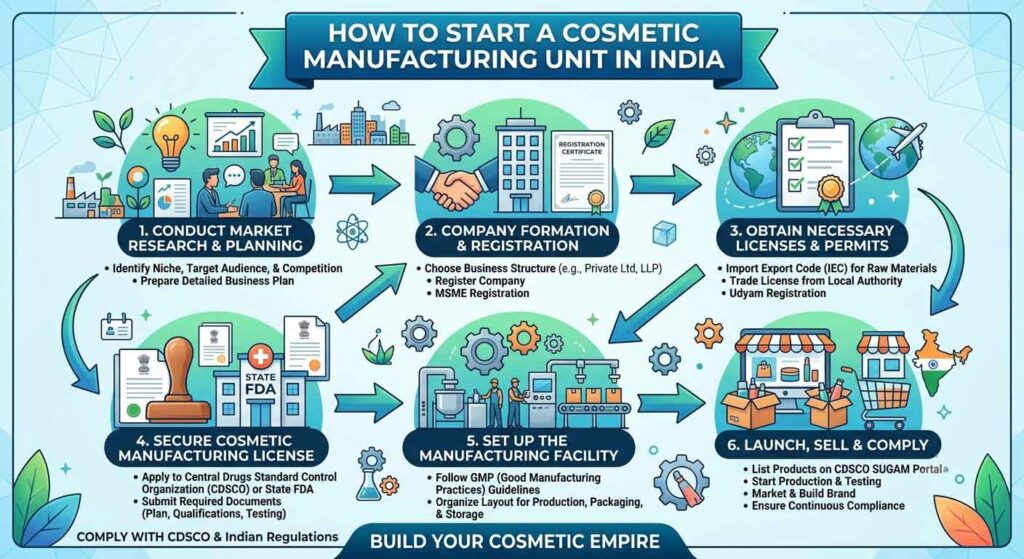
Select products → Classify them correctly → Prepare a business plan → Select an industrial premises → Design the unit under the Seventh Schedule → Recruit competent technical staff → Install machinery and testing facilities → Apply in Form COS-5 or COS-6 → Obtain Form COS-8 or COS-9 → Approve product formulas and labels → Begin licensed production
What Is a Cosmetic?
A cosmetic is generally an article intended to be:
Rubbed
Poured
Sprinkled
Sprayed
Introduced into
Otherwise applied to
the human body or any part of it for:
Cleansing
Beautifying
Promoting attractiveness
Altering appearance
It also includes an article intended for use as a component of a cosmetic.
The product must comply with the applicable standards and cannot carry false or misleading claims.
Cosmetic, Ayurvedic Medicine or Drug?
A cosmetic-like product does not automatically fall under the Cosmetics Rules.
Classification depends on:
Ingredients
Intended purpose
Product claims
Mode of action
Label presentation
Licence category
Applicable regulatory definition
For example:
Cosmetic Claim
“Moisturizes dry skin and improves appearance.”
This may fall within cosmetic use.
Medicinal Claim
“Treats eczema and cures fungal infection.”
Such claims may move the product into a medicinal or drug category and cannot ordinarily be made under a cosmetic licence.
Ayurvedic Product
An Ayurvedic proprietary or classical product must meet the applicable AYUSH requirements. A manufacturer cannot freely choose an Ayurvedic licence merely because the formula contains herbs.
The product category should be finalized before:
Formula development
Licence application
Packaging design
Advertising
Manufacturing
Can Cosmetics Be Manufactured at Home?
Commercial cosmetics cannot ordinarily be manufactured from an unlicensed residential kitchen, bedroom or household room.
The Cosmetics Rules require a licensed manufacturing premises. The Seventh Schedule states that the factory should:
Be situated in a sanitary location
Maintain hygienic conditions
Be clean and well ventilated
Not be used as a residence
Not be interconnected with residential areas
Prevent entry of insects, rodents and flies
Small-scale production does not create an automatic exemption from manufacturing licensing.
The requirements apply whether products are sold through:
Local shops
Instagram
Social media
Amazon
Own website
Salons
Exhibitions
Distributors
Direct-to-consumer channels
Select the Manufacturing Model
There are three practical ways to enter cosmetic manufacturing.
1. Own Cosmetic Manufacturing Unit
Under this model, the company establishes its own:
Premises
Machinery
Production team
Quality-control system
Manufacturing licence
Inventory
Packaging operations
The manufacturing licence is granted in Form COS-8.
This model provides greater production control but requires substantial investment and daily compliance.
2. Cosmetic Loan Licence
Under a loan licence, the applicant manufactures approved cosmetics using the facilities of another licensed cosmetic manufacturer.
The application is made in Form COS-6, and the loan licence is granted in Form COS-9.
A loan licence is different from an ordinary third-party purchase arrangement because the loan-licensee operates under a specific regulatory licence.
3. Third-Party or Private-Label Manufacturing
Under third-party manufacturing:
The licensed manufacturer produces the product.
The brand owner markets it under an agreed brand.
The manufacturer holds the manufacturing licence.
The commercial and quality responsibilities should be defined in an agreement.
This is usually the easiest model for a startup that wants to build a cosmetic brand without investing in a factory.
Cosmetic Manufacturing Licence Forms
Purpose
Application
Approval
Own manufacturing licence
Form COS-5
Form COS-8
Loan licence
Form COS-6
Form COS-9
GMP self-declaration
Form COS-7
Submitted with application
Permission for new cosmetic
Form COS-12
Form COS-3
Cosmetic testing laboratory
Form COS-22
Form COS-23
A separate manufacturing licence is required for each manufacturing premises.
Who Issues the Cosmetic Manufacturing Licence?
Manufacture of cosmetics in India is regulated by the respective State Licensing Authorities.
The Central Licensing Authority primarily handles matters such as:
Import registration
Permission for new cosmetics
Certain central regulatory functions
An own manufacturing licence is normally obtained from the State Drug Control or State Licensing Authority where the factory is located.
Application Fee
Under the Cosmetics Rules, the prescribed central fee structure includes:
₹10,000 for Form COS-8 covering up to ten products in one cosmetic category
₹500 for each additional product in that category
₹10,000 for up to ten products in each additional category
Similar basic fee structure for a Form COS-9 loan licence
The licence remains valid in perpetuity, subject to:
Continued compliance
Payment of the prescribed retention fee before completion of every five-year period
No suspension or cancellation
State portal, inspection, professional and other approval expenses may be additional.
New Cosmetic Permission
A “new cosmetic” requires prior permission from the Central Licensing Authority.
The applicant must submit:
Form COS-12
Prescribed fee
Safety information
Effectiveness information
Proposed composition
Test methods
Supporting technical data
If approved, permission is issued in Form COS-3.
The State Licensing Authority should not grant permission to manufacture that new cosmetic without the prior central approval.
Business-Entity Registration
The manufacturing business may be formed as:
Proprietorship
Partnership
LLP
Private Limited Company
The entity selected for the manufacturing licence should have lawful control of the premises.
Prepare suitable documents such as:
Proprietorship declaration
Partnership deed
LLP agreement
Certificate of incorporation
Memorandum and Articles
PAN
Authorized-signatory documents
Board resolution, where applicable
Registrations and Approvals Commonly Required
Depending on the state, factory and products, the unit may require:
Cosmetic manufacturing licence
GST registration
Factory or establishment registration
Consent to Establish
Consent to Operate
Fire NOC
Local trade licence
Electricity approval
Boiler approval, where applicable
Professional-tax and labour registrations
Legal Metrology registration
Udyam registration, where applicable
Trademark registration
Import Export Code for exports or imports
Not every approval applies to every unit. Applicability should be checked according to the state, machinery, employee strength and production process.
Selecting the Factory Location
Prefer an approved industrial area.
Before finalizing the premises, check:
Permitted land use
Commercial or industrial approval
Pollution category
Water availability
Electricity load
Drainage
Fire access
Road connectivity
Worker availability
Loading and unloading
Future expansion
Do not sign a long-term lease before confirming that the premises is acceptable to:
State Licensing Authority
Pollution Control Board
Factory authority
Fire department
Local authority
Owned or Rented Premises
A cosmetic manufacturing unit may operate from:
Owned premises
Rented premises
Leased premises
For rented premises, common documents include:
Rent or lease agreement
Owner’s NOC
Ownership proof
Utility bill
Property documents
Site plan
Authorization for industrial alterations
The lease should be long enough to justify investment in:
Flooring
Partitions
Electrical work
Water systems
Machinery
Exhaust systems
Fire controls
Factory Layout
The layout should provide a controlled flow of:
Personnel
Raw materials
Packing materials
Bulk products
Finished goods
Waste
Returned stock
A basic cosmetic unit may need separate areas for:
Raw-material receiving
Raw-material quarantine
Approved raw-material storage
Packing-material storage
Dispensing and weighing
Manufacturing
Bulk-product holding
Filling and sealing
Labelling and packing
Finished-goods quarantine
Released finished goods
Rejected materials
Returned products
Quality control
Washing
Change room
Office and documentation
Waste storage
Seventh Schedule GMP Requirements
The factory should comply with the Seventh Schedule of the Cosmetics Rules, 2020.
Important requirements include:
Sanitary location
Hygienic building
Smooth and washable surfaces
Adequate ventilation
Pest prevention
Suitable lighting
Adequate personnel
Potable-quality water
Proper waste disposal
Protective clothing
First-aid facilities
Equipment maintenance
Calibration
Quality-control procedures
Suitable storage
Washable work benches
Container-washing arrangements where required
Wastewater, sewage and other effluents must comply with Pollution Control Board requirements.
Recommended Manufacturing Areas
The Seventh Schedule provides recommended basic areas for specified categories.
Category
Recommended Basic Area
Face powders and similar powders
15 m²
Infant skin powder
15 m²
Creams, lotions, shampoos, hair oils and similar products
25 m²
Nail polish and nail lacquer
15 m²
Lipsticks and lip gloss
15 m²
Depilatories
10 m²
Eyeliner and similar eye preparations
10 m²
Kajal and surma
10 m² plus 5 m² for base sterilization
Aerosols
15 m²
Alcoholic fragrance solutions
15 m²
Hair dyes
15 m²
Tooth powder
15 m²
Toothpaste
Additional 15 m²
Small-scale toilet-soap production
100 m²
These areas cover basic manufacturing only.
Additional space is required for:
Raw-material storage
Packing-material storage
Finished goods
Quality control
Washing
Change rooms
Quarantine
Rejected stock
Packaging
Office operations
The Licensing Authority may modify the requirement according to the nature and extent of manufacturing.
Technical Staff Requirement
Manufacture should be conducted under the direction and personal supervision of at least one whole-time competent technical employee.
The person should possess one of the prescribed qualifications, such as:
Diploma in Pharmacy approved by the Pharmacy Council of India
Registration under the Pharmacy Act
Intermediate examination with Chemistry as a subject or an equivalent qualification accepted by the Licensing Authority
Bachelor’s degree in Cosmetic Technology from a recognized university
The person should be:
Genuinely employed full-time
Available at the factory
Properly appointed
Trained in the approved processes
Responsible for manufacturing supervision
Quality-Control Arrangements
The manufacturer must either:
Maintain an In-House Laboratory
This requires adequate:
Technical staff
Laboratory premises
Instruments
Test methods
Reference standards
Specifications
Records
or:
Use an Approved Outside Laboratory
Testing may be arranged through a laboratory that:
Is approved in Form COS-23
Meets the applicable regulatory requirements
Is accredited by NABL for the relevant testing scope
Outsourcing testing does not remove the manufacturer’s responsibility for product quality.
Batch Testing
The manufacturer should maintain proper systems for testing and release of:
Materials prohibited under the applicable BIS standards should not be used.
Only permitted dyes, colours and pigments should be incorporated.
Cosmetic animal testing is prohibited under the Rules.
Raw-Material Control
Each raw material should have:
Approved supplier
Purchase specification
Supplier certificate
Internal control number
Receipt record
Sampling record
Test or approval status
Storage condition
Retest or expiry date
Issue record
Do not purchase cosmetic ingredients only on the basis of:
Low price
WhatsApp quotation
Verbal purity claims
Unverified certificate of analysis
Water Quality
Water used in manufacturing should be of potable quality under the Seventh Schedule.
Depending on the product, the manufacturer may establish additional internal water specifications for:
Microbial quality
Conductivity
Total dissolved solids
Hardness
pH
Water systems should be:
Cleaned
Sanitized
Tested
Maintained
Documented
Machinery for Creams, Lotions, Shampoo and Hair Oil
A common skincare and haircare section may use:
Mixing vessels
Storage vessels
Heating kettle
Agitator
Homogenizer
Colloid mill
Transfer pump
Filtration system
Filling machine
Capping or sealing machine
Labelling machine
Weighing balances
The correct equipment depends on:
Batch size
Product viscosity
Heating requirement
Filling container
Production volume
Formula
Machinery for Powder Cosmetics
Possible equipment includes:
Powder mixer
Dust collector
Perfume and colour blender
Sifter
Grinder or ball mill
Stainless-steel trays and scoops
Powder filling machine
Sealing machine
Compact press
Weighing equipment
Dust extraction should be properly designed.
Machinery for Lipstick and Lip Gloss
Possible equipment includes:
Vertical mixer
Jacketed kettle
Stainless-steel mixing vessel
Triple roller mill
Ball mill
Moulds
Cooling or refrigeration facility
Filling equipment
Weighing equipment
Machinery for Toothpaste
Possible equipment includes:
Weighing balances
Heating kettle
Planetary mixer
De-aerator
Stainless-steel tanks
Tube-filling machine
Tube-sealing or crimping machine
Coding machine
Nail Polish and Solvent-Based Products
Nail-polish and lacquer sections require stronger fire controls.
Requirements include:
Industrial location
Separate section
Fire-resistant construction
Flameproof equipment
Concealed electrical connections
Exhaust system
Controlled solvent storage
Outward-opening doors
Fire-fighting equipment
Fire NOC
Do not use ordinary electrical mixers or filling machines in a flammable-solvent area.
Aerosol Products
Aerosol manufacturing may require:
Mixing tanks
Liquid filling equipment
Propellant filling
Crimping equipment
Leak testing
Suitable air compressor
Filtration
Fire protection
Ventilation
Approved storage
A fire NOC is specifically relevant to this category.
Manufacturing Documentation
A licensed unit should maintain controlled documents such as:
Product master formula
Batch manufacturing record
Batch packing record
Raw-material specifications
Packing-material specifications
Finished-product specifications
Standard operating procedures
Equipment logbooks
Cleaning records
Calibration records
Maintenance records
Training records
Testing reports
Distribution records
Complaint records
Recall records
Batch Manufacturing Records
The Eighth Schedule requires details including:
Product name
Batch size
Batch number
Manufacturing start and completion dates
Ingredients
Required quantities
Actual quantities used
Raw-material control numbers
Analytical-report references
Actual production
Packing details
Release date
Signature of responsible technical staff
Manufacturing records should remain traceable for the prescribed period.
Licence Application Documents
Documents commonly required include:
Form COS-5 or COS-6
Fee receipt
Approved layout plan
Premises-possession documents
Rent or lease agreement
Owner’s NOC
Entity documents
Machinery list
Equipment list
Technical-staff documents
Qualification certificates
Experience documents where requested
Full-time employment consent
Product list
Product compositions
Proposed labels
Brand-ownership documents
Testing arrangements
Form COS-7 self-declaration
Pollution and fire documents where applicable
The State Licensing Authority may request further state-specific documents.
Application Process
Step 1: Finalize Product Categories
Decide whether the unit will manufacture:
Creams and lotions
Shampoo and hair oil
Powders
Lip products
Eye products
Toothpaste
Soap
Aerosols
Fragrances
Step 2: Prepare the Project Report
Include:
Proposed products
Batch sizes
Machinery
Layout
Utilities
Staff
Quality control
Investment
Market plan
Step 3: Discuss the Site with Authorities
Confirm whether the premises is suitable before major construction.
Step 4: Establish the Legal Entity
Complete the proprietorship, partnership, LLP or company setup.
Step 5: Obtain Preliminary Approvals
Arrange pollution, fire, factory and building approvals where applicable.
Step 6: Develop the Layout
Design separate areas for manufacturing, storage, packing, testing and rejected stock.
Step 7: Install Machinery
Purchase equipment suitable for the approved categories and capacities.
Step 8: Recruit Technical Staff
Complete full-time appointment and qualification documentation.
Step 9: Develop Products and Labels
Prepare:
Formulas
Specifications
Test methods
Labels
Packaging
Safety information
Step 10: Submit the Application
Apply in:
Form COS-5 for own manufacturing
Form COS-6 for loan licensing
Submit the COS-7 GMP self-certification.
Step 11: Receive Licence
The Rules prescribe a 45-day period for scrutiny and grant or communication of deficiencies when the application is complete.
The licence is issued in:
Form COS-8
Form COS-9 for a loan licence
Step 12: Inspection
The Rules provide for inspection and verification of the COS-7 self-declaration after grant. Practical processing and inspection may depend on the state authority and application completeness.
Step 13: Begin Production
Commercial production should begin only after:
Licence grant
Product endorsement
Formula approval
Label approval
Testing arrangements
Batch documentation
Release procedure
Cosmetic Labelling Requirements
A cosmetic label generally needs to include applicable particulars such as:
Name of the cosmetic
Manufacturer’s name
Complete manufacturing-premises address
Expiry or use-before declaration
Batch or lot number
Manufacturing-licence number
Net contents
Ingredient list
Directions for safe use
Warnings and cautions
Product-specific declarations
Ingredients above 1% should generally be listed in descending order, followed by ingredients at or below 1% in any order.
False or misleading cosmetic claims are prohibited.
Legal Metrology Requirements
Retail cosmetic packages may also require declarations under the Legal Metrology framework, including applicable details such as:
Generic product name
Net quantity
Month and year
MRP inclusive of taxes
Manufacturer or packer details
Consumer-care details
Cosmetic Rules and Legal Metrology requirements should be reviewed together before printing packaging.
GST on Cosmetic and Personal-Care Products
GST should be confirmed product-wise through the applicable HSN.
From 22 September 2025, several daily-use personal-care products were reduced to 5%, including specified products such as:
Hair oil
Toilet soap bars
Shampoo
Toothpaste
Toothbrushes
Other beauty, make-up, perfume and cosmetic preparations may continue 18% or as prescribed under the standard rate according to their exact HSN classification.
Do not apply one GST rate to the entire cosmetic catalogue.
Stability and Shelf-Life Studies
The manufacturer should establish a justified shelf life for each product.
Stability work may examine:
Appearance
Colour
Odour
pH
Viscosity
Separation
Microbial quality
Packaging interaction
Leakage
Weight loss
Preservative performance
Do not print an arbitrary three-year expiry merely because similar products use it.
Product Claims
Cosmetic claims should remain:
Truthful
Supported
Non-misleading
Appropriate to cosmetic use
Consistent with test evidence
Examples of cosmetic claims may include:
Cleanses skin
Moisturizes
Improves appearance
Helps reduce visible dryness
Provides shine
Conditions hair
Claims such as the following may create regulatory concerns:
Cures psoriasis
Treats eczema
Eliminates fungal infection
Regrows hair permanently
Repairs damaged cells medically
Treats acne as a disease
Changes hormonal activity
Quality Complaints and Recall
The unit should maintain procedures for:
Receiving complaints
Recording the batch
Obtaining samples
Investigating manufacturing records
Reviewing test results
Identifying distributed quantities
Blocking affected stock
Recalling products where necessary
Taking corrective action
Distribution records should allow every affected batch to be traced.
Investment Required
There is no fixed statutory investment amount.
Investment depends on:
Product category
Batch capacity
Machinery
Automation
Factory location
Own or rented premises
Fire controls
Laboratory
Packaging
Working capital
Marketing plan
Illustrative Planning Ranges
Type of Unit
Broad Illustrative Investment
Small leased cream, lotion, shampoo or hair-oil unit
₹25–60 lakh
Multi-product skincare and haircare unit
₹60 lakh–₹1.5 crore
Larger semi-automatic multi-category facility
₹1.5–₹5 crore or more
Small toilet-soap production line
₹75 lakh–₹3 crore or more
Aerosol, perfume or solvent-heavy facility
₹1–₹5 crore or more
Land and building purchase may be additional.
These figures are planning estimates, not government-prescribed minimums.
Main Investment Heads
Fixed Capital
Premises deposit
Civil work
Flooring
Partitions
Machinery
Filling equipment
Water system
Exhaust system
Laboratory
Electrical installation
Fire safety
Computers and software
Pre-Operating Expenses
Licence work
Product development
Formula development
Testing
Stability
Artwork
Trademark
Trial batches
Technical consultancy
Staff recruitment
Inventory
Raw materials
Fragrances
Preservatives
Colourants
Bottles
Tubes
Jars
Labels
Cartons
Shipping boxes
Working Capital
Rent
Salaries
Electricity
Marketing
Freight
Distributor credit
Raw-material reorder
Packaging reorder
Laboratory testing
Maintenance
Illustrative Small-Unit Budget
For a leased cream, lotion, shampoo and hair-oil unit:
Investment Head
Illustrative Amount
Premises deposit and initial rent
₹3,00,000
Civil work and partitions
₹6,00,000
Mixing, heating and homogenizing equipment
₹12,00,000
Filling, sealing and labelling equipment
₹5,00,000
Water, electrical and utility setup
₹4,00,000
Laboratory and testing setup
₹4,00,000
Licence, consultancy and pre-operative work
₹2,00,000
Initial raw and packing materials
₹6,00,000
Operating reserve
₹6,00,000
Contingency
₹4,00,000
Illustrative Total
₹52,00,000
Actual quotations may be lower or substantially higher.
How to Reduce Investment
A startup can reduce capital requirement by:
Beginning with one category
Taking a compliant leased premises
Selecting semi-automatic equipment
Outsourcing specialized testing
Using standard packaging
Avoiding excessive product launches
Using third-party manufacturing first
Expanding after repeat demand
Do not reduce investment by compromising:
Licensing
Fire safety
Hygiene
Testing
Product stability
Technical staff
Waste disposal
Record keeping
Third-Party Manufacturing vs Own Unit
Choose Third-Party Manufacturing When:
You mainly want to build a brand.
Sales volume is not yet established.
Capital is limited.
You need several product categories.
You want a faster launch.
You do not have technical manufacturing experience.
Consider an Own Unit When:
Demand is proven.
Regular production volume exists.
You have technical staff.
You have long-term capital.
You intend to manufacture for other brands.
You can manage daily compliance.
Common Mistakes
Avoid:
Manufacturing commercially from home
Applying under obsolete Form 32
Selecting products after constructing the plant
Making medicinal claims under a cosmetic licence
Choosing a residential premises
Depending only on the recommended production-room area
Ignoring storage and quarantine space
Appointing technical staff only on paper
Using unapproved colours or ingredients
Printing labels before review
Ignoring Legal Metrology declarations
Using one GST rate for every product
Launching products without stability support
Mixing returned goods with saleable stock
Operating flammable sections without fire controls
Starting production before licence and product approval
Frequently Asked Questions
1. Which licence is required for cosmetic manufacturing?
An own manufacturing licence is granted in Form COS-8 after application in Form COS-5.
2. What is a cosmetic loan licence?
A loan licence is applied for in Form COS-6 and granted in Form COS-9 for manufacturing through another licensed facility.
3. Can I manufacture cosmetics at home?
Commercial manufacturing requires a licensed, compliant premises that is not used as or interconnected with a residence.
4. Is a pharmacist compulsory?
At least one whole-time competent technical person meeting any of the qualifications specified in Rule 26 is required. A Diploma in Pharmacy is one option, but it is not the only route.
5. Is an in-house laboratory compulsory?
The manufacturer may establish an adequate in-house laboratory or use an approved Form COS-23, NABL-accredited laboratory for applicable tests.
6. What is the minimum area?
The Seventh Schedule provides category-wise recommended basic areas. Additional storage, packing, laboratory and support areas are required.
7. Can one licence cover several products?
Yes, products may be endorsed under the approved categories. The fee structure covers up to ten items per category, with additional fees for more products and categories.
8. Is the licence renewed every five years?
The licence remains valid in perpetuity, subject to timely payment of the retention fee every five years and continued compliance.
9. Do new ingredients require approval?
A product meeting the definition of a new cosmetic requires prior central permission through Form COS-12 and Form COS-3.
10. Can cosmetic testing be performed on animals?
The Cosmetics Rules prohibit animal testing of cosmetics.
11. What GST applies to cosmetics?
The rate depends on HSN classification. Some daily-use personal-care products now attract 5%, while other beauty and cosmetic products may attract the standard rate.
12. Is third-party cosmetic manufacturing legal?
Yes, when the actual manufacturer holds the applicable licence and the product, label, testing and commercial agreements comply with the law.
Final Thoughts
Starting a cosmetic manufacturing unit requires the integration of:
**Correct product classification
Industrial premises
COS-8 or COS-9 licence
Seventh Schedule GMP
Competent technical staff
Quality testing
BIS compliance
Correct labelling
Fire and environmental safety
Adequate working capital**
The safest sequence is:
Finalize products → Confirm regulatory category → Design the factory → Obtain supporting approvals → Install equipment → Recruit staff → Apply for the licence → Approve formulas and labels → Manufacture controlled batches → Release products through quality control
Entrepreneurs whose main objective is to establish a cosmetic brand should compare the cost and responsibility of an own unit with private-label or third-party manufacturing before investing in land and machinery.
Looking for Ayurvedic Franchise or Distribution Opportunities?
Looking to start an Ayurvedic franchise, become a distributor, or launch your own herbal product range?
Elzac Herbal India offers:
Ayurvedic & Herbal Product Range
Franchise & Distribution Opportunities
Third-Party Manufacturing Services
Product Development Support
Marketing Guidance
PAN India Business Opportunities
Whether you are an entrepreneur, retailer, distributor, or healthcare professional, our team can help you explore the right business opportunity in the growing Ayurvedic sector.
Ajay Kamboj is an entrepreneur and business owners associated with many Ayurvedic and Pharmaceutical start-ups. With years of experience in Ayurvedic product marketing, pharmaceutical distribution, franchise development, and client relationship management, he regularly shares practical business insights based on real-world experiences. His articles focus on business growth, entrepreneurship, customer management, and lessons learned from the healthcare and wellness industry.
6 responses to “How to Start a Cosmetic Manufacturing Unit in India”
From where to get consultancy service for starting cosmetic manufacturing company
I want to set-up surface cleaner, hand wash, toilet cleaner liquid manufacturing company. Can you explain the process of manufacturing license and manufacturing area required by FDA for disinfectant manufacturing & how can apply for License .
Please, I’d like to know the estimated price of all the equipment needed to set up a cosmetic manufacturing plant. Thanks in anticipation for your reply.




From where to get consultancy service for starting cosmetic manufacturing company
I want to set-up surface cleaner, hand wash, toilet cleaner liquid manufacturing company. Can you explain the process of manufacturing license and manufacturing area required by FDA for disinfectant manufacturing & how can apply for License .
Please, I’d like to know the estimated price of all the equipment needed to set up a cosmetic manufacturing plant. Thanks in anticipation for your reply.
M wants Cosmetic manufacturing company in Haryana
How process
Get a premises at own or rented in industrial area,
Complete procedure and apply at state licensing authorities
Me cosmetics manufturing kerni ha