Homoeopathic medicines have a separate market in India and are used by many practitioners, clinics, pharmacies, and consumers. Entrepreneurs who are already working in pharma distribution, Ayurvedic products, or healthcare marketing often want to know whether they can also start a homoeopathic medicine marketing company.
The answer is yes, but homoeopathic medicines are also regulated under the Drugs and Cosmetics Act and Rules. Therefore, proper licence, documentation, product selection, third-party manufacturing arrangement, and distribution planning are required.
This guide explains how to start a homoeopathic medicine marketing company in India through third-party manufacturing.
What Is a Homoeopathic Medicine Marketing Company?
A homoeopathic medicine marketing company is a business that markets, promotes, distributes, or sells homoeopathic medicines under its own brand name or through a distribution network.
Such a company may not manufacture products itself. Instead, it may get products manufactured from a licensed homoeopathic manufacturer and then market or distribute them under its own brand.
Can an Allopathic Wholesale Drug Licence Be Used for Homoeopathic Medicines?
Generally, if you already have an allopathic wholesale drug licence, it does not automatically mean you can deal in homoeopathic medicines.
For wholesale sale or distribution of homoeopathic medicines, a separate licence in the applicable form is generally required.
For homoeopathic wholesale business, the relevant licence is commonly known as Form 20-D.
So, if your company already has an allopathic wholesale drug licence and now wants to deal in homoeopathic products, you should contact your State Drug Licensing Authority or local Drug Inspector and apply for the required homoeopathic licence.
Licence Required for Homoeopathic Medicine Marketing Company
For starting a homoeopathic medicine marketing and distribution business, the commonly required registrations include:
Homoeopathic wholesale drug licence
GST registration
Business registration
Proper premises
Competent person or responsible person, as required by the licensing authority
Purchase and sale records
Proper invoices and documentation
For wholesale distribution of homoeopathic medicines, licence in Form 20-D is generally required.
If you want to sell homoeopathic medicines by retail, Form 20-C may be relevant.
The exact requirement should always be confirmed from your State Drug Control Department because procedure and document checklists may differ slightly from state to state.
Manufacturing Licence for Homoeopathic Medicines
If you want to manufacture homoeopathic medicines yourself, then a manufacturing licence is required.
Manufacturing of homoeopathic medicines is generally covered under Form 25-C.
However, most beginners do not start with their own manufacturing unit because it requires premises, machinery, technical staff, documentation, and regulatory compliance.
For beginners, third-party manufacturing is often a practical option.
Third-Party Manufacturing of Homoeopathic Products
In third-party manufacturing, you get products manufactured from an existing licensed homoeopathic manufacturer.
The manufacturer produces the products as per agreed formulation, packing, batch size, and brand details.
You can focus on:
Brand development
Product selection
Marketing
Distributor appointment
Doctor promotion
Retail and wholesale supply
Online or offline business development, where legally permitted
Before placing an order, always verify whether the manufacturer has a valid homoeopathic manufacturing licence.
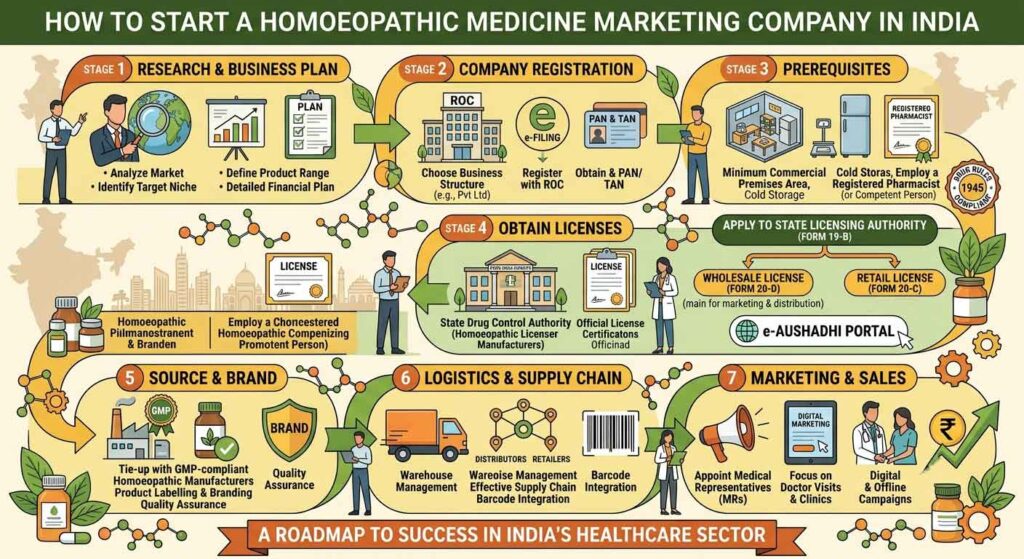
Step-by-Step Procedure to Start a Homoeopathic Marketing Company
Step 1: Decide Your Business Model
First, decide how you want to operate.
Common business models include:
Wholesale distribution
PCD or franchise marketing
Own brand marketing
Doctor prescription-based marketing
Retail supply
Online promotion with compliant distribution
Third-party manufacturing under your brand
For a new company, own brand marketing through third-party manufacturing is a popular option.
Step 2: Register Your Business
You can start as:
Proprietorship
Partnership firm
LLP
Private Limited Company
If you want to build a long-term brand, appoint distributors, and expand across India, a Private Limited Company or LLP may give better professional image.
However, proprietorship or partnership may be easier for small-scale start.
Step 3: Apply for Homoeopathic Wholesale Drug Licence
Apply for the required homoeopathic wholesale licence through your State Drug Control Department or local licensing authority.
Common documents may include:
Application form
Government fee receipt
Business constitution documents
Proprietor, partner, or director ID proof
Premises ownership proof or rent agreement
Site plan and key plan
Affidavit or declaration
GST details, if available
Competent person details, where required
Existing drug licence copy, if any
Inspection compliance documents
The licensing authority may inspect your premises before granting licence.
Step 4: Apply for GST Registration
GST registration is required for proper billing, purchase, sale, interstate supply, and input tax credit.
Most manufacturers, distributors, and retailers will ask for GST details before starting business with you.
Step 5: Finalize Product List
Product selection is very important in homoeopathic marketing.
Common homoeopathic product categories include:
Dilutions
Mother tinctures
Biochemic tablets
Biocombination tablets
Syrups
Drops
Ointments
Oils
Tonics
Specialty combinations
Single remedies
General wellness products
Select products according to your target market.
For example:
If your target is homoeopathic doctors, focus on commonly prescribed remedies.
If your target is retail counters, focus on fast-moving products.
If your target is franchise partners, prepare a wider product list.
If your target is clinics, prepare doctor-friendly literature and product information.
Step 6: Select a Licensed Homoeopathic Third-Party Manufacturer
Choosing the right manufacturer is one of the most important decisions.
Before finalizing a manufacturer, check:
Valid homoeopathic manufacturing licence
Product range
Batch size
Manufacturing capacity
Quality control system
Packaging quality
Delivery timeline
Documentation support
Market reputation
Pricing
Minimum order quantity
Do not choose a manufacturer only because of low rate. Quality, documentation, and timely dispatch matter more in the long run.
Step 7: Finalize Brand Name and Trademark
Before printing labels and packaging, check your brand names carefully.
You should:
Search trademark availability
Avoid names similar to existing brands
Avoid misleading disease-cure names
Avoid prohibited claims
Register trademark where possible
Finalize company logo and design
A strong brand identity helps in marketing and protects your business from future disputes.
Step 8: Prepare Packaging and Label Matter
Homoeopathic medicine labels should be prepared carefully as per applicable rules.
Packaging may include:
Product name
Potency or strength, where applicable
Composition
Batch number
Manufacturing date
Expiry date
Net quantity
Manufacturer details
Marketed by details
Licence number
MRP
Storage instructions
Alcohol content warning, where applicable
Other required declarations
Always get label matter checked by the manufacturer and regulatory professional before printing.
Step 9: Maintain Records for Alcoholic Homoeopathic Medicines
Many homoeopathic preparations contain alcohol.
For alcoholic homoeopathic medicines, special care is required in purchase and sale records.
Maintain proper records of:
Purchase details
Sale details
Batch number
Quantity
Buyer name
Buyer address
Invoice details
Stock movement
This is an important compliance point and should not be ignored.
Step 10: Plan Marketing Strategy
Homoeopathic medicine marketing may be done through multiple channels.
Common marketing methods include:
Homoeopathic doctor promotion
Distributor appointment
Retail pharmacy supply
Homoeopathic pharmacy supply
Clinic-based promotion
Franchise or PCD model
Product catalogue
Visual aids
Digital marketing
Educational blog content
WhatsApp product communication
Trade exhibitions
Marketing strategy should be ethical, compliant, and focused on product knowledge rather than exaggerated disease claims.
Step 11: Appoint Distributors or Franchise Partners
After you have product stock and licence, you can appoint distributors or franchise partners.
Before appointing partners, collect:
Drug licence copy
GST certificate
Firm details
Address proof
Contact details
Payment terms acceptance
Territory details
Agreement, if applicable
Clear terms help avoid future disputes.
Step 12: Decide Payment Policy
Like other pharma segments, payment management is important in homoeopathic marketing.
You may follow:
Advance payment for new parties
Partial advance and balance before dispatch
COD
Credit only for trusted distributors
Security cheque, where practically acceptable
Written payment terms
Avoid heavy credit in the beginning.
Approximate Investment Required
Investment depends on your scale, product range, packing style, inventory level, and marketing plan.
Major investment heads include:
Drug licence and documentation
GST and business registration
Brand and trademark
Product design and packaging
Third-party manufacturing order
Promotional material
Website and digital marketing
Office and storage setup
Staff and field expenses
Working capital
A small company may begin with selected products and gradually expand. A larger company with full product range, strong packaging, and promotion will require more working capital.
Important Points Before Starting
Before starting a homoeopathic marketing company, remember:
Homoeopathic products require proper licence for sale and distribution.
Existing allopathic wholesale licence may not be enough.
Third-party manufacturer must have valid homoeopathic manufacturing licence.
Alcoholic preparations require proper records.
Labels should comply with applicable rules.
Avoid misleading claims.
Do not overstock slow-moving products.
Start with a focused product range.
Build doctor and distributor trust slowly.
Difference Between Pharma and Homoeopathic Marketing
Pharma and homoeopathic marketing have many similarities, but they are not exactly the same.
Similarities
Both require proper licence.
Both need GST and billing.
Both need distribution network.
Both depend on product quality and service.
Both can use third-party manufacturing.
Differences
Homoeopathic products have different licence forms.
Product categories and preparations are different.
Alcoholic preparations need special record maintenance.
Homoeopathic doctors and pharmacies are a separate target market.
Product explanation and promotion style is different.
Final Thoughts
Starting a homoeopathic medicine marketing company can be a good opportunity for entrepreneurs who understand healthcare distribution, doctor promotion, and product marketing.
If you already have an allopathic wholesale drug licence, you should not assume that it covers homoeopathic medicines. Apply for the required homoeopathic wholesale licence, usually Form 20-D, before starting sale or distribution.
For beginners, third-party manufacturing is a practical way to launch products under your own brand without setting up a manufacturing unit.
Success in this business depends on:
Proper licence
Quality products
Reliable manufacturer
Good packaging
Ethical marketing
Strong distribution network
Timely supply
Controlled credit policy
Start with a clear plan, limited product range, and strong compliance foundation.
Frequently Asked Questions
1. Which licence is required to start a homoeopathic medicine marketing company?
For wholesale sale and distribution of homoeopathic medicines, Form 20-D licence is generally required. Confirm the exact requirement from your State Drug Licensing Authority.
2. Can I sell homoeopathic medicines with an allopathic wholesale drug licence?
Generally, no. An allopathic wholesale licence does not automatically cover homoeopathic medicines. You may need a separate homoeopathic wholesale licence.
3. Can I start homoeopathic business through third-party manufacturing?
Yes. You can get products manufactured from a licensed homoeopathic manufacturer and market them under your own brand, subject to proper licence and compliance.
4. Which manufacturing licence is required for homoeopathic medicines?
Manufacturing of homoeopathic medicines is generally done under Form 25-C by a licensed manufacturer.
5. Is GST required for homoeopathic medicine business?
Yes. GST registration is generally required for billing, purchase, sale, distribution, and interstate business.
6. What products can be included in a homoeopathic product list?
Common products include dilutions, mother tinctures, biochemic tablets, biocombinations, drops, syrups, ointments, oils, and specialty combinations.
7. Are records required for alcoholic homoeopathic medicines?
Yes. Purchase and sale records should be maintained carefully for homoeopathic medicines containing alcohol.
8. Is homoeopathic medicine marketing similar to pharma marketing?
The marketing structure is similar in terms of distribution and promotion, but licence forms, product category, target practitioners, and compliance requirements differ.
9. Can I appoint PCD or franchise distributors for homoeopathic medicines?
Yes, you can appoint distributors or franchise partners, but they should have required licences and GST registration as applicable.
10. What is the best way to start for beginners?
Beginners should start with a limited product range, proper Form 20-D licence, GST registration, a reliable third-party manufacturer, and a focused distributor or doctor-promotion strategy.
Looking for Ayurvedic Franchise or Distribution Opportunities?
Looking to start an Ayurvedic franchise, become a distributor, or launch your own herbal product range?
Elzac Herbal India offers:
Ayurvedic & Herbal Product Range
Franchise & Distribution Opportunities
Third-Party Manufacturing Services
Product Development Support
Marketing Guidance
PAN India Business Opportunities
Whether you are an entrepreneur, retailer, distributor, or healthcare professional, our team can help you explore the right business opportunity in the growing Ayurvedic sector.
Ajay Kamboj is an entrepreneur and business owners associated with many Ayurvedic and Pharmaceutical start-ups. With years of experience in Ayurvedic product marketing, pharmaceutical distribution, franchise development, and client relationship management, he regularly shares practical business insights based on real-world experiences. His articles focus on business growth, entrepreneurship, customer management, and lessons learned from the healthcare and wellness industry.
One response to “How to Start a Homoeopathic Medicine Marketing Company in India”
How to start Homoeopathic Medicine Marketing Company?






How to start Homoeopathic Medicine Marketing Company?