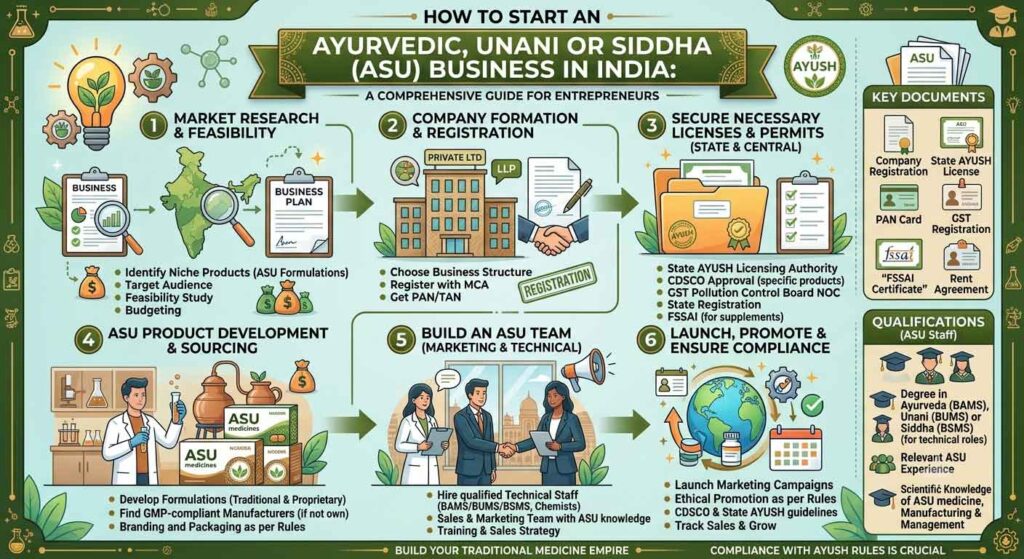
Select the exact business model first, identify whether each product is a medicine, food, cosmetic or device, and then obtain the licences applicable to that activity.
Ayurveda, Unani and Siddha: Important Difference
Ayurveda, Unani and Siddha are recognized systems of Indian medicine, but they are not interchangeable.
Ayurveda
Ayurveda is practised by appropriately qualified and registered Ayurvedic practitioners, commonly holding recognized qualifications such as BAMS.
Panchakarma is a specialized Ayurvedic therapeutic discipline.
Unani
Unani medicine is practised by appropriately qualified and registered Unani practitioners, commonly holding recognized qualifications such as BUMS.
Unani centres should describe their therapies according to the Unani system rather than calling every treatment Panchakarma.
Siddha
Siddha medicine is practised by appropriately qualified and registered Siddha practitioners, commonly holding recognized qualifications such as BSMS.
Siddha centres should offer and describe treatments within the practitioner’s recognized training and registration.
Clinical standards require practitioners to be registered with the relevant State or National Commission and to provide services in accordance with their qualification, training and registration.
Main Business Options
Business model
Principal requirement
Own ASU manufacturing unit
Form 25-D manufacturing licence and Schedule T GMP
Loan-licence manufacturing
Form 25-E loan licence
Third-party marketing company
Licensed manufacturer, product approval, agreement and business registrations
Wholesale or distribution
No separate central ASU sale licence ordinarily; verify state rules
Retail medicine shop
No separate central ASU sale licence ordinarily; verify state and local rules
Online medicine shop
Offline requirements plus e-commerce and Schedule E(1) controls
Ayurveda clinic
Qualified and registered Ayurvedic practitioner
Unani clinic
Qualified and registered Unani practitioner
Siddha clinic
Qualified and registered Siddha practitioner
Panchakarma centre
Registered Ayurvedic practitioner and therapy-centre compliance
Nutraceutical business
Applicable FSSAI licence
Cosmetic business
Applicable Cosmetics Rules compliance
Direct-selling company
Consumer Protection (Direct Selling) Rules
Export business
Domestic compliance, IEC and importing-country requirements
Product Classification Comes First
Before registering the business, determine whether each product is legally classified as:
Ayurvedic medicine
Siddha medicine
Unani medicine
Food supplement
Nutraceutical
Cosmetic
Medical device
General wellness product
The same dosage form can fall under different laws.
For example, a capsule may be:
An Ayurvedic medicine
A nutraceutical
A conventional drug
A food supplement
A syrup may be:
An Ayurvedic proprietary medicine
A classical Ayurvedic formulation
A food beverage
A nutraceutical
A conventional medicine
The category depends on:
Formula
Ingredients
Classical reference
Intended use
Product claims
Regulatory permission
Labelling
Ayurvedic, Siddha and Unani drugs are regulated under specific provisions of the Drugs and Cosmetics Act and Drugs Rules. The relevant Rules cover manufacture, labelling, packing, testing and enforcement.
Business Model 1: Ayurvedic, Siddha or Unani Manufacturing Unit
Manufacturing requires the highest level of investment and regulatory responsibility.
A licensed manufacturer is responsible for:
Raw-material authenticity
Formula compliance
Manufacturing processes
Product testing
Batch records
Labelling
Shelf life
Product complaints
Recalls
Quality and safety
Manufacturing-Licence Forms
Own Manufacturing Licence
An application is generally submitted in:
Form 24-D
The manufacturing licence is granted in:
Form 25-D
Loan Licence
An application is generally submitted in:
Form 24-E
The loan licence is granted in:
Form 25-E
A loan licence allows an applicant without its own complete manufacturing arrangements to use the approved facilities of another Form 25-D manufacturer under the regulatory arrangement.
Form 25-D and Form 25-E are the current licensing routes identified by State ASU drug-control authorities.
Who Grants the Manufacturing Licence?
Manufacturing licences are granted by the concerned State Licensing Authority or State Drug Controller.
They are not ordinarily issued directly by the central Ministry of Ayush.
The e-AUSHADHI system provides online services for licensing and management of Ayurveda, Siddha, Unani and homoeopathic manufacturing establishments and testing laboratories.
Schedule T GMP
Manufacturing premises must comply with Good Manufacturing Practices under Schedule T.
Schedule T compliance covers areas such as:
Location and surroundings
Factory building
Hygiene
Water
Waste disposal
Raw-material control
Manufacturing procedures
Equipment
Quality control
Documentation
Storage
Complaints
Product recall
Compliance with Schedule T, applicable pharmacopoeial standards and evidence requirements is mandatory for manufacturers.
Manufacturing-Premises Area
Many state checklists use approximately 1,200 square feet of compliant built-up premises as a baseline for an initial ASU manufacturing setup.
However, it should not be treated as a guaranteed nationwide area for every project.
Additional space may be necessary for:
Multiple dosage forms
Raw herbs
Separate Unani or Siddha processes
Minerals and metals
Furnace operations
Fermentation
Quality-control laboratory
Packing
Quarantine
Finished-goods storage
Rejected materials
Utilities
Kerala’s current official guidance uses 1,200 square feet as a baseline and also specifies manufacturing, quality-control and storage infrastructure.
Manufacturing Sections
A plant may establish one or more sections.
Powder or Churna Section
May require:
Herb-cleaning area
Dryer
Pulverizer
Sifter
Blender
Dust extractor
Filling machine
Sealing machine
Tablet and Vati Section
May require:
Pulverizer
Sifter
Mass mixer
Granulator
Dryer
Blender
Tablet press
Coating equipment
Blister or bottle-packing line
Capsule Section
May require:
Grinder
Sifter
Blender
Capsule-filling machine
Capsule polisher
Packing equipment
Liquid Section
May manufacture:
Syrups
Kwatha
Liquid extracts
Drops
Certain Unani preparations
Possible equipment includes:
Water-treatment system
Manufacturing vessel
Storage vessel
Homogenizer
Filtration unit
Filling machine
Capping and labelling equipment
Oil and Ghrita Section
May require:
Heating vessel
Steam-jacketed kettle
Mixing vessel
Filtration unit
Storage vessel
Filling equipment
Avaleha and Semi-Solid Section
Possible equipment includes:
Heating vessels
Mixing equipment
Concentration system
Controlled filling
Cooling arrangements
Asava and Arishta Section
Requires controlled fermentation, including:
Suitable fermentation vessels
Batch monitoring
Maturation
Alcohol-content testing
Cleaning controls
Mineral, Metal or Rasaushadhi Section
May require:
Separate processing areas
Furnaces
Heating arrangements
Occupational-safety controls
Environmental approvals
Specialized testing
Appropriate technical expertise
Technical Staff for Manufacturing
Technical-staff requirements depend on the system, products and state checklist.
A current state example requires:
BAMS, BSMS or BUMS-qualified manufacturing supervision
Qualified chemist for quality control
Botanist or pharmacognosy support for herbal-material identification
The final technical-staff requirement must be confirmed with the State Licensing Authority.
Quality-Control Requirements
The manufacturer must establish suitable quality-control arrangements.
Testing may include:
Botanical identification
Foreign matter
Moisture
Ash values
Extractive values
pH
Alcohol content
Microbial limits
Heavy metals
Pesticide residues
Aflatoxins
Finished-product specifications
Stability
Approved ASU testing laboratories are regulated under Rules 160-A to 160-J. Manufacturers remain responsible for product quality even where certain tests are outsourced.
Product Approval
A manufacturing licence does not automatically authorize every medicine.
Each product may require submission of:
Product name
Dosage form
Complete formula
Quantity of ingredients
Botanical name
Part used
Classical reference
Manufacturing method
Finished-product specification
Test method
Dose
Indications
Cautions
Proposed label
Safety and effectiveness evidence
Rule 158-B prescribes the licensing framework for classical and patent or proprietary ASU medicines, including applicable evidence requirements.
Classical and Proprietary Medicines
Classical Medicine
A classical medicine follows a formula described in an authoritative book recognized under the Act.
The application should contain the exact:
Book name
Chapter
Formula
Ingredient
Manufacturing method
Patent or Proprietary Medicine
A patent or proprietary ASU medicine is a formulation made from ingredients recognized in the authoritative books but is not itself the exact classical formula.
The term “patent or proprietary” does not mean that the product has received a patent.
Manufacturing Documents
Common documents include:
Form 24-D or Form 24-E
Fee receipt
Entity documents
Ownership or lease documents
Owner’s NOC
Layout plan
Site plan
Machinery list
Laboratory-equipment list
Technical-staff documents
Product applications
Schedule T documents
Water-analysis report
Pollution-control documents
Fire and factory approvals
Site Master File
SOP list
Quality-control arrangements
State-specific checklists and fees must be confirmed before submission.
Investment for Manufacturing
There is no fixed statutory investment amount.
Broad planning ranges may be:
Manufacturing project
Illustrative investment
Small leased single-category unit
₹40 lakh–₹1.25 crore
Multi-section ASU manufacturing facility
₹1.25–₹5 crore or more
Large automated or export-oriented plant
₹5 crore to several crores
The estimate depends on:
Premises
Dosage forms
Machinery
Laboratory
Raw materials
Packing
Staff
Utilities
Working capital
Business Model 2: Ayurvedic, Unani or Siddha Marketing Company
A marketing company develops and promotes products but gets them manufactured by a licensed third-party manufacturer.
Does a Marketing Company Need a Manufacturing Licence?
A pure marketing company using a properly licensed third-party manufacturer does not ordinarily require its own Form 25-D manufacturing licence.
The actual manufacturer must hold:
Form 25-D or applicable loan licence
Schedule T GMP compliance
Product permission
Suitable manufacturing sections
The marketing company should maintain a written agreement covering:
Formula
Product approval
Quality
Testing
Packaging
Complaints
Recall
Liability
Intellectual property
Payment
Expiry policy
Registrations for a Marketing Company
Common registrations may include:
Proprietorship, partnership, LLP or company
PAN
GST registration
Current bank account
Trademark application
Shop and Establishment registration
Municipal trade licence
Udyam registration
FSSAI licence for food-category products
Cosmetic or device-related compliance where applicable
FSSAI Relabeller Requirement
Where the business gets nutraceuticals or food supplements manufactured through a third-party food manufacturer, FoSCoS directs the brand owner to apply under the Relabeller Kind of Business.
The earlier new-application categories of “Supplier” and “Marketer” have been disabled.
Qualification for Marketing Company
No BAMS, BUMS, BSMS, B.Pharm or D.Pharm qualification is ordinarily required merely to own an ASU marketing company.
However:
Medical consultation requires a qualified practitioner.
Product development should involve qualified technical experts.
Medicinal claims must remain within approved product permissions.
Marketing employees should not diagnose or prescribe.
Marketing-Company Investment
Broad illustrative ranges are:
Marketing model
Planning range
Small PCD or third-party launch
₹4–12 lakh
Structured 10–25 product company
₹12–30 lakh
Regional marketing company
₹30 lakh–₹1 crore or more
The main investment heads are:
Initial products
MOQ
Packaging
Artwork
Trademark
Marketing material
Staff
Distributor credit
Reorder funding
Business Model 3: Wholesale and Distribution
An ASU distributor purchases products and supplies:
Retail shops
Clinics
Hospitals
Other distributors
Wellness centres
Institutions
Is a Drug-Sale Licence Required?
The Ministry of Ayush has stated that a separate sale licence is not required for Ayurvedic medicines under the central framework. Kerala’s current official guidance similarly says Ayurvedic, Siddha and Unani medicines do not require a special licence for sale, provided the products come from approved manufacturers.
However, the statement:
“No licence is required anywhere in India”
is unsafe.
Karnataka currently provides an online state service for licensing an establishment that sells or stores Ayurvedic, Siddha, Unani and homoeopathic medicines.
Therefore, verify the position with the:
State AYUSH Department
State Licensing Authority
District AYUSH Officer
Municipal authority
Distribution Registrations
A distributor may require:
Entity registration
PAN
GST
Shop and Establishment registration
Trade licence
State AYUSH establishment registration
FSSAI licence
Medical-device registration
Other product-category licences
Storage Controls
Maintain:
Clean racks
Dry premises
Pest control
Batch-wise records
Expiry control
Returned-goods segregation
Damaged-stock segregation
Schedule E(1) identification
Recall records
Business Model 4: Ayurvedic, Unani or Siddha Medicine Shop
A medicine shop sells properly licensed packaged medicines to consumers.
Central Sale-Licence Position
A separate central sale licence is ordinarily not prescribed merely for selling licensed Ayurvedic, Siddha or Unani medicines.
Nevertheless, local or state registrations can apply.
Qualification for Shop Owner
No system-specific medical degree is ordinarily required merely to own or operate an ASU medicine shop.
The shopkeeper may sell packaged products but should not:
Diagnose disease
Prescribe treatment
Advise patients to stop medical treatment
Claim to be a Vaidya, Hakim or Siddha doctor
Conduct therapeutic procedures without qualification
Guarantee a cure
Mixed-Product Shop
Separate requirements arise where the shop also sells:
Allopathic Medicines
Requires applicable retail drug licences and a registered pharmacist.
Homoeopathic Medicines
Requires the applicable homoeopathic retail licence.
Food Supplements
Requires FSSAI registration or licensing.
Medical Devices
May require premises registration under the Medical Devices Rules.
Cosmetics
Must comply with applicable cosmetic and packaging requirements.
Shop Investment
Broad planning ranges:
Shop model
Illustrative investment
Small local ASU shop
₹3–7 lakh
Well-stocked shop
₹7–15 lakh
Large franchise or wellness outlet
₹15–40 lakh or more
Business Model 5: Online Ayurvedic, Unani or Siddha Store
Online sales do not eliminate offline regulatory requirements.
The business should comply with:
Business registration
GST
E-commerce rules
Consumer-protection requirements
Product-category licences
Packaging declarations
Return and refund policies
Advertising restrictions
Data and prescription controls
Schedule E(1) Products
Medicines containing Schedule E(1) ingredients must carry:
“Caution: To be taken under medical supervision”
in English and Hindi.
The CCPA has advised e-commerce platforms to permit sale of Schedule E(1) ASU medicines only after the consumer uploads a valid prescription from a registered practitioner of the relevant system.
The online system should:
Flag Schedule E(1) products
Require prescription upload
Prevent automatic unrestricted checkout
Maintain records
Display warnings
Verify practitioner details where possible
Product-Quality Responsibility
Government authorities inspect and sample ASU medicines from manufacturers and retail shops. Where products fail standards, authorities may stop sales and initiate legal action.
Online sellers should therefore verify:
Manufacturer’s licence
Product approval
Batch
Expiry
Ingredients
Label
Supplier invoice
Schedule E(1) warning
Business Model 6: Ayurveda, Unani or Siddha Clinic
A clinic provides:
Consultation
Examination
Diagnosis
Prescription
Follow-up
Health advice
Dispensing, where permitted
Qualification Required
The practitioner should possess a recognized qualification in the relevant system and be registered with the appropriate State or National register.
Clinical standards define an AYUSH clinic as an establishment in which registered practitioners provide consultation, examination and prescriptions.
The practitioner’s name, qualification and registration number should be displayed.
Clinical-Establishment Registration
Clinic registration depends on:
Clinical Establishments Act applicability
State clinical-establishment law
Nursing-home law
Municipal rules
State AYUSH requirements
The central Clinical Establishments Act currently applies in adopting states and union territories and covers recognized systems of medicine, including single-doctor clinics.
Minimum Clinic Standards
The national minimum standards for an AYUSH consultation clinic specify:
Registered practitioner
Safe and hygienic environment
Ventilation and lighting
Registration signage
Fee display
Patient records
Infection control
Biomedical-waste management
First-aid arrangements
Emergency contact details
The published standard uses 100 square feet as the normal consultation-clinic baseline, with a limited 75-square-foot relaxation for space-constrained cities. State requirements may be higher.
Clinic Documents
Common documents may include:
Degree certificate
Internship completion
State or national registration
Identity proof
Premises documents
Clinical-establishment registration
Trade licence
Biomedical-waste agreement
Fire documents where applicable
Staff documents
Professional indemnity insurance
Patient-record formats
Clinic Records
Maintain:
Patient registration
History
Examination
Diagnosis
Prescription
Treatment
Consent
Follow-up
Referrals
Adverse reactions
Bills and receipts
Business Model 7: Panchakarma Centre
Panchakarma belongs specifically to the Ayurvedic system.
A Panchakarma centre should ordinarily operate under the clinical supervision of a registered Ayurvedic practitioner trained in the procedures being offered.
A massage or spa establishment should not present itself as a medical Panchakarma centre unless it meets clinical requirements.
Panchakarma-Centre Classification
Depending on services, the centre may be treated as:
Ayurveda clinic with procedures
AYUSH therapy centre
Day-care centre
Clinical establishment
Hospital, where inpatient beds are provided
The national Clinical Establishments framework separately publishes minimum standards for:
Consultation clinics
Dispensaries
Therapy or day-care centres
AYUSH hospitals
Panchakarma Infrastructure
Depending on services, the centre may require:
Doctor’s consultation room
Waiting area
Male therapy room
Female therapy room
Changing space
Attached or nearby washroom
Handwashing
Therapy tables
Shirodhara equipment
Steam chamber
Oil-heating arrangements
Medicine storage
Laundry arrangements
Waste segregation
Emergency equipment
Privacy controls
Panchakarma Staff
A centre may require:
Registered Ayurvedic doctor
Trained Panchakarma therapists
Male and female therapists
Nursing or support staff
Reception and housekeeping personnel
Therapists should work under documented clinical instructions and should not independently diagnose or prescribe.
Panchakarma Safety
Before treatment, maintain:
Medical assessment
Patient history
Contraindication review
Written treatment plan
Informed consent
Therapy record
Emergency referral plan
Hygiene and infection controls
Certain procedures require careful patient selection and should not be offered as general spa packages.
Panchakarma Claims
Avoid statements such as:
Guaranteed detoxification
Permanent cure
Removes every toxin
Cures diabetes in seven days
Reverses all chronic disease
Safe for every person
Claims should be consistent with:
Practitioner competence
Accepted clinical practice
Available evidence
Advertising law
Patient-specific assessment
Panchakarma-Centre Investment
Centre type
Broad planning range
Small consultation and therapy centre
₹8–20 lakh
Structured Panchakarma day-care centre
₹20–50 lakh
Premium multi-room centre
₹50 lakh–₹2 crore or more
The estimate depends on:
Location
Interiors
Therapy rooms
Equipment
Staffing
Laundry
Heating and ventilation
Clinical-establishment requirements
Siddha and Unani Therapy Centres
A Siddha or Unani practitioner may establish a therapy centre according to:
Recognized system-specific treatments
Professional qualification
State registration
Clinical-establishment standards
Practitioner competence
Such centres should not use “Panchakarma” as a general term where the procedures are not Ayurvedic Panchakarma.
Business Model 8: Consultancy
Consultancy may include:
Product-development consulting
Manufacturing-project planning
Quality-control advice
Distribution planning
Packaging and branding
Regulatory documentation
Clinic-management consulting
No medical qualification is necessarily required for general business consultancy.
However, clinical consultation, diagnosis and prescription require a qualified and registered practitioner.
A business consultant should not present themselves as a medical practitioner.
Business Model 9: PCD and Franchise
Franchise opportunities include:
Product-distribution franchise
Retail outlet franchise
Clinic brand franchise
Panchakarma-centre franchise
Third-party product franchise
Product Franchise
The franchise partner may:
Purchase products
Promote brands
Supply shops
Develop a territory
Appoint distributors
Required registrations depend on:
Product categories
Stock model
State sale requirements
GST
FSSAI
Local business laws
Clinic or Panchakarma Franchise
A franchise agreement does not permit an unqualified person to practise medicine.
Every clinical outlet must independently comply with:
Practitioner registration
Clinical-establishment registration
Staffing
Patient records
Biomedical waste
Local requirements
Franchise Agreement
A written agreement should cover:
Territory
Products or services
Brand use
Investment
Purchase terms
Royalty
Training
Quality standards
Advertising
Patient safety
Complaints
Termination
Closing stock
Intellectual property
Business Model 10: Direct Selling or MLM
Direct selling of legally compliant ASU products is possible, but the business must comply with the Consumer Protection (Direct Selling) Rules, 2021.
The Rules apply to direct-selling entities and sellers and prohibit:
Pyramid schemes
Recruitment-based disguised schemes
Money-circulation schemes
They also require written seller contracts, consumer disclosures, grievance systems and product-law compliance.
Warning Signs of an Illegal Scheme
Be cautious where:
Earnings depend mainly on recruitment.
Large joining fees are charged.
Members must purchase excessive stock.
Products have little genuine retail demand.
No return or buy-back process exists.
Unrealistic income is promised.
A product should not be used merely as a cover for a pyramid scheme.
Business Model 11: Export
Export may involve:
Ayurvedic medicines
Unani medicines
Siddha medicines
Herbal cosmetics
Food supplements
Raw herbs
Wellness services
Export Requirements
Possible requirements include:
Valid domestic product and manufacturing licences
IEC
GST
Export invoices
Product dossier
Free Sale Certificate
Certificate of Pharmaceutical Product
GMP or WHO-GMP documentation
Country-specific product registration
Certificate of analysis
Heavy-metal testing
Microbial testing
Stability data
Country-specific label
Importer authorization
Domestic approval does not automatically authorize sale in another country.
CDSCO publishes details of Ayurvedic products for which CoPP has been granted under the WHO-GMP certification scheme.
GST on ASU Medicines
From 22 September 2025, drugs and medicines generally attract 5% GST except items specifically placed under the nil-rate category.
However, this rate should not automatically be used for:
Food supplements
Herbal drinks
Cosmetics
Personal-care products
Devices
GST classification should be confirmed product-wise.
Advertising and Product Claims
Manufacturers, marketers, shops, online sellers, clinics and franchisees should avoid misleading claims.
Do not advertise:
No side effects
Guaranteed cure
Permanent cure
Government-approved cure
Works within a fixed number of days
Safe for everybody
Replaces surgery
Replaces prescribed medical treatment
The Government’s AYUSH quality and pharmacovigilance framework includes monitoring of suspected adverse reactions and objectionable or misleading advertisements through Ayush Suraksha.
Important Business Registrations
Depending on the model, registrations may include:
Proprietorship, partnership, LLP or company
PAN
GST
Current account
Shop and Establishment registration
Trade licence
Udyam
Trademark
FSSAI
Clinical-establishment registration
Biomedical-waste authorization
Fire NOC
Pollution Control Board consent
Factory licence
IEC
No single registration covers every ASU business activity.
Documents Generally Required
Business Documents
PAN
Aadhaar or identity proof
Address proof
Entity documents
Partnership deed
Incorporation documents
Bank details
Authorization
Premises Documents
Ownership proof
Rent or lease agreement
Owner’s NOC
Utility bill
Site plan
Commercial or industrial-use proof
Technical Documents
Degree certificates
Practitioner registration
Technical-staff appointment
Experience records
Manufacturing or laboratory qualifications
Product Documents
Formula
Classical reference
Product permission
Label
Manufacturer’s licence
GMP certificate
Certificate of analysis
Marketing agreement
Step-by-Step Business-Selection Guide
Choose Manufacturing When:
You have substantial capital.
You have technical experience.
You have regular demand.
You intend to manufacture for other brands.
You can manage daily GMP compliance.
Choose Third-Party Marketing When:
You want to build brands.
Capital is limited.
You want multiple dosage forms.
You do not want to operate a factory.
Faster market entry is needed.
Choose Distribution When:
You know local retailers and clinics.
You can manage stock and credit.
You have delivery capability.
You prefer trading over product promotion.
Choose a Shop When:
You have a suitable retail location.
Local consumer demand exists.
You can maintain a proper product range.
You understand mixed-product licences.
Choose a Clinic When:
You possess the recognized system-specific qualification.
Your professional registration is active.
You can meet clinical-establishment requirements.
Choose a Panchakarma Centre When:
A qualified Ayurvedic doctor will supervise it.
Trained therapists are available.
Clinical safety and hygiene systems can be maintained.
The business is not merely a spa using a medical name.
Common Mistakes
Avoid:
Treating Ayurveda, Unani and Siddha as identical systems
Describing every therapy centre as Panchakarma
Claiming that no licence is required for any ASU business
Ignoring state-specific shop registration
Manufacturing products without Form 25-D
Marketing products from an unlicensed manufacturer
Treating food supplements as medicines
Allowing an unqualified owner to practise medicine
Opening a clinic without practitioner registration
Opening a therapy centre without clinical-establishment review
Making no-side-effect claims
Selling Schedule E(1) products online without prescription controls
Operating an MLM based primarily on recruitment
Exporting without importing-country registration
Launching too many products without working capital
Frequently Asked Questions
1. Which licence is required for ASU manufacturing?
An application is generally made in Form 24-D, and the manufacturing licence is issued in Form 25-D.
2. What is a loan licence?
An application is made in Form 24-E, and the loan licence is granted in Form 25-E to use another approved manufacturer’s facilities.
3. Is Schedule T GMP compulsory?
Yes. Schedule T compliance is mandatory for licensed Ayurvedic, Siddha and Unani manufacturing.
4. Is a licence required to sell Ayurvedic medicines?
A separate central ASU sale licence is ordinarily not prescribed, but state-specific shop or establishment registration may apply.
5. Is a licence required for Unani and Siddha medicine shops?
The central position is similar, but the concerned state’s AYUSH rules and local registrations should be checked.
6. Is any qualification required to own an ASU shop?
No system-specific degree is ordinarily required merely to own a shop. Medical practice requires a recognized degree and registration.
7. Can a BAMS doctor open a Unani clinic?
A practitioner should practise according to their recognized system, qualification and registration. A BAMS qualification does not automatically authorize independent practice as a Unani physician.
8. Can a BUMS practitioner run a Panchakarma centre?
Panchakarma is an Ayurvedic discipline. The centre should be clinically supervised by a suitably qualified and registered Ayurvedic practitioner.
9. Who can open a Siddha clinic?
A suitably qualified and registered Siddha practitioner may provide Siddha clinical services according to applicable state requirements.
10. Is FSSAI required?
FSSAI registration or licensing is required for nutraceuticals, food supplements and other food-category products.
11. Can Schedule E(1) medicines be sold online?
E-commerce platforms have been advised to sell such medicines only after upload of a valid prescription from a registered practitioner.
12. Can ASU products be sold through MLM?
Yes, provided the products comply with applicable laws and the business complies with the Direct Selling Rules. Pyramid and money-circulation schemes are prohibited.
13. Is GST applicable?
Drugs and medicines generally attract 5% GST from 22 September 2025, except specifically nil-rated products. Other product categories may have different rates.
14. Can products be exported with only an Indian manufacturing licence?
No. Importing-country product registration and additional export documentation may be required.
15. Which business requires the lowest investment?
A small PCD, distribution or third-party marketing model normally requires less investment than establishing a manufacturing plant or full Panchakarma facility.
Final Conclusion
The correct process for starting an Ayurvedic, Unani or Siddha business is:
Select the exact business activity → Confirm the product category → Check central and state requirements → Register the entity → Arrange qualified staff where required → Obtain activity-specific licences → Purchase or manufacture only approved products → Maintain quality, safety and records → Use responsible advertising → Expand only after achieving stable demand
The major distinction is:
Manufacturing requires a manufacturing licence and Schedule T GMP.
Selling ASU medicines generally does not require a separate central sale licence, but state and local requirements may apply.
Clinical diagnosis and treatment require a qualified and registered practitioner.
Panchakarma should operate as a clinically supervised Ayurvedic service—not merely as a wellness massage business.
Looking for Ayurvedic Franchise or Distribution Opportunities?
Looking to start an Ayurvedic franchise, become a distributor, or launch your own herbal product range?
Elzac Herbal India offers:
Ayurvedic & Herbal Product Range
Franchise & Distribution Opportunities
Third-Party Manufacturing Services
Product Development Support
Marketing Guidance
PAN India Business Opportunities
Whether you are an entrepreneur, retailer, distributor, or healthcare professional, our team can help you explore the right business opportunity in the growing Ayurvedic sector.
Ajay Kamboj is an entrepreneur and business owners associated with many Ayurvedic and Pharmaceutical start-ups. With years of experience in Ayurvedic product marketing, pharmaceutical distribution, franchise development, and client relationship management, he regularly shares practical business insights based on real-world experiences. His articles focus on business growth, entrepreneurship, customer management, and lessons learned from the healthcare and wellness industry.
33 responses to “How to Start an Ayurvedic, Unani or Siddha Business in India”
ayurvedic marketing company ka registration india level par kaha hoga..please mujhe bataye
Sir I have a license from drug controller to manufacturing herbal medicine. I want list of all the permission or registration for running a firm. And list if all the equipment. List of official person like lab assistant
Sir. I am from Assam (middle segment of Assam) I m totally unknown about production & marketing of Ayurvedic medicine, but I m very interested to setup the business because I m hard worker and I hope I will success in this field with your kind help.so please write to me how can I will start and what is primary work for that.please inform me : dalilnagaon@hotmail.com. Phone 09864160172 If some producer wants to provide dealership in Assam or for entire north east area then you may kindly inform me. I m interested .
Sir I want start buisness for self home made herbal products like soap shampoo hair oil essential oils do we need license for making marketing herbal home made products , if yes waht is the procedure all are manufactured on experience
I have setup a pvt ltd company for selling herbal product, i am thinking of third party manufacturing. For this its compulsory to get brand name or trademark registration ?
Can i use "my comapny name ingredient name" eg "Cosm Dashashwa" as product name without registration of trademark ?
A Ayurvedic Doctor, Vaid, Akim or registered Ayurvedic practitioners are alowed to make medicines for their own patients use but if you want to make and sell it then you have to fulfill all requirements as per drug and cosmetic act and rule
sir i made a herbal churn but i dont know how to register and where for sell it.also i dont know that registration is compulsory for it or not.please guide me.
I would like to start Ayurvedha marketing business.Does it required to have drug licence??Please also clarify whether i have to show the name of manufacturer in the packing labels and promotions?
sir,i want to marketing and sales of ayurvadic as well as,vitamins ,minrals,nutraceuticals,dietry suppliment under fssai products in india and abrod ie europe etc for that start or register a company .can you help me in this regards. thanks
My father is an Ayurvedic practitioner and we have our own made confidential herbal medicines to treat serious illness. I want to promote these confidential medicines at large scale. My questions are.. 1, Do we need manufacturing license to give medicine to our patinets ? or to make distributors and supply them from the beginning?
Dear all,
Any one want to open Ayurvedic/juice/extract/medicinal plant processing etc/ company in India/Nepal/Bhutan/Bangladesh
Please contact
we provide full support in building/machinery/productions/formulation/product development/manufacturing/ marketing.
I am a BScChemistry graduate, 50 years part time teacher, Berhampur (W.Bengal) from Calcutta University 1991. I want guidance for growing one/two main ayurvedic medicinal plants in a small plot of land and earn for sustaining my family.
Kindly help me.
Abhijit Mukherjee
I want to Take agency of Ayurvedic products can you please guide me in this. Because I have to start this in a small village. I am Postgraduate in Ayurved.
Need to open a Ayurvedic Manufacture Unit. Pls let me know the procedure, and also provide me consultancy for the same. I want to open this unit in Noida (Delhi NCR)
An ayurvedic massage is a form of traditional Indian medicine that has been practiced for centuries. Ayurveda is based on the belief that good health and well-being are achieved by maintaining balance in the body, mind, and spirit.





ayurvedic marketing company ka registration india level par kaha hoga..please mujhe bataye
Sir I have a license from drug controller to manufacturing herbal medicine. I want list of all the permission or registration for running a firm.
And list if all the equipment.
List of official person like lab assistant
Sir.
I am from Assam (middle segment of Assam) I m totally unknown about production & marketing of Ayurvedic medicine, but I m very interested to setup the business because I m hard worker and I hope I will success in this field with your kind help.so please write to me how can I will start and what is primary work for that.please inform me : dalilnagaon@hotmail.com.
Phone 09864160172
If some producer wants to provide dealership in Assam or for entire north east area then you may kindly inform me. I m interested .
Sir I want start buisness for self home made herbal products like soap shampoo hair oil essential oils do we need license for making marketing herbal home made products , if yes waht is the procedure all are manufactured on experience
Hi
I have setup a pvt ltd company for selling herbal product, i am thinking of third party manufacturing. For this its compulsory to get brand name or trademark registration ?
Can i use "my comapny name ingredient name" eg "Cosm Dashashwa" as product name without registration of trademark ?
I want to a auyurvedic wholesale shop
Please tell tell me the documentation required.
And license procedure.
I am from uttar Pradesh.
I want to a auyurvedic wholesale shop
Please tell tell me the documentation required.
And license procedure.
I am from uttar Pradesh.
A Ayurvedic Doctor, Vaid, Akim or registered Ayurvedic practitioners are alowed to make medicines for their own patients use but if you want to make and sell it then you have to fulfill all requirements as per drug and cosmetic act and rule
sir i made a herbal churn but i dont know how to register and where for sell it.also i dont know that registration is compulsory for it or not.please guide me.
I would like to start Ayurvedha marketing business.Does it required to have drug licence??Please also clarify whether i have to show the name of manufacturer in the packing labels and promotions?
sir,i want to marketing and sales of ayurvadic as well as,vitamins ,minrals,nutraceuticals,dietry suppliment under fssai products in india and abrod ie europe etc for that start or register a company .can you help me in this regards. thanks
My father is an Ayurvedic practitioner and we have our own made confidential herbal medicines to treat serious illness. I want to promote these confidential medicines at large scale. My questions are..
1, Do we need manufacturing license to give medicine to our patinets ? or to make distributors and supply them from the beginning?
contact me Ashwani SHarma 9478178724
is there need of anyu type of licensing authority for wholesale marketing of ayurvedic medicines..
For Ayurvedic Products wholesale, no drug type license is required..
Sir mai aaurvedic maketed by company ke rajistetion ke bare me jankari chahta hun kaise kaha se karana hota hai sir
Me villape me ayurbed ki kudra mullya dokan khulna chahata hu.esliye koi licence chahiye kiya?
Ayurvedic Medicine ko sale krne ke liye koi license nhi chahiye..
I want to start my online business of Ayurvedic medicine. shud I need any type of license other than GST.
Dear all,
Any one want to open Ayurvedic/juice/extract/medicinal plant processing etc/ company in India/Nepal/Bhutan/Bangladesh
Please contact
we provide full support in building/machinery/productions/formulation/product development/manufacturing/ marketing.
I am a BScChemistry graduate, 50 years part time teacher, Berhampur (W.Bengal) from Calcutta University 1991. I want guidance for growing one/two main ayurvedic medicinal plants in a small plot of land and earn for sustaining my family.
Kindly help me.
Abhijit Mukherjee
I want to Take agency of Ayurvedic products can you please guide me in this. Because I have to start this in a small village. I am Postgraduate in Ayurved.
what a great information. I appreciate for your information. thank’s for sharing
contact us at 8930765982
I want to start own manufacturing plant of ayurveda
I am interested a new Ayurvedic manufacturing company.
ok Sir..
Do you have own ayurvedic medicine manufacturing unit
My name is Youssef. I am an Internet Business Marketer and SEO Expert, I have been working in this industry for more than 14 years.
herbal products manufacturing
herbal products manufacturing project report
herbal products manufacturing unit
Need to open a Ayurvedic Manufacture Unit. Pls let me know the procedure, and also provide me consultancy for the same. I want to open this unit in Noida (Delhi NCR)
Regards,
Ashutosh
An ayurvedic massage is a form of traditional Indian medicine that has been practiced for centuries. Ayurveda is based on the belief that good health and well-being are achieved by maintaining balance in the body, mind, and spirit.