Many entrepreneurs want to start a small chemical or hygiene-products business with products such as hand wash, liquid soap, toilet cleaner, floor cleaner, dishwash gel and other household cleaning products.
This is a practical business idea because hygiene, sanitation and personal-care products have regular demand in homes, offices, hospitals, hotels, schools, shops and institutions.
However, before starting, it is important to understand one basic point:
Hand wash and toilet cleaner may look like similar liquid products, but legally they may fall under different categories.
Hand wash is applied to the human body for cleansing and may come under the cosmetic category. Toilet cleaner is a household cleaning chemical and is generally not treated as a cosmetic product.
Therefore, the licence and compliance requirements are different.
Quick Answer
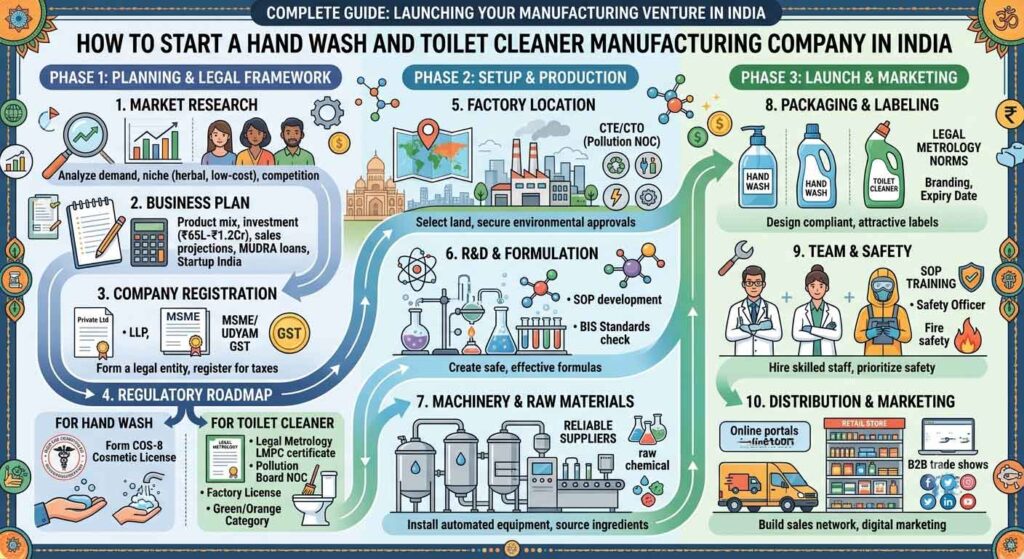
To start a hand wash and toilet cleaner manufacturing company, you should:
Decide the product category.
Register your business.
Obtain GST registration, where applicable.
Apply for Udyam/MSME registration.
Obtain cosmetic manufacturing licence for hand wash, liquid soap and similar human-use cleansing products.
Check pollution-control requirements for chemical manufacturing.
Arrange manufacturing premises, machinery, raw material and packing material.
Follow Legal Metrology labelling rules for packaged goods.
Maintain product quality, batch records and safety documentation.
Start distribution through retailers, wholesalers, institutions and online channels.
Difference Between Hand Wash and Toilet Cleaner
Hand Wash
Hand wash is used on the human body, especially hands, for cleansing.
It may be treated as a cosmetic product because it is applied to the human body.
Examples:
Liquid hand wash
Herbal hand wash
Moisturizing hand wash
Antibacterial hand wash, depending on claims
Liquid soap
Body wash
If you manufacture hand wash, you should check cosmetic manufacturing licence requirements with your State Drug Control Department.
Toilet Cleaner
Toilet cleaner is used for cleaning toilet surfaces and sanitary areas.
It is not applied to the human body.
Examples:
Toilet cleaner liquid
Bathroom cleaner
Floor cleaner
Tile cleaner
Disinfectant cleaner, depending on claims
Cleaning and polishing preparations
Toilet cleaner generally does not require a cosmetic manufacturing licence, but other registrations and permissions may apply depending on formulation, scale, chemicals used, factory location and state rules.
Licence Required for Hand Wash Manufacturing
For hand wash, liquid soap and similar personal cleansing products, a cosmetic manufacturing licence may be required.
The licence is usually obtained from the State Drug Control Department or State Licensing Authority.
Requirements may include:
Proper manufacturing premises
Approved layout plan
Technical staff
Machinery and equipment
Water system
Storage area
Raw material records
Batch manufacturing records
Quality-control arrangements
Labelling compliance
Inspection by authority
The exact requirement may vary from state to state, so it is advisable to consult the local State Drug Control Department before setting up the unit.
Licence Required for Toilet Cleaner Manufacturing
Toilet cleaner is generally a household cleaning chemical product and not a cosmetic product.
You may not need a cosmetic manufacturing licence for toilet cleaner, but you may need to consider:
Business registration
GST registration
Udyam/MSME registration
Local trade licence, where applicable
Factory licence, depending on number of workers and power usage
Pollution Control Board consent, depending on scale and discharge
Fire safety compliance, where applicable
Labour-law compliance, where applicable
Legal Metrology compliance for packaged goods
Proper safety labelling for chemicals
If you use strong acids, hazardous chemicals, flammable materials or disinfectant claims, additional permissions or precautions may be required.
Step-by-Step Process to Start the Business
Step 1: Select Your Product Range
First decide which products you want to manufacture.
Possible products include:
Hand wash
Liquid soap
Herbal hand wash
Toilet cleaner
Bathroom cleaner
Floor cleaner
Dishwash liquid
Glass cleaner
Phenyl
Surface cleaner
Multipurpose cleaner
Beginners should not start with too many products. Start with a focused range and expand gradually.
Step 2: Decide Product Category
Product category decides licence requirement.
For example:
Product
Possible Category
Hand wash
Cosmetic
Liquid soap for hands/body
Cosmetic
Toilet cleaner
Household cleaning chemical
Floor cleaner
Household cleaning chemical
Dishwash liquid
Cleaning preparation
Herbal hand wash
Cosmetic
Medicated hand wash
May require drug/cosmetic classification review
Disinfectant cleaner
Requires careful claim and classification review
Avoid making medical, antibacterial, germ-kill or disinfectant claims without checking the applicable rules.
Step 3: Register Your Business
You may start as:
Proprietorship
Partnership firm
LLP
Private Limited Company
One Person Company
For small manufacturing startups, proprietorship is simple. For larger business plans, partnership, LLP or private limited company may be better.
Step 4: Obtain GST Registration
GST registration may be required depending on turnover, interstate sales, e-commerce sales and business structure.
Even if your turnover is initially low, many distributors and online platforms prefer dealing with GST-registered businesses.
Step 5: Apply for Udyam/MSME Registration
Udyam registration is useful for MSME recognition.
Benefits may include:
MSME certificate
Easier access to some government schemes
Better business credibility
Bank loan support
Tender participation benefits, where applicable
For toilet cleaner and chemical cleaning products, choose the correct NIC code based on manufacturing activity.
A commonly relevant NIC category may fall under manufacture of chemicals and chemical products, including soap, detergents, cleaning and polishing preparations.
Always select NIC code according to your actual product and activity.
Step 6: Arrange Manufacturing Premises
Your premises should be suitable for manufacturing, storage and dispatch.
Basic requirements may include:
Separate raw material area
Manufacturing area
Packing area
Finished goods storage
Water supply
Drainage system
Ventilation
Fire safety arrangements
Worker safety arrangements
Separate chemical storage
Proper floor and cleaning system
For cosmetic manufacturing, premises requirements must comply with the applicable cosmetic rules and state licensing inspection.
For toilet cleaner, chemical-handling safety and pollution-control compliance are important.
Step 7: Arrange Machinery and Equipment
Machinery depends on product type and production scale.
For hand wash and liquid cleaning products, equipment may include:
Mixing tank
Stirrer
Storage tank
Filling machine
Capping machine
Labelling machine
Weighing balance
pH meter
Viscosity testing setup
Measuring cylinders
Water-treatment system, if required
Packing table
Batch coding machine
Small businesses may start with semi-automatic equipment and upgrade later.
Step 8: Arrange Raw Materials
Common raw materials may include:
Surfactants
Thickening agents
Preservatives
Fragrance
Colour
pH adjusters
Chelating agents
Moisturizing agents for hand wash
Acids or cleaning actives for toilet cleaner
Water
Stabilizers
Solubilizers
Packaging components
Raw materials should be purchased from reliable suppliers with proper invoice and quality documents.
Step 9: Prepare Formula and Trial Batch
Before commercial production, prepare a trial batch.
Check:
Appearance
Colour
Fragrance
Foam
Viscosity
pH
Stability
Cleaning performance
Skin feel for hand wash
Compatibility with bottle and cap
Leakage test
Shelf-life behaviour
Do not launch a product without basic stability and quality checks.
Step 10: Develop Packaging and Label Design
Packaging creates the first impression of your brand.
Packing material may include:
Bottle
Cap
Pump
Label
Shrink sleeve
Outer carton, if required
Shipper carton
Label should include mandatory details such as:
Product name
Net quantity
Manufacturing date
Best before or expiry
Batch number
MRP inclusive of all taxes
Manufacturer name and address
Customer care details
Directions for use
Caution or warning
Ingredients, where applicable
Storage instructions
Licence number, where applicable
Step 11: Follow Safety Labelling
For toilet cleaner and chemical cleaning products, safety labelling is very important.
Labels may need caution statements such as:
Keep away from children
For external surface use only
Avoid contact with eyes
Do not mix with other cleaning agents
Use gloves if required
Store in a cool and dry place
In case of contact with eyes, rinse with water
Not for human or animal consumption
Do not use misleading claims such as “100% safe,” “no side effects,” or “guaranteed germ-free” unless properly supported and legally allowed.
Step 12: Obtain Pollution Control Permission, If Applicable
Manufacturing of chemical products may involve wastewater, fumes, chemical handling or hazardous material storage.
Depending on your state, product type and scale, you may need:
Consent to Establish
Consent to Operate
Waste-disposal compliance
Effluent-handling arrangement
Hazardous chemical storage compliance, where applicable
Check with your State Pollution Control Board before starting manufacturing.
Step 13: Maintain Quality and Production Records
Maintain proper records such as:
Raw material purchase register
Batch manufacturing record
Batch packing record
Finished goods register
Quality-control reports
Complaint register
Dispatch records
Invoice records
Supplier details
Product formula records
Stability data, where applicable
Good documentation improves business credibility and helps in audits, complaints and distributor confidence.
Step 14: Decide Sales Channels
You can sell hand wash and toilet cleaner through:
Local retailers
Wholesale markets
Kirana stores
Medical stores
Cosmetic shops
General stores
Supermarkets
Institutional buyers
Hotels and restaurants
Hospitals and clinics
Schools and colleges
Cleaning-service companies
E-commerce platforms
Distributors and stockists
For toilet cleaners, institutional supply can be a strong opportunity.
Step 15: Build Your Brand
Branding is important in hygiene and cleaning products because competition is high.
Focus on:
Attractive packaging
Clear product benefits
Affordable pricing
Consistent fragrance
Good cleaning performance
Reliable supply
Dealer margin
Institutional bulk packs
Social media promotion
Local sampling
Distributor support
A small company can grow faster by focusing on quality and repeat purchase.
Can You Sell Hand Wash Without a Licence?
Selling and manufacturing are different activities.
Manufacturing hand wash may require a cosmetic manufacturing licence.
Retail selling of already licensed and properly labelled cosmetic products generally does not require a cosmetic manufacturing licence.
However, if you manufacture, repack, relabel or market under your own brand, you must check the applicable rules carefully.
Can You Sell Toilet Cleaner Without a Cosmetic Licence?
Toilet cleaner is generally not a cosmetic product, so a cosmetic licence may not be required.
However, you may still need other business registrations and compliances such as GST, Udyam, local trade licence, pollution-control permission, factory licence or Legal Metrology compliance depending on your business model.
Third-Party Manufacturing Option
If you do not want to set up your own unit, you can start through third-party manufacturing.
In this model:
You create your brand name.
A licensed manufacturer produces the product.
You focus on marketing and distribution.
Manufacturing compliance is handled by the manufacturer.
You can launch with lower investment.
This is a good option for beginners who want to test the market before setting up their own plant.
Common Mistakes to Avoid
Avoid these mistakes:
Starting production without checking licence requirement
Treating hand wash and toilet cleaner as the same category
Making medical or disinfectant claims without approval
Using poor-quality fragrance or colour
Ignoring pH and stability testing
Using weak or leaking bottles
Not checking Legal Metrology labelling rules
Not maintaining batch records
Using unsafe chemicals without precautions
Selling without proper invoices
Not checking pollution-control requirement
Basic Startup Checklist
Before starting, check the following:
Product range finalized
Business registration completed
GST status checked
Udyam registration completed
Cosmetic licence checked for hand wash
Pollution Control Board requirement checked
Premises arranged
Machinery finalized
Formula tested
Raw material suppliers finalized
Packaging design prepared
Label matter reviewed
Legal Metrology declarations included
Safety warnings added
Batch records format prepared
Sales channel selected
Distributor pricing prepared
Final Thoughts
Starting a hand wash and toilet cleaner manufacturing company can be a profitable business when done with proper planning.
Hand wash, liquid soap and similar human-use cleansing products may require a cosmetic manufacturing licence because they are applied to the body. Toilet cleaner is generally a household cleaning chemical and does not require a cosmetic licence, but other registrations and compliances may apply.
Before investing in machinery, packaging or raw material, confirm the correct product category and licence requirement with your state authority or compliance consultant.
A successful hygiene-products business depends on quality, safety, packaging, pricing, distribution and repeat customer trust.
Frequently Asked Questions
1. Is a licence required to manufacture hand wash in India?
Yes, hand wash may fall under cosmetic products because it is applied to the human body for cleansing. A cosmetic manufacturing licence may be required.
2. Is a cosmetic licence required for toilet cleaner?
Generally, toilet cleaner is not a cosmetic product because it is used for cleaning surfaces, not the human body. However, other registrations and permissions may apply.
3. Is GST registration required for hand wash and toilet cleaner business?
GST registration may be required depending on turnover, interstate supply, e-commerce sales and business structure.
4. Is Udyam registration compulsory?
Udyam registration is useful for MSME recognition, but it does not replace product-specific licences. It is generally recommended for small businesses.
5. Can I start through third-party manufacturing?
Yes. Third-party manufacturing is a practical option if you do not want to set up your own manufacturing unit initially.
6. What machinery is required for hand wash manufacturing?
Basic machinery may include mixing tank, stirrer, filling machine, capping machine, labelling machine, weighing balance and batch coding machine.
7. Do I need Pollution Control Board permission?
You may need permission depending on product type, chemicals used, effluent generation, factory size and state rules. Confirm before starting.
8. Can I sell cleaning products online?
Yes, but the products must be properly labelled, invoiced and compliant with marketplace, GST and product-category requirements.
9. What should be printed on the label?
Labels should include product name, net quantity, MRP, manufacturing date, batch number, manufacturer details, customer care details, directions for use and safety warnings.
10. Which business model is better for beginners?
For beginners, third-party manufacturing is often easier. Own manufacturing is better when you have sufficient investment, technical knowledge and compliance support.
Looking for Ayurvedic Franchise or Distribution Opportunities?
Looking to start an Ayurvedic franchise, become a distributor, or launch your own herbal product range?
Elzac Herbal India offers:
Ayurvedic & Herbal Product Range
Franchise & Distribution Opportunities
Third-Party Manufacturing Services
Product Development Support
Marketing Guidance
PAN India Business Opportunities
Whether you are an entrepreneur, retailer, distributor, or healthcare professional, our team can help you explore the right business opportunity in the growing Ayurvedic sector.
Ajay Kamboj is an entrepreneur and business owners associated with many Ayurvedic and Pharmaceutical start-ups. With years of experience in Ayurvedic product marketing, pharmaceutical distribution, franchise development, and client relationship management, he regularly shares practical business insights based on real-world experiences. His articles focus on business growth, entrepreneurship, customer management, and lessons learned from the healthcare and wellness industry.
12 responses to “How to Start a Hand Wash and Toilet Cleaner Manufacturing Company in India”
I need to Toilet cleaner ,Hand wash, Floor cleaner manufacturing licence
You need to take cosmetic manufacturing license for manufacturing liquid soap, hand wash and toilet cleaner. Check out detail for starting cosmetic manufacturing company
I LIKE TO SET UP A UNIT FOR TOILET CLEANER,GLASS CLEANER,FLOOR CLEANER,AIR FRESHNER,GLASS CLEANER ETC.FROM WHERE I CAN GET TECHNOLOGY OR EXPERIENCED CHEMIST?
Hi
Thank you for providing the information above. The Udyog Aadhar website states that it is only for running units and not for new units? Could you please confirm? Also we are looking for a consultant for our products which we will shortly start producing in India. Does your company provide consultancy?
Sir MI Bisnecns karna chahta hu Muze business ke bare me zankari chahiye ye kitne license ki zarurat pdegi hand wash. Galls cleaner floor cleaner liquid dish soap detergent powder toleat cleaner ets manefachar license in garment and kapoor. Mekig. Pen mekig. Agarbatti mekig dhoopbatti mekig. Dabar goli mekig ets manefachar license in garment
what are the license required for ” HERBAL HANDWASH”, “HERBAL DISHWASH”, ” HERBAL TOILET CLEANER”, “HERBAL PHENOL”, as it is a herbal one with no chemicals, so which are the license, if i take the herbal rawmaterial from the manufacturer and to just repack and sell in our brand name, kindly suggest at the earliest….




I need to Toilet cleaner ,Hand wash, Floor cleaner manufacturing licence
You need to take cosmetic manufacturing license for manufacturing liquid soap, hand wash and toilet cleaner. Check out detail for starting cosmetic manufacturing company
I LIKE TO SET UP A UNIT FOR TOILET CLEANER,GLASS CLEANER,FLOOR CLEANER,AIR FRESHNER,GLASS CLEANER ETC.FROM WHERE I CAN GET TECHNOLOGY OR EXPERIENCED CHEMIST?
Hi
Thank you for providing the information above. The Udyog Aadhar website states that it is only for running units and not for new units? Could you please confirm? Also we are looking for a consultant for our products which we will shortly start producing in India. Does your company provide consultancy?
I have an idea to start a business with dish wash and hand wash at home and it’s like a small unit.how can i get licence ?
You can’t get license at home…
Hello Sir, I want to know the license procedure for manufacturing surface disinfectant. Will it be same as Toilet cleaner ?
Hand wash. toilet cleaner. Floor cleaner. Glass cleaner. Dish wash enke manufacturer protc ke license ke bare bataye
Sir MI Bisnecns karna chahta hu Muze business ke bare me zankari chahiye ye kitne license ki zarurat pdegi hand wash. Galls cleaner floor cleaner liquid dish soap detergent powder toleat cleaner ets manefachar license in garment and kapoor. Mekig. Pen mekig. Agarbatti mekig dhoopbatti mekig. Dabar goli mekig ets manefachar license in garment
what are the license required for ” HERBAL HANDWASH”, “HERBAL DISHWASH”, ” HERBAL TOILET CLEANER”, “HERBAL PHENOL”, as it is a herbal one with no chemicals, so which are the license, if i take the herbal rawmaterial from the manufacturer and to just repack and sell in our brand name, kindly suggest at the earliest….
Hi do we require drug license to manufacture floor cleaner?
I want Toilet cleaner, floor cleaner, utincil cleaner, etc cleaner licence. It’s need for Production ?