The investment required to start a pharmaceutical company depends first on what the expression “pharmaceutical company” means in the proposed business.
A person may be planning to start:
A pharmaceutical marketing company using third-party manufacturing
A PCD or pharma-franchise company
A wholesale or distribution firm
A retail pharmacy
A pharmaceutical manufacturing unit
A loan-licence manufacturing business
A nutraceutical or food-supplement brand
An Ayurvedic marketing or manufacturing company
Each business model requires a different level of:
Fixed investment
Product inventory
Licensing
Infrastructure
Staff
Marketing
Working capital
Credit funding
The practical answer is:
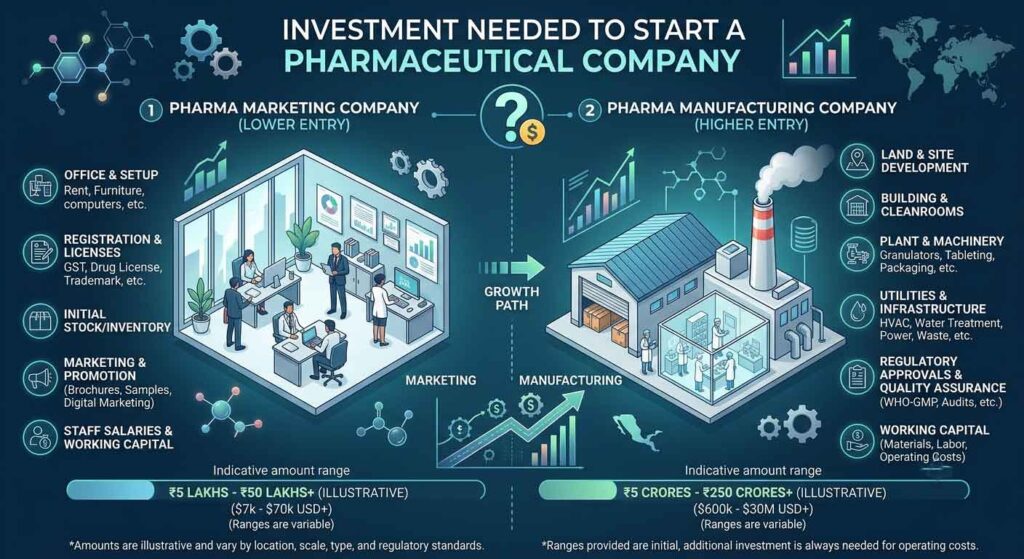
A small pharmaceutical marketing company using third-party manufacturing may require approximately ₹5 lakh to ₹20 lakh for a controlled launch. A professionally structured regional marketing company may require ₹20 lakh to ₹1 crore or more. A compliant allopathic manufacturing plant will generally require investment running into several crores, with the amount increasing substantially for multiple dosage forms, sterile products, APIs and large-scale facilities.
These are planning ranges, not statutory minimum amounts.
First Decide Which Pharmaceutical Business You Want to Start
The largest mistake is asking:
“How much money is needed to start a pharma company?”
without deciding whether the company will manufacture, market, stock or distribute products.
Pharmaceutical Marketing Company
A pharmaceutical marketing company:
Selects products
Owns or uses brand names
Gets products manufactured by licensed third-party manufacturers
Markets the products
Appoints distributors or franchise partners
Handles promotional and commercial activities
It does not necessarily own a manufacturing plant.
This is usually the least capital-intensive way to launch pharmaceutical brands.
Pharmaceutical Manufacturing Company
A manufacturing company:
Owns or controls an approved manufacturing facility
Installs production and testing equipment
Employs technical staff
Manufactures products
Maintains quality systems
Obtains manufacturing licences
Complies with revised Schedule M
Manufacturing requires much more capital and technical management.
Wholesale or Distributor Business
A wholesaler or distributor:
Purchases finished medicines
Maintains stock
Supplies retailers or institutions
Manages delivery and collections
Its major investment is generally in:
Opening stock
Retailer credit
Warehouse
Delivery
Working capital
PCD Franchise Business
A PCD franchise partner purchases products from a pharmaceutical company and develops an assigned territory.
Its investment depends on:
Number of products
Initial order
Territory
Sales team
Promotion
Distributor arrangement
Market credit
Four Main Types of Investment
Total investment should be divided into four parts.
1. Fixed Capital
Fixed capital includes assets purchased or established for long-term use.
Examples:
Office
Warehouse
Factory building
Machinery
Laboratory equipment
Furniture
Computers
Refrigerator
Air conditioning
Power backup
Vehicles
Software
2. Pre-Operating Expenses
These are expenses incurred before commercial operations begin.
Examples:
Entity registration
Professional consultation
Licence applications
Trademark work
Product selection
Formula development
Artwork
Packaging development
Sample batches
Vendor qualification
Employee recruitment
Training
3. Inventory Investment
Inventory may include:
Finished products
Raw materials
Packing materials
Printed cartons
Labels
Promotional samples
Consumables
4. Working Capital
Working capital keeps the business running after launch.
It includes:
Salaries
Rent
Electricity
Marketing
Travel
Freight
Distributor credit
Retailer credit
Manufacturing advances
GST payments
Expiry replacements
Daily operating expenses
Total Funding Formula
A practical formula is:
Total Funding Required
=
Fixed Setup Cost
+ Pre-Operating Expenses
+ Initial Inventory
+ Market Receivables
+ Operating Runway
+ Contingency Reserve
− Supplier Credit
The business should not calculate investment only from the first manufacturing invoice.
Investment Required for a Pharmaceutical Marketing Company
A marketing company can be launched at different levels.
Model 1: Very Lean Marketing Launch
This model may involve:
Proprietorship or small legal entity
Home or low-cost administrative office where legally suitable
No large sales team
Third-party manufacturing
Five to ten focused products
Licensed distributor handling stock
Limited territory
Digital promotional material
Advance-payment business
Illustrative Investment Range
Approximately ₹5 lakh to ₹12 lakh
This may be workable when:
Product quantities are small.
Expensive dosage forms are avoided.
The promoter handles sales personally.
A distributor handles inventory.
The manufacturer offers reasonable MOQs.
Credit is tightly controlled.
It may not be sufficient when the product range includes expensive:
Antibiotics
Softgel capsules
Sachets
Protein formulations
Injectables
Special packaging
Large liquid batches
Model 2: Small Structured Marketing Company
This model may involve:
Ten to twenty-five products
Own wholesale-licensed stock premises
Small office
One or two employees
Product literature
Samples
Local sales activity
Six months of working capital
Illustrative Investment Range
Approximately ₹12 lakh to ₹30 lakh
Model 3: Regional Pharmaceutical Marketing Company
This model may involve:
Twenty-five to seventy-five products
Multiple manufacturers
Sales team
Distributor network
Larger stock holding
Promotional materials
Several districts
Credit to distributors
Regular product launches
Illustrative Investment Range
Approximately ₹30 lakh to ₹1 crore or more
Model 4: Multi-State Marketing Company
This model may require:
Several divisions
C&F agents
State distributors
Larger sales team
Regional offices
Wider product range
Substantial promotional expenditure
Large receivables
Inventory at multiple locations
Illustrative Investment
₹1 crore to several crores, depending on scale.
Sample Budget for a Small Marketing Company
Suppose a promoter plans to launch:
Ten products
Third-party manufacturing
Own wholesale premises
One compact territory
An illustrative budget may be:
Investment Head
Illustrative Amount
Business formation, professional work and initial registrations
₹60,000
Trademark, product-name and legal review
₹50,000
Premises deposit and initial rent
₹1,00,000
Racks, computer, printer and software
₹1,00,000
Wholesale storage setup and refrigerator
₹75,000
Artwork, cartons and packaging development
₹1,00,000
Initial manufactured inventory
₹5,00,000
Samples and promotional material
₹1,00,000
Freight, GST timing and miscellaneous setup
₹75,000
Six-month operating reserve
₹3,00,000
Contingency
₹1,00,000
Illustrative Total
₹15,60,000
This is not an official minimum. Actual product quotations should replace every estimate.
Does a Marketing Company Need a Wholesale Drug Licence?
Yes, A Pharmaceutical Marketing Company needs a wholesale drug license.
An appropriate wholesale drug licence is generally required when the company itself:
Purchases medicines
Receives stock
Stores medicines
Raises wholesale invoices
Supplies distributors
Supplies retail chemists
Handles saleable returns
Forms 20-B and 21-B are commonly relevant for ordinary allopathic wholesale operations.
Your own wholesale licence may not be necessary where:
You only promote products.
You never receive or store medicine stock.
A licensed manufacturer invoices a licensed distributor directly.
The commercial arrangement is properly documented.
The exact model should be confirmed with the State Licensing Authority.
Business and Regulatory Setup Cost
The setup may involve:
Proprietorship, partnership, LLP or company formation
PAN and bank account
GST registration
Wholesale drug licence
Shop and Establishment registration
Trademark application
Agreements
Accounting setup
Local permissions
The government fee itself may be only one part of the expenditure.
Professional and setup costs vary according to:
State
Entity type
Number of licences
Premises
Products
Trademark classes
Consultant involvement
Do not trust a promoter claiming that one large “pharma-company licence fee” covers everything.
There is generally no universal government licence called a:
Pharma company licence
Product Development Cost
Before placing the order, budget for:
Product formula
Strength
Dosage form
Pack size
Brand-name search
Artwork
Label review
Packaging design
Carton printing
Foil or label cylinders
Sample approval
Batch documentation
Some manufacturers include basic artwork in the quotation.
Others charge separately for:
Design
Plates
Cylinders
Blocks
Special cartons
Printed foil
Small-run packaging
Initial Inventory Investment
Initial inventory is usually the largest marketing-company investment.
It depends on:
Initial Stock Investment
=
Number of Products
× Minimum Batch Quantity
× Purchase Rate
Example
Suppose:
Ten products
Average minimum quantity: 500 packs
Average purchase rate: ₹80 per pack
10 × 500 × ₹80
= ₹4,00,000
Add:
GST
Freight
Packaging-development charges
Samples
Damage provision
The total may become approximately ₹4.5 lakh to ₹5 lakh.
Product Type Strongly Affects Investment
Lower-Investment Products May Include
Depending on formula and MOQ:
Basic tablets
Hard-gelatin capsules
Simple syrups
Classical formulations
Basic topical products
Higher-Investment Products May Include
Softgel capsules
Protein powders
Granules
Sachets
Effervescent products
Specialized nutraceuticals
Controlled-release tablets
Hormonal products
Injectables
Ophthalmic products
Novel packaging
Imported ingredients
Do not choose the launch range only from expected margin.
Also check:
Demand
MOQ
Shelf life
Manufacturer consistency
Regulatory status
Competition
Repeat-order time
Should a Startup Launch 50 or 100 Products?
Usually not.
Starting with too many products creates:
High opening investment
Slow stock movement
Expiry risk
Packaging obsolescence
Complex sales training
More working-capital blockage
A focused launch of approximately 8–20 suitable products may be easier to manage.
Products can be added after:
Repeat sales
Customer feedback
Distributor demand
Cash-flow improvement
Working-Capital Requirement
A marketing company may need funds before receiving customer payments.
Working capital should cover:
Manufacturing advance
Remaining supplier payment
Freight
Salaries
Travel
Promotional material
Distributor credit
Returns
Reorder stock
Working-Capital Formula
Working Capital Required
=
Inventory
+ Customer Receivables
+ Operating Cash
− Supplier Credit
Example
Inventory: ₹8 lakh
Distributor receivables: ₹5 lakh
Six-month operating reserve: ₹4 lakh
Supplier credit: ₹2 lakh
Working Capital
= ₹8 lakh + ₹5 lakh + ₹4 lakh − ₹2 lakh
= ₹15 lakh
Operating Runway
A new marketing company should normally plan for several months before expecting stable repeat business.
A reasonable internal planning period may be:
Six months for a very lean business
Nine to twelve months for a structured sales model
This is not a promise that the company will break even within that period.
Monthly Operating Budget
Possible monthly expenses include:
Expense
Illustrative Range
Office or warehouse rent
₹10,000–₹50,000
Staff
₹20,000–₹1,50,000
Travel and field expenses
₹15,000–₹1,00,000
Digital and printed promotion
₹10,000–₹1,00,000
Software, phone and administration
₹5,000–₹25,000
Freight and delivery
Depends on sales
Professional compliance
Depends on structure
A business with monthly expenses of ₹1 lakh and a nine-month runway needs:
₹1,00,000 × 9
= ₹9,00,000
in operating reserve, excluding stock.
Investment Required for PCD Franchise
A PCD franchise normally requires less setup investment than creating a completely independent marketing company.
Typical investment components include:
Initial product order
GST and business setup
Distributor arrangement
Samples
Visual aids
Territory travel
Promotional material
Working capital
Illustrative Range
Small focused territory: ₹2 lakh to ₹5 lakh
Structured district operation: ₹5 lakh to ₹15 lakh
Large territory with sales staff: ₹15 lakh to ₹40 lakh or more
The parent company’s stated minimum order is not the complete business investment.
Investment Required for a Pharmaceutical Wholesale Business
A small wholesale business may require funds for:
Premises
Wholesale licence
Competent person
Racks
Refrigerator
Computer and billing software
Opening inventory
Delivery
Retailer credit
Illustrative Range
Small focused wholesaler: ₹10 lakh to ₹25 lakh
Established multi-company distributor: ₹25 lakh to ₹75 lakh
Large stockist or institutional supplier: ₹75 lakh to several crores
The largest variable is often customer credit rather than the licence cost.
Investment Required for a Retail Pharmacy
A retail pharmacy may require:
Shop deposit
Interiors
Computer and billing software
Refrigerator
Retail drug licence
Registered pharmacist
Initial stock
Working capital
Illustrative Range
Small neighbourhood pharmacy: ₹8 lakh to ₹15 lakh
Well-stocked urban pharmacy: ₹15 lakh to ₹35 lakh
Large or premium pharmacy: ₹35 lakh and above
Location and inventory depth strongly affect the cost.
Investment Required for a Nutraceutical Marketing Company
A nutraceutical brand using third-party manufacturing may need:
Legal entity
FoSCoS Relabeller licence
Product compliance
Formula review
Packaging
Testing
Initial stock
Marketing
Working capital
Illustrative Range
Focused 3–5 product launch: ₹5 lakh to ₹12 lakh
Structured 10–20 product launch: ₹12 lakh to ₹35 lakh
Consumer brand with advertising: ₹35 lakh to several crores
Marketing expenditure can be greater than manufacturing expenditure in consumer-health products.
Investment Required for an Ayurvedic Marketing Company
An Ayurvedic marketing company using licensed third-party manufacturers may be started with:
Limited product range
Genuine marketing agreement
Brand registration work
Wholesale and GST structure where applicable
Initial stock
Promotion
Illustrative Range
Small focused launch: ₹4 lakh to ₹10 lakh
Structured range: ₹10 lakh to ₹30 lakh
Wider franchise and distribution launch: ₹30 lakh to ₹1 crore or more
The investment depends on:
Classical or proprietary products
Dosage form
Pack size
Herbal raw-material cost
MOQ
Packaging
Investment Required for an Allopathic Manufacturing Plant
A pharmaceutical manufacturing facility is a major capital project.
As of 2026, a new plant should be designed around revised Schedule M requirements.
Investment categories include:
Land
Industrial building
Clean manufacturing areas
HVAC
Airlocks
Water systems
Electrical systems
Compressed air
Production machinery
Quality-control laboratory
Microbiology facilities where applicable
Warehousing
Utilities
Validation
Documentation
Technical staff
Licensing
Working capital
Illustrative Manufacturing Investment Ranges
These figures are broad planning ranges and exclude or include land differently depending on the project.
Small Non-Sterile Formulation Facility
For a focused dosage-form facility such as tablets and capsules or oral liquids:
Approximately ₹5 crore to ₹15 crore or more
The amount depends on:
Existing compliant leased building
Production capacity
Automation
Laboratory
HVAC
Number of product lines
Multi-Dosage Non-Sterile Plant
For tablets, capsules, liquids, ointments and multiple sections:
Approximately ₹12 crore to ₹40 crore or more
Sterile or Injectable Facility
For injections, ophthalmics or other sterile products:
No manufacturing decision should be based only on these ranges.
A detailed project report is essential.
Manufacturing Fixed Capital
A manufacturing budget may include:
Fixed Manufacturing Investment
=
Land
+ Building
+ HVAC
+ Utilities
+ Production Machinery
+ Laboratory
+ Warehouse
+ Safety Systems
+ Validation
+ Licensing
Manufacturing Working Capital
Working capital includes:
Raw materials
Packing materials
Salaries
Power
Testing
Maintenance
Rejected batches
Credit to marketing companies
Finished-goods inventory
Regulatory expenses
A manufacturing project should often maintain a longer operating runway than a marketing business.
Manufacturing Budget Example
A simplified non-sterile project might contain:
Investment Head
Illustrative Amount
Lease deposit, site development or land contribution
₹1.00 crore
Building and clean-area development
₹3.00 crore
HVAC and utilities
₹2.00 crore
Production machinery
₹2.50 crore
Quality-control laboratory
₹1.00 crore
Warehousing, electrical and backup systems
₹75 lakh
Validation, licensing and pre-operative work
₹75 lakh
Raw and packing material
₹1.00 crore
Twelve-month operating reserve
₹2.00 crore
Contingency
₹1.00 crore
Illustrative Total
₹15.00 crore
Actual quotations may be lower or significantly higher.
Loan-Licence Manufacturing
Under a loan-licence arrangement, the licence holder uses another approved manufacturer’s facilities under the applicable regulatory structure.
This may reduce investment in:
Land
Building
Machinery
Utilities
However, the loan-licensee still needs funds for:
Licence and professional work
Technical oversight
Raw materials
Packing materials
Manufacturing charges
Testing
Quality documentation
Marketing
Inventory
Working capital
A loan licence is not simply another name for ordinary third-party manufacturing.
Third-Party Manufacturing vs Own Plant
Third-Party Manufacturing
Advantages:
Lower initial investment
Faster launch
Less infrastructure
Wider dosage-form access
Easier scaling
Limitations:
MOQ
Manufacturer dependence
Less production control
Scheduling delays
Need for vendor qualification
Own Manufacturing Plant
Advantages:
Production control
Capacity ownership
Manufacturing income
Potential contract-manufacturing business
Greater process control
Limitations:
Very high capital requirement
Technical complexity
Compliance burden
Staff requirements
Capacity-utilization risk
A startup should not build a manufacturing plant merely to place its own brand name on products.
Third-party manufacturing is usually more practical until sufficient volume is established.
Break-Even Calculation
The company should calculate the sales required to cover monthly operating costs.
Break-Even Sales
=
Monthly Fixed Expenses
÷ Contribution Margin Percentage
Example
Monthly expenses: ₹3 lakh
Contribution margin: 20%
Break-Even Sales
= ₹3,00,000 ÷ 20%
= ₹15,00,000 per month
The business needs approximately ₹15 lakh in monthly ex-GST sales before generating operating profit.
Product-Wise Investment Formula
For each product, prepare:
Product Investment
=
MOQ
× Ex-GST Purchase Rate
+ GST Cash Requirement
+ Freight
+ Artwork and Packaging Development
+ Promotion
Example
MOQ: 1,000 packs
Rate: ₹60
GST: 5%
Freight: ₹4,000
Artwork and printing development: ₹15,000
Samples and promotion: ₹10,000
Product cost:
1,000 × ₹60
= ₹60,000
GST:
₹60,000 × 5%
= ₹3,000
Total initial product investment:
₹60,000
+ ₹3,000
+ ₹4,000
+ ₹15,000
+ ₹10,000
= ₹92,000
Input tax credit may reduce the final GST cost, but cash is still required at the transaction stage.
Prepare Product-Wise Budget Instead of Guessing
Create a table:
Product
MOQ
Ex-GST Rate
Product Cost
GST
Packaging Development
Promotion
Total
This produces a more reliable launch budget than assuming every product costs the same.
Inventory Reserve
Do not use the entire budget for the first batch.
A practical internal allocation may be:
45%–55%: initial inventory
15%–25%: working-capital reserve
10%–20%: marketing and sales
5%–10%: infrastructure and compliance
5%–10%: contingency
This allocation should change according to the business model.
Reorder Funding
A company may need to order the second batch before receiving payment for the first batch.
Therefore:
Required Inventory Funding
=
Opening Batch
+ Reorder Batch Funding
+ Emergency Stock Reserve
A profitable business may still face a cash shortage when money is blocked in:
Distributors
Hospitals
Production
Pending GST credit
Unsold stock
Credit Investment
Suppose:
Monthly sales: ₹10 lakh
Average credit: 45 days
Approximate receivables:
₹10 lakh × 45 ÷ 30
= ₹15 lakh
The business may need approximately ₹15 lakh only to support customer credit.
Credit can therefore require more investment than office setup.
Contingency Reserve
Maintain a reserve for:
Raw-material increases
Packaging changes
Delayed product permissions
Failed batches
Slow sales
Expiry
Customer default
Employee replacement
Regulatory changes
Product recall
A contingency of approximately 10%–15% of the project budget may be considered for internal planning.
Factors Affecting the Investment
1. Number of Products
More products mean:
More MOQs
More packaging
More stock
More samples
Greater expiry risk
2. Dosage Form
Tablets, liquids, softgels, injectables and powders have different production costs and MOQs.
3. Pack Size
A 10-tablet strip and a 60-capsule bottle require different:
Material
Packaging
Freight
Carton space
4. Product Composition
Imported, patented, standardized or high-dose ingredients may increase cost.
5. Packaging Quality
Premium packaging may involve:
Laminated cartons
Printed foil
Bottles
Induction seals
Special labels
Measuring devices
Holograms
6. Territory
Operating costs differ between:
One town
One district
One state
All-India distribution
7. Sales Model
Investment differs for:
PCD franchise
Prescription marketing
Generic marketing
Institutional supply
Online consumer marketing
8. Credit Policy
Longer credit increases funding requirements.
9. Staff
A founder-managed business needs less initial cash than one beginning with:
Sales managers
Medical representatives
Office staff
Warehouse employees
10. Product Classification
Different categories require different licences and compliance.
Examples:
Allopathic medicines
Ayurvedic medicines
Nutraceuticals
Cosmetics
Medical devices
How to Reduce Startup Investment Safely
Start With Fewer Products
Launch a focused range rather than a large catalogue.
Use Third-Party Manufacturing
Avoid plant investment until adequate volume exists.
Use a Licensed Distributor
A distributor may handle stock and delivery during the initial stage.
Rent Premises
Avoid purchasing expensive commercial property at launch.
Use Digital Promotional Material
Print only quantities that will actually be used.
Control Credit
Start with advance payment or carefully approved credit.
Negotiate MOQ
Select manufacturers whose MOQ suits the launch plan.
Avoid Unnecessary Staff
The promoter may initially handle:
Sales
Follow-up
Product selection
Basic administration
Do not reduce investment by compromising:
Product quality
Licensing
Storage
Testing
Label compliance
Working-capital reserve
Common Investment Mistakes
Avoid:
Treating the manufacturer’s quotation as the total investment
Launching too many products
Spending all funds on stock
Maintaining no reorder reserve
Giving uncontrolled distributor credit
Ignoring GST cash flow
Underestimating expiry
Choosing a large office before sales begin
Purchasing land before proving demand
Starting a plant without a detailed project report
Ignoring revised Schedule M
Assuming every product has the same MOQ
Taking expensive loans without break-even analysis
Depending on verbal manufacturer quotations
Printing packaging before final compliance review
Recommended Startup Roadmap
Step 1: Select the Business Model
Choose marketing, PCD, wholesale, retail or manufacturing.
Step 2: Select the Product Category
Choose allopathic, Ayurvedic, nutraceutical, cosmetic or medical device.
Step 3: Conduct Market Research
Study:
Customer demand
Competitors
Prices
Distributor availability
Product movement
Step 4: Obtain Product Quotations
Collect written quotations covering:
MOQ
Rate
GST
Freight
Packaging
Testing
Delivery time
Payment
Step 5: Prepare the Compliance Budget
Include licences, agreements, trademarks and professional work.
Step 6: Calculate Inventory
Prepare a product-wise MOQ and cost sheet.
Step 7: Calculate Monthly Expenses
Prepare a realistic monthly operating budget.
Step 8: Add Working Capital
Include credit, reorder and contingency.
Step 9: Calculate Break-Even Sales
Confirm whether the expected market can support the planned expenses.
Step 10: Launch Gradually
Add products and employees only after achieving repeat business.
Practical Investment Summary
Business Model
Broad Illustrative Investment
Small PCD franchise
₹2–5 lakh
Structured PCD operation
₹5–15 lakh
Lean pharmaceutical marketing company
₹5–12 lakh
Small structured marketing company
₹12–30 lakh
Regional marketing company
₹30 lakh–₹1 crore+
Small pharmaceutical wholesaler
₹10–25 lakh
Established distributor
₹25–75 lakh+
Small retail pharmacy
₹8–15 lakh
Structured nutraceutical brand
₹12–35 lakh
Small non-sterile allopathic manufacturing unit
₹5–15 crore+
Multi-dosage formulation plant
₹12–40 crore+
Sterile or injectable plant
₹40–150 crore+
API manufacturing project
₹25 crore to several hundred crores
These are planning ranges—not quotations or legal minimums.
Frequently Asked Questions
1. What is the minimum amount needed to start a pharmaceutical company?
A very lean third-party marketing or PCD setup may begin around ₹5 lakh, but a more sustainable small marketing company commonly needs approximately ₹12–30 lakh after inventory and working capital are included.
2. Can I start with ₹1 lakh?
It may be possible to work as a commission agent or begin with an extremely limited franchise order, but ₹1 lakh is generally insufficient for a properly structured independent pharmaceutical marketing company with inventory and working capital.
3. Is ₹10 lakh enough?
₹10 lakh may be enough for a focused third-party marketing or PCD launch with few products, low overhead and controlled credit.
4. Is ₹15 lakh enough for a marketing company?
It may be sufficient for approximately 8–15 carefully selected products and a compact operating model. Product MOQs and credit requirements must be checked first.
5. Do I need my own manufacturing plant?
No. A marketing company may use licensed third-party manufacturers.
6. Does a marketing company need a drug manufacturing licence?
Not merely for marketing products manufactured by another licensed manufacturer. However, its wholesale stock-and-sale activities may require the applicable wholesale drug licences.
7. How much does a manufacturing plant cost?
A new compliant non-sterile plant generally requires several crores. Multiple dosage forms, sterile products and API projects require substantially greater investment.
8. Why is manufacturing more expensive now?
Modern projects must budget for revised Schedule M, pharmaceutical quality systems, HVAC, validation, utilities, laboratories, documentation and technical personnel.
9. Should I purchase an office?
Not necessarily. A rented premises generally reduces startup investment.
10. What is the largest hidden investment?
Customer credit and second-batch funding are frequently larger than licence and office expenses.
11. How much reserve should be maintained?
Maintain enough funds for reorder requirements and several months of operating expenses, plus a contingency provision.
12. Which model is best for a beginner?
Third-party manufacturing or PCD distribution is usually less capital intensive than establishing an own manufacturing plant.
Final Thoughts
The correct way to calculate pharmaceutical-company investment is:
Do not build the plan around the smallest amount with which someone else claims to have started.
Build it around the amount required to:
Operate legally
Maintain product quality
Keep products available
Pay expenses on time
Survive delayed sales
Finance repeat orders
Control expiry and credit
Looking for Ayurvedic Franchise or Distribution Opportunities?
Looking to start an Ayurvedic franchise, become a distributor, or launch your own herbal product range?
Elzac Herbal India offers:
Ayurvedic & Herbal Product Range
Franchise & Distribution Opportunities
Third-Party Manufacturing Services
Product Development Support
Marketing Guidance
PAN India Business Opportunities
Whether you are an entrepreneur, retailer, distributor, or healthcare professional, our team can help you explore the right business opportunity in the growing Ayurvedic sector.
Ajay Kamboj is an entrepreneur and business owners associated with many Ayurvedic and Pharmaceutical start-ups. With years of experience in Ayurvedic product marketing, pharmaceutical distribution, franchise development, and client relationship management, he regularly shares practical business insights based on real-world experiences. His articles focus on business growth, entrepreneurship, customer management, and lessons learned from the healthcare and wellness industry.
21 responses to “How Much Investment Is Needed to Start a Pharmaceutical Company?”
HI WE ARE —— LABS LTD.,A PHARMA MANUFACTURING COMPANY THAT IS SITUATED IN KALA-AMB IN HIMACHAL PRADESH.WE ARE GIVING FRANCHISES IN ALL OVER INDIA FOR GENERIC RANGE OF PRODUCTS .OUR COMPANY IS A GMP AND ISO CERTIFIED COMPANY PROVIDING OVER 150 PRODUCTS .WE WELCOME ALL THE PERSON WHO ARE INTERESTED TO START PHARMA FRANCHISE IN ALL INDIA .WE PROVIDE YOU HELP AT EVERY STEP TO START A PHARMA FRANCHISEE .SO IF YOU ARE INTERESTED TO JOIN THEN PLEASE CONTACT ON BELOW MENTION CONTACT:
Dear sir, i want to start pharma marketing company at delhi. please guide me all necessary document, process and capital required. please also help me regarding scope in pharma industry. please help. Thank you
Dear,
Kindly provide detail information o my email,
I am interested to establish a Pharma co. I appreciate and utilize your
support as well.
The following information shall be provided.
1. List of products.
2. Facilities available at site.
3. Site visit for inspection
4. Your expected amount.
Sir I'm kalai from Chennai ,I'm working as business executive in pvt company . I have very good relationship with my area doctor.so I'm willing to start a pharma company With very very low amount of investment . I need one brand with that brand I want to start a company. So can u guide me that what I want to do and how to do . Sir this is my maid I'd —— eagerly waiting for ur response thank you
Sir, i am working in pharmacovigilance in one of the hyderabad based Pharma firm. Initially i want to start a marketing company in pharma with export license. I am keen and looking forward to market drugs in less regulated regions with my company tag. I want to start with 2-3 class of drugs. please guide me with the process and the limitations that i may experience in my journey.
i wana to open pharmacy shop , and i am new to this business can u please tell me each nd every infrmtn related to this
even how much stock of medicene nd which medicen i have to keep nd everything
i wl b very grateful for u
If you want to go into pharmacy business, There are so many company platform this days like that will enable you as a beginner to raise the fund you need to start up your pharmacy business without you seeking for a loan.
This company platform is where many business dealers from all over the world generate fund that backup their various businesses financially.
I used this company to backup my cocoa beans export business each time my business is running down.
You can visit and register with the company website here to raise the fund you need now to start up your pharmacy business now.



HI WE ARE —— LABS LTD.,A PHARMA MANUFACTURING COMPANY THAT IS SITUATED IN KALA-AMB IN HIMACHAL PRADESH.WE ARE GIVING FRANCHISES IN ALL OVER INDIA FOR GENERIC RANGE OF PRODUCTS .OUR COMPANY IS A GMP AND ISO CERTIFIED COMPANY PROVIDING OVER 150 PRODUCTS .WE WELCOME ALL THE PERSON WHO ARE INTERESTED TO START PHARMA FRANCHISE IN ALL INDIA .WE PROVIDE YOU HELP AT EVERY STEP TO START A PHARMA FRANCHISEE .SO IF YOU ARE INTERESTED TO JOIN THEN PLEASE CONTACT ON BELOW MENTION CONTACT:
Please mail me your contact t details and product list on Nikesh Parekh@S Gmail.com
How much money is required to get a franchise in hyderbad can u reply
Hi
We wanted to start pharmaceutical manufacturing company.
Pl do contact me!
Maheshwar S
I want to open a medicine factory in bihar
Add:- Industrial area , pahase 3, (803201)Fatuha, Patna.
I want to open a medicine production factory in Patna
Add:- Industrial area Fatuha.(803201) Patna, bihar
Dear sir, i want to start pharma marketing company at delhi. please guide me all necessary document, process and capital required. please also help me regarding scope in pharma industry. please help. Thank you
I have to start small scale pharma industry. Currently i dont have space as well as money. So how should I proceed.
how to starts small scale pharma product budget.. 6 to 7 lacs
My Pharma company is for sale plz contact me Madhu 9164979799 all brands are registered on my name ……
Dear,
Kindly provide detail information o my email,
I am interested to establish a Pharma co. I appreciate and utilize your
support as well.
The following information shall be provided.
1. List of products.
2. Facilities available at site.
3. Site visit for inspection
4. Your expected amount.
Thanks.
Anwar
I I want to start Pharmacy business please share your contact details in my mail ID
Rakesh.rws@gmail.com.
Sir I'm kalai from Chennai ,I'm working as business executive in pvt company . I have very good relationship with my area doctor.so I'm willing to start a pharma company With very very low amount of investment . I need one brand with that brand I want to start a company. So can u guide me that what I want to do and how to do . Sir this is my maid I'd —— eagerly waiting for ur response thank you
Sir, i am working in pharmacovigilance in one of the hyderabad based Pharma firm. Initially i want to start a marketing company in pharma with export license. I am keen and looking forward to market drugs in less regulated regions with my company tag. I want to start with 2-3 class of drugs. please guide me with the process and the limitations that i may experience in my journey.
I want to open a pharmaceutical company in Nigeria, please i need advice and directions.
Thanks
you can start pharma marketing company in this budget
Hai, i want to start a pharma manufacturing unit. Please guide me
I want to establish my own pharmaceuticals company in baddi
i wana to open pharmacy shop , and i am new to this business can u please tell me each nd every infrmtn related to this
even how much stock of medicene nd which medicen i have to keep nd everything
i wl b very grateful for u
Hello,
If you want to go into pharmacy business, There are so many company platform this days like that will enable you as a beginner to raise the fund you need to start up your pharmacy business without you seeking for a loan.
This company platform is where many business dealers from all over the world generate fund that backup their various businesses financially.
I used this company to backup my cocoa beans export business each time my business is running down.
You can visit and register with the company website here to raise the fund you need now to start up your pharmacy business now.
I really appreciate your help