Many new pharma entrepreneurs get confused between PCD work and prescription work.
Both models are used in pharmaceutical marketing, and both ultimately depend on product demand in the market. However, the working style, customer type, investment, responsibility and marketing control are very different.
A common query is:
“I currently sell products to wholesalers at net rates. The wholesaler handles all marketing by himself. Is this PCD work or prescription work? If I shift to prescription work, do I need to appoint my own MR?”
The simple answer is:
In PCD work, your main customer is the distributor, franchisee or wholesaler.
In prescription work, your main customer is the doctor, and your company generates prescriptions through medical representatives.
Let us understand the difference in detail.
What Is PCD Work?
PCD stands for Propaganda Cum Distribution.
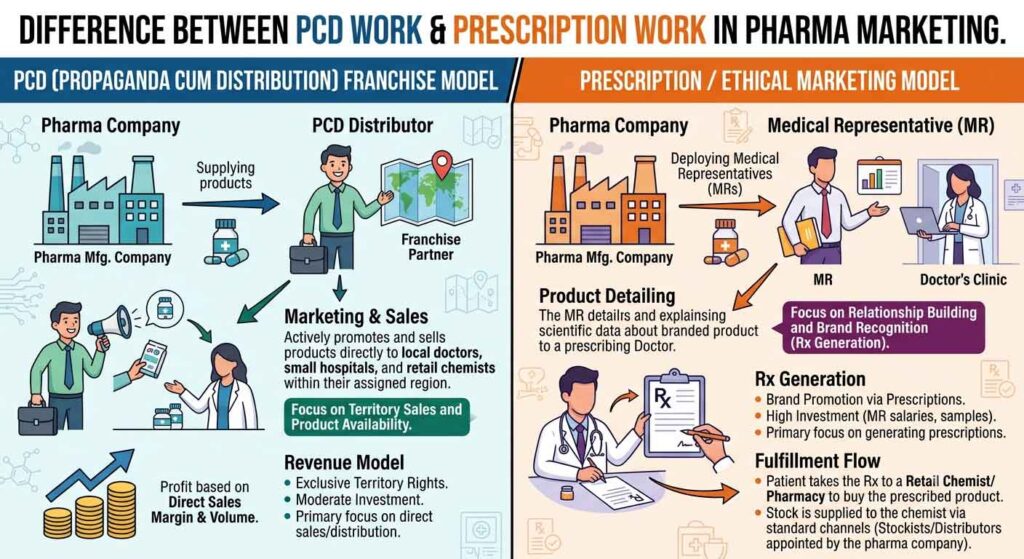
In PCD work, a pharma company appoints distributors, franchise partners or wholesalers in different areas. The company supplies products at net rates or agreed rates. The distributor then promotes and sells the products in his area.
In this model, the company usually does not directly handle doctor promotion in that territory. The distributor or franchise partner manages local marketing.
How PCD Work Happens
The usual process is:
Company appoints a PCD distributor or franchisee.
Company provides product list and net rates.
Distributor purchases stock from company.
Distributor promotes products in his area.
Distributor may appoint his own MR or personally visit doctors.
Distributor supplies products to chemists, retailers and hospitals.
Repeat orders depend on distributor’s marketing efforts.
What Is Prescription Work?
Prescription work is also called ethical marketing.
In prescription work, the company itself appoints medical representatives, area managers or sales staff. These MRs visit doctors, promote products and generate prescriptions.
The company then supplies products through stockists, distributors or wholesalers, but the prescription generation is handled by the company’s own sales team.
How Prescription Work Happens
The usual process is:
Company appoints medical representatives.
MR visits doctors regularly.
MR promotes company products.
Doctor prescribes the products if satisfied.
Patients buy products from chemists.
Chemists purchase from stockist/distributor.
Company generates sales through prescription demand.
Main Difference Between PCD Work and Prescription Work
Point
PCD Work
Prescription Work
Main customer
Distributor/franchisee
Doctor
Selling rate
Net rate
PTR/PTS/MRP structure
Marketing handled by
Distributor/franchisee
Company MR/sales team
Company control
Lower
Higher
Investment
Lower
Higher
Field staff requirement
Not always required
Required
Brand building
Depends on distributor
Built by company
Risk
Distributor performance risk
Salary and marketing expense risk
Area expansion
Faster
Slower but controlled
Profit margin
Fixed margin at net rate
Depends on sales structure and expenses
Suitable for
Companies wanting franchise expansion
Companies wanting direct brand control
What Is Net Rate Selling?
In PCD work, the company usually sells products at net rates.
Net rate means the company fixes its margin and sells the product to the distributor at a final agreed price.
The distributor then manages:
Doctor promotion
Chemist supply
Local marketing
Sales team, if any
Retailer relationship
Payment recovery
The company earns from product supply to the distributor.
What Is PTR and PTS?
In prescription work, rates are usually structured around:
MRP: Maximum Retail Price
PTR: Price to Retailer
PTS: Price to Stockist
Scheme or discount
Company margin
The company’s own MR generates prescriptions. The product moves through stockist and retailer based on demand created by doctors.
Who Is the Customer in PCD Work?
In PCD work, your practical customer is:
Distributor
Franchisee
Wholesaler
Stockist
Area partner
The company’s main job is to support the distributor with:
Quality products
Promotional material
Attractive packaging
Timely supply
Monopoly or area support, if agreed
Product list
Net rates
Marketing inputs
Who Is the Customer in Prescription Work?
In prescription work, the company’s main target is the doctor.
The company’s MR visits:
Physicians
Pediatricians
Gynecologists
Orthopedicians
Dermatologists
ENT specialists
Hospitals
Clinics
The doctor generates prescription demand, and the product sale happens through the distribution channel.
Do You Need MR for Prescription Work?
Yes. If you want to do prescription-based work, you generally need:
Medical representatives
Area sales managers
Field managers
Doctor visit planning
Promotional inputs
Samples, where legally permitted
Product literature
Monthly sales targets
Chemist follow-up
You can also handle prescription work yourself in a small area, but for expansion, an MR team is required.
If I Sell to a Wholesaler at Net Rates, Is It PCD?
Yes, if you sell products to a wholesaler or distributor at net rates and he manages marketing by himself, it is closer to PCD/franchise-style work.
In this case:
You supply products.
He promotes products.
He handles local customers.
He generates prescriptions or retail demand.
He earns his own margin.
This is different from prescription work, where your company controls doctor promotion.
Can a Wholesaler Do Prescription Work?
Yes, a wholesaler or distributor can do prescription promotion if he appoints MRs or personally promotes products to doctors.
But from your company’s side, this remains PCD/franchise-style work because the distributor is handling the promotion.
Which Model Is Better for Beginners?
Both models can work, but the choice depends on your budget, experience and business goal.
PCD Work Is Better If:
You have limited investment.
You want faster area expansion.
You do not want to appoint many MRs.
You want to sell at net rates.
You want distributors to handle local promotion.
You have a good product list and promotional support.
Prescription Work Is Better If:
You want full control over marketing.
You can appoint and manage MRs.
You want to build your own brand equity.
You have enough working capital.
You can manage doctor promotion ethically.
You want long-term brand value.
Advantages of PCD Work
PCD work has several advantages:
Lower field expense
No need for a large MR team
Faster expansion
Distributor handles local work
Easier for startups
Fixed margin on supply
Less direct marketing pressure
Suitable for small and medium companies
Disadvantages of PCD Work
PCD work also has challenges:
Less control over promotion
Distributor may not work actively
Payment delay risk
Monopoly disputes
Product misuse risk
Brand image depends on distributor
Repeat order depends on franchisee performance
Advantages of Prescription Work
Prescription work has strong long-term advantages:
Better brand control
Direct doctor relationship
Stronger market identity
Better prescription loyalty
Company controls marketing message
Long-term brand value creation
Disadvantages of Prescription Work
Prescription work also requires more effort and investment:
MR salary expense
Travel expense
Promotional material cost
Doctor visit management
Longer time to generate sales
Sales team supervision
Monthly target pressure
Higher risk if prescriptions do not convert
Can a Company Do Both PCD and Prescription Work?
Yes. Many pharma companies use both models.
For example:
In some territories, they appoint PCD distributors.
In important cities, they appoint their own MRs.
For specialty products, they do prescription work.
For general products, they use PCD/franchise distribution.
This hybrid model can be useful, but territories must be clearly defined to avoid conflict.
How to Avoid Conflict Between PCD and Prescription Work
If you are doing both models, avoid overlapping territories.
Mention clearly:
Which area is PCD territory
Which area is company prescription territory
Whether the distributor gets monopoly
Which products are included
Who will handle doctors
Who will handle stockists
How online leads will be handled
What happens if sales are low
Written terms prevent disputes.
How to Generate PCD Queries
If you want more PCD distributors or franchise partners, use multiple lead-generation methods.
1. Company Website
Create a professional website with pages like:
Pharma PCD Franchise
Monopoly Pharma Franchise
Product List
Third-Party Manufacturing
Contact Form
Available Areas
2. SEO and Blog Content
Publish useful articles such as:
How to start pharma franchise business
Investment required for PCD franchise
Best pharma franchise company
How to choose pharma products
Difference between PCD and prescription marketing
SEO generates long-term inquiries.
3. Pharma Portals
You can list your company on pharma business portals and directories.
4. Google Business Profile
Create and optimize your Google Business Profile with:
Company name
Address
Contact number
Website
Product photos
Reviews
Business category
5. Social Media
Use platforms like:
Facebook
Instagram
LinkedIn
YouTube
WhatsApp Business
Share product lists, franchise opportunities and business guidance.
6. Pharma Magazines and Drug Books
Traditional pharma advertising can still generate queries in some regions.
7. WhatsApp Marketing
Maintain a proper WhatsApp Business catalogue and share:
Product list
Monopoly areas
Offers
Visual aids
Product images
Franchise benefits
Do not spam. Use professional communication.
8. Existing Distributor Network
Referrals from existing distributors can bring good-quality leads.
How to Choose Between PCD and Prescription Work
Ask yourself:
Do I have money to appoint MR?
Do I want to control doctor promotion?
Do I have distributor network?
Do I want faster area expansion?
Can I manage sales team?
Do I want fixed net-rate supply?
Do I want long-term brand building?
Can I handle payment recovery?
If your budget is limited, start with PCD. If you want brand control and can invest in field force, start prescription work.
Practical Example
Suppose you sell a product to a distributor at net rate.
The distributor promotes it to doctors, supplies chemists and handles marketing. This is PCD-style work.
But if your company appoints an MR, the MR visits doctors, generates prescriptions and the stockist only supplies the product. This is prescription work.
Final Thoughts
PCD work and prescription work are two different models of pharma marketing.
In PCD work, the distributor or franchisee handles marketing and you supply products at net rates.
In prescription work, your company handles doctor promotion through MRs and sells products through the distribution channel at PTR/PTS structure.
For beginners, PCD work is usually easier because investment and field responsibility are lower. Prescription work is better for companies that want stronger brand control and are ready to invest in medical representatives and long-term promotion.
The right model depends on your budget, team, product range, territory and business goal.
Frequently Asked Questions
1. What is the main difference between PCD and prescription work?
In PCD work, the distributor/franchisee promotes and sells products in his area. In prescription work, the company appoints MRs to generate prescriptions from doctors.
2. In PCD work, who is the customer?
The company’s direct customer is the distributor, franchisee or wholesaler.
3. In prescription work, who is the customer?
The doctor is the main promotional target, while stockists and retailers handle product supply.
4. Do I need MR for PCD work?
Not always. In PCD work, the distributor may appoint his own MR or promote products himself.
5. Do I need MR for prescription work?
Yes, usually prescription work requires company-appointed medical representatives or field staff.
6. What is net rate in PCD?
Net rate is the agreed final supply price at which the company sells goods to the distributor after fixing its margin.
7. What is PTR and PTS?
PTR means Price to Retailer, and PTS means Price to Stockist. These are commonly used in prescription/ethical marketing distribution.
8. Which model is better for startups?
PCD work is often easier for startups because it requires lower investment and fewer field expenses.
9. Which model builds stronger brand value?
Prescription work usually builds stronger brand value because the company directly promotes products to doctors.
10. Can I do both PCD and prescription work?
Yes, but territories and product responsibilities should be clearly defined to avoid conflict.
Partner with Elzac Herbal India
Looking to start an Ayurvedic franchise, become a distributor, or launch your own herbal product range?
Elzac Herbal India offers:
Ayurvedic & Herbal Product Range
Franchise & Distribution Opportunities
Third-Party Manufacturing Services
Product Development Support
Marketing Guidance
PAN India Business Opportunities
Whether you are an entrepreneur, retailer, distributor, or healthcare professional, our team can help you explore the right business opportunity in the growing Ayurvedic sector.
Ajay Kamboj is an entrepreneur and business owners associated with many Ayurvedic and Pharmaceutical start-ups. With years of experience in Ayurvedic product marketing, pharmaceutical distribution, franchise development, and client relationship management, he regularly shares practical business insights based on real-world experiences. His articles focus on business growth, entrepreneurship, customer management, and lessons learned from the healthcare and wellness industry.
One response to “Difference Between PCD Work and Prescription Work in Pharma Marketing”
i planning to start a small wholesale business in medicine, initially investment would be RS-1,500,000 then either need to go for pcd, what are the process to get the pcd franchise or distributionship of reputed drugs like cipla ranbaxy etc please guild me




i planning to start a small wholesale business in medicine, initially investment would be RS-1,500,000 then either need to go for pcd, what are the process to get the pcd franchise or distributionship of reputed drugs like cipla ranbaxy etc
please guild me
i will be thanksfull of yours