Selling Ayurvedic and herbal products online can be a promising business opportunity. A startup can reach customers through its own website, online marketplaces, social media, WhatsApp and other digital channels without opening a large physical retail network.
However, an entrepreneur should not begin by simply selecting a product, printing a label and listing it online.
Before launching, the business must determine:
What type of product it intends to sell
Which licence applies
Whether GST registration is required
Who will manufacture the product
What claims may legally be made
How product quality will be verified
Which documents an online marketplace will require
How orders, returns and customer complaints will be managed
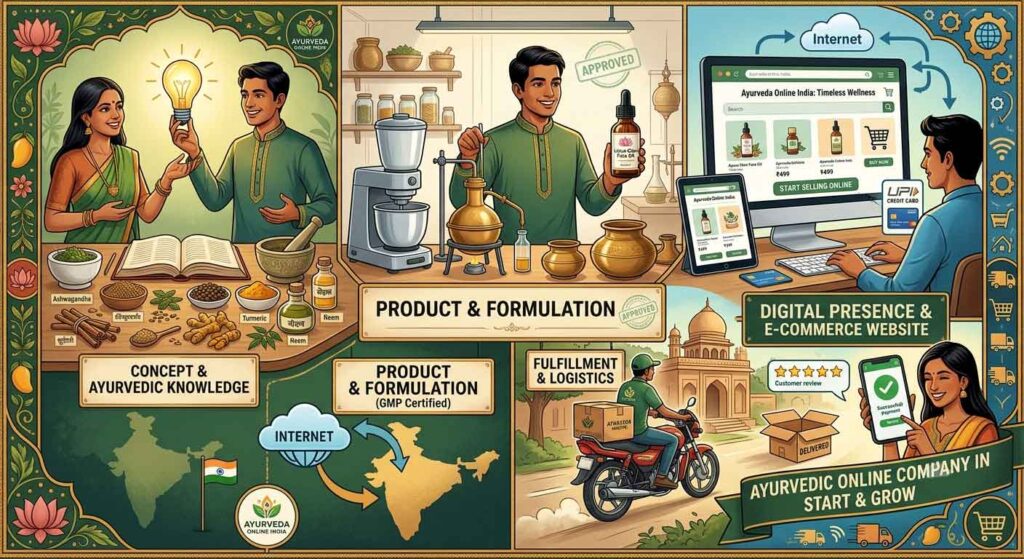
This guide explains the practical procedure for launching an Ayurvedic or herbal product company through third-party manufacturing and online selling.
Quick Answer
To start an Ayurvedic company for online selling:
Select the product and determine its legal category.
Register the business.
Apply for GST, FSSAI or other registrations where applicable.
Register or apply for the brand name.
Select a properly licensed third-party manufacturer.
Finalise the formulation, quality specifications and claims.
Obtain samples and test reports.
Approve compliant packaging and labels.
Create an online store or marketplace account.
Establish inventory, delivery, return and customer-support systems.
For most beginners, third-party manufacturing is more practical than setting up an independent Ayurvedic manufacturing unit.
First Decide What Type of Product You Are Selling
The word “Ayurvedic” is commonly used in marketing, but it is not a single legal product category.
A Brahmi capsule, herbal syrup, hair oil or health powder may fall under different regulatory systems depending on:
Ingredients
Formula
Intended use
Claims
Dosage form
Method of administration
Product presentation
The product may be classified as one of the following.
1. Ayurvedic Medicine
An Ayurvedic medicine may be:
A classical Ayurvedic medicine
An Ayurvedic patent or proprietary medicine
Such products are manufactured under the applicable Ayurvedic drug-manufacturing licence.
Their formulation, label, claims and manufacturing arrangements must comply with the applicable provisions for Ayurvedic, Siddha and Unani drugs.
2. Food or Health Supplement
A herbal capsule or powder intended for nutritional or physiological support may fall under the food or nutraceutical framework.
Such products require compliance with FSSAI requirements relating to:
Ingredients
Permitted quantities
Product standards
Claims
Labelling
Manufacturer licensing
Food-business licensing
A food supplement cannot be marketed as though it were a medicine for treating or curing disease.
3. Cosmetic
Products such as herbal face wash, shampoo, cosmetic cream, lotion, serum and certain hair oils may fall under the cosmetics category.
Their manufacturer must hold the applicable cosmetic manufacturing licence, and the label and claims must comply with cosmetic regulations.
A cosmetic should not be promoted with drug-like disease-treatment claims unless it is separately licensed under the appropriate category.
4. General Wellness or Traditional Product
Some products may appear simple but still fall within a regulated category based on their ingredients and claims.
Do not determine the product category only from:
Dosage form
Product name
Competitor listing
Manufacturer’s sales quotation
Marketplace category
Obtain written classification guidance from the proposed manufacturer or a competent regulatory professional before finalising the formulation.
Ayurvedic Medicine vs Food Supplement: Why Classification Matters
Consider a Brahmi capsule.
It might be presented as:
An Ayurvedic proprietary medicine
A health supplement
A nutraceutical product
A traditional wellness product
The same ingredient name does not mean the same regulatory route can be used in every case.
Classification affects:
Permitted formulation
Standardisation
Daily serving
Product licence
Manufacturing licence
Label wording
Warning statements
Advertising claims
Marketplace documentation
A startup should therefore decide its intended market positioning before requesting a manufacturing quotation.
Can a Startup Sell Ayurvedic Products Only Online?
Yes. A company can operate primarily through online channels.
However, “online only” does not remove licensing, tax, product-quality or consumer-protection responsibilities.
The business still needs:
A legal business identity
Proper invoices
Applicable tax registration
Applicable product or food-business licence
Compliant labels
Genuine manufacturer details
Customer-support information
Delivery and return procedures
Is GST Registration Compulsory for Online Selling?
GST requirements depend on:
Turnover
Product taxability
Interstate or intrastate selling
Marketplace policy
Whether sales are through your own website or an e-commerce operator
Whether the business qualifies for a notified exemption
Selling Through Your Own Website
Selling through your own website does not by itself make GST registration compulsory in every case.
Normal GST rules relating to turnover, taxable supplies and interstate transactions apply.
However, if you plan to sell taxable products across India, GST registration is usually required because interstate supplies and practical marketplace or logistics requirements may trigger registration obligations.
Selling Through an Online Marketplace
Certain eligible small suppliers can now sell goods through an e-commerce operator without GST registration under specified conditions.
Common conditions include:
Turnover remains below the applicable registration threshold.
Goods are supplied only within one state or union territory.
No interstate supply is made.
The seller has only one state or union territory for such supplies.
PAN and other details are declared and validated through the prescribed enrolment process.
The e-commerce operator supports the required procedure.
However, a marketplace may still require GST registration for taxable categories under its commercial onboarding policy.
For example, a marketplace may allow non-GST sellers only for exempt products.
Practical Recommendation
For an Ayurvedic startup planning to:
Sell across India
Claim input tax credit
Work with marketplaces
Purchase stock from manufacturers
Appoint distributors
Expand into wholesale
Maintain professional tax invoices
GST registration is generally the more practical route.
Before applying, discuss the business model with a CA or GST professional.
What Business Registrations May Be Required?
Depending on the product and business model, registrations may include:
Proprietorship, partnership, LLP or Private Limited Company
PAN
Business bank account
GST registration, where applicable
Udyam registration
Trademark application
FSSAI licence, where applicable
Shop and Establishment registration, where applicable
Local trade permission, where applicable
Import Export Code for import or export
Product-specific or state permissions
The marketing company normally does not need to build its own factory when products are manufactured by a licensed third-party manufacturer.
Choosing a Third-Party Manufacturer
A startup should not select a manufacturer solely on the basis of price.
Verify:
Manufacturing licence
GMP status
Product-category approval
Product permissions
Manufacturing capacity
Testing facilities
Experience with the required dosage form
Batch size
Delivery time
Documentation support
Packaging options
Complaint-handling process
Recall procedure
Client references
If you intend to sell a Brahmi extract capsule, confirm whether the manufacturer already produces a similar formulation.
A regularly manufactured formulation may be available at a lower MOQ than a completely customised product.
Minimum Order Quantity
MOQ depends on:
Formulation
Capsule size
Raw-material availability
Machine batch size
Printed packaging MOQ
Whether the manufacturer regularly produces the formula
Custom testing
Product category
Packaging format
There is no universal legal MOQ for third-party manufacturing.
A customised extract formulation may require a higher quantity than a standard private-label formulation.
To reduce initial investment, a startup may:
Select an existing approved formulation.
Use standard bottle sizes.
Avoid special moulds.
Use labels instead of directly printed containers.
Start with fewer SKUs.
Select a manufacturer that regularly purchases the required extract.
Negotiate a pilot or shared batch where technically and legally feasible.
Advance Payment
Advance-payment terms are commercial and vary between manufacturers.
A manufacturer may request:
Partial advance with purchase order
Packaging-material advance
Balance before dispatch
Full advance for the first order
Separate payment for artwork, cylinders or special packaging
Before paying, obtain a written quotation or pro forma invoice mentioning:
Product specification
Quantity
Rate
Taxes
Packaging
Testing
Delivery time
Payment schedule
Transport
Validity of quotation
Rejection and replacement policy
Do not transfer money only on the basis of a phone or WhatsApp discussion.
Documents Commonly Required by the Manufacturer
The manufacturer may request:
Company PAN
GST certificate, where applicable
Business registration document
Registered office address
Brand name
Trademark application or authorisation
Marketing-company details
Purchase order
Artwork approval
Identity proof
FSSAI licence, where applicable
Product specification
Brand-name declaration or affidavit
Manufacturing agreement
The exact documents depend on the product category and state requirements.
Packaging Options
Common packaging options include:
HDPE or PET Bottle
Advantages:
Suitable for online sales
Easy to label
Lower breakage risk
Available in different counts
Can include desiccant and induction seal
Blister Pack
Advantages:
Individual capsule protection
Better dose visibility
Reduced exposure after opening
Professional pharmaceutical appearance
Alu-Alu Pack
Advantages:
Strong moisture and light protection
Suitable for sensitive products
Higher packaging cost
The final pack may also include:
Outer carton
Product insert
Tamper-evident seal
Shrink sleeve
Measuring accessory, where relevant
Desiccant
Barcode
QR code
Packaging should be selected after considering product stability, customer convenience, courier handling and cost.
Who Should Arrange Packing Material?
There are two options.
Manufacturer-Arranged Packaging
The manufacturer procures:
Bottles
Caps
Labels
Cartons
Foils
Shippers
This is normally easier for startups.
Brand-Owner-Arranged Packaging
The marketing company procures the packaging and sends it to the manufacturer.
This gives greater control over:
Material quality
Design
Supplier
Cost
Brand consistency
However, the manufacturer must approve the material and artwork before printing.
Label Information
Depending on the category, labels may require:
Product name
Product category
Ingredient list
Quantity of ingredients
Net quantity
Recommended dosage or serving
Usage directions
Warnings
Batch number
Manufacturing date
Expiry or best-before date
MRP
Manufacturer name and address
Manufacturing licence number
Marketed-by details
Customer-care details
Storage instructions
Vegetarian symbol, where applicable
FSSAI number, where applicable
Other mandatory declarations
Avoid printing labels until the manufacturer’s regulatory or QA team has approved the final artwork.
Health Claims and Online Advertising
Online selling does not allow unrestricted health claims.
Avoid claims such as:
Guaranteed cure
Permanent cure
No side effects
Reverses all diseases
Treats every memory problem
Clinically proven, without evidence
100% safe for everyone
Doctor recommended, without support
Claims should match:
Product category
Approved indication or permitted claim
Ingredient evidence
Label
Licence
Available substantiation
The same compliance rules apply to:
Website pages
Amazon listings
Social-media posts
Videos
Influencer promotions
WhatsApp messages
Paid advertisements
Customer testimonials used in advertising
How to Register on an Online Marketplace
Marketplace requirements vary, but commonly requested information includes:
Business name
PAN
GSTIN, where required
Bank account
Pickup address
Email and mobile number
Product-category approval
Product images
Brand authorisation
Trademark details
Manufacturer invoice
FSSAI licence for food products
Other applicable licences
Before manufacturing a large batch, confirm that the marketplace will accept:
The product category
Your licence
Your label
The brand name
The claims
Your GST status
Marketplace approval should be checked before final packaging is printed.
Starting Through Your Own Website
An own website gives greater control over:
Brand presentation
Customer data
Product education
Pricing
Bundles
Subscription plans
Repeat orders
Content marketing
The website should contain:
Business identity
Contact information
Product details
Ingredient information
Usage instructions
Pricing
Shipping policy
Cancellation policy
Return and refund policy
Privacy policy
Terms and conditions
Customer grievance contact
Applicable licence details
Install a secure payment gateway and issue proper invoices for all orders.
Inventory and Fulfilment Planning
Online businesses should establish systems for:
Batch-wise inventory
Expiry tracking
First-expiry-first-out dispatch
Damaged stock
Customer returns
Courier loss
Leakage
Replacement
Recall
Temperature-sensitive storage
Low-stock alerts
Do not dispatch a product without checking:
Batch number
Expiry
Seal
Bottle condition
Label
Quantity
Invoice
Step-by-Step Startup Procedure
Step 1: Select the Product
Choose one focused product or a small related range.
For example:
Brahmi capsules
Brahmi syrup
Memory-support herbal powder
Do not launch a very large range without testing customer demand.
Open a current bank account and obtain the applicable tax registrations.
Step 4: Protect the Brand
Search the proposed brand name and consider filing a trademark application before printing packaging.
Step 5: Shortlist Manufacturers
Take quotations from at least three suitable manufacturers.
Compare:
Licence
Product quality
MOQ
Rate
Testing
Documentation
Delivery
Communication
Packaging
Complaint support
Step 6: Finalise Product Specifications
Prepare a written specification covering:
Ingredients
Strength
Extract standardisation
Capsule shell
Excipients
Tests
Pack size
Shelf life
Claims
Target market
Step 7: Approve Samples
Evaluate:
Appearance
Odour
Capsule quality
Fill variation
Packaging
Test reports
Customer acceptability
Step 8: Sign the Manufacturing Agreement
Include:
Formulation ownership
Confidentiality
Quality standards
Testing
Rejection
Replacement
Delivery
Complaints
Recall
Packaging ownership
Payment
Step 9: Approve Artwork
Obtain written regulatory and commercial approval before printing.
Step 10: Manufacture the First Batch
Begin with a commercially practical quantity that does not create excessive expiry risk.
Step 11: Complete Marketplace Onboarding
Submit licences, invoices, tax details, bank information and product documents.
Step 12: Launch With Educational Content
Publish useful content about:
Brahmi
Ingredient sourcing
Standardisation
Quality testing
Capsule type
How to read the label
Responsible use
Avoid turning every article into a direct advertisement.
Recommended Documents to Keep
Maintain digital and physical copies of:
Business registration
GST certificate
FSSAI or other licence
Manufacturer licence
GMP certificate
Manufacturing agreement
Product permission
Purchase order
Invoice
Raw-material COA
Finished-product COA
Independent test reports
Approved artwork
Trademark documents
Batch records
Complaint records
Recall contacts
Common Mistakes to Avoid
Assuming every herbal capsule is an Ayurvedic medicine
Manufacturing before confirming the product category
Printing packaging before licence and artwork approval
Depending only on the manufacturer’s verbal claims
Asking only for the lowest price
Ignoring heavy-metal and microbial testing
Making unsupported disease claims
Ordering excessive packaging
Registering on a marketplace only after manufacturing
Assuming USDA Organic replaces Indian licensing
Claiming “no additives” without formulation evidence
Selling across India without checking GST requirements
Launching too many products together
Frequently Asked Questions
1. Can I start an Ayurvedic company without my own manufacturing unit?
Yes. A startup can use a licensed third-party manufacturer and focus on branding, online selling and distribution.
2. Is GST compulsory for selling Ayurvedic products online?
Not in every possible case. GST depends on turnover, product taxability, interstate sales, marketplace policy and eligibility for an e-commerce exemption. For pan-India sales of taxable products, GST registration is generally the practical route.
3. Do I need an Ayurvedic manufacturing licence?
The third-party manufacturer requires the appropriate manufacturing licence. The marketing company’s own licence requirements depend on product category, storage, sales model and state rules.
4. Is an FSSAI licence required for herbs capsules?
It is required when the product is classified and sold as a food, health supplement or nutraceutical. It is not a substitute for an Ayurvedic drug licence where the product is classified as an Ayurvedic medicine.
5. Can I sell an Ayurvedic product on Amazon without GST?
Marketplace rules and GST law both apply. Amazon generally asks for GSTIN for taxable products and provides non-GST onboarding mainly for exempt categories.
6. What is the minimum order for ayurvedic capsules?
There is no universal MOQ. It depends on formulation, raw materials, packaging and the manufacturer’s normal batch size.
7. Are vegetarian capsules available?
Yes. HPMC and other plant-based shells are commonly available, subject to manufacturer capability and cost.
8. Can capsules be made without fillers or flow agents?
Possibly, but not always. Technical feasibility depends on powder flow, density, moisture and machine performance.
9. Is a manufacturer’s COA sufficient?
A manufacturer’s batch COA is important, but independent testing may provide additional assurance, especially for assay, heavy metals, pesticides and microbial quality.
10. Does GMP certification prove the product is organic?
No. GMP and organic certification address different requirements.
11. Can I claim that herbs cures a particular disease?
Disease-treatment claims should not be made unless they are legally permitted for the licensed product and properly supported.
12. Should I register the brand before manufacturing?
Trademark filing is not always a condition for obtaining a quotation, but searching and protecting the brand before printing packaging is strongly advisable.
Looking for Ayurvedic Franchise or Distribution Opportunities?
Looking to start an Ayurvedic franchise, become a distributor, or launch your own herbal product range?
Elzac Herbal India offers:
Ayurvedic & Herbal Product Range
Franchise & Distribution Opportunities
Third-Party Manufacturing
Product Development Support
Marketing Guidance
PAN India Business Opportunities
Whether you are an entrepreneur, retailer, distributor, or healthcare professional, our team can help you explore the right business opportunity in the growing Ayurvedic sector.
Ajay Kamboj is an entrepreneur and business owners associated with many Ayurvedic and Pharmaceutical start-ups. With years of experience in Ayurvedic product marketing, pharmaceutical distribution, franchise development, and client relationship management, he regularly shares practical business insights based on real-world experiences. His articles focus on business growth, entrepreneurship, customer management, and lessons learned from the healthcare and wellness industry.






Leave a Reply
You must be logged in to post a comment.