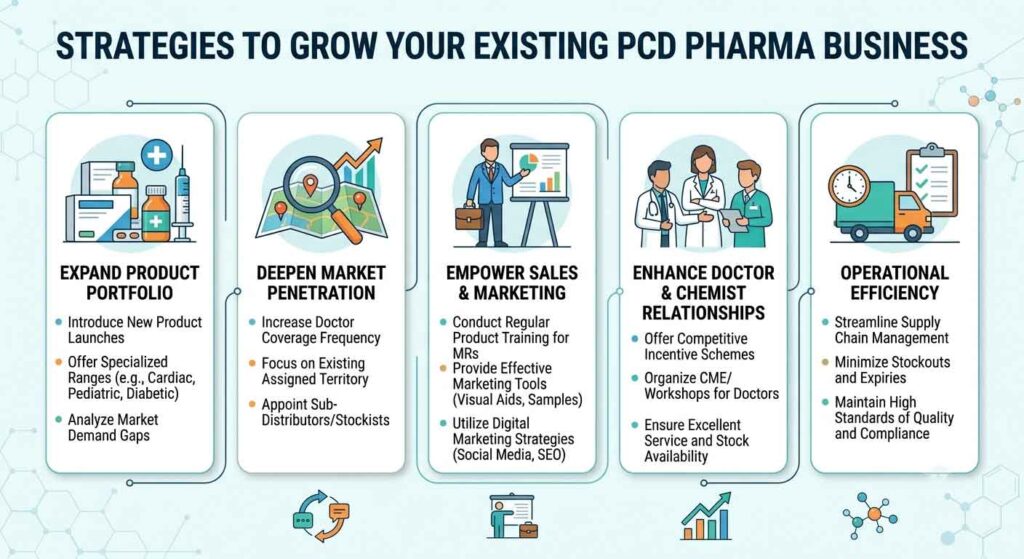
PCD pharma franchise business can be grown successfully if you understand product selection, doctor coverage, chemist availability, stock planning, fieldwork and distributor expansion.
A common query is:
“I have been involved in PCD pharma franchise work for the last two years in Uttar Pradesh. Earlier my father was running this business, and now I want to take it to the next level. I have done MBA but do not have enough knowledge of the pharmaceutical field. Please suggest how I can understand the pharmaceutical sector and increase sales.”
This is a practical situation. Many second-generation business owners have good management knowledge but need deeper understanding of pharma market working.
The good thing is that MBA knowledge can be useful in pharma business if combined with ground-level market learning.
First Understand the Nature of Pharma Business
Pharmaceutical business is different from many other businesses because it is largely prescription-driven.
In most cases, the demand for a medicine is influenced by:
Doctor prescription
Chemist availability
Product quality
Brand recall
Stockist service
Patient affordability
Repeat use
Seasonal demand
Product category
Field promotion
In PCD business, you may work through doctor promotion, distributor supply, chemist network, nursing homes, clinics or sub-franchise partners.
To increase sales, first understand how your current sales are being generated.
Main Ways to Sell Pharma Products
There are different ways to sell pharma products:
1. Prescription-Based Marketing
In this model, doctors prescribe your products after regular visits and proper product detailing.
This requires:
Product knowledge
MR or fieldwork
Doctor list
Regular follow-up
Chemist availability
Ethical promotion
2. PCD or Franchise Marketing
In this model, you take products from a company at net rates and promote or distribute them in your area.
You may also appoint sub-distributors or franchise partners in nearby areas, if permitted by your parent company.
3. Generic or Trade Marketing
In this model, products are sold mainly through wholesalers, retailers, hospitals or institutions based on price, availability and demand.
4. Institutional Supply
Products are supplied to:
Hospitals
Clinics
Nursing homes
Charitable hospitals
Local institutions
This requires proper billing, rates, supply reliability and relationship management.
5. Ayurvedic or Nutraceutical Marketing
Ayurvedic and nutraceutical products may be promoted through doctors, distributors, wellness stores, retail counters and direct customer awareness, subject to label and claim compliance.
Step 1: Audit Your Existing Business
Before increasing sales, first check your current business position.
Prepare a simple report:
Monthly sales of last 12 months
Product-wise sales
Doctor-wise sales
Chemist-wise sales
Area-wise sales
Fast-moving products
Slow-moving products
Expiry stock
Outstanding payment
Company supply issues
Profit margin
Field expenses
Repeat orders
This audit will show where the business is strong and where improvement is needed.
Step 2: Identify Your Best-Selling Products
Every PCD business has some products that sell better than others.
Make three lists:
A-Class Products
These are your fast-moving products. They generate regular sale.
Focus more on these products.
B-Class Products
These products sell occasionally and need better promotion.
Improve their visibility.
C-Class Products
These products are slow-moving or near expiry.
Do not overstock them.
Your first growth should come from pushing A-class and selected B-class products.
Step 3: Stop Promoting Unavailable Products
Product availability is one of the biggest factors in PCD success.
If you promote a product and it is not available when needed, doctors and chemists lose confidence.
Focus on products that are:
Regularly available
Good quality
Properly packed
Fast-moving
Supported by your company
Easy to reorder
Do not build your market around products that frequently remain out of stock.
Step 4: Improve Doctor Coverage
Make a complete doctor list for your territory.
Classify doctors into:
General physicians
Pediatricians
Orthopedic doctors
Gynecologists
ENT specialists
Dermatologists
Dentists
Ayurvedic practitioners, where relevant
Hospitals and clinics
Then divide them into:
A-class: high potential
B-class: medium potential
C-class: future potential
Visit A-class doctors more consistently.
Step 5: Match Products with Doctor Specialty
Do not promote every product to every doctor.
Promote products according to specialty.
General Physicians
PPIs
Antibiotics, where approved and prescription-based
All promotional material should be accurate, balanced and not misleading.
Step 16: Work Ethically
Do not try to grow by unethical shortcuts.
Build your business through:
Quality products
Regular availability
Responsible promotion
Good service
Doctor confidence
Chemist support
Timely supply
Transparent billing
Proper records
Ethical business creates long-term trust.
Step 17: Control Credit and Payment
Sales growth is useless if payment is stuck.
Maintain:
Party-wise outstanding report
Credit limit
Payment due date
Product-wise billing
Monthly collection target
Written terms with sub-distributors
No excessive credit to new parties
Avoid increasing sales only by giving uncontrolled credit.
Step 18: Reduce Expiry and Dead Stock
Expiry loss reduces profit.
To control expiry:
Review stock every month
Track slow-moving products
Promote near-expiry stock early
Avoid overstocking seasonal products
Maintain first-expiry-first-out system
Buy according to actual demand
Return or replace products as per company policy
Stock management is as important as sales generation.
Step 19: Use Digital Tools
Use simple digital tools to improve business.
You can use:
Excel sheet for sales tracking
WhatsApp Business catalogue
Google Sheets for MR reporting
Billing software
CRM system
Google Business Profile
Product images
Digital price list
Social media business page
Digital systems help you monitor the market professionally.
Step 20: Build Local Brand Identity
Your personal reputation matters in PCD business.
Doctors, chemists and distributors should know you as:
Reliable
Regular
Honest
Professional
Product-aware
Quick in service
Consistent in supply
Your local identity can become your biggest strength.
How an MBA Can Use Skills in Pharma Business
Your MBA knowledge can help in:
Sales planning
Team management
Expense control
Market analysis
Customer segmentation
Inventory planning
Profit calculation
Branding
Digital marketing
Distributor management
Reporting system
Growth strategy
You do not need to know everything from day one. Learn pharma-specific details step by step.
90-Day Sales Growth Plan
First 30 Days: Business Audit
Check product-wise sales
Check doctor-wise sales
Check stock position
Identify top 20 doctors
Identify top 20 chemists
Check outstanding payment
Identify slow-moving products
Study competitor activity
Days 31–60: Focused Market Work
Promote only top products
Visit A-class doctors regularly
Improve chemist availability
Meet stockist weekly
Train MR, if appointed
Collect retailer feedback
Push selected products
Days 61–90: Expansion
Add 5 to 10 new doctors
Appoint one sub-distributor if suitable
Add one nearby town
Introduce 2 to 3 new products
Review sales increase
Review profit and payment
Prepare next 90-day plan
Practical Ways to Increase Sales
Use these techniques:
Focus on fast-moving products
Visit doctors regularly
Ensure product availability at chemists
Improve product knowledge
Add nearby towns
Appoint sub-distributors carefully
Build MR team slowly
Track daily fieldwork
Reduce expiry stock
Control credit
Improve packaging and presentation
Use digital catalogues
Maintain regular follow-up
Select better products
Work ethically and consistently
Mistakes to Avoid
Avoid these mistakes:
Expanding too fast
Giving too much credit
Appointing many MRs without monitoring
Promoting unavailable products
Depending only on one doctor
Ignoring chemist availability
Buying too much stock
Ignoring expiry
Not tracking product-wise profit
Copying competitors blindly
Not learning product knowledge
Not defining sub-distributor terms
Using unethical promotion
Final Thoughts
To increase an existing PCD pharma business, you need both market understanding and management discipline.
Since you already have two years of business background and your father has experience, you have a strong foundation. Now your goal should be to organize the business professionally.
Start with product-wise analysis, doctor segmentation, chemist availability and payment control. Then expand through sub-distributors, nearby territories and a trained MR team.
Do not grow only by adding more products or giving more credit.
Grow through better planning, better coverage, better availability, better service and ethical promotion.
A PCD business can increase steadily if you work with patience, discipline and proper market strategy.
Frequently Asked Questions
1. How can I increase sales in existing PCD business?
Increase sales by improving doctor coverage, chemist availability, product selection, sub-distributor network, MR productivity and stock availability.
2. Should I appoint sub-distributors?
Yes, if your company permits it and you can control territory, payment and supply. Appoint sub-distributors only with clear written terms.
3. Should I hire medical representatives?
Hire MRs only when you have enough products, doctor list, stockist support and budget to pay salary for several months.
4. How many products should I focus on?
Focus on fast-moving and repeat-demand products first. Do not promote every product equally.
5. What is most important in PCD business?
Regular product availability, doctor relationship, chemist support and payment control are very important.
6. How can I learn pharmaceutical marketing?
Work in the market daily, study prescriptions, talk to chemists, learn products, observe competitors and maintain regular reporting.
7. Can MBA help in pharma business?
Yes. MBA helps in planning, analysis, sales management, reporting, budgeting, branding and team management.
8. How can I expand in nearby areas?
Start with nearby towns, appoint local sub-distributors or assign MR coverage. Ensure product supply and payment system before expansion.
9. How do I control expiry loss?
Buy according to demand, track stock monthly, avoid overstocking, promote slow-moving products early and follow first-expiry-first-out system.
10. What is the best growth strategy for PCD business?
The best strategy is to strengthen existing territory first, then expand gradually through sub-distributors, MR team and focused product promotion.
Looking for Ayurvedic Franchise or Distribution Opportunities?
Looking to start an Ayurvedic franchise, become a distributor, or launch your own herbal product range?
Elzac Herbal India offers:
Ayurvedic & Herbal Product Range
Franchise & Distribution Opportunities
Third-Party Manufacturing Services
Product Development Support
Marketing Guidance
PAN India Business Opportunities
Whether you are an entrepreneur, retailer, distributor, or healthcare professional, our team can help you explore the right business opportunity in the growing Ayurvedic sector.
Ajay Kamboj is an entrepreneur and business owners associated with many Ayurvedic and Pharmaceutical start-ups. With years of experience in Ayurvedic product marketing, pharmaceutical distribution, franchise development, and client relationship management, he regularly shares practical business insights based on real-world experiences. His articles focus on business growth, entrepreneurship, customer management, and lessons learned from the healthcare and wellness industry.




Leave a Reply
You must be logged in to post a comment.