Pharmaceutical marketing is the process of promoting, distributing and selling medicines, healthcare products, medical devices, nutraceuticals, OTC products and related healthcare solutions to the right customer segment.
Unlike many other industries, pharma marketing is highly regulated because medicines directly affect patient health. A pharma company cannot promote products only like normal consumer goods. It must consider product category, prescription status, drug licence, advertising rules, ethical marketing practices, doctor communication, distributor network, pricing and patient safety.
In the pharmaceutical sector, different marketing models are used depending on product type, target customer and business strategy.
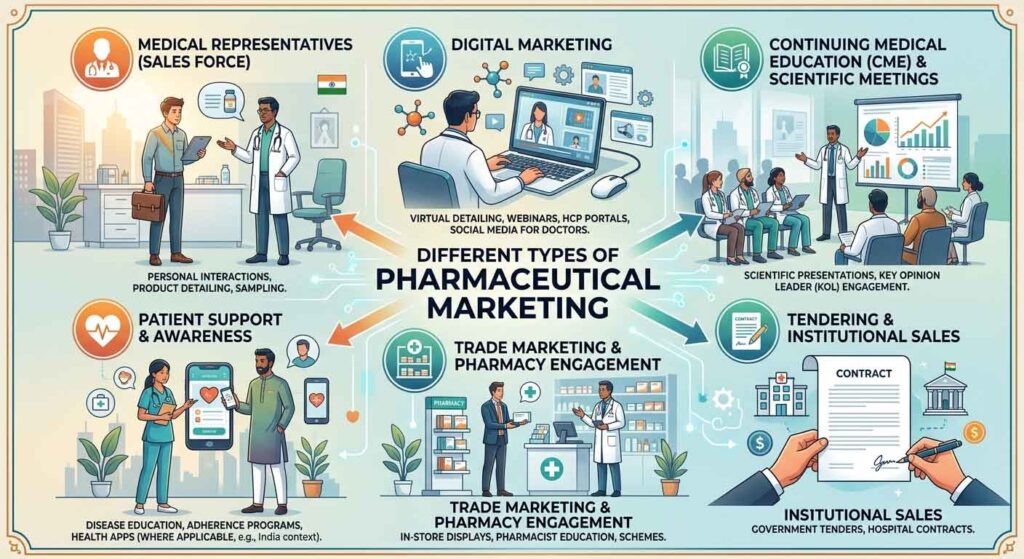
Main Types of Pharmaceutical Marketing
Pharmaceutical marketing can be divided into the following major types:
Branded pharmaceutical marketing
Generic pharmaceutical marketing
PCD/franchise pharmaceutical marketing
OTC pharmaceutical marketing
Institutional pharmaceutical marketing
Hospital and tender marketing
Online pharmacy and digital marketing
Trade and distribution-based marketing
Specialty and super-specialty pharmaceutical marketing
Medical device and diagnostic marketing
1. Branded Pharmaceutical Marketing
Branded pharmaceutical marketing is the traditional prescription-based pharma marketing model.
In this model, pharmaceutical companies promote their branded medicines to doctors, hospitals and healthcare professionals. The main objective is to generate prescriptions for the company’s brand.
For example, many companies may sell the same molecule, but each company promotes its own brand name.
Doctors are the main target customers in branded pharma marketing because prescription generation is the major source of sale.
Suitable For
This model is suitable for:
Ethical pharma companies
Prescription medicine companies
Specialty product companies
Chronic therapy companies
Companies with field sales teams
Important Compliance Point
Branded pharma marketing should be ethical and scientific. Companies should avoid misleading claims, unethical inducements, gifts or unapproved promotional practices. UCPMP 2024 provides a formal framework for ethical pharmaceutical marketing practices in India.
2. Generic Pharmaceutical Marketing
Generic pharmaceutical marketing focuses on medicines sold by generic name or generic-brand positioning, often through distributors, wholesalers, pharmacies, hospitals, institutional buyers and generic medicine channels.
In this model, the focus is generally on:
Affordable pricing
Higher trade margin
Wide availability
Distributor network
Pharmacy substitution
Institutional supply
Generic medicine outlets
India’s Jan Aushadhi scheme was launched to make quality generic medicines available at affordable prices, and PMBJP states that Jan Aushadhi medicines are available at substantially lower prices than branded medicines in the open market.
How Generic Pharma Marketing Works
Generic marketing may be done through:
C&F agents
Super stockists
Distributors
Generic medicine wholesalers
Retail pharmacy chains
Jan Aushadhi-type outlets
Hospital purchase departments
Online B2B promotion
Price-list marketing
Telecalling and field visits
Suitable For
This model is suitable for:
Generic medicine companies
Wholesale distributors
Price-sensitive markets
Institutional suppliers
Pharmacy chain suppliers
Entrepreneurs with strong distribution network
Main Challenge
Generic pharma marketing is highly competitive. Margins, pricing, availability, product quality and replacement policy are very important.
3. PCD / Franchise Pharmaceutical Marketing
PCD means Propaganda Cum Distribution. In PCD or franchise pharmaceutical marketing, a company appoints distributors, sales professionals or franchise partners and gives them marketing and distribution rights in a particular territory.
This model is popular among small and medium pharma companies because it allows expansion without maintaining a large company-employed sales team.
How PCD Marketing Works
The company provides:
Product range
Monopoly or semi-monopoly territory
Promotional material
Product samples, where permitted
Visual aids
MR bags
Prescription pads, where legally appropriate
Price list
Product training
Marketing support
The franchise partner promotes and sells products in the assigned area.
The biggest challenge is selecting genuine franchise partners who can generate regular sales and make timely payments.
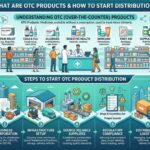
4. OTC Pharmaceutical Marketing
OTC means Over-the-Counter. These are products commonly sold without a doctor’s prescription.
However, in India, OTC is mostly a market term. Licence and advertising requirements depend on whether the product is a drug, food supplement, cosmetic, AYUSH medicine, medical device or general healthcare product.
Examples of OTC-Type Products
Common OTC-type products include:
Pain relief gels
Pain sprays
Antacid products
Digestive products
Cough lozenges
Protein powders
Multivitamins
Herbal syrups
Ayurvedic oils
Personal care products
Cosmetic products
First-aid products
How OTC Marketing Works
OTC marketing targets:
Consumers
Chemists
Pharmacies
Retail counters
General stores, where permitted
Online buyers
Supermarkets
Wellness stores
Doctors, where appropriate and ethical
Marketing methods include:
Retail display
Counter branding
Posters
Digital ads
Social media
Influencer awareness, where compliant
Consumer education
Product sampling, where permitted
Chemist recommendation
Local advertising
Important Compliance Point
OTC products cannot be advertised carelessly. If a product is a Schedule H, H1 or X drug, public advertising is restricted. Product claims must also avoid misleading disease-cure claims and must match the product’s approved category.
5. Institutional Pharmaceutical Marketing
Institutional pharmaceutical marketing focuses on bulk supply to institutions instead of normal retail distribution.
Target customers include:
Government hospitals
Private hospitals
Charitable hospitals
Defence institutions
Railways
ESIC hospitals
Medical colleges
Corporate hospitals
NGOs
Pharmacy chains
Large clinics
Tender-based buyers
How Institutional Marketing Works
Institutional business may involve:
Tender participation
Rate contracts
Hospital purchase meetings
Product registration with institutions
Quotation submission
Technical documentation
Sample submission
Compliance documents
Lowest-price bidding
Regular supply
Payment follow-up
Suitable For
This model is suitable for:
Manufacturers
Large distributors
Hospital suppliers
Generic companies
Surgical and device suppliers
Companies with strong documentation
Main Challenge
Institutional business often has lower margin but higher volume. Payment cycles may be long, and documentation must be strong.
6. Hospital and Tender Marketing
Hospital marketing is closely related to institutional marketing but may include more direct engagement with hospital doctors, purchase departments, pharmacy heads and hospital administration.
Tender marketing is mainly rate-based and documentation-based.
Common Requirements
Hospitals and tender authorities may ask for:
Manufacturing licence
Drug licence
GST certificate
WHO-GMP certificate, where required
Product permission
COA
Stability data
Non-conviction certificate
Market standing certificate
Samples
Price bid
Technical bid
EMD/security deposit
Past supply experience
Suitable For
This model is suitable for companies with manufacturing capacity, documentation strength and ability to supply large quantities regularly.
7. Online Pharmacy and Digital Marketing
Online pharmacy marketing includes selling or promoting medicines and healthcare products through digital platforms.
This may include:
Own e-commerce pharmacy
Existing online pharmacy portals
Digital product promotion
Search engine marketing
SEO blogs
YouTube education
Social media marketing
WhatsApp ordering
B2B pharma portals
Email marketing
App-based pharmacy model
Important Point
Online marketing does not remove licence and prescription requirements. Prescription drugs still require proper sale compliance and valid prescription handling. Schedule H/H1/X advertisement restrictions should also be respected.
This type of marketing focuses on wholesalers, stockists, distributors, chemists and retail chains.
It is common in generic, OTC, Ayurvedic and PCD product segments.
Marketing Methods
Trade marketing includes:
Product price lists
Trade schemes
Stockist appointment
Retailer schemes
Display offers
Launch discounts
Replacement policy
Chemist visits
Distributor meetings
Product availability campaigns
Suitable For
This model is suitable for:
Generic products
OTC brands
FMCG-style healthcare products
Ayurvedic products
High-margin trade products
Local distributor-driven brands
Main Challenge
Trade marketing can increase volume, but excessive schemes and credit can reduce profitability.
9. Specialty and Super-Specialty Pharma Marketing
Specialty pharma marketing focuses on products prescribed by specialist doctors.
Target doctors may include:
Cardiologists
Diabetologists
Neurologists
Gastroenterologists
Dermatologists
Orthopaedics
Gynaecologists
Oncologists
Nephrologists
Psychiatrists
Paediatricians
Features of Specialty Marketing
Specialty marketing usually requires:
Strong product knowledge
Scientific detailing
Clinical references
Small but trained sales team
Focused doctor list
Key opinion leader engagement
Better therapy understanding
Strong patient-support systems, where applicable
Suitable For
This model is suitable for companies dealing in chronic therapy, high-value medicines, complex generics, injectables, hospital products and specialized formulations.
10. Medical Device and Diagnostic Marketing
Medical device and diagnostic marketing are different from medicine marketing.
It may include:
Surgical products
Diagnostic kits
Glucometers
BP monitors
Orthopaedic implants
Hospital equipment
Lab equipment
Point-of-care devices
Wound care products
Medical consumables
Medical-device promotion in India is also covered under a separate Uniform Code for Medical Devices Marketing Practices.
Target Customers
Target customers include:
Hospitals
Diagnostic centres
Doctors
Surgeons
Procurement departments
Distributors
Retail pharmacies
Medical equipment dealers
Comparison Table: Types of Pharmaceutical Marketing
Marketing Type
Main Target
Main Method
Best For
Branded pharma
Doctors and hospitals
MR visits, scientific promotion
Prescription brands
Generic pharma
Distributors and pharmacies
Price, availability, trade network
Affordable medicines
PCD/franchise
Franchise partners
Digital leads, monopoly marketing
Small/medium companies
OTC
Consumers and chemists
Retail display, ads, digital promotion
Non-prescription products
Institutional
Hospitals and institutions
Tender, quotation, rate contract
Bulk supply
Online pharmacy
Patients and digital buyers
E-commerce, SEO, ads
OTC, supplements, compliant medicines
Trade marketing
Stockists and retailers
Schemes, margins, availability
Generic/OTC/AYUSH
Specialty marketing
Specialist doctors
Scientific detailing
Chronic/specialty products
Medical device marketing
Hospitals and clinics
Demonstration, tender, distributor
Devices and diagnostics
Which Type of Pharma Marketing Is Best?
There is no single best type of pharma marketing. The best model depends on your product, budget, licence, team and market.
For New Pharma Marketing Company
PCD/franchise or third-party manufactured branded marketing may be suitable.
For Low Investment
PCD franchise, distribution or OTC products with limited range may be practical.
For Strong Field Team
Branded prescription marketing may be suitable.
For Strong Distributor Network
Generic or trade-based marketing may work better.
For Strong Digital Skills
Online lead generation, OTC digital marketing or franchise marketing may be effective.
For Manufacturing Units
Institutional sales, tender supply and third-party manufacturing marketing may be useful.
Final Thoughts
Pharmaceutical marketing is not limited to one method. A company can choose one or combine multiple models according to its strength.
The main types of pharmaceutical marketing are:
Branded pharmaceutical marketing
Generic pharmaceutical marketing
Franchise/PCD pharmaceutical marketing
OTC pharmaceutical marketing
Institutional and tender marketing
Online pharmacy and digital marketing
Trade distribution marketing
Specialty marketing
Medical device marketing
For long-term success, every pharma company should focus on quality products, proper licence, ethical promotion, strong distribution, correct pricing, and regulatory compliance.
Pharma marketing should not be built only on schemes or margins. It should be built on trust, product knowledge, availability and ethical business practice.
Frequently Asked Questions
1. What are the main types of pharmaceutical marketing?
Main types include branded pharma marketing, generic pharma marketing, PCD/franchise marketing, OTC marketing, institutional marketing, online pharmacy marketing, trade marketing, specialty marketing and medical-device marketing.
2. What is branded pharmaceutical marketing?
Branded pharmaceutical marketing is a prescription-based model where companies promote their brands to doctors and hospitals through medical representatives and scientific product communication.
3. What is generic pharmaceutical marketing?
Generic pharmaceutical marketing focuses on affordable medicines, distributor networks, pharmacy channels and price-sensitive markets.
4. What is PCD pharma marketing?
PCD marketing means appointing franchise partners or distributors and giving them rights to promote and distribute products in a specific territory.
5. What is OTC pharma marketing?
OTC marketing focuses on products commonly purchased without prescription, but licence and advertising rules still depend on product category and claims.
6. What is institutional pharmaceutical marketing?
Institutional marketing involves supplying medicines to hospitals, government departments, medical colleges, defence, railways, pharmacy chains and other bulk buyers.
7. Can prescription medicines be advertised online?
Prescription medicines, especially Schedule H/H1/X drugs, require caution because public advertising is restricted. Promotions should follow applicable laws and ethical codes.
8. Which pharma marketing model is best for beginners?
For beginners, PCD franchise, distribution, generic marketing or limited OTC product marketing may be easier than full branded prescription marketing with a large sales team.
9. Is digital marketing useful in pharma?
Yes, digital marketing is useful for franchise lead generation, OTC products, educational content, brand awareness and B2B enquiries, but it must follow legal and ethical restrictions.
10. What is the most important factor in pharma marketing?
Trust is the most important factor. Product quality, availability, ethical promotion, correct pricing and service build long-term trust.
Looking for Ayurvedic Franchise or Distribution Opportunities?
Looking to start an Ayurvedic franchise, become a distributor, or launch your own herbal product range?
Elzac Herbal India offers:
Ayurvedic & Herbal Product Range
Franchise & Distribution Opportunities
Third-Party Manufacturing
Product Development Support
Marketing Guidance
PAN India Business Opportunities
Whether you are an entrepreneur, retailer, distributor, or healthcare professional, our team can help you explore the right business opportunity in the growing Ayurvedic sector.
Ajay Kamboj is an entrepreneur and business owners associated with many Ayurvedic and Pharmaceutical start-ups. With years of experience in Ayurvedic product marketing, pharmaceutical distribution, franchise development, and client relationship management, he regularly shares practical business insights based on real-world experiences. His articles focus on business growth, entrepreneurship, customer management, and lessons learned from the healthcare and wellness industry.