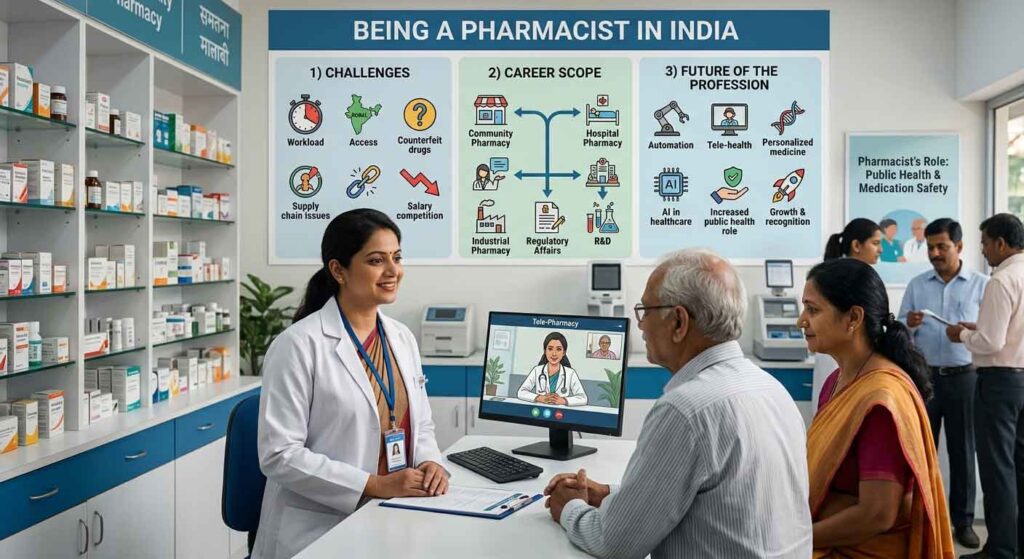
Being a pharmacist in India can be both rewarding and frustrating.
On paper, pharmacy is an important healthcare profession. Pharmacists are educated in medicines, dosage forms, pharmacology, drug interactions, pharmaceutical quality, patient safety and the proper use of medicines.
In practice, however, many pharmacists feel that their professional identity is not always fully recognized.
Common concerns include:
Low salaries in some entry-level jobs
Limited patient-facing authority in many pharmacies
Registered pharmacists being used only for licence compliance
Weak enforcement of professional-presence requirements
Lack of public awareness about the pharmacist’s role
Uneven opportunities between cities and smaller towns
Confusion between pharmacist, pharmacy owner and medicine seller
Underutilization of pharmacists in clinical care
These concerns are real.
But it would also be incorrect to say that there is no career or future for pharmacists in India.
The pharmacy profession is changing.
Opportunities now exist in:
Community pharmacy
Hospital pharmacy
Clinical pharmacy
Pharmaceutical manufacturing
Quality Assurance
Quality Control
Regulatory affairs
Pharmacovigilance
Clinical research
Medical affairs
Drug safety
Supply chain
Pharma marketing
Research and development
Government services
Academics
Entrepreneurship
The bigger question is:
Why is the professional role of the pharmacist still not fully visible to the average Indian patient?
Who Is a Pharmacist?
A pharmacist is a healthcare professional educated and trained in medicines.
A registered pharmacist may work in areas such as:
Dispensing medicines
Reviewing prescriptions
Providing medicine-use information
Supporting medication safety
Counselling patients
Monitoring adverse drug reactions
Supporting antimicrobial stewardship
Managing medicine inventory
Ensuring proper storage
Working in hospitals
Working in pharmaceutical manufacturing
Working in regulatory and drug-safety functions
The exact scope depends on:
Qualification
Registration
Place of employment
Applicable law
Employer structure
Clinical privileges
Pharmacist, Chemist and Pharmacy Owner Are Not the Same Thing
This distinction is very important.
Pharmacist
A pharmacist is a professionally qualified and registered person.
Pharmacy or Medical Store Owner
The owner of a pharmacy may be a pharmacist or a non-pharmacist, depending on the legal business structure.
Ownership of the shop does not automatically make someone a pharmacist.
Chemist
In everyday Indian language, the word “chemist” is often used for a medical store or medicine retailer.
But operating or owning a medicine shop is not the same as being professionally qualified as a pharmacist.
This confusion has contributed to the weak public identity of the pharmacist.
A patient may say:
“I asked the chemist.”
But the person behind the counter may or may not actually be a registered pharmacist.
Does India Legally Recognize Pharmacists?
Yes.
India has:
The Pharmacy Act
The Pharmacy Council of India
State Pharmacy Councils
Registration of pharmacists
Pharmacy education regulations
Drug-sale and dispensing requirements
Therefore, the pharmacist is legally recognized as a professional.
The problem is often the difference between:
What the law and professional framework intend
and
What happens at ground level.
The Biggest Challenge: Lack of a Strong Public Identity
Many patients understand the role of:
Doctor
Nurse
Dentist
Physiotherapist
But they may not clearly understand what a pharmacist does beyond handing over medicine.
This is unfortunate because the pharmacist can add significant value between:
Prescription → Dispensing → Medicine Use → Patient Outcome
A good pharmacist can help the patient understand:
How to take the medicine
When to take it
Whether it should be taken with food
How to store it
What common side effects to watch for
Whether special precautions apply
Whether the patient is using duplicate medicines
Whether there may be a medicine interaction requiring professional attention
The pharmacist should not replace the doctor.
The pharmacist should strengthen medication safety.
Doctor and Pharmacist Have Different but Complementary Roles
The older argument that:
“The doctor should only diagnose and prescribe, and the pharmacist alone should decide the dose”
is not correct.
Doctors are trained to:
Diagnose disease
Select treatment
Prescribe medicines
Decide dose
Decide route
Decide frequency
Decide duration
Monitor clinical response
Pharmacists contribute a different area of expertise.
They may help:
Review the prescription
Identify possible interactions
Detect duplicate therapy
Check allergies
Confirm appropriate dispensing
Counsel the patient
Support medication adherence
Identify potential medication-related problems
Refer concerns back to the prescriber
The best healthcare system is not:
Doctor versus Pharmacist
It is:
Doctor + Pharmacist + Nurse + Other Healthcare Professionals + Patient
Each professional should work within his or her competence.
What Is the Role of a Community Pharmacist?
A community pharmacist may be the most accessible healthcare professional for the public.
A responsible community pharmacist can:
Dispense prescription medicines correctly
Check prescription completeness
Explain medicine administration
Counsel on storage
Explain use of inhalers or devices
Encourage adherence
Identify potential interactions
Warn against inappropriate self-medication
Refer the patient to a doctor when necessary
Maintain required records
Support responsible antibiotic use
Unfortunately, in many places the pharmacist’s professional role is reduced to:
Billing and handing over a strip of tablets.
This is one of the biggest opportunities for improvement.
The Problem of Nominal or “Rented” Pharmacist Registration
A long-standing concern in the pharmacy sector is the alleged practice of using a registered pharmacist’s credentials only for regulatory paperwork while the pharmacist is not genuinely performing the professional role expected at the pharmacy.
This practice should not be normalized.
A pharmacist’s registration is not simply a commercial document.
The purpose of requiring qualified pharmacy professionals is to protect patients and ensure responsible medicine dispensing.
A proper system should ensure:
Genuine pharmacist involvement
Clear duty hours
Proper professional responsibility
Inspection and enforcement
Adequate remuneration
Accountability
A system in which a pharmacist is present only “on paper” harms:
The pharmacist
The profession
The pharmacy owner
The patient
The healthcare system
Why Pharmacists Sometimes Accept Poor Working Conditions
The issue cannot be understood only by blaming individual pharmacists.
Possible reasons include:
Too many graduates competing for entry-level positions
Lack of good jobs in some locations
Financial pressure
Weak bargaining power
Limited career guidance
Lack of specialization
Poor awareness of alternative careers
Need for immediate income
The long-term solution is not only stricter enforcement.
It also requires:
Better training
Better professional skills
More clinical opportunities
Better career planning
Industry-relevant education
Stronger professional organizations
Public awareness
Is Pharmacy Only Useful for Getting a Drug Licence?
No.
This is one of the most damaging misconceptions about pharmacy education.
A pharmacy qualification can lead to multiple career paths.
Career Options for Pharmacists in India
1. Community Pharmacy
Work may include:
Dispensing
Patient counselling
Prescription handling
Inventory management
Pharmacy operations
The future of community pharmacy should move toward greater professional service.
2. Hospital Pharmacy
Hospital pharmacists may work with:
Inpatient medicines
Discharge medication
High-risk drugs
Drug distribution
Inventory
Medication safety
Hospital formulary systems
3. Clinical Pharmacy
Clinical pharmacy may involve:
Medication review
Patient counselling
Drug-information services
Adverse-reaction monitoring
Medication reconciliation
Supporting rational medicine use
The extent of the role varies between institutions.
4. Pharmaceutical Manufacturing
Pharmacists may work in:
Tablet production
Capsule production
Liquid manufacturing
Sterile manufacturing
Packing
Production planning
5. Quality Assurance
QA professionals may work with:
GMP
SOPs
Batch documentation
Deviations
CAPA
Validation
Audits
Change control
Quality systems
6. Quality Control
QC roles may involve:
Raw-material testing
Finished-product testing
Instrumental analysis
Stability studies
Microbiology
Documentation
7. Regulatory Affairs
Regulatory professionals may work with:
Product dossiers
Licensing
Product approvals
Label compliance
Regulatory submissions
Export documentation
Authority communications
8. Pharmacovigilance
Pharmacovigilance focuses on medicine safety.
Work may include:
Adverse-event case processing
Signal management
Safety databases
Literature review
Aggregate reports
Risk management
9. Clinical Research
Career options may include:
Clinical trial operations
Site management
Clinical data management
Medical writing
Regulatory documentation
10. Medical Affairs
Pharmacy graduates with suitable qualifications and experience may work in:
Scientific communication
Medical information
Product training
Evidence review
Medical education support
11. Research and Development
R&D may involve:
Formulation development
Analytical development
Novel drug-delivery systems
Stability
Scale-up
12. Pharma Sales and Marketing
Pharmacists can use their technical knowledge in:
Product management
Brand management
Medical representative training
Business development
PCD franchise
Third-party manufacturing
13. Government Jobs
Opportunities may exist in:
Government hospitals
Public-health institutions
Drug-control departments
Government procurement
Research institutions
Eligibility varies by post and recruitment rules.
14. Academics
After suitable higher qualifications, pharmacists may work in:
Teaching
Research
Academic administration
15. Entrepreneurship
Pharmacists may start businesses such as:
Retail pharmacy
Wholesale distribution
Pharma marketing company
PCD franchise
Third-party manufacturing brand
Nutraceutical business
Healthcare consultancy
A pharmacist should think beyond only:
“Where can I get a job?”
and also ask:
“Which area of pharmacy suits my skills?”
Why Are Entry-Level Salaries Sometimes Low?
Low salaries in some parts of the pharmacy profession are a genuine concern.
Possible reasons include:
Large supply of graduates
Skill mismatch
Regional variation
Small employers
Limited specialization
Weak professional differentiation
A degree alone may not guarantee a high salary.
Students should build additional skills in areas such as:
GMP
Regulatory affairs
Pharmacovigilance
Clinical research
Data analysis
Medical writing
Communication
English
Digital systems
Quality documentation
Specialization can improve career potential.
Should Non-Pharmacy Graduates Work in the Pharmaceutical Industry?
The pharmaceutical industry is multidisciplinary.
It requires people from many backgrounds, including:
Pharmacy
Chemistry
Microbiology
Biotechnology
Engineering
Medicine
Management
Statistics
Information technology
Therefore, it would not be correct to say that every non-pharmacist should be removed from the pharmaceutical industry.
The more important principle is:
The right responsibility should be performed by a person with the legally required and technically appropriate qualification.
A chemist may be suitable for analytical work.
An engineer may be essential for plant maintenance.
A microbiologist may be essential for sterility and microbial testing.
A pharmacist may bring expertise in medicines, formulation, dispensing and pharmaceutical systems.
Healthcare and pharma need multidisciplinary teams.
Pharmacists and Self-Medication
Pharmacists can play an important role in reducing unsafe self-medication.
A patient may directly ask for:
Antibiotics
Steroids
Sleeping medicines
Painkillers
Prescription cough medicines
A responsible pharmacist should not treat every customer request as an automatic sale.
The pharmacist can:
Check whether prescription is required
Explain why medical consultation may be necessary
Refer the patient when symptoms are serious
Educate on safe medicine use
This is where professional pharmacy practice creates real public-health value.
Pharmacists and Antibiotic Resistance
Antimicrobial resistance is a major public-health problem.
Pharmacists can help by:
Avoiding unauthorized sale of prescription antibiotics
Encouraging patients to follow the prescribed course
Explaining correct dosing schedules
Discouraging sharing of leftover antibiotics
Supporting antimicrobial stewardship
Referring inappropriate requests
But antimicrobial resistance cannot be solved by pharmacists alone.
It requires cooperation among:
Doctors
Pharmacists
Hospitals
Microbiology laboratories
Government
Veterinary sector
Agriculture
Patients
Pharmacists and Drug Interactions
Drug interactions can occur when:
Two medicines interact
A medicine interacts with food
A medicine interacts with alcohol
A medicine interacts with supplements
A medicine worsens another health condition
Pharmacists can help identify possible problems.
Examples of information useful during medication review include:
Current medicines
Allergies
Pregnancy status
Kidney problems
Liver problems
Herbal supplements
Previous adverse reactions
However, significant concerns should be communicated to the prescribing doctor rather than the pharmacist independently changing treatment without authority.
Food–Drug and Supplement–Drug Interactions
Patients often assume that:
“Natural means completely safe.”
This is not always true.
Herbs and supplements may interact with medicines.
Examples of potential concerns include:
Increased bleeding risk
Altered absorption
Increased sedation
Effects on blood sugar
Effects on blood pressure
Pharmacists can improve safety by asking patients about:
Herbal products
Nutritional supplements
OTC medicines
Other prescriptions
Pharmacists and Adverse Drug Reactions
Pharmacists can contribute to pharmacovigilance.
They may help:
Recognize suspected adverse reactions
Document patient information
Encourage appropriate reporting
Educate patients
Refer serious reactions for medical attention
Greater pharmacist participation in medicine-safety reporting can strengthen the healthcare system.
What Should Improve in Indian Pharmacy Practice?
1. Genuine Pharmacist Presence
Licensed pharmacies should have meaningful professional pharmacist involvement.
2. Better Enforcement
Regulations should be implemented consistently.
3. Better Salaries
Professional responsibility should be matched with appropriate compensation.
4. More Patient Counselling
Pharmacy should move beyond only product dispensing.
5. Stronger Hospital Pharmacy
Hospitals should use pharmacists more effectively in medication management.
6. Public Awareness
Patients should know why they should speak with a pharmacist about medicines.
7. Better Career Guidance
Students should understand the full range of pharmacy careers.
8. Continuous Professional Development
Pharmacists should keep updating their knowledge.
9. Better Use of Technology
Digital prescription systems and pharmacy software can improve:
Interaction alerts
Allergy records
Prescription records
Inventory control
10. Stronger Collaboration
Pharmacists should work with doctors and other healthcare professionals, not against them.
What Should Pharmacists Themselves Do?
Professional recognition cannot come only from government action.
Pharmacists must also demonstrate professional value.
A pharmacist should:
Keep knowledge updated
Counsel patients properly
Refuse unsafe shortcuts
Maintain professional ethics
Improve communication skills
Report medicine-safety concerns
Understand applicable rules
Specialize where possible
Participate in continuing education
Build public trust
Respect is strengthened when professional competence is visible.
What Should Pharmacy Students Do?
A pharmacy student should not wait until the final year to ask:
“What job can I get?”
Start early.
During the Course
Learn:
Basic pharmacology
Pharmaceutical calculations
Dosage forms
Drug interactions
GMP
Documentation
Communication
Digital skills
Choose a Direction
Decide whether you prefer:
Patients
Manufacturing
Laboratory work
Research
Regulation
Business
Data
Get Practical Exposure
Try:
Internship
Hospital exposure
Manufacturing visit
Industry training
Research project
Build Communication Skills
Technical knowledge without communication can limit career growth.
Is Pharmacy a Good Career in India?
There is no single answer.
Pharmacy can be a good career for a person who:
Is interested in medicines
Builds practical skills
Chooses a suitable specialization
Continues learning
Does not depend only on the degree certificate
The profession has challenges.
But it also offers one of the broadest career ranges in the healthcare and pharmaceutical sector.
The Future of Pharmacists in India
The future can improve through:
Better hospital pharmacy systems
Clinical pharmacy development
Stronger enforcement of dispensing rules
Growth in pharmacovigilance
Expansion of regulatory affairs
Increasing complexity of pharmaceutical manufacturing
Digital health
Medication-safety programs
Patient counselling
Public-health initiatives
The pharmacist of the future should not be viewed merely as:
“The person required for the licence.”
The pharmacist should be recognized as:
A medicine expert and an important member of the healthcare team.
A Balanced View
It is understandable why many pharmacists feel disappointed.
Some may experience:
Low salary
Limited professional recognition
Poor working conditions
Underemployment
These issues should not be ignored.
But saying:
“There is no future in pharmacy in India”
may discourage students who could build successful careers in the right field.
A better conclusion is:
The pharmacy profession in India has significant potential, but the gap between professional education, legal recognition and actual practice still needs to be reduced.
Frequently Asked Questions
1. Is pharmacist a recognized profession in India?
Yes. Pharmacists are registered through State Pharmacy Councils under the Pharmacy Act framework.
2. Can anyone dispense prescription medicines?
Applicable pharmacy and drug laws regulate the dispensing and sale of medicines. Professional dispensing requirements should be followed through the appropriate registered and licensed system.
3. Is a pharmacist the same as a pharmacy owner?
No. The owner of a pharmacy and the registered pharmacist may be different people.
4. Can doctors decide medicine dose?
Yes. Selecting the medicine, dose, frequency and duration is part of prescribing and medical treatment. Pharmacists may independently review the prescription for medication-safety concerns.
5. What is the pharmacist’s role in patient care?
The pharmacist can support safe dispensing, counselling, interaction checking, adherence and medication safety.
6. Is community pharmacy the only career option?
No. Pharmacists work in manufacturing, QA, QC, regulatory affairs, pharmacovigilance, clinical research, hospitals, marketing, research and many other fields.
7. Why are some pharmacy salaries low?
Salary varies according to skill, employer, location, specialization and experience. Entry-level competition can be high in some sectors.
8. Can pharmacists help reduce antibiotic resistance?
Yes. Pharmacists can support responsible antibiotic dispensing and patient education as part of a wider antimicrobial-stewardship system.
9. Is using a pharmacist only for a licence a good practice?
No. A pharmacist’s registration should represent genuine professional responsibility, not merely a paper arrangement.
10. How can the pharmacy profession become stronger?
Through better enforcement, genuine pharmacist participation, better training, appropriate remuneration, patient counselling, specialization and stronger collaboration with the healthcare team.
Final Thoughts
India does not need a conflict between doctors and pharmacists.
It needs a stronger healthcare team.
Doctors should diagnose and prescribe.
Pharmacists should contribute their expertise in medicines, safe dispensing, medication review and patient counselling.
Nurses and other healthcare professionals should perform their own essential roles.
The goal should not be:
“Who is more important?”
The goal should be:
“How can every professional contribute to safer and better patient care?”
A pharmacist should not be treated merely as a name required for a drug licence.
At the same time, pharmacists must continuously prove their value through knowledge, ethics, communication and professional responsibility.
The future of pharmacy in India will become stronger when:
Qualified pharmacists are genuinely involved in medicine use, patients understand their role, employers value their skills, and pharmacists themselves take responsibility for building a respected profession.
Looking for Ayurvedic Franchise or Distribution Opportunities?
Looking to start an Ayurvedic franchise, become a distributor, or launch your own herbal product range?
Elzac Herbal India offers:
Ayurvedic & Herbal Product Range
Franchise & Distribution Opportunities
Third-Party Manufacturing Services
Product Development Support
Marketing Guidance
PAN India Business Opportunities
Whether you are an entrepreneur, retailer, distributor, or healthcare professional, our team can help you explore the right business opportunity in the growing Ayurvedic sector.
Ajay Kamboj is an entrepreneur and business owners associated with many Ayurvedic and Pharmaceutical start-ups. With years of experience in Ayurvedic product marketing, pharmaceutical distribution, franchise development, and client relationship management, he regularly shares practical business insights based on real-world experiences. His articles focus on business growth, entrepreneurship, customer management, and lessons learned from the healthcare and wellness industry.






Leave a Reply
You must be logged in to post a comment.