Pharmacy is the branch of healthcare and pharmaceutical science concerned with:
Medicines
Drug formulation
Medicine manufacturing
Quality testing
Safe dispensing
Patient counselling
Drug regulation
Clinical research
Medicine safety
Pharmaceutical business
A pharmacy qualification can lead to work in a medical store or hospital, but the profession is much broader than retail dispensing.
Pharmacy graduates may work in:
Pharmaceutical factories
Quality Control laboratories
Quality Assurance departments
Hospitals
Clinical research organizations
Pharmacovigilance companies
Regulatory departments
Research and development
Government services
Pharma sales and marketing
Medical writing
Supply-chain management
Colleges and research institutions
Their own healthcare businesses
The best course depends on whether the student is more interested in:
Patient care
Manufacturing
Laboratory work
Research
Regulation
Sales and management
Entrepreneurship
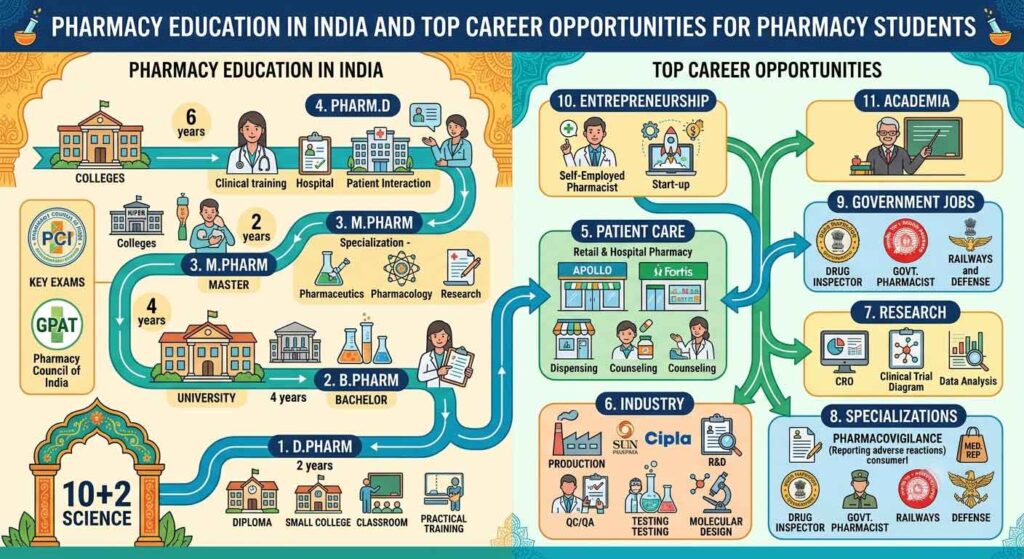
Pharmacy Courses Available in India
The major pharmacy-education routes include:
Undergraduate and Professional Courses
Diploma in Pharmacy
Bachelor of Pharmacy
Bachelor of Pharmacy Practice
Doctor of Pharmacy
Doctor of Pharmacy—Post Baccalaureate
Postgraduate and Research Courses
Master of Pharmacy
Doctor of Philosophy in Pharmacy or a related pharmaceutical specialization
Minimum Eligibility for Pharmacy Courses
Eligibility After Class 12
For courses such as D.Pharm, B.Pharm and Pharm.D, students generally need to pass 10+2 in the science stream with:
Physics
Chemistry
Biology or Mathematics
The required:
Minimum percentage
Entrance examination
Age
Reservation criteria
Subject combination
may vary according to the state, university, institution and admission year.
Students should check the official admission notice rather than relying on an old online information.
Importance of PCI Approval
Before taking admission, confirm that:
The institution is approved by the Pharmacy Council of India.
Approval covers the exact course.
Approval covers the proposed academic session.
The examining university or board is recognized.
The approved student intake has not been exceeded.
A college may be approved for B.Pharm but not for Pharm.D or M.Pharm.
Similarly, approval for an earlier academic session should not automatically be assumed to continue indefinitely.
1. Diploma in Pharmacy
D.Pharm is one of the shortest professional routes into pharmacy after Class 12.
Duration
The course generally includes:
Two academic years
500 hours of practical training
Practical training lasting at least three months
Students covered by the applicable regulations must also meet the D.Pharm Exit Examination requirements before pharmacist registration.
Major D.Pharm Subjects
The Education Regulations, 2020 include subjects such as:
First Part
Pharmaceutics
Pharmaceutical Chemistry
Pharmacognosy
Human Anatomy and Physiology
Social Pharmacy
Second Part
Pharmacology
Community Pharmacy and Management
Biochemistry and Clinical Pathology
Pharmacotherapeutics
Hospital and Clinical Pharmacy
Pharmacy Law and Ethics
The revised curriculum is more patient- and practice-oriented than many older D.Pharm syllabi.
Practical Training
Training may cover activities such as:
Storage of drugs and medical devices
Inventory control
Reading prescriptions
Dispensing
Patient counselling
Maintaining records
Hospital or community pharmacy practices
The training institution and records should comply with the applicable education regulations.
Registration After D.Pharm
Completing the college examination alone may not be the final step.
The student may need to complete:
Approved D.Pharm course
Required practical training
D.Pharm Exit Examination, where applicable
Application to the concerned State Pharmacy Council
Payment of the prescribed registration fee
Document verification
The State Pharmacy Council—not the college or PCI—issues pharmacist registration.
Career Opportunities After D.Pharm
Community Pharmacist
A registered pharmacist may work at a retail pharmacy and handle:
Prescription dispensing
Patient counselling
Medicine storage
Expiry control
Schedule-drug records
Inventory
Hospital Pharmacist
Opportunities may exist in:
Government hospitals
Private hospitals
Nursing homes
Charitable hospitals
Institutional dispensaries
Recruitment conditions depend on the employer.
Government Pharmacist
D.Pharm graduates may apply for eligible pharmacist posts advertised by:
State governments
Central government institutions
Railways
Armed forces establishments
Public hospitals
Municipal bodies
Selection normally involves an examination, merit process or recruitment procedure.
Retail Pharmacy Business
A registered pharmacist may work in or establish a retail pharmacy, subject to:
Drug licence
Suitable premises
Business registration
Storage requirements
Applicable state rules
The pharmacy registration certificate is not itself the retail drug licence.
Wholesale Distribution
A D.Pharm holder may work in:
Wholesale medicine distribution
Stockist operations
Hospital supply
Inventory management
The business still requires an appropriate wholesale drug licence.
Medical Representative
D.Pharm graduates may enter pharma sales where employers accept their qualification.
Further Education
After D.Pharm, a student may consider:
B.Pharm
B.Pharm lateral-entry opportunities under applicable rules
B.Pharm Practice, where eligible and available
Business or healthcare-management courses
2. Bachelor of Pharmacy
B.Pharm is a four-year undergraduate professional pharmacy course after 10+2.
It provides broader exposure than D.Pharm to:
Pharmaceutical manufacturing
Formulation science
Medicinal chemistry
Pharmacology
Pharmaceutical analysis
Quality systems
Drug regulation
Clinical pharmacy
Research
B.Pharm Course Duration
The regular course generally runs for:
Four academic years
Eight semesters, subject to the applicable university and PCI scheme
D.Pharm candidates may have separate admission routes under applicable regulations and state admission policies.
B.Pharm Curriculum
The exact semester structure may differ depending on the curriculum applicable to the admission batch.
PCI has published a 2026 B.Pharm syllabus aligned with NEP 2020. Therefore, students should not rely on old subject lists taken from a particular university.
The broad areas generally include:
Pharmaceutical Sciences
Pharmaceutics
Physical pharmacy
Pharmaceutical engineering
Industrial pharmacy
Biopharmaceutics
Pharmacokinetics
Novel drug-delivery systems
Pharmaceutical Chemistry
Organic chemistry
Inorganic chemistry
Medicinal chemistry
Biochemistry
Drug Analysis and Quality
Pharmaceutical analysis
Instrumental analysis
Quality Assurance
Validation
Pharmacopoeial standards
Biological and Medical Sciences
Human anatomy and physiology
Pathophysiology
Pharmacology
Microbiology
Biotechnology
Natural Products
Pharmacognosy
Phytochemistry
Herbal drug technology
Natural-product formulation
Pharmacy Practice and Regulation
Community pharmacy
Hospital pharmacy
Clinical pharmacy
Pharmaceutical jurisprudence
Regulatory science
Pharmacotherapeutics
Professional Development
The curriculum may also contain:
Communication
Computer applications
Research methodology
Biostatistics
Entrepreneurship
Project work
Practice-school or experiential learning
Electives and interdisciplinary subjects
Students should obtain the official syllabus applicable to their admission year from their college or university.
Career Opportunities After B.Pharm
B.Pharm offers one of the widest career selections in the pharmaceutical industry.
Pharmaceutical Production
Production officers supervise the manufacture of:
Tablets
Capsules
Syrups
Suspensions
Creams
Ointments
Sterile products
Work may involve:
Batch manufacturing
Equipment operation
GMP compliance
Yield reconciliation
Documentation
Line clearance
Process control
Quality Control
Quality Control professionals test:
Raw materials
Packaging materials
In-process samples
Finished products
Stability samples
Important skills include:
HPLC
Gas chromatography
UV spectroscopy
Dissolution testing
Analytical documentation
Pharmacopoeial methods
Quality Assurance
Quality Assurance focuses on the system used to ensure consistent product quality.
Responsibilities may include:
SOPs
Batch-record review
Deviations
CAPA
Change control
Validation
Audits
Training
Product release
Data integrity
QA and QC are related but different.
QC primarily performs testing, while QA controls and reviews the overall quality system.
Formulation Research and Development
Formulation scientists develop products such as:
Tablets
Capsules
Liquids
Modified-release products
Topical preparations
Novel delivery systems
The work may involve:
Excipient selection
Preformulation
Trial batches
Scale-up
Stability
Technology transfer
An M.Pharm in Pharmaceutics or a related specialization can improve prospects in advanced formulation roles.
Analytical Research and Development
Analytical R&D professionals develop and validate testing methods.
They may work on:
Assay methods
Dissolution methods
Impurity analysis
Stability-indicating methods
Method transfer
Regulatory documentation
Regulatory Affairs
Regulatory Affairs professionals prepare and manage:
Product applications
Drug licences
Dossiers
Label reviews
Variations
Regulatory submissions
Authority responses
Export documents
This career requires strong knowledge of both science and regulations.
Pharmacovigilance
Pharmacovigilance is concerned with the detection, assessment and reporting of medicine-safety information.
Roles may include:
Adverse-event case processing
Medical coding
Narrative writing
Literature screening
Signal detection
Aggregate safety reports
Risk-management support
B.Pharm, Pharm.D and M.Pharm graduates commonly enter this field.
Clinical Research
Pharmacy graduates may work in:
Clinical trial operations
Clinical data management
Site coordination
Regulatory documentation
Trial monitoring support
Ethics documentation
Medical writing
Additional knowledge of Good Clinical Practice and research methodology is useful.
Medical Writing
Medical writers prepare:
Scientific articles
Clinical documents
Regulatory documents
Safety narratives
Product information
Educational material
Literature summaries
Strong English, scientific reading and accurate referencing are important.
Pharma Sales and Marketing
Career positions may include:
Medical representative
Area business manager
Regional sales manager
Product executive
Product manager
Brand manager
Business-development manager
A technical pharmacy background can help in understanding and communicating product information.
Supply Chain and Procurement
Pharmacists may work in:
API procurement
Packaging-material purchase
Inventory planning
Vendor qualification
Warehousing
Cold-chain management
Distribution
Demand forecasting
Hospital and Community Pharmacy
After registration with the State Pharmacy Council, B.Pharm graduates may work in:
Retail pharmacies
Hospital pharmacies
Institutional pharmacies
Medicine-information services
Government Careers
Eligible graduates may apply for posts such as:
Government pharmacist
Drug inspector
Analyst
Regulatory officer
Procurement officer
Scientific assistant
A B.Pharm degree does not automatically make someone a drug inspector or drug controller.
The candidate must satisfy the recruitment rules, experience conditions and selection process prescribed for the particular post.
Entrepreneurship
A B.Pharm graduate may explore:
Retail pharmacy
Wholesale distribution
PCD pharma franchise
Pharma marketing company
Third-party manufacturing brand
Nutraceutical business
Ayurvedic marketing
Regulatory consultancy
Medical-content business
Separate licences and business registrations remain necessary.
3. Bachelor of Pharmacy Practice
B.Pharm Practice is a separate professional course intended for eligible D.Pharm-qualified registered pharmacists under its applicable regulations.
Duration
The course is generally two years after D.Pharm.
Purpose
It is designed to strengthen areas such as:
Pharmacy practice
Patient counselling
Community pharmacy
Hospital pharmacy
Clinical pharmacy
Medication management
Availability is limited, and candidates should check:
PCI-approved institutions
Eligibility
Professional experience requirements
Current admission status
4. Doctor of Pharmacy
Pharm.D is a professional pharmacy course with a strong focus on:
Clinical pharmacy
Hospital practice
Pharmacotherapeutics
Patient care
Drug information
Medication safety
Duration
The regular Pharm.D course is generally six years after 10+2:
Five years of academic study
One year of internship or residency training
A Pharm.D Post Baccalaureate route is also available for eligible B.Pharm graduates at approved institutions.
Major Pharm.D Study Areas
The curriculum includes areas such as:
Human anatomy and physiology
Pathophysiology
Pharmacology
Pharmacotherapeutics
Hospital pharmacy
Clinical pharmacy
Clinical toxicology
Biopharmaceutics and pharmacokinetics
Clinical research
Pharmacoepidemiology
Pharmacoeconomics
Therapeutic drug monitoring
Clerkship
Project work
Hospital internship
Sixth-Year Internship
The internship includes clinical postings in hospital departments.
Students may participate in supervised services such as:
Medication-history collection
Prescription review
Drug-information support
Adverse-reaction monitoring
Patient counselling
Ward-round participation
Medication-safety activities
The quality of a Pharm.D programme depends heavily on:
Hospital attachment
Patient flow
Clinical faculty
Preceptor involvement
Genuine ward exposure
Students should verify these facilities before admission.
Career Opportunities After Pharm.D
Clinical Pharmacist
Clinical pharmacists may support:
Medication review
Interaction identification
Dose-related review
Patient counselling
Drug-information services
Adverse-event monitoring
The role and authority vary between hospitals.
Hospital Pharmacist
Pharm.D graduates may work in advanced hospital-pharmacy services, subject to institutional recruitment rules.
Drug-Information Pharmacist
Responsibilities may include answering evidence-based queries from:
Doctors
Nurses
Pharmacists
Patients
Hospital committees
Medication-Safety Officer
Some hospitals and healthcare organizations employ professionals to:
Review medication errors
Improve medicine-use systems
Analyse high-risk medicines
Develop safety procedures
Pharmacovigilance
Pharm.D graduates are well suited to drug-safety roles because of their clinical and therapeutic training.
Clinical Research
Possible roles include:
Clinical research coordinator
Trial associate
Drug-safety associate
Clinical data specialist
Medical writer
Medical Affairs
With suitable skills and experience, Pharm.D graduates may work in:
Medical information
Scientific communication
Evidence review
Product training
Medical-affairs support
Important Scope Clarification
A Pharm.D graduate is a pharmacist and may use the academic title according to applicable professional rules.
However, the Pharm.D qualification does not by itself authorize the holder to practise medicine as an MBBS doctor.
A pharmacist should not independently:
Diagnose diseases as a medical practitioner
Write medical prescriptions without legal authority
Substitute prescribed medicines contrary to pharmacy regulations
Present a pharmacy service as an independent medical clinic
Clinical pharmacy should operate in collaboration with the medical and healthcare team.
5. Master of Pharmacy
M.Pharm is normally a two-year postgraduate course after B.Pharm.
It provides specialization in a selected pharmaceutical field.
Common M.Pharm Specializations
Depending on institutional approval and availability, specializations may include:
Pharmaceutics
Industrial Pharmacy
Pharmaceutical Technology
Pharmaceutical Chemistry
Medicinal Chemistry
Pharmaceutical Analysis
Pharmacology
Pharmacognosy
Quality Assurance
Regulatory Affairs
Pharmacy Practice
Pharmaceutical Biotechnology
The exact title and availability vary by institution.
Structure
M.Pharm commonly includes:
Advanced theory
Specialized practical work
Seminar presentations
Research methodology
Journal clubs
Dissertation or research project
Career Opportunities After M.Pharm
Research and Development
The specialization should match the role:
Pharmaceutics for formulations
Pharmaceutical Chemistry for drug design and synthesis
Pharmacology for preclinical research
Analysis for analytical development
Pharmacognosy for natural-product research
Quality Assurance and Validation
M.Pharm graduates may work in:
Process validation
Cleaning validation
Quality risk management
Auditing
Qualification
Compliance
Regulatory Affairs
Specialized regulatory education can support careers in:
Domestic licensing
Export dossiers
Common Technical Documents
Regulatory strategy
Label compliance
Post-approval changes
Academic Teaching
M.Pharm is commonly required for many teaching positions in pharmacy institutions.
The exact post, specialization, experience and qualification must meet current PCI and university recruitment rules.
Clinical and Pharmacy Practice
M.Pharm in Pharmacy Practice may support careers in:
Hospital pharmacy
Clinical research
Drug information
Medication safety
Pharmacy-practice teaching
Doctoral Research
M.Pharm graduates may pursue Ph.D. programmes in pharmacy or related areas.
6. Ph.D. in Pharmacy
Ph.D. is a research degree rather than a basic professional qualification for pharmacist registration.
Eligibility
Admission commonly requires:
M.Pharm or another accepted postgraduate qualification
University entrance examination or national-level eligibility, where applicable
Interview
Research proposal
Supervisor availability
Exact requirements differ by university.
Research Areas
Possible areas include:
Drug discovery
Novel drug delivery
Nanotechnology
Pharmacology
Toxicology
Natural products
Pharmaceutical analysis
Clinical pharmacy
Pharmacoeconomics
Regulatory science
Biotechnology
Career Opportunities
Ph.D. graduates may work in:
Universities
Research institutions
Pharmaceutical R&D
Scientific writing
Regulatory science
Patent research
Research management
Academic leadership
A Ph.D. does not automatically provide registration as a pharmacist if the person does not hold an approved professional pharmacy qualification.
Top Career Opportunities for Pharmacy Students
1. Pharmaceutical Quality Assurance
Suitable for students who enjoy:
Systems
Documentation
Compliance
Audits
Problem-solving
Helpful qualifications:
B.Pharm
M.Pharm Quality Assurance
M.Pharm Pharmaceutics
Important skills:
GMP
SOP writing
CAPA
Change control
Validation
Data integrity
2. Quality Control and Pharmaceutical Analysis
Suitable for students interested in:
Chemistry
Laboratory instruments
Testing
Data interpretation
Helpful skills:
HPLC
GC
UV spectroscopy
Dissolution
Method validation
Good laboratory practices
3. Formulation Research and Development
Suitable for students who enjoy:
Product development
Experimentation
Dosage forms
Scale-up
A postgraduate specialization in Pharmaceutics is often useful.
4. Regulatory Affairs
Suitable for students who enjoy both:
Science
Law and documentation
Important skills include:
Drug regulations
Dossier preparation
Technical writing
Label review
Regulatory communication
5. Pharmacovigilance
Suitable for students interested in:
Medicine safety
Clinical information
Case analysis
Medical terminology
Pharm.D, B.Pharm and M.Pharm graduates may enter this sector.
6. Clinical Research
Suitable for students interested in:
Clinical trials
Patient research
Data
Protocols
Ethics
Additional knowledge of Good Clinical Practice is valuable.
7. Hospital and Clinical Pharmacy
Suitable for students who prefer:
Patient interaction
Clinical environments
Medication counselling
Hospital systems
Pharm.D or postgraduate Pharmacy Practice training may provide an advantage for advanced clinical roles.
8. Pharmaceutical Production
Suitable for students interested in:
Manufacturing
Machinery
Process control
Team supervision
Production work may involve shift duties and strict documentation.
9. Medical Writing
Suitable for students who have:
Strong English
Scientific understanding
Research ability
Attention to detail
10. Medical Affairs and Drug Information
Suitable for candidates with:
Strong pharmacology
Literature-review skills
Presentation skills
Clinical understanding
11. Pharma Sales and Product Management
Suitable for students who enjoy:
Communication
Travel
Targets
Strategy
Market development
Product management commonly requires experience in sales, marketing or an additional management qualification.
12. Government Services
Government opportunities may include:
Pharmacist
Drug inspector
Analyst
Regulatory officer
Research assistant
Hospital procurement
Every post has its own eligibility and selection rules.
13. Intellectual Property and Patent Research
Pharmacy graduates with additional patent-law or intellectual-property training may work in:
Patent searching
Prior-art review
Patent drafting support
Freedom-to-operate analysis
14. Pharmaceutical Supply Chain
Roles include:
Procurement
Warehouse management
Vendor development
Demand planning
Cold-chain management
Distribution
15. Entrepreneurship
Business options include:
Pharmacy
Wholesale distribution
PCD franchise
Pharma marketing
Nutraceutical brand
Ayurvedic brand
Third-party manufacturing
Healthcare content and consultancy
Entrepreneurship requires regulatory and financial understanding in addition to pharmacy knowledge.
Which Course Should a Student Choose?
Choose D.Pharm When
You want a shorter professional course.
Your main goal is community or hospital pharmacy.
You want to enter the workforce earlier.
You may continue to B.Pharm later.
Choose B.Pharm When
You want broad opportunities in industry.
You are interested in QA, QC, production or regulation.
You may pursue M.Pharm, management or research.
You want flexibility between technical and commercial roles.
Choose Pharm.D When
You are strongly interested in patient care.
You prefer a hospital environment.
You want to study therapeutics and clinical pharmacy deeply.
The selected institution has genuine hospital facilities.
Choose M.Pharm When
You want technical specialization.
You want research, academics or advanced industry roles.
You already know your preferred pharmacy field.
Choose Ph.D. When
You are committed to original research.
You want an academic or scientific career.
You understand that a Ph.D. requires several years of focused research.
How to Choose the Right Pharmacy College
Do not select a college only because it is near your home or offers a discount.
Check:
PCI Approval
Verify current approval for:
Course
Intake
Academic year
Examining authority
Faculty
Review:
Qualifications
Experience
Faculty stability
Student–teacher interaction
Laboratories
Check whether students receive genuine access to:
Pharmaceutical instruments
Manufacturing equipment
Analysis laboratories
Computer systems
Hospital Facilities
This is especially important for:
Pharm.D
Pharmacy Practice
Clinical training
Industrial Exposure
Ask about:
Internships
Industrial visits
Live projects
Training partners
Placement records
Placement Information
Do not rely only on the highest package mentioned in an advertisement.
Ask for:
Number of students placed
Job profiles
Employer names
Median or typical roles
Internship conversion
Fees and Return on Investment
Compare:
Tuition
Hostel
Transport
Examination fees
Training costs
Realistic career outcomes
Skills Pharmacy Students Should Develop
A degree alone may not be enough for a strong career.
Technical Skills
Depending on the target career, learn:
GMP
HPLC
Validation
Regulatory documentation
Pharmacovigilance databases
Clinical research
Medical terminology
Literature searching
Statistics
Communication Skills
Learn to:
Write professional emails
Explain scientific concepts
Prepare presentations
Counsel patients
Speak confidently in interviews
Digital Skills
Useful tools may include:
Microsoft Excel
PowerPoint
Data-analysis tools
Reference managers
Regulatory databases
Pharmacy software
Documentation Skills
The pharmaceutical industry requires accurate and traceable documentation.
Students should practise:
SOP writing
Report preparation
Data review
Scientific referencing
Record control
Common Mistakes Made by Pharmacy Students
Avoid:
Joining an unapproved institution
Choosing a course only because friends selected it
Assuming D.Pharm and B.Pharm have identical careers
Collecting certificates without practical knowledge
Ignoring English and communication
Completing an internship only on paper
Expecting a government job automatically
Selecting M.Pharm specialization without understanding the career
Assuming every sales job is unsuitable for pharmacy graduates
Believing that only factory jobs are available
A Practical Career Plan
First Year
Understand pharmacy basics.
Improve communication and computer skills.
Explore different sectors.
Middle Years
Select two or three possible career directions.
Learn relevant practical skills.
Attend industrial or hospital training.
Final Year
Prepare a professional résumé.
Complete a meaningful project.
Apply for internships.
Practise interviews.
Develop job-specific knowledge.
First Two Years After Graduation
Focus on learning and specialization.
Avoid changing jobs only for a very small salary difference.
Build measurable technical skills.
Maintain professional contacts.
Consider postgraduate education only when it supports a clear career goal.
Frequently Asked Questions
1. Which pharmacy course is best after Class 12?
B.Pharm provides the broadest industry options, while Pharm.D is more focused on clinical and hospital pharmacy. D.Pharm is the shorter route to entry-level pharmacy practice.
2. Can a D.Pharm graduate become a registered pharmacist?
Yes, after completing the approved course, practical training, applicable exit examination and State Pharmacy Council registration requirements.
3. Is B.Pharm a four-year course?
Yes, regular B.Pharm is generally a four-year course after 10+2.
4. Is Pharm.D equal to MBBS?
No. Pharm.D is a professional pharmacy qualification, not an MBBS medical degree.
5. Can a Pharm.D graduate prescribe medicines?
The qualification alone does not provide general independent medical-prescribing authority. Pharmacists must work within applicable pharmacy-practice and institutional rules.
6. Is M.Pharm compulsory after B.Pharm?
No. Many industry careers are available after B.Pharm. M.Pharm is useful for specialization, research, advanced technical work and academics.
7. Can B.Pharm graduates apply for drug inspector posts?
They may apply when they satisfy the specific recruitment rules. Selection is not automatic and may require examinations and experience.
8. Which field has the best scope?
There is no single best field. Strong areas include Quality Assurance, Regulatory Affairs, Pharmacovigilance, clinical research, formulation R&D and pharmaceutical analysis.
9. Who registers pharmacists in India?
Registration, renewal and transfer are handled by the respective State Pharmacy Councils.
10. How should students verify a pharmacy college?
Check the Pharmacy Council of India’s current approved-institution list for the exact course and academic session.
Final Thoughts
Pharmacy is not limited to working behind a medical-store counter.
It combines:
Healthcare
Chemistry
Biology
Engineering
Research
Regulation
Business
The best career depends on the student’s interest.
A student who enjoys patient interaction may prefer hospital or community pharmacy.
A student who enjoys laboratory work may prefer Quality Control or analytical research.
A student who enjoys systems and documentation may prefer Quality Assurance or Regulatory Affairs.
A student who enjoys communication and business may prefer marketing, product management or entrepreneurship.
The strongest career formula is:
Approved education + practical training + communication + specialization + continuous learning
A pharmacy degree creates an opportunity, but skills, professional ethics and practical experience determine long-term growth.
Looking for Ayurvedic Franchise or Distribution Opportunities?
Looking to start an Ayurvedic franchise, become a distributor, or launch your own herbal product range?
Elzac Herbal India offers:
Ayurvedic & Herbal Product Range
Franchise & Distribution Opportunities
Third-Party Manufacturing Services
Product Development Support
Marketing Guidance
PAN India Business Opportunities
Whether you are an entrepreneur, retailer, distributor, or healthcare professional, our team can help you explore the right business opportunity in the growing Ayurvedic sector.
Ajay Kamboj is an entrepreneur and business owners associated with many Ayurvedic and Pharmaceutical start-ups. With years of experience in Ayurvedic product marketing, pharmaceutical distribution, franchise development, and client relationship management, he regularly shares practical business insights based on real-world experiences. His articles focus on business growth, entrepreneurship, customer management, and lessons learned from the healthcare and wellness industry.






Leave a Reply Cancel reply
You must be logged in to post a comment.