Compounding and dispensing are two important terms used in pharmacy practice. Many pharmacy students, new pharmacists, medical-store owners and healthcare entrepreneurs get confused between these two words.
Both activities are related to medicines and prescriptions, but they are not the same.
In simple words:
Compounding means preparing or mixing a medicine according to a prescription or formula.
Dispensing means supplying a prescribed medicine to the patient after checking and interpreting the prescription.
Compounding involves preparation of medicine. Dispensing involves supplying medicine with proper checking, labelling and patient guidance.
Quick Answer
Compounding is the process of preparing, mixing, assembling, packing and labelling a medicine according to a prescription or approved formula.
Dispensing is the process of receiving a prescription, checking it, selecting the correct medicine, supplying it to the patient and explaining how to use it.
Both require professional knowledge and should be done by a registered pharmacist or under the legal responsibility and supervision of a registered pharmacist as per applicable rules.
What Is Compounding?
Compounding is the process of preparing a medicine by mixing, combining or altering ingredients according to the requirement of a patient or prescription.
It may involve:
Weighing ingredients
Measuring liquids
Mixing powders
Preparing ointment
Preparing suspension
Preparing solution
Filling capsules
Labelling the preparation
Packing the medicine
Giving proper instructions
Compounding is usually done when a ready-made commercial medicine is not available in the required form, strength, quantity or combination.
Example of Compounding
A doctor prescribes a special ointment for a patient by giving a formula.
The pharmacist prepares the ointment by mixing the required ingredients in the correct quantity and packs it in a suitable container.
This is compounding.
Another example:
A child needs a lower dose of medicine, but the required strength is not available commercially. A pharmacist may prepare a suitable liquid formulation if legally and technically permitted.
What Is Dispensing?
Dispensing is the process of supplying medicine to a patient against a prescription.
It includes:
Receiving prescription
Reading prescription
Checking doctor details
Checking patient details
Checking medicine name
Checking dose and frequency
Checking availability
Selecting correct medicine
Labelling, where required
Supplying medicine
Explaining dose and use
Giving storage advice
Warning about precautions
Maintaining records, where required
Dispensing is not only handing over medicine. It also includes prescription evaluation and patient guidance.
Example of Dispensing
A patient brings a prescription for:
Tablet A, one tablet twice daily after food
Syrup B, 5 ml twice daily
Capsule C, once daily at night
The pharmacist checks the prescription, supplies the correct medicines, explains the dose and gives necessary instructions.
This is dispensing.
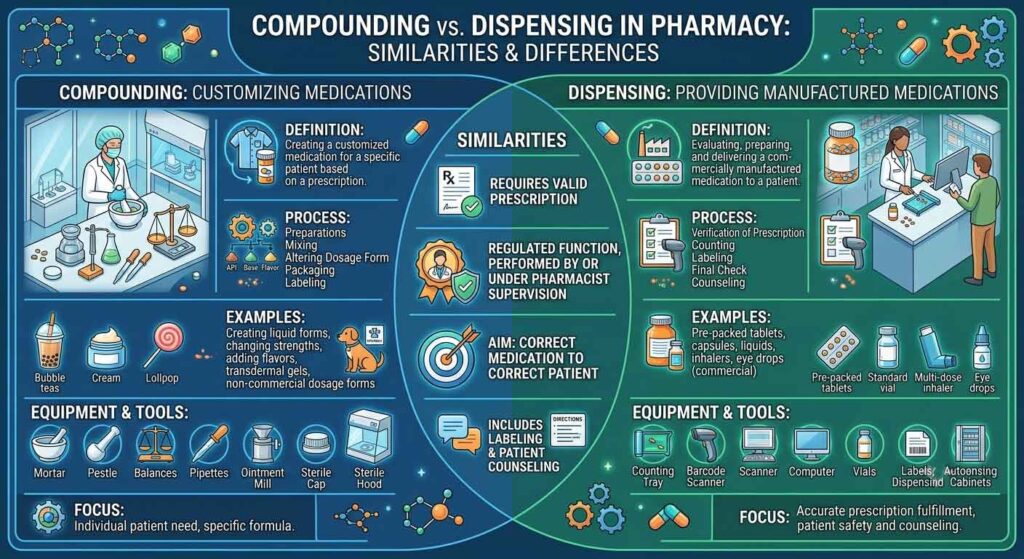
Similarities Between Compounding and Dispensing
Compounding and dispensing have some similarities.
1. Both Are Pharmacy Activities
Both are professional pharmacy-related activities.
They are connected with the safe supply of medicines to patients.
2. Both Are Linked with Prescription
Both may be performed against the prescription of a Registered Medical Practitioner.
Compounding is done when medicine has to be prepared.
Dispensing is done when medicine has to be supplied.
3. Both Require Pharmacist Responsibility
Both activities require the involvement, responsibility and supervision of a registered pharmacist as per applicable law and pharmacy practice standards.
4. Both Can Be Performed in Pharmacy
Both compounding and dispensing can be performed in a pharmacy where required facilities, licence conditions and pharmacist supervision are available.
5. Both Need Accuracy
Both require accuracy because any mistake can harm the patient.
Mistakes may include:
Wrong medicine
Wrong dose
Wrong strength
Wrong label
Wrong instructions
Wrong quantity
Wrong patient counselling
6. Both Need Proper Labelling
Whether a medicine is compounded or dispensed, the patient should receive proper instructions.
Labels may include:
Patient name
Medicine name
Dose
Frequency
Direction for use
Storage condition
Warning, where required
Date of supply
Pharmacy details
7. Both Are Related to Patient Safety
The main purpose of both compounding and dispensing is safe and effective use of medicine.
Difference Between Compounding and Dispensing
Point
Compounding
Dispensing
Meaning
Preparing or mixing medicine
Supplying medicine to patient
Main activity
Preparation
Prescription checking and supply
Product type
Usually customized preparation
Usually ready-made manufactured medicine
Work involved
Weighing, mixing, preparing, packing
Selecting, checking, supplying, counselling
Need of formula
Formula or prescription required
Prescription required for prescription medicines
Technical complexity
Usually higher
Professional checking and counselling required
Common place
Pharmacy with compounding facility
Retail pharmacy/chemist shop
Label requirement
Very important because product is prepared
Important for correct use and safety
Example
Preparing ointment or mixture
Giving prescribed tablets from stock
Risk
Formulation and preparation error
Prescription interpretation and supply error
Main Difference in Simple Words
The easiest way to understand the difference is:
Compounding = Making the medicine
Dispensing = Giving the medicine correctly
In compounding, the pharmacist prepares a medicine.
In dispensing, the pharmacist supplies a medicine that may already be manufactured and packed.
Compounding Involves Preparation
Compounding may include:
Mixing ingredients
Preparing dosage form
Adjusting strength
Making small batches
Preparing patient-specific medicine
Packing and labelling the compounded medicine
Compounding requires technical knowledge of pharmaceutics, formulation, stability, compatibility and dose calculation.
Dispensing Involves Prescription Handling
Dispensing may include:
Prescription interpretation
Medicine selection
Dose checking
Substitution checks
Patient counselling
Sale record
Schedule drug record, where required
Safe supply to patient
Dispensing requires professional judgement, attention and patient-care responsibility.
Is Compounding Common in Modern Retail Pharmacy?
In earlier times, compounding was very common in pharmacies.
Today, most medicines are manufactured by pharmaceutical companies and supplied as ready-made tablets, capsules, syrups, injections, ointments and other dosage forms.
Therefore, routine compounding is less common in many retail pharmacies.
However, compounding may still be used in:
Dermatology prescriptions
Pediatric dose adjustments
Special ointments
Veterinary preparations
Hospital pharmacy
Customized formulations
Some traditional pharmacy setups
Is Dispensing Common in Every Pharmacy?
Yes.
Dispensing is the main daily activity of a retail pharmacy or chemist shop.
Every time a pharmacist supplies medicine against a prescription after checking it, dispensing is involved.
Can a Helper Do Compounding or Dispensing?
A helper may assist with non-professional activities such as arranging stock, billing support or packing under supervision, but the professional responsibility of prescription handling, compounding and dispensing belongs to the registered pharmacist.
A helper should not independently interpret prescriptions, compound medicines or dispense prescription drugs without pharmacist supervision.
Pharmacist presence and responsibility are essential.
Why Pharmacist Supervision Is Important
Pharmacist supervision is important because the pharmacist checks:
Correct medicine
Correct strength
Correct dose
Correct dosage form
Correct patient
Correct quantity
Correct instructions
Prescription legality
Possible error
Storage requirement
Patient understanding
Without pharmacist supervision, the risk of wrong medicine and wrong use increases.
Steps Involved in Compounding
A typical compounding process may include:
Receiving prescription or formula
Checking suitability
Calculating required quantity
Selecting ingredients
Weighing or measuring ingredients
Mixing or preparing dosage form
Checking appearance and quality
Packing in suitable container
Labelling properly
Giving patient instructions
Maintaining records, where required
Steps Involved in Dispensing
A typical dispensing process may include:
Receiving prescription
Checking prescription completeness
Reading medicine name and dose
Checking patient details
Checking prescription validity
Selecting correct medicine
Checking expiry date
Checking batch and storage condition
Preparing bill
Labelling, where required
Supplying medicine
Explaining dosage and precautions
Maintaining records, where required
What Should Be Checked Before Dispensing?
Before dispensing medicine, pharmacist should check:
Doctor’s prescription
Patient name and age
Medicine name
Strength
Dosage form
Route of administration
Dose
Frequency
Duration
Quantity
Expiry date
Schedule warning
Storage condition
Possible confusion in handwriting
High-risk medicines
Patient understanding
What Should Be Checked Before Compounding?
Before compounding medicine, pharmacist should check:
Prescription formula
Dose calculation
Ingredient compatibility
Quantity required
Quality of ingredients
Equipment cleanliness
Stability of preparation
Suitable container
Label requirement
Storage condition
Beyond-use instruction
Patient safety
Examples of Compounding
Examples of compounding may include:
Preparing ointment from prescribed ingredients
Preparing oral suspension from powder
Preparing medicated cream
Preparing mouth paint
Preparing powder mixture
Preparing pediatric liquid dose
Preparing special dermatology preparation
Preparing capsule by filling powder manually, where permitted
Preparing veterinary formulation
Examples of Dispensing
Examples of dispensing may include:
Supplying prescribed tablets
Supplying capsules from stock
Supplying antibiotic syrup
Supplying insulin with storage advice
Supplying eye drops with usage instruction
Supplying inhaler with demonstration
Supplying scheduled medicine with required record
Supplying medicine after checking prescription
Why Compounded Medicines Need Proper Labelling
Compounded medicines are prepared specifically and may not have a manufacturer’s printed label like commercial medicines.
Therefore, proper labelling is essential.
A compounded medicine label should mention:
Patient name
Preparation name
Ingredients or formula, where appropriate
Strength
Quantity
Direction for use
Storage condition
Date of preparation
Use-before instruction
Pharmacy details
Warning, where required
Incorrect labelling can cause misuse.
Why Dispensed Medicines Need Patient Counselling
Dispensing should include patient counselling.
A pharmacist should explain:
How to take the medicine
When to take it
Before food or after food
How long to continue
What precautions to follow
How to store the medicine
What to do if dose is missed
When to consult doctor
Whether medicine may cause drowsiness or other caution
Good counselling improves treatment outcome.
Common Errors in Compounding
Common compounding errors include:
Wrong ingredient
Wrong quantity
Wrong calculation
Poor mixing
Contamination
Wrong container
No stability consideration
Incorrect label
Poor hygiene
Incompatible ingredients
Common Errors in Dispensing
Common dispensing errors include:
Wrong medicine
Wrong strength
Wrong patient
Wrong dose instruction
Wrong quantity
Expired medicine
Similar-looking medicine confusion
Misreading prescription
Not explaining usage
Not checking storage requirement
Which Requires More Technical Knowledge?
Both require professional knowledge, but compounding usually requires deeper formulation knowledge.
Compounding needs knowledge of:
Pharmaceutics
Calculation
Compatibility
Stability
Mixing
Dosage forms
Preservation
Labelling
Dispensing needs knowledge of:
Prescription reading
Pharmacology
Dosage
Drug interactions
Storage
Schedule drugs
Patient counselling
Legal requirements
So, compounding and dispensing both need pharmacy expertise, but the nature of knowledge is different.
Compounding vs Manufacturing
Compounding should not be confused with manufacturing.
Compounding
Compounding is generally patient-specific or prescription-based preparation in a pharmacy.
Manufacturing
Manufacturing is large-scale production of medicines for sale in the market under a manufacturing licence.
A pharmacy cannot manufacture medicines commercially without the applicable manufacturing licence.
Dispensing vs Selling
Dispensing is also different from simple selling.
Selling means commercial transaction.
Dispensing means professional supply of medicine after prescription checking and patient guidance.
A pharmacy is not just selling medicines like ordinary goods. It is supplying healthcare products with professional responsibility.
Role of Registered Pharmacist
The registered pharmacist plays a central role in both compounding and dispensing.
The pharmacist is responsible for:
Checking prescription
Preventing errors
Preparing medicine, where required
Supervising pharmacy activity
Labelling properly
Explaining medicine use
Maintaining required records
Protecting patient safety
Following pharmacy ethics and rules
Practical Example to Understand Difference
Suppose a doctor prescribes a ready-made antibiotic tablet.
The pharmacist checks the prescription and gives the same tablet from stock with directions.
This is dispensing.
Now suppose a doctor prescribes a special skin ointment with ingredients to be mixed in specific ratio.
The pharmacist prepares the ointment, packs it and labels it.
This is compounding.
If the pharmacist then supplies that prepared ointment to the patient with directions, dispensing is also involved.
So, compounding and dispensing can sometimes happen together.
Can Compounding and Dispensing Happen at Same Time?
Yes.
A pharmacy may first compound a medicine and then dispense it to the patient.
For example:
Doctor prescribes a special mixture.
Pharmacist compounds the mixture.
Pharmacist labels it.
Pharmacist dispenses it to patient.
Pharmacist explains use and storage.
In this case, both activities happen in the same prescription process.
Important Difference for Pharmacy Owners
If your shop only sells ready-made medicines, you may be mainly doing dispensing.
If your pharmacy prepares medicines as per prescription, then you also need compounding facility, equipment, trained pharmacist and proper records.
Do not claim compounding service unless you have the required facility and professional ability.
Common Mistakes to Avoid
Avoid these mistakes:
Thinking compounding and dispensing are the same
Allowing helpers to dispense prescription medicines independently
Preparing medicines without proper knowledge
Not labelling compounded medicines
Not checking prescription properly
Not counselling patients
Dispensing without registered pharmacist
Confusing pharmacy with ordinary retail shop
Preparing medicines commercially without manufacturing licence
Not maintaining required records
Final Answer
Compounding and dispensing are related but different pharmacy activities.
Compounding means preparing or mixing a medicine according to prescription or formula.
Dispensing means checking a prescription and supplying the correct medicine to the patient with proper instructions.
Both activities require pharmacist knowledge and responsibility.
In modern pharmacy, dispensing is more common because most medicines are already manufactured and packed by pharmaceutical companies. Compounding is done only when a specific preparation is required and the pharmacy has the facility and professional competence.
A registered pharmacist plays an essential role in both processes to ensure patient safety and proper medicine use.
Frequently Asked Questions
1. What is compounding in pharmacy?
Compounding is the process of preparing, mixing, packing and labelling a medicine according to prescription or formula.
2. What is dispensing in pharmacy?
Dispensing is the process of checking a prescription and supplying the correct medicine to the patient with proper instructions.
3. What is the main difference between compounding and dispensing?
Compounding means making the medicine. Dispensing means giving the medicine correctly to the patient.
4. Can compounding and dispensing happen together?
Yes. A pharmacist may compound a medicine first and then dispense it to the patient.
5. Is compounding common in retail pharmacy?
It is less common today because most medicines are commercially manufactured, but it may still be used for special prescriptions.
6. Can a helper dispense medicine?
A helper should not independently dispense prescription medicines. Dispensing should be done by or under the legal responsibility of a registered pharmacist.
7. Who can compound medicine?
Compounding should be done by a registered pharmacist or under pharmacist responsibility where legally permitted and technically suitable.
8. Is dispensing only selling medicine?
No. Dispensing includes prescription checking, medicine selection, supply, labelling and patient counselling.
9. Is compounding the same as manufacturing?
No. Compounding is usually prescription-based preparation. Manufacturing is large-scale production under manufacturing licence.
10. Why is pharmacist important in dispensing?
The pharmacist helps prevent medication errors and guides the patient about correct medicine use.
Looking for Ayurvedic Franchise or Distribution Opportunities?
Looking to start an Ayurvedic franchise, become a distributor, or launch your own herbal product range?
Elzac Herbal India offers:
Ayurvedic & Herbal Product Range
Franchise & Distribution Opportunities
Third-Party Manufacturing Services
Product Development Support
Marketing Guidance
PAN India Business Opportunities
Whether you are an entrepreneur, retailer, distributor, or healthcare professional, our team can help you explore the right business opportunity in the growing Ayurvedic sector.
Ajay Kamboj is an entrepreneur and business owners associated with many Ayurvedic and Pharmaceutical start-ups. With years of experience in Ayurvedic product marketing, pharmaceutical distribution, franchise development, and client relationship management, he regularly shares practical business insights based on real-world experiences. His articles focus on business growth, entrepreneurship, customer management, and lessons learned from the healthcare and wellness industry.
One response to “Similarities and Differences Between Compounding and Dispensing in Pharmacy”






thank you for that sir