A loan licence is a pharmaceutical manufacturing arrangement under which a company that does not have its own manufacturing facility obtains a separate licence to use the manufacturing facilities of an existing licensed pharmaceutical manufacturer.
It is useful for companies that want greater regulatory control than ordinary third-party manufacturing but do not want to establish a complete factory immediately.
A loan licence should not be confused with:
Third-party manufacturing
Private-label manufacturing
Renting an entire factory
Wholesale drug licence
Marketing authorization
Product trademark registration
Each of these has a different purpose.
What Is a Loan Licence?
A loan licence permits an applicant that does not have its own complete manufacturing arrangements to use the facilities of another licensed manufacturer.
The existing manufacturer is commonly called:
Parent manufacturer
Host manufacturer
Principal manufacturer
Manufacturing facility provider
The applicant receiving the loan licence is called:
Loan licensee
Loan licence holder
The loan licensee does not take possession of the entire plant. It is permitted to use approved manufacturing and testing facilities for specified products under the supervision and conditions accepted by the Licensing Authority.
Which Authority Issues a Loan Licence?
For most allopathic drug-manufacturing loan licences, the application is made to the concerned State Licensing Authority having jurisdiction over the manufacturing facility.
Therefore, if:
Your company is registered in Maharashtra, but
The host manufacturing plant is situated in Himachal Pradesh,
the manufacturing loan-licence application will ordinarily involve the licensing authority having jurisdiction over the Himachal Pradesh manufacturing premises.
Your registered office may be in another state, but the authority must be able to inspect and regulate the actual manufacturing facility.
Certain product categories may also require approval or coordination with the Central Licensing Authority.
Common Loan-Licence Forms
The correct form depends on the product category.
Drugs Other Than Schedules C, C(1) and X
Commonly used forms are:
Form 24-A: Application for grant of loan licence
Form 25-A: Loan licence granted by the authority
This category may cover many ordinary pharmaceutical formulations and APIs, subject to the exact regulatory classification.
Schedule C and Schedule C(1) Drugs, Excluding Schedule X
Commonly used forms are:
Form 27-A: Application for loan licence
Form 28-A: Loan licence granted by the authority
Schedule C and C(1) contain specified biological and special products. Certain categories may require central approval, specialised facilities or additional documentation.
Schedule X Products
Do not assume that a normal Form 25-A or 28-A arrangement automatically permits Schedule X products.
Schedule X products are subject to stricter licensing, storage, record and control requirements. Obtain product-specific guidance from the State Licensing Authority.
Cosmetics
The old reference to Forms 31-A and 32-A belongs to the earlier cosmetics framework.
Under the Cosmetics Rules, 2020, the current COS forms are used. The commonly relevant forms include:
Form COS-6: Application for loan licence to manufacture cosmetics
Form COS-9: Loan licence to manufacture cosmetics
Applicants should confirm the current state portal and latest form requirements before filing.
Ayurvedic, Siddha and Unani Medicines
Ayurvedic, Siddha and Unani loan licensing follows a separate pathway.
Commonly referenced forms include:
Form 24-E: Application for loan licence
Form 25-E: Loan licence for manufacture of Ayurvedic, Siddha or Unani medicines
The application is generally handled by the concerned State AYUSH Drug Licensing Authority.
Do not use allopathic loan-licence forms for Ayurvedic products.
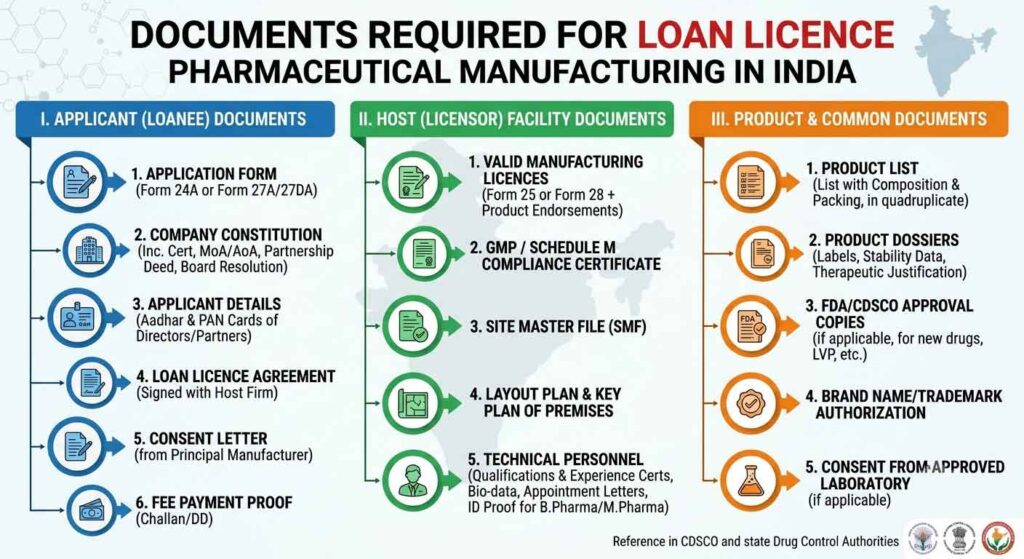
Core Documents Required for a Pharma Loan Licence
The precise checklist varies by state, dosage form and product category. Most applications require documents from four areas:
Applicant or loan licensee
Host manufacturer
Manufacturing and quality agreement
Product dossiers
A. Documents of the Loan-Licence Applicant
1. Covering Letter
The covering letter should explain:
Applicant’s legal name
Registered-office address
Host manufacturing facility
Product category
Dosage forms requested
Forms under which the application is submitted
List of enclosed documents
It should be signed by the authorized person.
2. Prescribed Application Form
Submit the applicable form, such as:
Form 24-A
Form 27-A
Form COS-6
Form 24-E
Use the current state licensing portal and format.
3. Government Fee Receipt
Attach the prescribed:
Online payment receipt
Treasury challan
Government fee receipt
The fee depends on:
Licence category
Number of products
State procedure
Additional inspection or product fees
Do not rely on an old fee chart.
4. Constitution of the Firm
Depending on business type, submit:
Proprietorship
Proprietorship declaration
PAN
Identity and address proof of proprietor
Business-registration evidence
Partnership
Partnership deed
Registration certificate, where applicable
List of partners
Identity and address proofs
LLP
Certificate of incorporation
LLP agreement
Details of designated partners
Authorization resolution
Private Limited Company
Certificate of incorporation
Memorandum of Association
Articles of Association
List of directors
Board resolution
Authorized-signatory documents
The business objects should permit pharmaceutical manufacturing or related activities.
5. Authorization Letter or Board Resolution
The company should authorize a responsible person to:
Sign the application
Communicate with the Licensing Authority
Submit documents
Attend inspections
Receive notices
6. PAN and GST Documents
Common documents include:
PAN of the applicant
GST registration
Billing-address details
Principal place of business
GST registration is not a substitute for a manufacturing licence.
7. Applicant’s Address Proof
Submit proof for the:
Registered office
Corporate office
Storage or warehouse premises, where applicable
Possible documents include:
Ownership deed
Rent agreement
Utility bill
Landlord’s NOC
Local registration
8. Responsible-Person Declaration
The authority may require:
Affidavit or declaration
Photograph
Identity proof
Residential-address proof
Contact details
Details of the person responsible for day-to-day affairs
The prescribed affidavit format varies by state.
9. Details of Existing Licences
Declare whether the applicant already holds:
Manufacturing licence
Loan licence
Wholesale drug licence
Other state manufacturing approvals
Include licence numbers, sites and product categories.
10. Non-Conviction or Compliance Declaration
The authority may ask for declarations regarding:
Previous licence cancellation
Suspension
Prosecution
Drug-law conviction
Blacklisting
Regulatory action
All disclosures should be accurate.
11. Wholesale Drug Licence, Where Applicable
A manufacturing loan licence permits manufacturing through the approved host facility.
It does not automatically resolve every requirement for:
Separate storage
Wholesale sale
Billing
Distribution from another premises
If finished products will be stocked and sold from the applicant’s warehouse, appropriate wholesale drug-licence support may also be required.
B. Documents from the Host Manufacturer
1. Consent Letter or No-Objection Certificate
The host manufacturer should provide written consent stating that it agrees to make its facilities available to the applicant.
The letter should mention:
Name of applicant
Manufacturing-site address
Dosage forms
Sections and facilities available
Proposed products
Duration of arrangement
Responsibility for manufacturing and testing
2. Host Manufacturer’s Licence
Submit a current copy of the host manufacturers:
Manufacturing licence
Approved product categories
Approved dosage-form sections
Additional product endorsements
The licence address must match the factory being proposed.
3. GMP Compliance Documents
Depending on the category, collect:
Applicable GMP certificate
Schedule M compliance documentation
WHO-GMP certificate, where relevant
Latest inspection status
A general ISO certificate does not replace a drug manufacturing licence or GMP compliance.
4. Approved Plant Layout
The layout should identify relevant areas, such as:
Raw-material warehouse
Dispensing
Manufacturing sections
Packing areas
Quality-control laboratory
Finished-goods warehouse
Quarantine and rejected-goods areas
Utilities
Change rooms
The applicant should use only sections approved for the required dosage forms.
5. Machinery and Equipment List
Provide details of equipment proposed for manufacturing the loan-licensee’s products.
Examples include:
Mixing and granulation equipment
Tablet presses
Capsule-filling machines
Liquid-manufacturing vessels
Filling and sealing machines
Packing equipment
Analytical instruments
The authority may assess whether the facility has sufficient capacity for its own products and existing loan licensees.
6. Quality-Control Facilities
Submit details of:
In-house QC laboratory
Testing instruments
Microbiology laboratory, where required
Approved external testing laboratory, where permitted
Specifications and test procedures
The agreement should state who will test and release each batch.
7. Technical Staff Details
Documents may be required for personnel responsible for:
Production
Quality Control
Quality Assurance
Microbiology
Analytical testing
Common documents include:
Qualification certificates
Experience certificates
Appointment letters
Approval letters
Identity proofs
Attendance or full-time declarations
The authority will decide whether the existing and proposed technical staffing is adequate.
8. Details of Existing Loan Licences
The host manufacturer may need to declare:
Number of existing loan licensees
Dosage forms handled
Manufacturing commitments
Available production capacity
A host plant should not accept more loan licences than its premises, equipment and technical staff can properly manage.
9. Site Master File
The authority may request the host facility’s Site Master File or relevant extracts containing information about:
Premises
Personnel
Quality system
Equipment
Documentation
Production
Quality control
Complaints and recalls
10. Latest Inspection and Compliance Records
Depending on state procedure, submit or make available:
Recent inspection report
Compliance report
Corrective-action response
Licence-retention or fee records
C. Agreements Between Applicant and Host Manufacturer
1. Loan-Licence Manufacturing Agreement
The agreement should clearly state:
Parties involved
Manufacturing site
Products and dosage forms
Commercial terms
Manufacturing responsibility
Material ownership
Packing responsibility
Delivery terms
Duration and termination
2. Quality Agreement
A quality agreement is different from the commercial agreement.
It should define:
Raw-material approval
Vendor qualification
Sampling and testing
Manufacturing controls
In-process testing
Finished-product testing
Batch release
Deviations
Out-of-specification results
Change control
Stability studies
Complaints
Recalls
Retention samples
Regulatory inspections
Document retention
3. Technical-Staff Arrangement
Clarify:
Who supervises manufacturing?
Who supervises testing?
Whether additional technical staff will be appointed
How availability and responsibility will be recorded
4. Trademark and Brand-Use Agreement
Where the applicant uses its own brands, the agreement should specify:
Brand ownership
Permission given to host manufacturer
Prohibition on unauthorized use
Artwork ownership
Responsibility for trademark disputes
5. Confidentiality and Intellectual Property
For custom formulations, specify ownership of:
Formula
Manufacturing process
Technical data
Artwork
Stability data
Regulatory dossier
6. Defective-Product and Indemnity Terms
The agreement should define responsibility for:
Batch failure
Manufacturing defect
Packaging defect
Regulatory non-compliance
Market recall
Replacement
Destruction
Financial loss
A private agreement does not eliminate statutory responsibility, but it helps allocate commercial responsibility.
D. Product-Wise Documents
1. Consolidated Product List
Prepare a product list showing:
Generic name
Brand name
Complete composition
Strength
Dosage form
Pack size
Pharmacopoeial status
Prescription schedule
Proposed MRP, where relevant
2. Complete Formula
For each product, provide:
Active ingredients
Quantity of each active ingredient
Excipients
Overages, where scientifically justified
Final batch size
3. Manufacturing Procedure
Submit:
Step-by-step manufacturing method
Process flow chart
Critical process parameters
In-process controls
Packing process
4. Master Formula Record
The Master Formula Record should include:
Batch size
Raw-material quantities
Equipment
Manufacturing steps
In-process specifications
Yield limits
Packing details
5. Specifications and Methods of Analysis
Provide specifications for:
Raw materials
Packaging materials
In-process material
Finished products
Where the ingredient or finished product is not pharmacopoeial, submit a validated or justified method of analysis.
6. Pharmacopoeial Monographs
Attach applicable monographs from:
Indian Pharmacopoeia
Other officially accepted pharmacopoeia
Recognized compendium, where permitted
Do not submit a copied monograph without checking whether the current version applies.
7. Product-Permission Status
Confirm whether the product is:
An established formulation
A new drug
A subsequent new drug
An approved fixed-dose combination
A prohibited or restricted combination
Where central approval is required, obtain it before seeking commercial manufacturing permission.
8. Stability Data
Depending on the product, provide:
Accelerated stability data
Long-term stability commitments
Proposed shelf life
Storage conditions
Packaging used during the study
9. Process and Cleaning Validation
The authority may require or inspect:
Process-validation protocol
Cleaning-validation procedure
Hold-time studies
Equipment qualification
Analytical-method validation
10. Bioavailability or Bioequivalence Documents
BA/BE data may be required for certain products, especially where mandated under applicable new-drug or formulation requirements.
It is not required for every ordinary formulation.
11. Specimen Labels and Cartons
Submit proposed:
Primary label
Outer carton
Blister or foil matter
Package insert
Patient-information leaflet, where applicable
Check:
Composition
Generic name
Brand name
Prescription warning
Storage instructions
Batch details
Manufacturer and loan-licensee particulars
MRP
Manufacturing-licence information
The label should follow the particulars approved by the Licensing Authority.
12. Brand-Name Undertaking
The applicant may need to submit an undertaking concerning:
Ownership or lawful use of the brand
Similarity with existing drug brands
Product composition under the trade name
Responsibility for trademark disputes
Trademark registration does not replace product approval.
13. Packaging Specifications
Submit information on:
Blister or strip material
Bottle and closure
Carton
Label
Tube
Container-closure compatibility
Pack size
14. Proposed Certificate of Analysis Format
The COA should show:
Product name
Batch number
Specifications
Results
Test methods
Approval status
Authorized signatures
Additional Documents for Bulk Drugs and APIs
Loan-licence applications for APIs or bulk drugs generally require more technical and environmental information.
1. Detailed Manufacturing Process
Provide:
Reaction steps
Process flow
Solvents and reagents
Purification
Drying
Milling
Packing
2. Material Balance
Submit:
Input-output ratio
Yield
Process losses
Solvent recovery
By-products
Waste generation
3. Consumption Coefficients
State expected consumption of:
Raw materials
Solvents
Water
Utilities
for the proposed batch or production quantity.
4. Effluent and Waste Details
Provide details of:
Liquid effluent
Solid waste
Hazardous waste
Solvent waste
Emissions
Treatment and disposal
The host facility should have applicable pollution-control permissions.
5. API Specifications
Include:
Identification
Assay
Related substances
Residual solvents
Heavy metals or elemental impurities
Water content
Particle size, where relevant
Microbial limits, where applicable
6. Impurity Profile
Provide impurity information and controls appropriate to the API and process.
7. Safety Documents
These may include:
Safety Data Sheets
Occupational exposure precautions
Containment requirements
Emergency procedures
Loan-Licence Application Procedure
Step 1: Select the Host Manufacturer
Choose a plant that has:
Correct dosage-form section
Valid licence
Adequate GMP compliance
Quality-control facilities
Available capacity
Suitable technical staff
Step 2: Conduct Due Diligence
Verify:
Licence status
Regulatory history
Product permissions
Quality systems
Existing loan licensees
Complaint history
Capacity
Step 3: Finalize Products
Do not apply with a random catalogue.
Finalize products after checking:
Regulatory status
Market demand
Host capability
Testing requirements
Packaging
MOQ
Step 4: Execute Consent and Agreements
Sign:
Host consent
Loan-licence agreement
Quality agreement
Brand-use agreement
Commercial terms
Step 5: Prepare Application Dossier
Arrange documents section-wise and product-wise.
Use the current portal and checklist of the state where the factory is located.
Step 6: Submit Application and Fee
Upload or submit:
Prescribed form
Fees
Applicant documents
Host documents
Product dossiers
Agreements
Step 7: Scrutiny
The authority may raise queries concerning:
Product approval
Staff
Facility capacity
Testing
Labels
Agreement
New-drug status
Reply with complete and consistent documents.
Step 8: Inspection
The authority may inspect the host facility and verify:
Available space
Equipment
Technical staff
Documentation
QC laboratory
Capacity
Product controls
Loan-licensee arrangements
Step 9: Product Approval and Grant
After satisfactory review, the authority may grant the loan licence with approved products or categories.
Do not manufacture unapproved products merely because the main licence has been issued.
Step 10: Commercial Manufacturing
Manufacture should begin only after:
Licence grant
Product endorsement
Artwork approval
Batch documents
Quality system readiness
Validity and Retention
Drug-manufacturing licences operate under the applicable current validity and retention-fee framework.
Many drug licences now continue subject to:
Payment of retention fee at the prescribed interval
Continued compliance
Inspection
No suspension or cancellation
Confirm the exact retention date, fee and process with the State Licensing Authority. Do not assume that no action is needed merely because the licence is described as perpetual.
Common Mistakes in Loan Licensing
Avoid:
Treating loan licence as ordinary third-party manufacturing
Selecting a factory without checking capacity
Applying under the wrong form
Using old Form 32-A for cosmetics
Submitting only a commercial agreement
Ignoring the quality agreement
Launching a new drug without central approval
Using unsearched brand names
Printing packaging before approval
Manufacturing products not endorsed on the licence
Assuming the host manufacturer carries all responsibility
Ignoring wholesale licensing for separate storage and sale
Following old excise-duty calculations
Using outdated state checklists
Practical Document Checklist
Before submitting, confirm that you have:
Covering letter
Applicable application form
Government fee receipt
Applicant constitution documents
Board resolution or authorization
PAN and GST
Address proof
Responsible-person affidavit
Host consent letter
Host manufacturing licence
GMP documents
Plant layout
Machinery list
QC laboratory details
Technical-staff documents
Existing loan-licence declaration
Loan-licence agreement
Quality agreement
Product list
Formula and manufacturing procedure
Specifications and test methods
Product-permission documents
Stability documents
Proposed labels and cartons
Brand-name undertaking
Packaging specifications
Complaint and recall procedure
Frequently Asked Questions
1. What is a loan licence?
It is a manufacturing licence issued to an applicant that intends to use the facilities of another licensed manufacturer.
2. Is a loan licence the same as third-party manufacturing?
No. Under a loan licence, the applicant obtains a separate manufacturing licence and assumes greater regulatory responsibility.
3. Which form is used for an ordinary allopathic loan licence?
Form 24-A is commonly used for application and Form 25-A for the licence for drugs other than specified Schedule C, C(1) and X categories.
4. Which forms apply to Schedule C and C(1) products?
Form 27-A and Form 28-A are commonly relevant, excluding Schedule X and subject to product-specific requirements.
5. Is Form 32-A still used for cosmetics?
The old Form 32-A reference is outdated. Cosmetics are now governed under the Cosmetics Rules, 2020 and use COS forms.
6. Does the applicant need its own manufacturing premises?
The purpose of a loan licence is to use an approved host manufacturer’s facilities. The applicant does not need to establish a complete separate manufacturing plant for that licence.
7. Does the applicant need technical staff?
The authority will examine the technical personnel responsible for manufacturing and testing. The exact staffing arrangement must be declared and approved.
8. Can APIs be manufactured under a loan licence?
Potentially yes, provided the host facility is licensed and suitable and the applicable product, process, environmental and technical documentation is approved.
9. Is excise duty calculated on the MRP of an API?
No. The old excise explanation is obsolete. APIs and finished drugs generally follow the applicable GST and customs framework.
10. Where should the application be filed?
It is generally filed with the Licensing Authority having jurisdiction over the host manufacturing premises.
Final Thoughts
A loan licence is suitable for companies that want to manufacture through another factory while holding a separate regulatory manufacturing licence.
The correct sequence is:
Select host plant → Verify licence and capacity → Finalize products → Sign technical and quality agreements → Submit application → Complete inspection → Obtain product permissions → Begin manufacturing
The document list is not identical in every state. Forms, fees, affidavits and portal requirements should always be confirmed with the State Licensing Authority where the manufacturing facility is located.
Looking for Ayurvedic Franchise or Distribution Opportunities?
Looking to start an Ayurvedic franchise, become a distributor, or launch your own herbal product range?
Elzac Herbal India offers:
Ayurvedic & Herbal Product Range
Franchise & Distribution Opportunities
Third-Party Manufacturing Services
Product Development Support
Marketing Guidance
PAN India Business Opportunities
Whether you are an entrepreneur, retailer, distributor, or healthcare professional, our team can help you explore the right business opportunity in the growing Ayurvedic sector.
Ajay Kamboj is an entrepreneur and business owners associated with many Ayurvedic and Pharmaceutical start-ups. With years of experience in Ayurvedic product marketing, pharmaceutical distribution, franchise development, and client relationship management, he regularly shares practical business insights based on real-world experiences. His articles focus on business growth, entrepreneurship, customer management, and lessons learned from the healthcare and wellness industry.
7 responses to “Documents Required for Loan Licence Pharmaceutical Manufacturing in India”
Dear Sir,
I understand the Loan License. In Loan License in the manufacturing address : the hired company name with the manufacturer address. Since Manufacturer name is not mentioned any where in the product manufacturing, how the COA/ MSDS/ DMF/ GMP/ other regulatory documents of Pharma will be of whose name ?
These will be the responsibility of Hired Company because hired company is doing manufacturing activities by own at manufacturer’s premises, not by manufacturer. Manufacturer only give its manufacturing facilities, not doing manufacturing for hired company…
please suggest me how to get loan license from other company or contract manufacturing license . i want to start IV fluid manufacturing unit in central India
For taking Loan license, you need to contact a manufacturer. Loan license will be applied by manufacturer on behalf of you. You can’t apply for loan license at your hand. You contact to manufacturer and ask him for applying loan license for you. Discuss all term and conditions, and formalities with manufacturer before proceed into loan license manufacturing agreement
i want start my four fathers AYUR MEDICINE IN sidha s
so could u pls give clear information
how i can start ayur plants and research centers and products for fever to cancer ayur medicine could u pls give clear information with supporting with funding

Dear Sir,
I understand the Loan License. In Loan License in the manufacturing address : the hired company name with the manufacturer address. Since Manufacturer name is not mentioned any where in the product manufacturing, how the COA/ MSDS/ DMF/ GMP/ other regulatory documents of Pharma will be of whose name ?
These will be the responsibility of Hired Company because hired company is doing manufacturing activities by own at manufacturer’s premises, not by manufacturer. Manufacturer only give its manufacturing facilities, not doing manufacturing for hired company…
please get in touch with me for a detailed discussion on my requirement.
Regards
Nilender Kumar
8929291493
Hi
Can I get a few names of the loan licensed manufacturer for IV infusion Bags in India
Regards
Nagaraju
please suggest me how to get loan license from other company or contract manufacturing license . i want to start IV fluid manufacturing unit in central India
For taking Loan license, you need to contact a manufacturer. Loan license will be applied by manufacturer on behalf of you. You can’t apply for loan license at your hand. You contact to manufacturer and ask him for applying loan license for you. Discuss all term and conditions, and formalities with manufacturer before proceed into loan license manufacturing agreement
i want start my four fathers AYUR MEDICINE IN sidha s
so could u pls give clear information
how i can start ayur plants and research centers and products for fever to cancer ayur medicine could u pls give clear information with supporting with funding