Starting a medicines distribution business in South Africa can be a good opportunity, but it is a regulated business. You cannot simply register a company and start distributing pharmaceutical products. You need proper licensing, premises, responsible pharmacist arrangement, quality systems and product compliance.
In South Africa, pharmaceutical distribution is regulated mainly through SAHPRA, the South African Health Products Regulatory Authority, along with pharmacy-related requirements involving the South African Pharmacy Council and National Department of Health.
Earlier, people used the name Medicines Control Council or MCC, but the current authority is SAHPRA.
Quick Answer
To start a medicines distribution business in South Africa, you generally need:
Registered business entity
Suitable premises
Pharmacy premises licence or relevant premises approval
SAHPRA licence to act as wholesaler or distributor
Responsible pharmacist
SAPC recording of pharmacy/pharmacy owner, where applicable
Good Wholesaling Practice system
Site Master File
Product list
Registered or authorised products
Proper storage and cold-chain arrangements
Quality-management system
Purchase and sale records
Recall and complaint procedure
Do not start sale, import, storage or distribution of medicines before obtaining the required approvals.
Can a Registered Company Start Medicine Distribution Without Licence?
No.
Company registration alone is not enough to distribute pharmaceutical products in South Africa.
A registered company gives you a legal business identity, but medicines distribution requires regulatory licensing.
If you want to distribute medicines, scheduled substances or related regulated health products, you need to apply for the applicable licence from SAHPRA and fulfil pharmacy-premises and responsible-pharmacist requirements.
Which Authority Regulates Medicines Distribution in South Africa?
The main regulatory authority is:
SAHPRA – South African Health Products Regulatory Authority
SAHPRA regulates health products, including:
Medicines
Scheduled substances
Medical devices
Complementary medicines
Veterinary medicines
Clinical trials
Related health products
For pharmacy ownership, premises and responsible pharmacist matters, the South African Pharmacy Council and National Department of Health requirements may also apply.
Is Medicine Registration Required Before Distribution?
Yes, in general, medicines should be registered or authorised before being sold or marketed in South Africa.
Before distributing a product, check whether:
The product is registered with SAHPRA
The product is permitted for sale in South Africa
The product is scheduled or unscheduled
The product is a medicine, complementary medicine, medical device or another category
Import permission is required
Special authorisation is required for unregistered medicines
Do not assume that a product approved in another country can automatically be sold in South Africa.
Types of Pharma Business Licences in South Africa
Depending on your business model, you may need one or more of the following:
1. Wholesaler Licence
Required if your company wants to act as a wholesaler of medicines or scheduled substances.
This is suitable when you buy medicines and supply to pharmacies, hospitals, clinics, institutions or other licensed parties.
2. Distributor Licence
Required where your company distributes medicines or scheduled substances as per applicable SAHPRA requirements.
3. Import Licence
Required if you plan to import medicines or scheduled substances into South Africa.
Importing has additional requirements such as product registration, quality documents, customs compliance and SAHPRA approval.
4. Export Licence
Required if you plan to export medicines from South Africa.
5. Pharmacy Premises Licence
A pharmacy premises licence may be required where the business operates as a pharmacy-type premises.
Applications are handled through the official Department of Health/SAPC process.
6. Medical Device Establishment Licence
If your products are medical devices, separate medical-device establishment licensing may apply.
7. Complementary Medicine Compliance
If your products are complementary medicines, herbal medicines or supplements making health claims, SAHPRA requirements for complementary medicines should be checked.
Wholesale vs Distribution in South Africa
In practical business language, wholesale and distribution are often used together, but they may have different regulatory meanings depending on product flow and licence category.
Wholesaler
A wholesaler usually buys and sells medicines to licensed trade customers.
Distributor
A distributor may handle storage, supply, transport and movement of medicines on behalf of manufacturer, importer, wholesaler or marketing authorisation holder.
Both require proper regulatory approval and Good Wholesaling/Distribution Practice compliance.
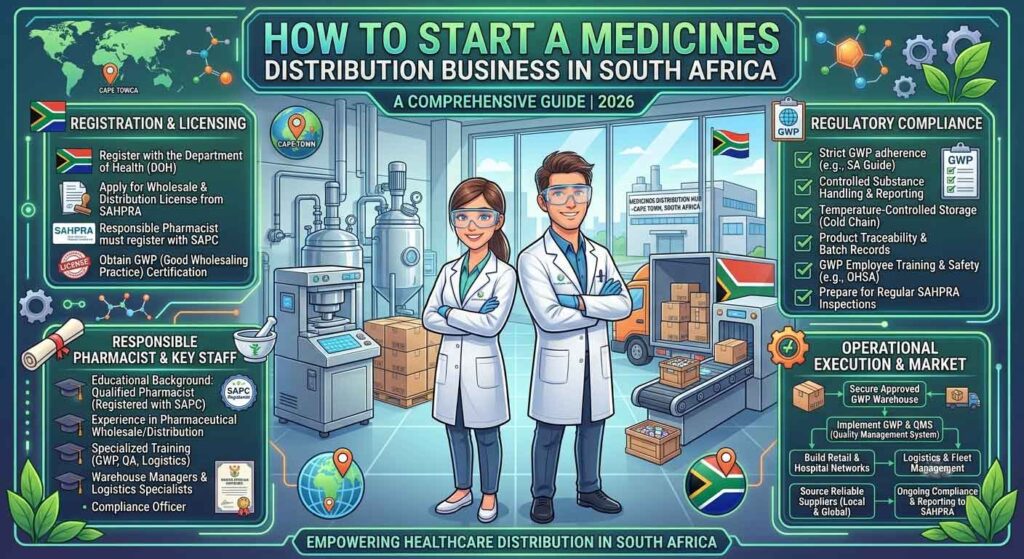
Basic Steps to Start Medicines Distribution Business in South Africa
Step 1: Decide Your Business Model
First decide what exactly you want to do.
Your business model may be:
Local wholesale distribution
Import and distribution
Export distribution
Distribution for another company
Hospital and institutional supply
Pharmacy-chain supply
Medical-device distribution
Complementary medicine distribution
Generic medicine distribution
OTC medicine distribution
The licence requirement depends on your model.
Step 2: Register Your Company
You should have a legally registered company in South Africa.
Business documents may include:
CIPC registration documents
Company registration certificate
Director details
Tax registration
Company address
Bank account
Business profile
Company registration is only the first step. It does not replace medicine distribution licence.
Step 3: Select Suitable Premises
Your premises should be suitable for medicine storage and distribution.
It should have:
Adequate space
Clean storage area
Temperature control
Security
Pest-control system
Quarantine area
Rejected/returned goods area
Cold-chain facility, where required
Separate storage for scheduled substances, where required
Office and documentation area
Dispatch area
Good access for inspection
The premises should support Good Wholesaling Practice.
Step 4: Appoint a Responsible Pharmacist
A responsible pharmacist is a very important requirement.
The responsible pharmacist is responsible for ensuring that medicine handling, storage, distribution and quality systems are properly maintained.
The responsible pharmacist should be registered with the South African Pharmacy Council as required.
Without a responsible pharmacist or SAPC case number, the application may not move properly.
Step 5: Record Pharmacy or Pharmacy Owner With SAPC
Depending on the business structure, recording with the South African Pharmacy Council may be required.
You may need:
SAPC certificate of recording of pharmacy
SAPC certificate of recording of pharmacy owner
Responsible pharmacist registration
SAPC case number if application is in process
Confirm exact requirements with SAPC and SAHPRA.
Step 6: Apply for Premises Licence
A pharmacy premises licence or related premises approval may be required through the National Department of Health process.
The premises licence supports the legal operation of a pharmacy-related premises.
Do not sign a long-term lease before checking whether the premises can be approved.
Step 7: Prepare Site Master File
A Site Master File is an important document for pharmaceutical premises.
It describes:
Company details
Premises layout
Storage areas
Quality systems
Staff responsibilities
Product handling
Temperature control
Cleaning system
Pest control
Returns handling
Recall system
Complaint system
Documentation control
Transport system
A weak Site Master File can delay the application.
Step 8: Prepare Good Wholesaling Practice System
Medicines distribution requires proper quality systems.
Good Wholesaling Practice should cover:
Procurement
Receipt of goods
Storage
Stock rotation
Temperature monitoring
Cold-chain products
Picking and packing
Dispatch
Transportation
Returns
Recalls
Complaints
Damaged goods
Expired goods
Documentation
Staff training
Step 9: Prepare Product List
SAHPRA may require a product list.
The product list should include details such as:
Product name
Dosage form
Strength
Registration number, where applicable
Schedule status
Manufacturer
Supplier
Storage condition
Product category
Only products that are legally allowed in South Africa should be included.
Step 10: Submit SAHPRA Licence Application
Depending on your business, you may need to submit:
Application to act as wholesaler
Application for importing and distribution
Application for export, if applicable
Application to manufacture/import/export, if applicable
Use the correct current SAHPRA form and guideline.
Step 11: Inspection
SAHPRA or the concerned authority may inspect the premises.
Inspection may check:
Premises suitability
Storage conditions
Temperature records
Security
Responsible pharmacist role
Staff training
Documentation
Quality system
Product list
Recall procedure
Complaint handling
Good Wholesaling Practice compliance
Approval depends on whether the authority is satisfied with the setup.
Step 12: Start Only After Licence Approval
Do not start buying, stocking, selling, importing or distributing medicines before licence approval.
After approval, operate strictly according to licence conditions.
Documents Required for Medicine Distribution Licence in South Africa
Document requirements may change, but commonly required documents may include:
Completed SAHPRA application form
Licence application cover letter
Proof of payment of SAHPRA fee
CIPC/CIPRO/DTI business ownership documents
NDoH premises licence or proof of application
Responsible pharmacist registration or SAPC case number
SAPC certificate of recording of pharmacy or SAPC case number
SAPC certificate of recording of pharmacy owner or SAPC case number
Product list
Site Master File
Floor plan
Local area plan
Premises layout
Quality-management system documents
SOPs
Staff qualification documents
Storage and cold-chain arrangements
Previous licence details, if renewal/amendment
Annual retention fee proof, where applicable
Always download the latest checklist directly from SAHPRA before applying.
Important SOPs Required
Your distribution company should prepare written SOPs for:
Product receiving
Product storage
Temperature monitoring
Cold-chain handling
Stock rotation
Picking and packing
Dispatch
Transport qualification
Cleaning
Pest control
Returns
Recalls
Complaints
Handling expired goods
Handling damaged goods
Training
Documentation control
Self-inspection
Supplier qualification
Customer qualification
SOPs should not be copied blindly. They should match your actual working system.
Storage Requirements for Medicines
Medicine storage is one of the most important parts of distribution.
Your premises should maintain required conditions such as:
Room temperature storage
Controlled temperature storage
Refrigerator storage, where required
Protection from sunlight
Protection from moisture
Security from theft
Segregation of expired products
Segregation of damaged products
Quarantine area
Batch-wise traceability
First-expiry-first-out system
Improper storage can damage medicines and create regulatory action.
Cold-Chain Products
If you distribute cold-chain products such as vaccines, insulin, biologicals or temperature-sensitive medicines, you need extra arrangements.
This may include:
Qualified refrigerator
Temperature data logger
Backup power
Temperature alarm
Cold boxes
Ice packs
Transport validation
Temperature mapping
Emergency procedure
Staff training
Beginners should avoid cold-chain products until their system is strong.
Can You Import Medicines From India or Other Countries?
Yes, import may be possible, but it is more complex than local distribution.
For import, you may need:
SAHPRA import licence
Registered product
Local authorised applicant/holder
GMP-compliant manufacturer
Product dossier
Quality documents
Import permit, where required
Customs clearance
Labelling compliance
Post-importation testing, where applicable
Responsible pharmacist
Storage and distribution system
For beginners, it may be better to first distribute products already registered in South Africa before starting imports.
Can You Distribute Unregistered Medicines?
Do not distribute unregistered medicines without proper authorisation.
Unregistered medicines may require special permission under applicable South African law.
Distribution of unregistered or unauthorised products can create serious legal risk.
Can a Non-Pharmacist Own a Medicine Distribution Company?
A non-pharmacist may own a company, but the company must appoint the required responsible pharmacist and fulfil all licensing requirements.
Ownership and professional responsibility are different.
For regulated medicine distribution, pharmacist involvement is important.
Can Foreign Nationals Start Distribution Business in South Africa?
Foreign investors or foreign nationals may be able to participate through legal company structures, but they must follow South African company, tax, immigration, banking and SAHPRA requirements.
For a local registered company, focus first on local compliance, responsible pharmacist appointment and licensing.
Common Mistakes to Avoid
Avoid these mistakes:
Starting medicine distribution with only company registration
Using old MCC terminology instead of SAHPRA
Not appointing a responsible pharmacist
Not recording pharmacy/pharmacy owner with SAPC where required
Not applying for NDoH premises licence
Not preparing Site Master File
Not following Good Wholesaling Practice
Importing products before registration or authorisation
Distributing unregistered medicines
Selecting products without checking schedule status
Not maintaining temperature records
Ignoring recalls and complaints procedure
Selling to unverified customers
Taking too much credit risk
Depending only on foreign investors
Practical Startup Checklist
Before starting, check:
Company registered in South Africa
Business model finalized
Premises selected
Responsible pharmacist appointed
SAPC requirements checked
NDoH premises licence process checked
SAHPRA licence form selected
Site Master File prepared
Good Wholesaling Practice SOPs prepared
Product list prepared
Product registration status confirmed
Storage system ready
Cold-chain system ready, if needed
Supplier agreements prepared
Customer verification system prepared
Recall and complaint system prepared
Working capital planned
Final Answer
To start a medicines distribution business in South Africa, a registered company is only the beginning. You need the proper SAHPRA licence to act as a wholesaler or distributor, suitable premises, responsible pharmacist, SAPC-related recording where applicable, NDoH premises compliance and Good Wholesaling Practice systems.
If you also plan to import medicines, you will need import-related licensing and product registration or authorisation.
You do not need overseas investors to grow in this field. You can start with local capital, a focused product range, strong compliance, good supplier relationships and disciplined credit control.
Before investing heavily, contact SAHPRA, SAPC and the National Department of Health licensing process to confirm the latest requirements for your exact business model.
Frequently Asked Questions
1. Can I distribute medicines in South Africa without licence?
No. Medicines distribution requires the applicable regulatory licence.
2. Which authority gives medicine distribution licence in South Africa?
SAHPRA handles licensing for manufacturers, wholesalers and distributors of medicines and scheduled substances.
3. What replaced the Medicines Control Council?
SAHPRA replaced the Medicines Control Council as South Africa’s health-products regulatory authority.
4. Is a responsible pharmacist required?
Yes, a responsible pharmacist is generally required for medicine distribution or wholesale business.
5. Can a non-pharmacist own a distribution company?
A non-pharmacist may own the company, but a responsible pharmacist and regulatory compliance are required.
6. Is product registration required before sale?
In general, medicines should be registered or authorised before sale or marketing in South Africa.
7. Can I import medicines from India to South Africa?
Yes, but import requires SAHPRA licensing, product registration or authorisation, GMP-compliant supply and customs compliance.
8. What is a Site Master File?
A Site Master File describes your premises, quality systems, storage, distribution process, staff responsibility and compliance arrangements.
9. Can I start without foreign investment?
Yes. Start small with local suppliers, focused products, proper licence and disciplined working capital.
10. What is the biggest risk in distribution business?
The biggest risks are non-compliance, unregistered products, poor storage, weak credit control and lack of product availability.
Looking for Ayurvedic Franchise or Distribution Opportunities?
Looking to start an Ayurvedic franchise, become a distributor, or launch your own herbal product range?
Elzac Herbal India offers:
Ayurvedic & Herbal Product Range
Franchise & Distribution Opportunities
Third-Party Manufacturing Services
Product Development Support
Marketing Guidance
PAN India Business Opportunities
Whether you are an entrepreneur, retailer, distributor, or healthcare professional, our team can help you explore the right business opportunity in the growing Ayurvedic sector.
Ajay Kamboj is an entrepreneur and business owners associated with many Ayurvedic and Pharmaceutical start-ups. With years of experience in Ayurvedic product marketing, pharmaceutical distribution, franchise development, and client relationship management, he regularly shares practical business insights based on real-world experiences. His articles focus on business growth, entrepreneurship, customer management, and lessons learned from the healthcare and wellness industry.
7 responses to “How to Start a Medicines Distribution Business in South Africa”
My company need to become one of the distributors.
Hi my name is Iketleng . I have a registered business . I I’m interested on start a medical distribution business for public schools .
I want to partner with government in opening dispensary in schools. To make it easy for learners to access in emergency medications that going to public centres for help.
Hi I have an interest in medical distribution. I want to sell basic pain killers, coughing medication, medication for kids.
In my town doesn’t have such facility.
I would like your help in this regard. Please provide me with more information.
Thank you in advance for your response




My company need to become one of the distributors.
Thank you.
Abel Nkuna
082 600 7880
I am very interested in staring a medica distribution business in South Africa. I will appreciate your direction and advice.
My name is Juliet
My email address
bahjuliette6@gmail.com
Hi my name is Iketleng . I have a registered business . I I’m interested on start a medical distribution business for public schools .
I want to partner with government in opening dispensary in schools. To make it easy for learners to access in emergency medications that going to public centres for help.
What do I need to do?
I’m interested
I am very interested
Hi I have an interest in medical distribution. Please provide more information.
Hi I have an interest in medical distribution. I want to sell basic pain killers, coughing medication, medication for kids.
In my town doesn’t have such facility.
I would like your help in this regard. Please provide me with more information.
Thank you in advance for your response